A scene from The Tale of Chun Hyang. The popular Korean folk tale has been told in films and on television many, many times. The Festival du nouveau cinema in Montreal is showing a version made in North Korea in 1980.
Some of the films being shown at the Festival du nouveau cinéma will go into general release here in Montreal within the next few days weeks or months. But others fall into the “now-or-never” category. Unless you are a cinema scholar or have good connections, chances are you won’t be able to see them again. The Tale of Chun Hyang, being shown just once, on Saturday Oct.10, 2015, is one of these “now-or-never” films.
The Tale of Chun Hyang is a Korean folk tale that has been put on film many, many times. (Two thousand times according to the FNC program!) So far, I’ve only seen the one directed by Im Kwon Taek, in 2000. (Guess I’m a slacker!)
But the version being shown at FNC was made in 1980, in North Korea. While that country makes many films, we can’t see them very often.
Im’s film was visually stunning, so I’m wondering how this North Korean version, directed by Yun Ryong-gu and Yu Won-jun will play out.
The Romeo and Juliet story is often invoked when describing The Tale of Chun Hyang to Westerners. It’s only a rough approximation though. (SPOILER: Chun Yang has a much happier ending.) The conflict here is not so much between families as between classes. Many nobles and officials do what they please with the country, its assets and the people lower down on the social scale than they are. And women have the worst deal of all, as happens so often in fairy tales. See The Tale of Chun Hyang with your friends and you could probably have some interesting arty and political discussions afterwards.
Chun Hyang is the beautiful daughter of a woman who became the second wife of an official.
Mongryong, the young, handsome, honest decent son of an official falls in love with her and marries her in secret. Then he has to go away to study for his career advancement and he cannot take Chun Hyang with him. She suffers greatly in his absence. When she refuses to become the mistress of a newly arrived official, she is thrown into prison and threatened with execution, but she values her love and loyalty more than she values her own life. (A topic for further discusion, as well.)
The Tale of Chun Hyang
Directed by: Yun Ryong-gu and Yu Won-jun
Screenplay: Kim Sung-Gu, Paek In-Jun
Cast: Kim Yong-Suk, Choe Sun-Gyu, Yong Suk-Kim
In Korean with French subtitles.
Saturday, Oct.10, 2015, 5 p.m
Program #88
Salle Fernand Seguin of the Cinémathèque Québécoise, 355 de Maisonneuve Blvd. E.
Click to read more about The Tale of Chun Hyang on the FNC web site.
Concordia professor Clarence Bayne (left), director Mina Shum and producer Selwyn Jacob across the street from the Henry F. Hall Building of Concordia University. (National Film Board of Canada photo.)
“Sirens reverberated through downtown Montreal as fire trucks and police cars rushed towards the three-year-old Hall Building. Surrounded by riot police clashing with protestors, the ninth floor of the jewel of Sir George Williams University was on fire. Black smoke billowed from open windows and onlookers watched with horror and disbelief.” (Excerpt from an anniversary article by Justin Giovannetti in the student newspaper The Link, Feb. 10, 2009.)
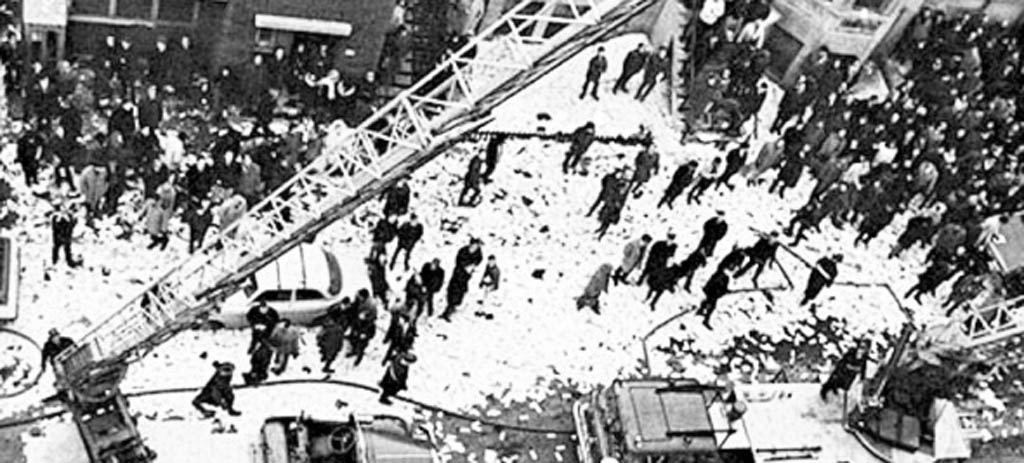
It’s known in local lore as the “Sir George Williams computer riot.” In May 1968, a biology professor at Sir George Williams University was accused of racism against his Caribbean students. After months passed without action from the university administration, students occupied the ninth floor computer centre in February of 1969. Eventually, computers were trashed, windows were broken, and punch cards floated down onto the snowy street below. The riot squad moved in; someone started a fire. The damage was in the millions of dollars.
Computer punch cards and other paper litters the ground below the Henry F. Hall Building of Concordia University in February, 1969. (Concordia Archives photo via Nationa Film Board of Canada web site.)
On Friday, Oct. 9, 2015 we Montrealers will have a rare opportunity involving time, memory and (physical space). In the ground floor in Room H-110 of the Henry F. Hall Building, of Concordia University, we can watch a documentary about the events that took place all those years ago, just a few storeys above. (Before the occupation, a committee to discuss the complaints against the teacher had taken place in H-110 itself.)
Among the people who attend tonight, some will have little to no knowledge of what happened, some will have watched footage on the nightly news back in the day, some might have been part of the occupation. Some might be second-generation Concordia students.
What will it feel like? I can’t imagine, but I intend to find out. I’m sure there will be many interesting questions and comments. Director Mina Shum and members of the Concordia Caribbean Student Union will be among the guests at the screening.
Ninth Floor was shown at the Toronto Internationl Film Festival (TIFF) and received positive reviews. Some U.S. writers expressed surprise and disappointment that Canada is not always the kinder, more gentle nation that we (and they) might like to think that we are.
For those who cannot go on Friday, Oct. 9, there will be another screening at noon on Friday, Oct. 16, 2015, in the J. W. McConnell Building across the street.
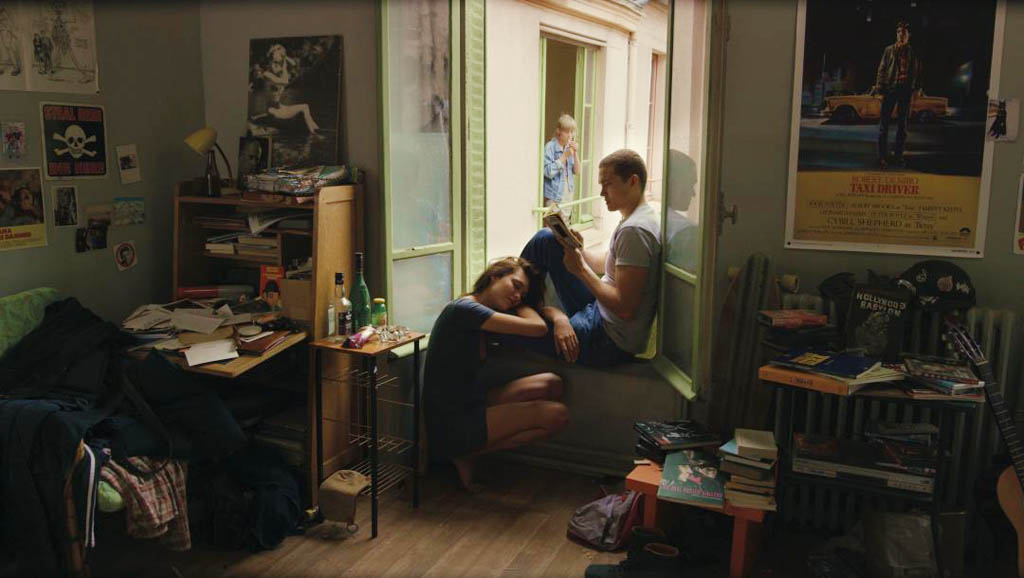
In this scene from Gaspar Noe’s film Love, Electra (Aomi Muyock) and her boyfriend Murphy (Karl Glusman) relax in their Paris apartment. New neighbour Omi (Klara Kristin) can be seen through the window.
“Well, that’s two hours of my life I’ll never get back.” It’s not a very original complaint (sorry!) but that’s what I was thinking, long before Love, the latest film from Gaspar Noé, was over. I wasn’t able to appreciate it. And it’s actually two hours and 14 minutes long, strictly speaking.
The film is called Love, but “Clueless Jerk,” might be a more apt title.
The main male character is an American in Paris named Murphy (Karl Glusman). His girlfriend, dark-haired Electra (Aomi Muyock), left him because he got another woman pregnant.
The film opens with Murphy and Electra having sex. Is that Murphy’s dream in the present day, or is that Noé telling us that they used to be a couple? Could be either, I guess. His phone rings and Murphy wakes up. He is in the same room (though it has different decor now) and the woman in the bed beside him is blonde. It’s New Year’s Day and the call is from Electra’s mother. She has not heard from her daughter for two or three months and she’s worried. Does Murphy know where she is?
There’s lots of voice over as we hear Murphy’s thoughts, which are not very interesting and (when it comes to the blonde, the mother of his child), quite rude and crude.
As the story unfolds we see that Murphy behaved very badly on many, many occasions. He wishes he could turn back time, though there’s no indication he would have behaved differently. In his mind, he declares his love for Electra, over and over. I was not convinced. Is he even serious about that, or is it just a story he’s telling himself, now that something bad might have happened to Electra, and she might be permantently out of his reach?
There are so many sex scenes in Love. I hear that you can see that kind of thing on the Internet, at home, for free. No need to go to the cinema! There isnt much laughter between this couple, though. What kind of relationship is that?
Love is in 3D, which added nothing to the experience for me, except for a scene where Murphy blows smoke rings, which was cool for a few seconds.
If you are already a Gaspar Noe fan, Love might be for you, especially since he will be in town to present the film.
LOVE, 134 Min, VOSTF
Written and directed by Gaspar Noé
Cast: Aomi Muyock, Karl Glusman, Klara Kristin, Juan Saavedra
Thursday, Oct. 8, 2015 at 8 p.m.
Concordia University, Alumni Auditorium (H-110), Hall Building, 1455 de Maisonneuve Blvd. W., Montréal, QC
Montrealers can see the important documentary film about climate change, This Changes Everything, at 7 p.m., on Monday, Oct. 5, 2015, at Concordia University (1455 de Maisonneuve Blvd. W., Room H-110) thanks to the organization Cinema Politica. Writer Naomi Klein and director Avi Lewis will be there. Suggested donation is $10 – $20. That’s probably all the information many of you will need. For others, I hope the review below will make you want to see it.
It’s all about the story – the story that we’ve been told, the story that we tell ourselves, the story that we believe. That story might be so firmly engrained in us that we never even think about it, or question it.
And that story is, that the Earth is a machine, and that mankind can and should manipulate its levers. The unfortunate results of that thinking can be seen all around us.
Changing the story is the first step toward changing our lives, our future and the life of this planet that we all depend upon.
After some opening shots of hurricanes, parched earth, polar bears and crumbling, tumbling ice bergs, This Changes Everything takes us to the ugly and monstrous tars sands of Fort McMurray, “the largest industrial project on Earth.” Would the citizens of any large city like Calgary, Edmonton, Vancouver, Toronto or Montreal accept such a huge and destructive project if it were in their own backyard? Somehow I doubt it. But the tar sands are far away and the local population is small. Later in the film, such a place is called a “sacrifice zone.”
One worker claims: “If not for the oil sands, there’d be nothing to come here for.” Then the camera shows us some stunning scenery – a majestic river flowing through a pine forest.It might be difficult for the average person to get up there, but many people would enjoy seeing it, or just knowing that such a place exists.
When we’re told that $150 to $200 billion would be invested there over the next decade, I couldn’t help but wonder what could be accomplished if that kind of money was spent on sustainable development instead.
The abuse of the English language and the twisted metaphors used by some of the people in this film – you have to hear them to believe them. I predict gasps, laughter, boos and hisses at various points during the screening of This Changes Everything.
One guy has the nerve to frame the tar sands project this way: “We’re cleaning up one of the largest oil spills on earth.” There are claims that the area will be brought back to its original state 20 years from now. Tailing ponds will be cleaned and, “you’ll be able to drink the water.” I’d really like to believe that, but I just can’t.
Meanwhile, the Beaver Lake Cree Nation has filed a court case to stop any further exploration, since the oil sands are under their traditional land and the present project has already done so much damage to their lives.
I won’t describe the whole film in detail, but I will say that it visits activists in Montana, New York state, India, Greece, China and Germany. People are standing up, complaining, saying “No!” to rampant development, demanding their rights and a new way of doing things.
While Klein does not present Germany as a perfect place, she produces some impressive statistics (30 per cent of Germany’s electricity comes from renewables, emissions are down, employment is up, etc.) Could Canada do the same? Especially if we can elect a new government in a few weeks?
Speaking of our country, as a Canadian, I’m embarrassed and distressed to see a Canadian mining company throwing its weight around in Greece, eager to get its corporate mitts on the gold there. My apologies to you, people of Halkidiki. And shame on you, mayor of Halkidiki, who dismissed the intimidation and arrests of protestors when he said: “the police don’t knock on doors without a reason; they don’t knock on yours or mine.”
This woman in Halkidiki, Greece, opposes a Canadian gold mine in her area.
This Changes Everything, the film, is a companion piece to Naomi Klein’s book This Changes Everything: Capitalism vs. the Climate. They were created at the same time, the film is not based on the book.
I think it’s quite wise that the subhead, “Capitalism vs. the Climate” is not attached to the film – why alienate some of your potential audience right off the bat? As far as I can recall, the word “market,” as a synonym for capitalism, is not heard until 27 minutes into the film, and capitalism itself is not mentioned until 45 minutes in, when Greek activist Mary Christianou identifies it as the core problem. She’s initially reluctant to even say so on camera, because: “I don’t know if it helps the struggle.”
In reviewing the book, some writers suggest that “neo-liberalism” is more to blame for many of our present ills than capitalism alone. Abandoning the belief that all the resources of the Earth, the metals, the coal, the gas and the oil must be extracted, and that the Earth itself is just a machine that we can be trusted to run, seem like easier first steps on the path to change.
This screen grab from the documentary film This Changes Everything shows India buried under “Proposed Coal-Fired Power Plants.”
This Changes Everything will be shown on Monday, Oct. 5, 2015, 7 p.m., at
1455 de Maisonneuve West, Room H110, Concordia University, Montreal, QC.
Naomi Klein and Avi Lewis will be there for a Q&A session after the film.
Manos Sucias (Dirty Hands) is a taut tale set in Buenaventura, on the Pacific coast of Colombia. Within the first few minutes we see several tough-looking guys and many serious weapons. (There’s even a little kid nonchalantly cleaning a revolver.) Buenaventura is obviously a dangerous place, and a quick Google search will confirm that, with headlines like: Colombian City’s New Face and Violent Underbelly Collide; Colombian port city terrorised by criminal gangs – BBC News; Welcome to Buenaventura, Colombia’s most violent city.
There are 400,000 people Buenaventura, though we only see a handful of them, in the roughest, poorest parts of town.
Our main characters are Jacobo (Jarlin Martinez) and his younger brother Delio (Cristian Advincula). They’ve been estranged for years but end up working on the same drug run for Don Valentin. It’s the first time that Delio has done this kind of thing; Jacobo is an old hand who plans to move to Bogota once the job is done. That made me suspect that things might not go well for these guys. Just think of all the films have been made about that one last heist, or the cop who is one week, or even one day away from his retirement.
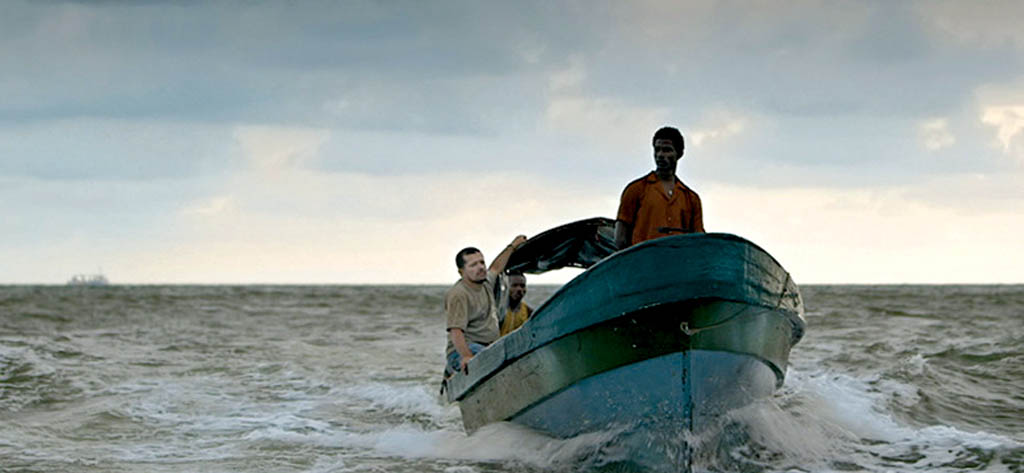
Jacobo and Delio will help a man named Miguel (Hadder Blandon) to pilot a small, battered fishing boat north towards Panama. This will take several days. Attached to the boat is a “torpedo” filled with 100 kg of cocaine in small packets. All of the packets will be weighed at the checkpoint, the guys are told. Point taken, no need to elaborate further.
The torpedo is fitted with a tracking device just in case it comes loose from the boat. (Cough.) Miguel has a cellphone, a GPS locator, and a gun. Delio has a machete that he uses to open coconuts, among other things. Seeing these items, one wonders if, or more likely when, they will be used, and in what circumstances.
Jarlin Martinez plays Jacobo in Manos Sucias, a film from Colombia that’s being shown at the 2015 Montreal International Black Film Festival.
During their trip they will have to worry about running into guerrillas, the military, the paramilitaries, and anyone else who might have designs on their cargo. These people will feel entitled to take anything they might have, including their lives. There’s nothing dashing or glamourous here. Just danger and dread.
Soccer and racism are recurring themes in Manos Sucias. Before the trip, Jacobo watches an informal game with an old friend. When told about the plan to move to Bogota, the friend says there are no blacks there, or hardly any. They’re only able to get the most horrible jobs, and it’s freezing there, too. Later, Jacobo, Delio and Miguel sit around a campfire, talking about the great soccer stars of the past. Seems like your typical male bonding stuff, until the white Miguel spoils the mood and makes some racist remarks to the Afro-Colombian brothers.
When some unexpected events take Miguel out of the picture, Jacobo and Delio continue with the mission. What else can they do? But what will happen afterwards? (They HAD been told that this would be the “easiest job you ever had.” “Like a paid vacation.” Ha!)
The music Manos Sucias is worth mentioning. Haunting tunes from Grupo Gualajo make use of soaring women’s voices and a marimba.
Fans of Colombian salsa might nod their heads (I did, anyway) when Jacobo has one of those “kids, these days!” chats with his brother, disparaging the rap music that Delio admires and suggesting that he listen to “something good,” like Grupo Niche, Nemus del Pacifico, or Orquesta Guayacan.
Manos Sucias (Dirty Hands) U.S.A./Colombia, 2014, 82 minutes, in Spanish with English subtitles
Directed by Josef Kubota Wladyka, with Cristian Advincula, Jarlin Martinez, Manuel David Riascos, Hadder Blandon. Spike Lee was an executive producer
Sunday, Oct. 4, 2015, at 5 p.m.
At the Former NFB Cinema, 1564 St. Denis
Admission is $10
The documentary License to Operate introduces us to former Los Angeles gang members who were deadly enemies in their younger days but are now co-operating, through an organization called A Better LA, to break a cycle of murder and retaliation that had lasted for decades.
One man gets out his high school yearbook and tells us that most of his former classmates are dead now. He has photos from their funerals. it’s obvious that he’s lucky to still be alive himself. Another man tells of seeing five candlelight memorials for murder victims in just one evening. That was the night that he knew he had to do something to save the next generation of children.
After receiving instruction from the Professional Community Intervention Training Institute, the men do liaison work between neighbourhoods and the police and fire departments, encouraging young people to stay out of gangs and calming tensions after murders. If something happens, even in the middle of the night, they’re out there on the street, trying to keep the situation from escalating, eliminating rumours, etc.
They certainly have their work cut out for them. A Better LA says that there are more than 450 gangs in Los Angeles, and that: “ ‘Invisible lines’ drawn by gangs to designate their turf cause children to live in a constant state of fear, wondering if walking to school or crossing the street puts them in harm’s way.”
A lawyer explains that many of the children in these neighbourhoods have the same levels of post traumatic stress disorder as children living in war zones. Before the age of 16, they have lost as many as 10 friends to murder. We see doors and walls that have been riddled with bullets. It’s truly appalling.
License To Operate, directed by James Lipetzky, 101 minutes, in English
Saturday, Oct, 3, 2015 – 7 pm
Cinéplex Odéon du Quartier Latin
350, Rue Émery, Montréal (Métro Berri UQAM)
Admission is $10.
Check the Montreal International Black Film Festival web site, www.montrealblackfilm.com/ for details, the film schedule, film synopses and trailers.
The Montreal International Black Film Festival has a Facebook page, too.
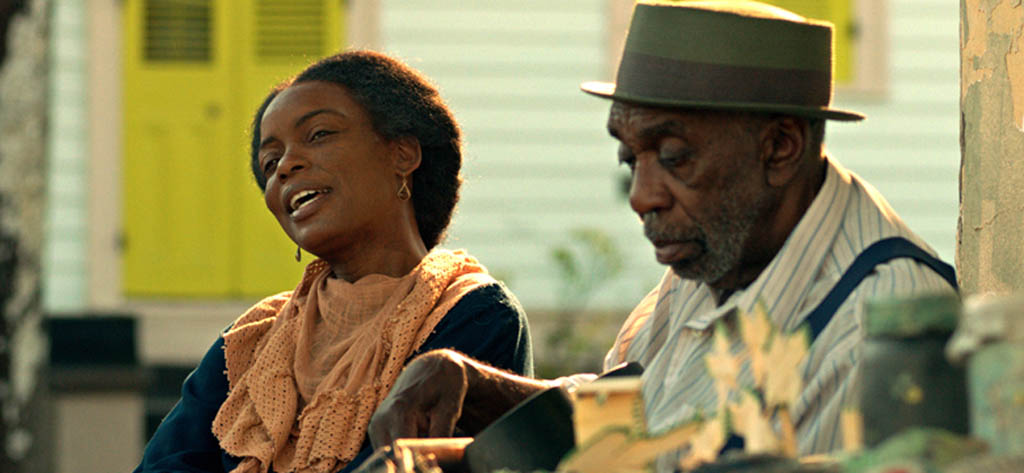
Aunjanue Ellis, left, and Bill Cobbs in Una Vida: Of Mind and Music, one of the films being shown at the 2015 Montreal International Black Film Festival.
Many Montreal film festivals show several films at the same time, which can make life difficult for fans. How to choose?
Here are brief reviews of the two films that will be shown at 7 p.m. on Thursday, Oct. 1, 2015 at part of the Montreal International Black Film Festival; I hope that they are helpful!
Una Vida: Of Mind and Music is a gentle tale that unfolds in an unhurried way. Dr. Alvaro Cruz (Joaquim de Almeida) is a neuroscientist who lives in New Orleans. Appropriately enough for someone who lives there, he likes jazz and blues. His mother has Alzheimer’s disease.
Soon after the film begins he is overcome by guilt because his mother died when he was away at a medical conference. He keeps dreaming of a time in his childhood when he got lost while chasing an elusive butterfly.
He takes time off from work to just kinda hang around. He meets an elderly musical couple – singer Una Vida, and guitarist Stompleg. They play on the street and in a small bar. He can see that the woman’s memory is failing, though her songs seem more firmly rooted in her brain than other things are. As a scientist, he is intrigued by this situation; as a human being he wants to help if he can.
Everyone seems to like Dr Cruz, except for a young woman named Jessica, who does a lousy job of helping Stompleg to look after Una Vida. She is hostile and suspicious and tells him to stay away. of course, we know that he won’t, don’t we?
Oh, for what it’s worth – Una Vida is also known as Queenie, though her real name is Maizie.
There are some nice tunes in Una Vida: Of Mind and Music, but there isn’t really much of a plot. The fortysomething actress Aunjanue Ellis, who plays Una Visa, is made up to look much older, yet her voice still sounds quite youthful most of the time. The film is based on a novel written by a real life neuroscientist Nicolas Bazan. It has many rave reviews on Amazon.com.
Una Vida: Of Mind and Music, 2014, U.S.A., 97 minutes, In English, with some Spanish dialogue when Dr Cruz talks to his mother.
Director: Richie Adams
Cast: Joaquim De Almeida, Bill Cobbs, Ruth Negga, Sharon Lawrence and Aunjanue Ellis
Screenwriter: Richie Adams, Nicholas Bazan
Producers: Richie Adams, Brent Caballero, Nicolas Bazan, Nancy Green-Keyes
Busisiwe Mtshali plays Zanele in the South African film Thina Sobabili (The Two of Us), which is one of the selections at the 2015 Montreal International Black Film Festival.
Thina Sobabili (The Two of Us) is about high-school student Zanele, and her older brother Thulas, who is raising her in the Johannesburg township of Alexandra. He is very strict and stern with Zanele, though he makes his living from robbing the homes of rich people. (We don’t actually see them do it, we just hear Thulas and his friends talk about it, and we see a bit of the loot.)
Zanele and her friend Tumi look very young in their school uniforms and white ankle socks, but Tumi is already flirting and accepting rides, meals, drinks and money from smarmy older men who own cars. She calls one of them the Minister of Finance. There are always lots of people in the street, so her behaviour does not pass unnoticed.
Thulas orders his sister to stay away from Tumi, but rebellious Zanele remains loyal to her friend. We know that this is bound to lead to trouble.
There are some very uncomfortable scenes in Thina Sobabili, and certain connections and coincidences seem too a bit of a stretch. Nonetheless, it is quite impressive, especially considering the fact that it was made on a tiny budget and shot in a mere seven days. Thina Sobabili is South Africa’s submission for the foreign-language Oscar.
Thina Sobabili (The Two of Us) 2015, 90 minutes, South Africa, in Zulu with English subtitles,
Director: Ernest Nkosi
Cast: Richard Lukunku, Emmanuel Nkosinathi Gweva, Zikhona Sodlaka, Thato Dhladla, Busisiwe Mtshali and Mpho (Popps) Modikoane
Screenplay: Ernest Nkosi, Mosibudi Pheeha
Producers: Ernest Nkosi, Enos Manthata, Mosibudi Pheeha Una Vida: Of Mind and Music
Thursday, Oct. 1, 2015, 7 p.m.
Cineplex Quartier Latin, 350 Emery St.
Thina Sobabili (The Two of Us)
Thursday, Oct. 1, 2015, 7 p.m.
Former NFB Cinema
(Judith Jasmin Annexe)
1564 St. Denis
Fabienne Colas, left, founder of the Montreal International Black Film Festival, speaks to journalists at the festival’s press conference. (Don’t let the empty seats fool you – the event was quite well attended, but many guests chose to sit at the back of the room. )
The Montreal International Black Film Festival starts tonight, Tuesday, Sept. 29, 2015 and runs until Sunday, Oct. 4.
The films include features, shorts and medium-length works, from Canada, Benin, Brazil, Bahamas, Colombia, Cuba, Dominican Republic, France, Germany, Guadeloupe, Haiti, Mali, South Africa, Senegal, Spain, Swaziland, Trinidad and Tobago, the U.S., the U.K., and Zambia.
There are dramas, documentaries, and animation, including Battledream Chronicle, the first feature-length animated film from Martinique.
In addition to the fims, there will be panel discussions, a film market and dance parties.
Guests include Martin Luther King III, musician Pras Michel, filmmakers Paul Haggis and David Belle (who will be honoured on Friday Oct. 2, 2015), filmmakers Souleymane Cissé, Moussa Touré, Abderahmane Sissako, and Pierre Magny (who will take part in a panel discussion on North-South collaboration on Saturday, Oct. 3, 2015.)
Graduates of the Ciné Institue, in Jacmel, Haiti, will present their films on Friday, Oct. 2, 2015.
Tuesday’s opening film is the documentary Sweet Micky For President, in which Pras Michel of The Fugees travels to Haiti to help the presidential campaign of musician Michel Martelly, (aka Sweet Micky). Martin Luther King III will be given a 2015 Humanitarian Award before the film screening. These events take place at the Imperial Cinema.
The closing film, on Sunday Oct. 4, is Black Panthers: The Vanguard of the Revolution, in the Hall Theatre of Concordia University. Other films will be shown at Concordia’s DB Clarke Theatre, Cineplex Quartier Latin, and the former National Film Board cinema on St. Denis St.
Admission to the opening film is $25, the closing film costs $20, and others are $10. Several packages are available as well. Check the Montreal International Black Film Festival web site, www.montrealblackfilm.com/ for further pricing details, the film schedule, film synopses and trailers.
The Montreal International Black Film Festival has a Facebook page, too.
The northern Ontario town of Attawapiskat has been in the public eye a lot over the last few years, because of its housing crisis. Victoria Lean’s documentary film, After the Last River, provides a much deeper look at the situation than you’re likely to get on a nightly newscast. The stories that she tells would be interesting (and distressing) at any time, but they are particularly relevant now, as the federal election gets nearer.
Lean visited Attawapiskat for the first time in 2008. She tagged along with her father, ecotoxicologist David Lean, who had been invited there by the Cree community to share his expertise. De Beers had just opened a diamond mine in the area and residents were worried that this would lead to an increase the already high mercury levels in the local fish that were part of their traditional diet. That’s exactly what did happen.
Canadian diamonds are marketed as ethical, in contrast to “conflict diamonds” or “blood diamonds” from Africa, but an article on the Mining Watch Canada web site says “There are no clean diamonds. Exploring for them, digging them out of the ground and selling them requires sacrifices from the natural environment, from the wildlife and fish that live on it, and from the Aboriginal people who depend on it. . .The federal, provincial and territorial regulatory frameworks in Canada are inadequate to protect the environment from long term and cumulative environmental effects.” (The film informs us that the federal government weakened environmental protection legislation when it passed Bill C-38 and C-45.)
An aerial view of the Attawapiskat River community.
Victoria Lean returned to Attawapiskat several times over the next five years. She began making a film with an ecological focus, but as she explains in her director’s notes, “it expanded to the community’s rights to education, healthcare, housing and a clean and safe environment. One of the goals of the film is to draw attention to a number of intersecting challenges.”
Among the things we learn in After the Last River: In the 1970s and 1980s, the federal government built homes with substandard materials, and that housing has deteriorated further since then. Many homes do not have running water; residents use buckets for toilets. Some homes are plagued with black mould. In 1979, 30,000 gallons of diesel leaked under the elementary school, which remained in use, despite bad smells and students complaining of headaches. The school finally closed in 2001, and the students were moved into portables, right next to the toxic site. They had to wait until 2014 for a new school.
Relatively recent news clips from Parliament and the Ontario legislature show that both levels of government are adept at playing the old “it’s-not-my-department” game. It’s truly maddening to watch those clips, after seeing the terrible conditions that people are living in. Old news clips shot in the north show that little has changed in decades.
Residents discussing their situation with Lean say that “People in the south think that we own diamonds and we’re rich. They don’t know what’s happening here.” “We’re not rich; it’s just the land that rich.”
The mine has not improved the lives of the people of Attawapiskat. In fact, it looks like the mine has only brought benefits to DeBeers and its immediate employees.
Amazingly enough, the amount of royalties paid by DeBeers to the Ontario government is confidential. However, through diligent digging, the CBC discovered that: “the provincial government made more money on salt royalties in 2013-14 than diamonds. De Beers Canada, which owns the only diamond mine in the province, paid $226 in royalties while salt netted the province $3.89 million in royalties.” “. . .De Beers paid little or nothing for most of the seven years its Victor mine has been in production in Northern Ontario, about 90 kilometres west of Attawapiskat.”
De Beers is said to have its eyes on 15 more diamond deposits in the area.
After The Last River
Victoria Lean / Canada / 2015 / 86 ‘ / English
Monday, Sept. 28, 2015, 7 p.m.
Concordia University
1455 de Maisonneuve West, Room H-110
Montreal, QC
Canada
Director Victoria Lean, producer Jade Blair and special guests will be in attendance. The screening is co-presented with the Sustainability Action Fund and Mining Watch Canada. The venue is wheelchair accessible.
For more information visit Cinema Politica’s Facebook page for this event.
A scene from the film Le Plaisir (Pleasure) by Max Ophuls.
The raison d’être of Le Cinéclub: The Film Society is to give people the chance to watch worthy films in their original film format, that is, not via DVD. This is not something average film fans can do at home, no matter how wonderful their setup might be.
Tonight’s presentation is Le Plaisir (Pleasure) by Max Ophuls. It’s a 1952 film in three parts, (Le Masque, La Maison Tellier, Le Modèle) all based on short stories by Guy de Maupassant about men, women and their pursuit of pleasure. Jean Servais provides narration as the voice of de Maupassant. It’s in French with English subtitles. More details about the plots can be found on the Facebook page for the screening of Le Plaisir. The Harvard Film Archive says: “Max Ophuls (1902-1957) was a supreme stylist of the cinema and a master storyteller of romance, doomed love and sexual passion. Fusing the subject of his stories with his endlessly mobile camera, he choreographed emotion, overflowing into ecstatic and extended moments that merge images of desire with desire for cinema.”
Ophuls is known for his fluid camera movement, as pointed out by Noel Murray of the AV Club who decribes the filmmakers work this way:
“short, expertly crafted scenes, in which the actors dwelled on the comic subtleties of human interaction while Ophüls moved the camera around them at odd angles, like an eavesdropper craning his neck to take it all in.”
On the review site DVD Verdict, Daryl Loomis says: “Le Plaisir is beautifully shot by Ophuls with attention to fine details. The film is packed with sweeping tracking shots and constantly changing perspectives. The lighting and camera shots are often put at opposing angles, adding to Joe Hajos already delirious music. With strong performances all around and a great sense of style, Le Plaisir is a true pleasure to watch.”
The Criterion Collection has made a DVD of the film; people who cannot attend the screening might check that out. Those who do go, and like the film, could buy it for repeat viewing. Many reviews of Le Plaisir refer to that Criterion DVD, like this one, by V.F. Perkins in Film Quarterly and this one, by Fernando Croce in Slant Magazine. This essay by Robin Wood, appears on the Criterion Collection web site. Reading them in advance will prompt viewers to be on the alert for various events and film techniques, but those who dislike “spoilers” are advised to read them after watching the film.
LE PLAISIR (Pleasure) 1952, France, 97 min. French with English subtitles) directed Max Ophuls
With Claude Dauphin, Gaby Morlay, Madelaine Renaud, Ginette Leclerc, Danielle Darrieux, Pierre Brasseur, Jean Servais and Jean Gabin.
A short film by Georges Franju will be shown before Le Plaisir
Sunday, Sept. 27, 2015 AT 6:30 p.m.
Cinéma VA-114 of Concordia University, 1395 René-Lévesque Blvd. W. (metro Lucien l’Allier, metro Guy)
General admission: $8, students and seniors (65+) $6










 Mostlymovies.ca