Go Away Mr. Tumor Review: Hilarity and heartbreak mix amazingly well in this popular film from China

Bai Baihe, left, and Daniel Wu promote their film Go Away, Mr. Tumor. (Xinhua photo)

Go Away Mr. Tumor is a film full of laughs about a woman who is very ill. This might sound questionable, but the people in the cinema where I saw it (Cineplex Odeom Forum) seemed to like it a lot. It worked for me, too! On top of that, Go Away Mr. Tumor, is drawing huge audiences in China. (Variety says it earned “$29.7 million in four days.”

The main character in Go Away Mr. Tumor is Xiong Dun, aka Bearton – “Xiong like bear, Dun like Newton,” she says – a graphic artist who is 29 but fast approaching 30, and comparing herself to others who did great things at that age, or at least started to do them. (The long list includes computer guys Steve Jobs and Bill Gates, and writer Haruki Murakami.)

In the first few scenes, she is so very perky and quirky that I felt annoyed, and feared that I’d made a mistake by going to see the film. False alarm, though; things picked up quite quickly.

While entertaining her friends, in her very nice apartment, Xiong Dun (Bai Baihe, who also uses the name Fay Bai) collapses and ends up in a hospital. The first sight she sees upon waking are the eyes and long eyelashes of Dr. Liang (U.S. actor Daniel Wu.) All right then! Things are not so bad after all. They seem better still after he takes off his surgical mask.

Xiong spends more time dreaming and daydreaming about Dr. Liang, and figuring out how to get more of his attention, than she does thinking about her health problem, which turns out to be quite grave when her test results come back. She obviously thinks that being a patient is a pretty good thing; it allowed her to meet him, after all. There’s a delicate balance here; her craving for attention is almost puppyish, but she’s not pathetic in any way. And she’s quite cute, with her big eyes and gamine haircut. If not for those pesky doctor-patient taboos, who knows what might happen?

Daniel Wu plays Dr. Liang as a guy who’s very serious and very professional, but also very caring. He lives in a bit of a bubble though – he’s astonished to learn that his subordinates are afraid of him. He’s also very busy and mindful of all the proprieties. He gently explains to Xiong that it’s his job to look after her and her job to have faith in him. There doesn’t seem to be any possibilty of more than that. And yet. . .

The two characters do have a lovely rapport. Dr. Liang enjoys listening to Xiong’s stories about her childhood, and her rationale for her sunny outlook on life, even in the face of adversity. (Now and then, I did think that her optimism was a bit farfetched, but hey, some people really are like that. Also, yeah, that “trust me, have faith” thing is more than a little retro and patriarchal, but. . . )

Dream and fantasy sequences add much appeal to Go Away Mr. Tumor. Many are laugh-out loud hilarious, though with hindsight others don’t seem quite as funny as they had been.

In Xiong’s dreams, zombies are a metaphor for her illness. At first, she fights them alone, like a superhero in a video game, or a Marvel movie, wearing a cape, flying around via wirework and firing two guns at once like Chow Yun Fat in an old John Woo movie. Later, when a zombie has her in a chokehold, Dr. Liang appears, dressed all in black, armed with a crossbow, to save her with one well-timed, well-placed arrow. Pow! Peng! Cheers from the audience! (Spoiler, sorry!)

You want this guy on your side, right? Dr. Liang, (Daniel Wu) is prepared to go all out to protect the life of his patient.

Another scene mocks the international popularity of romantic Korean TV dramas. Xiong, wearing adorable furry earmuffs, stands in a park amidst falling snowflakes. As she starts to fall over backwards, in a slow motion swoon, Dr. Liang appears, clad in a quietly elegant camel-hair coat. He catches her gracefully with one arm while stopping the snowfall with a masterful, magical snap of his fingers. “Oppa!” Xiong exclaims. (It means “big brother,” but it’s also what Korean girls call their boyfriends, and what fans write on messageboards devoted to their crush. Don’t ask me how I know.) As a further nod to Korea’s powerful influence, Xiong gives Dr. Liang some Korean hand lotion, to repair the damage done by his frequent hand washing. (He keeps it in an office drawer with his British tea.) Korea has its share of medical dramas, the “trust me, have faith” likely appears there, too.

Dr. Liang (Daniel Wu) and his patient Xiong Dun (Bai Baihe) in the Chinese film, Go Away Mr Tumor. Xiong has watched lots of Korean TV dramas and she has a crush on Dr. Liang, so she imagines many scenes like this one.

Xiong’s friends are a loyal, supportive and entertaining bunch, with some quirks of their own. They visit her often in the hospital, and gleefully help her with an elaborate, spur-of-the-moment prank against her obnoxious ex-boyfriend.

The film is based on the real-life experiences of cartoonist Xiang Yao. (Xiong Dun/Bearton was her pen name, which she chose because bears were her favourite animal.) She had already written several comic books before she became ill; an article on the web site China.org.cn says that her other books were about “teenage love, weight-loss, living the single life and her lifelong idol Michael Jackson.”

Bears were Xiong Dun's favourite animal. Could you tell?
Bears were Xiong Dun’s favourite animal. Could you tell?

Once she became sick she wrote an online comic to raise money for her treatment and share her ordeal with her fans. (While she is often seen sketching in the film, the book is not actually mentioned.) In addition to Go Away Mr Tumor, various articles have rendered the English translation of the book’s title as Go To the Devil, Mr. Tumor, Be Gone, Mr. Tumor, Get out, Mr. Tumor, even F*** Off, Mr. Tumor! The article goes on to say that “More than one million books of the cartoons were sold, and the series inspired millions of people with its optimism and courage.” It includes this quote from Xiang: “I hope my drawings can entertain people and bring positive energy to me and to others. I am happy and delighted that they can enjoy it.”

Go away Mr Tumor Xiong Dun cartoon


BTW: The actors chosen to play her loving parents look quite a bit like their real-life counterparts.

Go Away Mr. Tumor (Gun dan ba! Zhong liu jun)
125 min., in Mandarin with English subtitles.
Director: Han Yan
Cast: Bai Baihe, Daniel Wu, Zhang Zixuan, Li Yuan, Liu Ruilin, Cheng Yi, Liu Lili, Li Jianyi, Temur Mamisashvili, Joel Adrian

In Montreal, Go Away Mr. Tumor is being shown at Cineplex Odeon Forum Cinemas. It’s also being shown in Vancouver, Edmonton, Toronto, in several U.S. cities, and in New Zealand and Australia.
 

Fantasia 2015 Review: Therapy for a Vampire

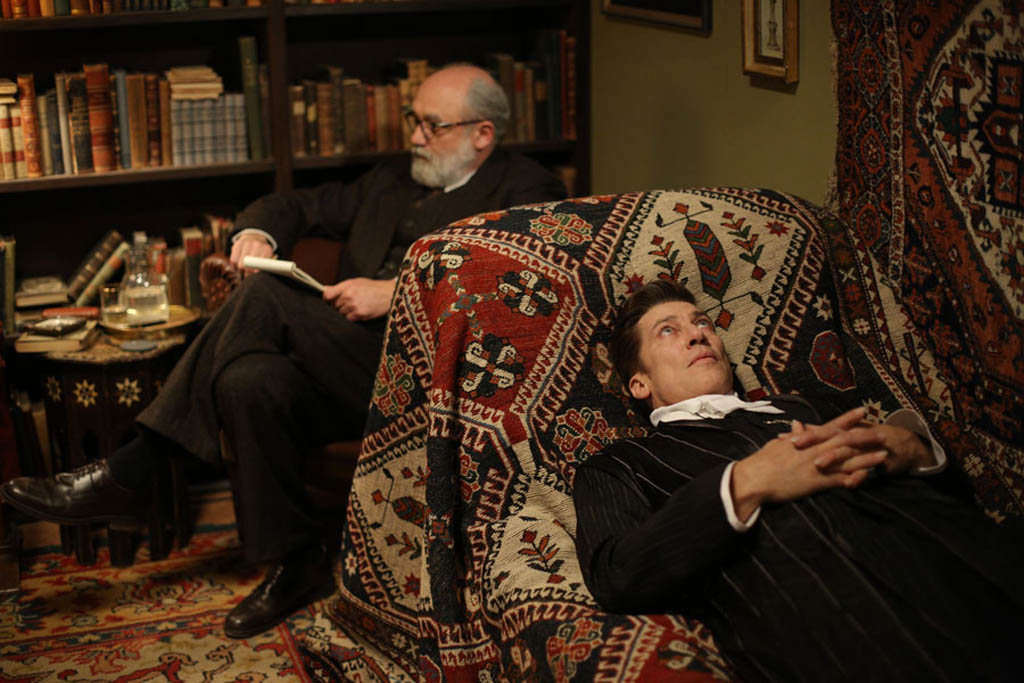
Karl Fischer as Dr. Sigmund Freud, Tobias Moretti as Count Geza von Kozsnom in the Austrian film Therapy For a Vampire.

Therapy for a Vampire is a little confection from Austria, something to while away 87 minutes early on Friday afternoon.

The conceit is that a vampire consults Sigmund Freud in his Vienna office, in 1932. In the evening, of course. Count Geza von Kozsnom says that his life has lost its bite, that he has seen it all, that his blood runs cold, that he is tired of this endless night. Naturally, the good doctor assumes that his new patient is using the language of metaphor. Ha!

The Count no longer loves his wife, Elsa, and he’s had it with her constant questioning: “How do I look?” It’s that old problem with the mirrors, you know.

In a parallel situation, sort of, are Lucy and Viktor. Their relationship is rocky. He’s a painter who lives in the requisite garret and Lucy is his model and girlfriend. He never paints her as she really is, a bruntte with a bun, he paints a fantasy blonde, instead. Lucy is very hurt and insulted by this. (She doesn’t visit Freud, though.)

One day, who knows why, Lucy arrives at Viktor’s place in a bright orange dress, with her hair curled and dyed blonde. All the neighbourhood men are sending her chocolates and flowers and Viktor doesn’t like that one bit. Lucy’s new look reminds the Count of his long-lost true love, Nadila, who promised him that she’d be reincarnated some day.

The Count sends Elsa to Viktor to get her portrait painted; when it’s finished, she will know what she looks like; in the meantime, he will be freeto spend time with Lucy, telling her about her past life.

Viktor is quite happy to meet the mysterious Countess, and seems willing to forget about Lucy, but changing partners is not going to be as simple as all that.

Therapy for a Vampire, Horror/Comedy, Austria, (2014) 87 min., DCP, German, with English subtitles
Director: David Rühm
Screenplay: David Rühm
Cast: Tobias Moretti, Jeanette Hain, 
Cornelia Ivancan, Dominic Oley
Company: Picture Tree International

Therapy for a Vampire
Friday, July 17, 2015, 12:45 p.m.
J.A. de Sève Theatre, 1400 de Maisonneuve Blvd. W.

The Fantasia International Film Festival runs from July 14-Aug. 4, 2015. Read more about the festival at fantasiafestival.com

See legendary adventure film The Thief of Bagdad, with live musicians, Saturday night!

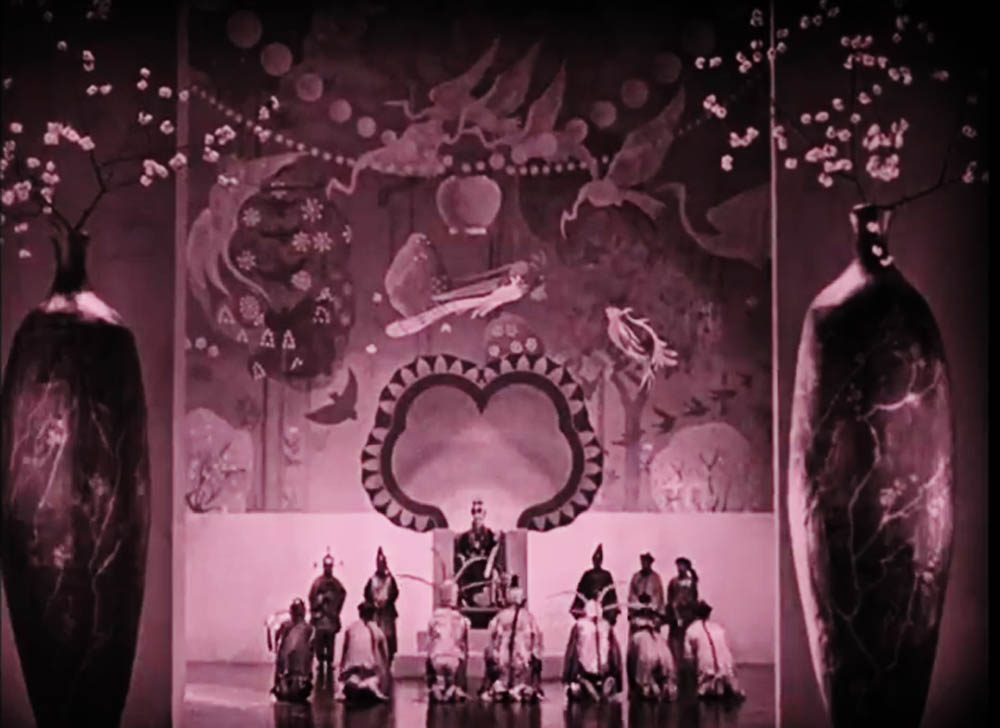
This Thief of Bagdad image is from the Facebook page created by Le CinŽclub de MontrŽal / The Film Society.

Douglas Fairbanks! His name, along with Errol Flynn’s, was once synonymous with swashbuckling adventure and derring do, and for some people, it still is.

See what the fuss was about when Le Cinéclub de Montréal / The Film Society presents The Thief of Bagdad on Saturday, May 30, 2015.

The Thief of Bagdad, which was made in 1924, is a silent film, but that just means that you won’t hear the actors speak. The evening itself will not be silent, far from it. Guillaume Martineau (piano) Joannie Labelle (percussion) and Jean-Sebastien Leblanc (clarinet) will provide lively musical accompaniment. (That’s one more person than the Cinémathèque Québécoise had on hand when it showed the film in 2013.)

The sets of The Thief of Bagdad are elaborate and luxurious.

The Thief of Bagdad appears on the “must-see” lists of many critics. The fairy-tale adventure was directed by Raoul Walsh and features sumptuous costumes by Mitchell Leisen, large, lavish sets by William Cameron Menzies, and genies, giant jars, magic baskets, flying carpets and other special effects, along with the proverbial “cast of thousands.” The $2-million budget was quite extraordinary for the time.

"Ah ha! Treasure!" Douglas Fairbanks as the thief, in The Thief of Bagdad, a silent film from 1924.
“Ah ha! Treasure!” Douglas Fairbanks as the thief, in The Thief of Bagdad, a silent film from 1924.


Douglas Fairbanks plays Ahmed, the thief of the title, who decides to go big and steal a princess, the daughter of the Caliph of Bagdad. But through one thing and another, he ends up in one of those competitions so common in myths, legends and fairy tales where a suitor has to prove his worth by doing, discovering, or defeating, some thing or someone.

Fairbanks is incredibly acrobatic, with lots of leaping, swinging, and climbing; he’s usually smiling, and he’s often shirtless, too. (Fairbanks was also the producer, and one of the screenwriters of The Thief of Bagdad.)

The princess is played by Julanne Johnston, whose name is not well known today. The better known Anna May Wong is listed as the “Mongol slave” of the princess, though she was actually more of a (scantily-clad) spy. In a different era she might have been given bigger and better roles.

Anna May Wong in The Thief of Bagdad.


Here are excerpts from some reviews of The Thief of Bagdad:
Kim Newman, Empire Magazine:  “Grinning impishly, (Fairbanks) has an energetic magnetism that few stars have since managed to recapture, every set-piece designed to showcase his swashbuckling prowess. Silent cinema at its most magical.”

The New York Times: “. . . Fairbanks. . .essentially invented the American action star, with his combination of easy athleticism, can-do optimism and self-deprecating humour. By the time of “The Thief of Bagdad” he had moved from modern dress to costume roles (“The Mark of Zorro,” “Robin Hood”) and into the particular timelessness of the superstar, standing at the centre of his own universe. . . ”
“The film’s extraordinary production design — located somewhere between the swoony Art Nouveau curves of Aubrey Beardsley and the robust literary illustrations of N. C. Wyeth — is the first major work of William Cameron Menzies, a brilliant jack-of-all-trades who would leave his mark on movies from “Gone With the Wind”. . .to the low-budget nightmare “Invaders from Mars.”

“Using a panoply of optical and mechanical effects Fairbanks leads the viewer through a range of magical worlds. Most memorably there is an undersea kingdom, where the chandeliers. . . are giant jellyfish composed of Venetian glass.”

From an unsigned review in TV Guide:  “Forty-year-old Douglas Fairbanks was at his peak when he released the film in 1924. Stripped to the waist virtually throughout, Fairbanks displays the physique of a 20-year-old gymnast and the exuberance of a person even younger. His daringly, beautifully florid performance is grounded less in dramatics than in dance. . .and acrobatics. . . Fairbanks’s kinetic performance is saved from pretentious posturing by his enormous likability, effervescence, and predisposition to self-mockery.”
The Thief of Badgad, Saturday, May 30, 2015, at 7:30 p.m. (doors open at 7.)
United Church 4695 de Maisonneuve W. (Vendôme Metro)
Tickets at the door, cash only, are $13, $9 (for students and those 65, and over, with ID).

Or buy your tickets online at lavitrine.com
INFO LINE: 514-738-FILM
The film is approximately two hours long. Coffee, tea, beer, popcorn, and sweet treats will be on sale before the film and at the intermission.

For more information visit the Facebook page for The Thief of Bagdad screening.

Learn more about Le Cinéclub de Montréal / The Film Society on its web page.

Documentary film How to Save the World examines the early days of Greenpeace

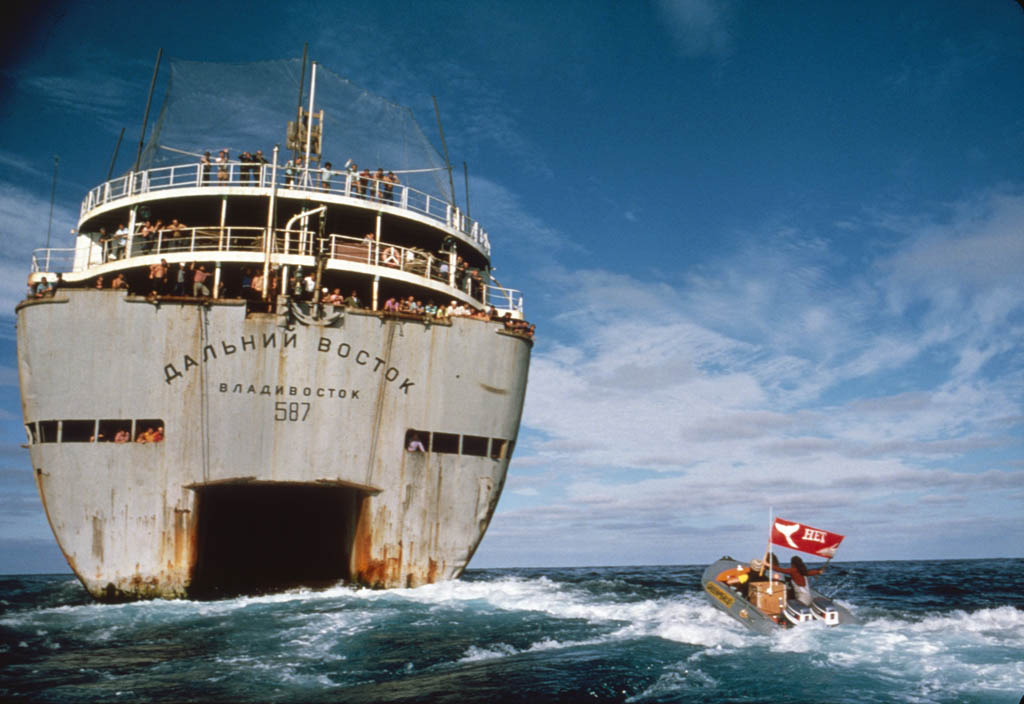
A Russian whaling ship towers over protesting members of Greenpeace.


RIDM, Montreal’s documentary film festival, takes place in November. But outside of that framework, RIDM’s Docville series presents a film at Excentris on the last Thursday of the month.

The selection for May, How To Change the World looks at the early days of Greenpeace. The non-governmental environmental organization now has branches in 41 countries, but it got its start in Vancouver, B.C., back in the 1970s.

Long before Facebook, Twitter, Instagram, smart phones, and widespread access to the World Wide Web, Greenpeace activists were able to galvanize the public against the testing of nuclear weapons, and the killing of whales and baby seals. They famously vowed to place themselves between the harpoons of fishermen and the whales those fishermen were hunting. Look at the trailer below, to see how vulnerable the Greenpeace members were, bobbing on the ocean waves in their small, inflatable boats while huge whaling ships loomed over them.

How To Change the World is a Canada-U.K. co-production, directed by Jerry Rothwell. Rothwell was blessed with access to many hours of original 16 mm footage that had been shot by cinematographer Ron Precious near the beginning of his career. In an interview with IndieWire, Precious says: “We got some great images for sure, like [Greenpeace co-founder] Paul Watson on the back of a dead whale. These are images that become iconic. For me, they’re some of my proudest moments. My entire career in film, nothing tops that. What gave me the most satisfaction was the days doing that work with Greenpeace.”

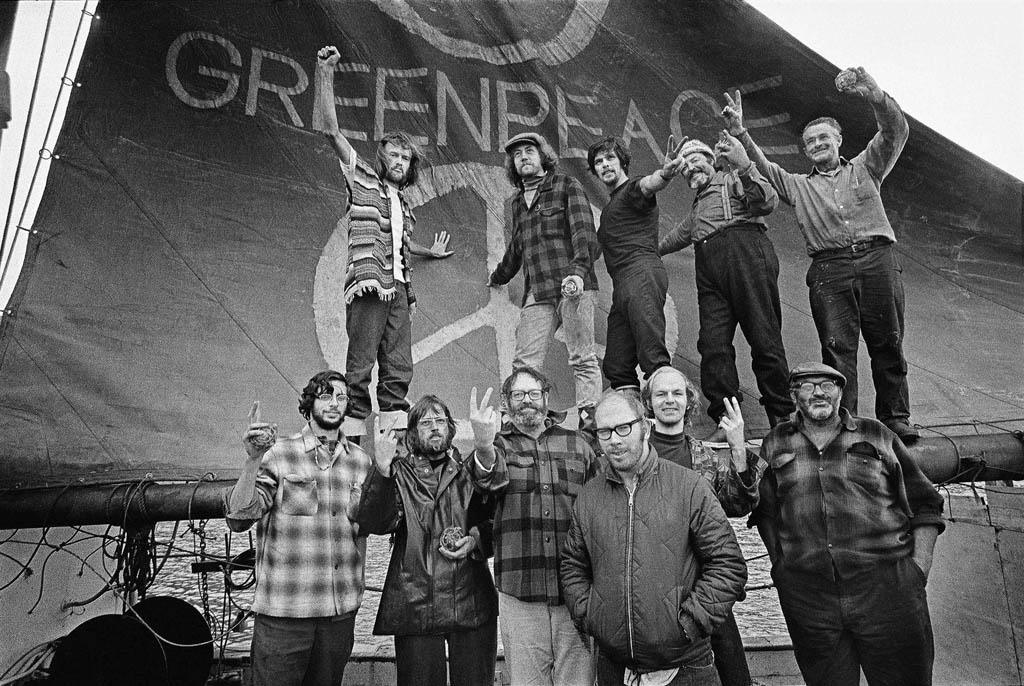
Canadian hippie journalists, photographers, musicians, scientists, and U.S. draft dodgers were among the people who created Greenpeace.

In his Director’s Notes, Rothwell writes: “The group had a prescient understanding of the power of media, knowing that capturing the perfect image was the most powerful weapon of all. But their footage richly evokes not only the dramatic actions they undertook, but their friendships and conflicts, dilemmas and decisions – a sometimes crazy mix of psychedelia and politics, science and theatre.”

In addition to dealing with dramatic public actions by Greenpeace, the film goes behind the scenes to document the internal workings of the group and disagreements and power struggles between three of the founders Paul Watson, Patrick Moore and Bob Hunter.

The film’s soundtrack includes music from Leonard Cohen, Joni Mitchell, Pink Floyd, Canned Heat and Country Joe and the Fish.

How To Change the World had its premiere at the Sundance Film Festival, and has been shown at many other festivals since then, including Toronto’s Hot Docs Film Festival, DOXA in Vancouver, theTrue/False Film Fest in Columbia, Mo., and the EcoFilm Festival in Portland, Ore. Future screenings will take place in San Francisco, Sheffield, England, Sydney and Canberra, Australia, Sao Paulo, Brazil, and Oakville, Ontario.

Embed from Getty Images

Will Jackson, left, Bous De Jong, Bobbi Hunter, Al Morrow, director Jerry Rothwell, John Murray, Rex Wyler and Emily Hunter at How To Change The World premiere at the 2015 Sundance Film Festival on January 22, 2015 in Park City, Utah. (Photo by Robin Marchant/Getty Images for Sundance)


HOW TO CHANGE THE WORLD
Directed by Jerry Rothwell. Canada/United Kingdom. 2015. 112 min. In the original English.
Thursday, May 28, 8 p.m., Cinéma Excentris, 3536 St Laurent Blvd.

Tickets can be bought online.

For more information, visit the How to Change the World Facebook page, or the How to Change the World web site.

Docville honours Albert Maysles and celebrates spring with colourful and exuberant Iris

iris apfel

RIDM, Montreal’s documentary film festival, takes place in November, but festival organizers keep film fans supplied with documentaries throughout the year via the monthly Docville program.

The presentation for Thursday, April 30, 2015, is Iris, a portrait of 93-year-old New York style icon Iris Apfel. It was the second-to-last film made by director Albert Maysles who died on March 5, 2015 at age 88.

You might have seen Iris Apfel in the documentaries Bill Cunningham, New York (2010), directed by Richard Press, or Bury My Ashes at Bergdorf’s (2013) by Matthew Miele. Both films were shown here in Montreal at Cinema du Parc.

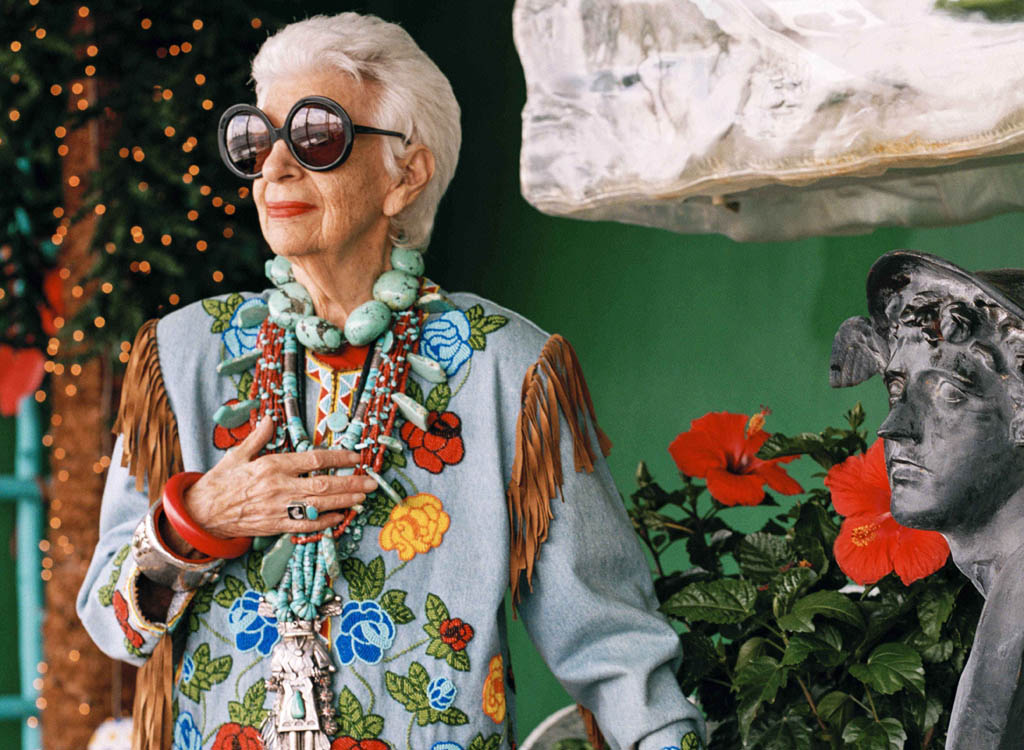
The documentary Iris is a portrait of fashion legend Iris Apfel, directed by Albert Maysles.

Once seen, Apfel is not easily forgotten. She likes to wear several large necklaces at once, and covers her arms in chunky bracelets. As a look at the trailer below will show you, she isn’t one of those people who wears black all the time. More power to her, I say! The world is full of colour, so why not enjoy it as much as possible and as long as possible?
Many critics have praised the film and the obvious rapport that existed between Maysles and Apfel. (Certainly, they had time to get to know one another – Apfel told Vogue magazine that the film was shot “on and off for four years.”)

Manohla Dargis of the New York Times says: “There are few better ways right now to spend 80 movie minutes than to see Iris, a delightful eye-opener about life, love, statement eyeglasses, bracelets the size of tricycle tires and the art of making the grandest of entrances. . . this is a documentary about a very different kind of woman who holds your imagination from the moment she appears. You can’t take your eyes off Iris Apfel (she wouldn’t have it any other way), but, then, why would you want to?”

Stephanie Zacharek of the Village Voice says: “like all good documentaries, Iris is about much more than what we see on the surface, no matter how dazzling that surface may be. . . Iris is more than just a movie about an amusing lady who likes clothes an awful lot. It’s also a celebration of the revivifying power of creativity. . .Maysles’s camera opens its eyes wide to Apfel, taking the measure of her wildly beautiful and witty outfits as if it can hardly believe what it sees. There’s delight here in Maysles’s way of seeing. . .It’s also very quietly moving, considering that it’s not about growing old, but about already being there.”

Richard Brody of the New Yorker says: “The warm relationship between Apfel and Maysles comes through from the start, as she playfully shows off some of her treasures and addresses him on-camera throughout. Maysles endearingly reveals Apfel’s blend of blind passion and keen practicality, her unflagging enthusiasm for transmitting her knowledge to young people, and her synoptic view of fashion as living history.”

Iris, directed by Albert Maysles, United States, 2014, 83 min., in the original English.
Thursday, April 30, 8 p.m., at Cinéma Excentris, 3536 St. Laurent Blvd.
Single screenings cost $12 ($10 for students and seniors).

Tickets can be bought online. Doing so might be a good idea, since the Facebook page for Iris already indicates that 261 people intend to go. The Salle Cassavetes only holds 271 people and more than 1,000 (!) have been invited.
(If you can’t make it to Thursday’s screening, Iris will open at Cinéma du Parc on May 29, 2015.)

FIFA 2015: See Escape From Moominvalley for beautiful paintings by Tove Jansson

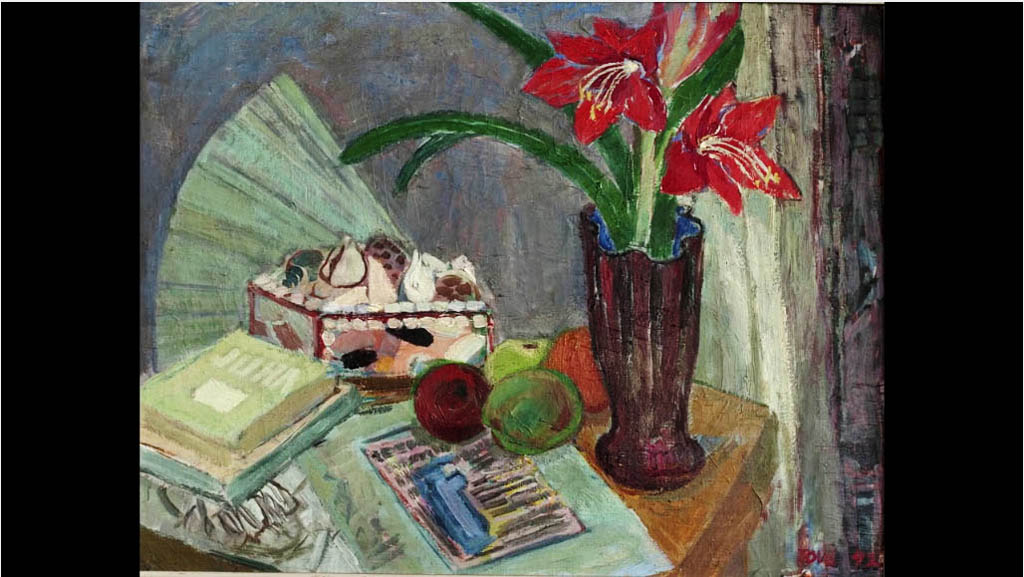
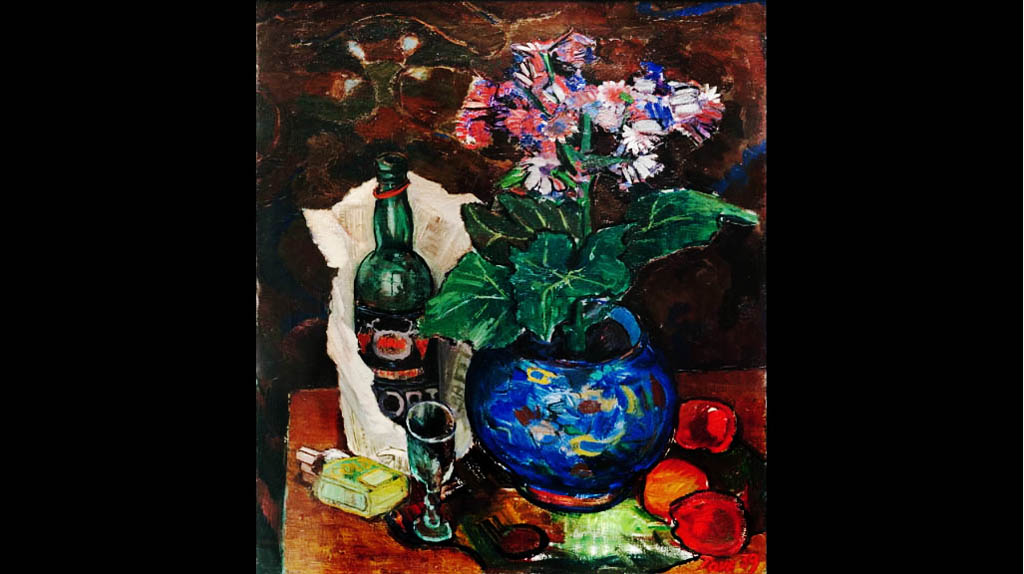
A still life by Tove Jansson, from the documentary film Escape From Moominville.

No need to be a Tove Jansson fan, or to know anything about her to enjoy Escape From Moomin Valley, it’s such a visual pleasure.

Tove Jansson (1914-2001) a member of Finland’s Swedish minority, achieved fame and presumably, fortune, through Moomins, creatures of her own invention who look vaguely like upright hippos. Moomins appeared in children’s books and a long-running comic strip; they are available as figurines, plush toys and printed on assorted bags, mugs, aprons, pencil cases, notebooks, etc. (Local publisher Drawn & Quarterly printed a large volume of her work in 2006.)

Artist and author Tove Jansson as a young adult, from the documentary film Escape From Moominville.

Jansson wrote short stories for adults and plays, as well, but she always considered herself a painter first and foremost. That’s what she wrote on her tax return, according to Escape From Moomin Valley.

Jansson came from an arty family; her father was a sculptor, her mother a graphic artist. She was expected to be an artist and a good one, too.

The film uses lots of photos, sketches, paintings and extracts read from Jansson’s letters and diaries to fill us in on her family life (she often argued with her father) her friends, her art classes and her travels. She studied in Stockholm and Paris, and visited Dresden, Brittany and Florence. Probably many other places, too. She was a forceful character and her art is wonderful to look at. Her studio is quite impressive, too. You might be jealous!

A still life by Tove Jansson, from the documentary film Escape From Moominville.

Jansson speaks briefly in the film and there are many remarks from her brothers, niece, and childhood friends.

Escape From Moominvalley is being shown as part of a double bill with the 55-minute film J.R.R. Tolkien: des mots, des mondes. A review of that is coming up! There’s a connection, too – while I don’t remember it in Escape From Moominvalley, Jansson illustrated a Swedish edition of The Hobbit.

Sunday, March 29, 2015, 1:30 pm, J.A. de Sève Theatre, McConnell Library Building, Concordia University, 1400 de Maisonneuve Blvd. W.

Escape From Moominvalley
Finland, Denmark, Sweden / 2014 / Color / 58 Min / Finnish S.T. English

A still life by Tove Jansson, from the documentary film Escape From Moominville.

Escape From Moominvalley
Realisation: Charlotte Airas
Script: Charlotte Airas, Kimmo Kohtamäki
Cinematography: Timo Peltonen
Sound: Pietari Koskinen
Editing: Kimmo Kohtamäki
Music: Pessi Levanto
Narration: Ylva Ekblad
Participation(s): Sophia Jansson, Per Olof Jansson, Boel Westin, Erik Kruskopf, Boris Konickoff, Tuula Karjalainen
Producer(s): Kaarle Aho
Production: Making Movies
Distribution: Making Movies
The Festival International du Film sur l’Art, known as FIFA, runs until Sunday, March 29, 2015. Visit the web site www.artfifa.com for more information

FIFA 2015 Review: Microtopia, a film about tiny homes, gets an extra Sunday screening

Ana Rewakowicz's Sleeping Bag Dress expands to become a kind of cocoon, in the documentary film Microtopia.
Ana Rewakowicz’s Sleeping Bag Dress expands to become a kind of cocoon, in the documentary film Microtopia.

Previous screenings of Microtopia at the Festival International du Film sur l’Art (FIFA) were sold out; an extra screening has been added for Sunday March 29, 2015. Another film, Strange and Familiar: Home and Architecture on Fogo Island, will be shown with it, as part of a double bill.

Microtopia is about possibilities, news ways of thinking and living. It features tiny houses, micro dwellings, and a VERY portable shelter – the Sleeping Bag Dress.

Montreal artist Ana Rewakowicz arranges her Sleeping Bag Dress, in the documentary film Microtopia. Note the Farine Five Roses sign in the background.

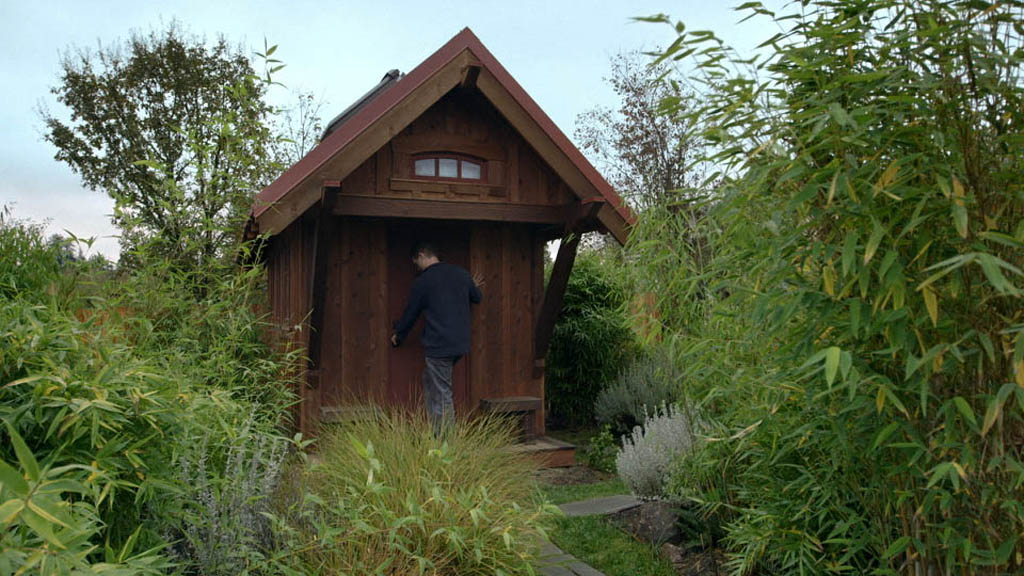
In northern California, Jay Shafer is living in his fourth tiny (and tidy) house. He built it himself. It’s made of dark wood and from the outside it looks like something a surbanite might put in the backyard as a place to store the lawnmower or where children can play house. The exposed wood on the inside gives it a warm and cosy look. Burners for cooking hang on the wall when not in use, to free up counter space.

Shafer explains that in the U.S., there are regulations that specify a minimum size for rooms in a house. He got around this restriction by putting his dwelling on wheels; strictly speaking, it is no longer a house.

Jay Shafer's tiny house in the documentary film Microtopia. It is being shown on Sunday, March 29, at FIFA, Montreal's Festival of Films on Art.
Jay Shafer’s tiny house in the documentary film Microtopia. It is being shown on Sunday, March 29, at FIFA, Montreal’s Festival of Films on Art.

Jennifer Siegel makes homes from former shipping containers, or long-haul trucks. These look relatively spacious compared to Shafer’s home.

In Mexico, Richart Sowa built his own floating island on a base of wooden pallets and reclaimed plastic bottles. (“Boats rock but island roll,” he says.) It is quite ramshackle, compared to Shafer’s construction.


Richart Sowa built his own island in Mexico, using wooden pallets and plastic bottles, lots of plastic bottles. Sowa is one of several participants in the documentary film Microtopia.

Greek architect Aristide Antonas proposes making a home from old tanker trucks, though he admits living in one might feel like being in prison.

In Denmark, Ion Sorvin shows a sort of plastic igloo that one call roll along the sidewalk and then “park” on the road, between cars. He’s also made a more spacious creation – a “walking house.”

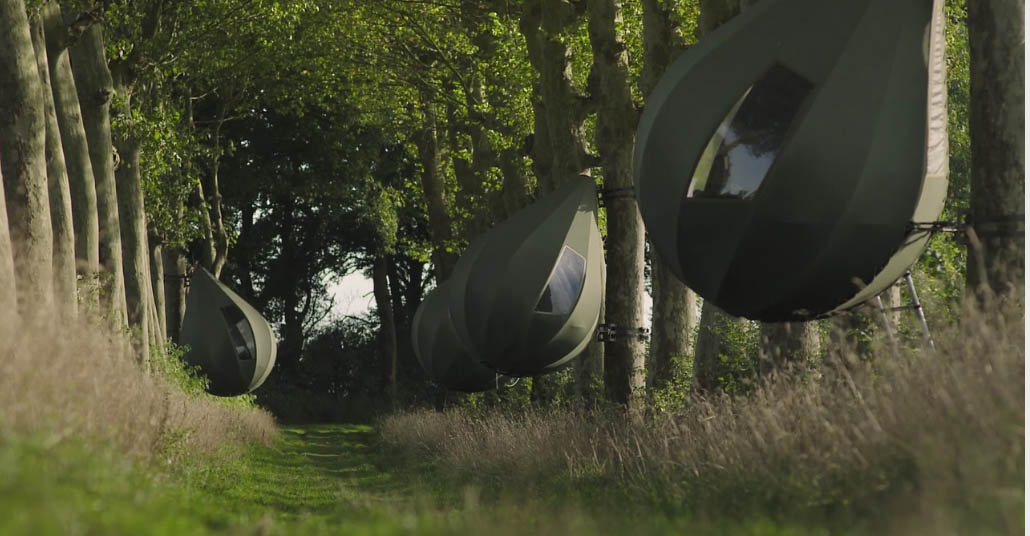
Dre Wapenaar of the Netherlands hangs pod-like tents from trees. He had designed them with the thought that eco-activists could use them while carrying out “actions” to save forests, but before he could contact any such activists, a campsite owner offered to buy them.

Dre Wapenaar of the Netherlands designed these tree tents. Rockabye baby!


There’s even a Montreal segment! Artist Ana Rewakowickz, who’s originally from Poland, demonstrates the Sleeping Bag Dress within sight of the famous Five Roses Flour sign.

And that brings me to one of my quibbles about the film. During the opening credits, we see the names faces and dwellings of the participants while they say a few words. That’s the last time we see their names.

They rarely say where they are, either. Three people were obviously in the U.S., and two of them were in deserts, though it was not clear if it was the same desert, or what state they were in. I had to Google Sowa to find out where his island was. Maybe I should recognize Copenhagen when I see it, but I had to Google Sorvin, too.

The artists and architects in the film talk about reusing and recycling, shrinking their environmental footprints, and ask how much stuff and how much space do we really need, etc?

A fascinating topic, though one size would definitely not fit all. Claustrophobics need not apply! It’s interesting to note that, the occasional drawing aside, we never see more than one person at a time in these dwellings. Few of these people could tell their friends “Drop by anytime!”

I cannot agree with Jennifer Siegel’s statement that we can keep all our memories on our hard drives now, and therefore we can get by with very few physical things. Speak for yourself, lady! There must be a happy medium, no?
Microtopia
Sweden / 2013 / Color / 52 min / English

Strange and Familiar: Home and Architecture on Fogo Island
Canada⎢ Katherine Knight, Marcia Connolly⎢ 2014 ⎢ 52 min
Cinquième Salle of Place des Arts, 175 Ste. Catherine St. W.

Microtopia
Realisation: Jesper Wachtmeister
Cinematography: Kenneth Svedlund
Sound: Jesper Wachtmeister, Kenneth Svedlund
Editing: Jesper Wachtmeister, Oscar Willey
Music: Benny Nilsen
Producer(s): Jesper Wachtmeister, Jonas Kellagher
Production: Solaris Filmproduktion, Eight Millimetres AB
Distribution: Autlook Filmsales

The Festival International du Film sur l’Art, known as FIFA, runs until Sunday, March 29, 2015. Visit the web site www.artfifa.com for more information.

FIFA 2015 Review: Donald Duck documentary is really two films in one


Image from the documentary film Donald Duck Ð Le Vilain Petit Canard En Nous, which is being shown in Montreal at FIFA, the Festival International du Film sur l'Art.
Image from the documentary film Donald Duck Ð Le Vilain Petit Canard En Nous, which is being shown in Montreal at FIFA, the Festival International du Film sur l’Art.

Ninety minutes devoted to Walt Disney’s film and comic book character Donald Duck? Yessireebob!

In truth, Donald Duck – Le Vilain Petit Canard En Nous, is more like two films, awkwardly cobbled together. For about the first 30 minutes, it’s all about The Donald. Apparently, he is really big in Europe. Every week, to this very day, in some European countries, one person in four reads about Donald Duck. Who knew?

Asssorted people from France, Germany and Scandinavia talk about their first encounter with the cranky fowl and what he means to them.

After World War II, Donald Duck was part of an effort to de-Nazify German children. In translating the comics into German Erika Fuchs made them more literary, witty and thoughtful than the originals.

Gottfried Helnwein of Germany is one of the many artists who appears in the documentary film Donald Duck Ð Le Vilain Petit Canard En Nous, which is being shown in Montreal at FIFA, the Festival International du Film sur l'Art.
Gottfried Helnwein of Germany is one of the many artists who appears in the documentary film Donald Duck Ð Le Vilain Petit Canard En Nous, which is being shown in Montreal at FIFA, the Festival International du Film sur l’Art.

Donald Duck fans (Donaldistes in French, if I heard correctly) have yearly conferences where they present serious papers about him.

Among the statements made by assorted talking heads: Donald Duck is never satisfied, he always wants more. He wants fame and recognition. He is ordinary, naive, but not an idiot. We can all identify with him; he can be a clown, evil or generous. He never wins, but he never gives up. Okay then.

Then, the film turns to winners and losers and success, with segments about the Razzie Awards (it’s a rather long segment), the Funny or Die comedy-video website, life coaches, the tradition of the village idiot, and an excerpt from the German version of the TV show The Office. To be honest, this second part was not that interesting for me.

Donald Duck - always full of big dreams! Image from the documentary film Donald Duck Ð Le Vilain Petit Canard En Nous, which is being shown in Montreal at FIFA, the Festival International du Film sur l'Art.
Donald Duck – always full of big dreams! Image from the documentary film Donald Duck Ð Le Vilain Petit Canard En Nous, which is being shown in Montreal at FIFA, the Festival International du Film sur l’Art.

Pet peeve: This film is made for French audience. When anyone is speaking a language other than French, a translator talks on top of them. No subtitles. Two people talking at once. Annoying in the extreme. There should be a law, I say!
Donald Duck – Le Vilain Petit Canard En Nous (Germany / 2014 / Color / 90 Min / French, English, German with French translation), Friday, March 27, 2015 at 6:30 pm at the Cinematheque Québecoise, 335 de Maisonneuve Blvd. E,

Donald Duck – Le Vilain Petit Canard En Nous
Realisation: Edda Baumann-Von Broen
Script: Edda Baumann-von Broen
Cinematography: Edda Baumann-von Broen
Participation(s): Jean-Pierre Dionnet, Gottfried Helnwein, Øyvind Holen
Producer(s): Hasko Baumann
Production: Avanti Media Plus
Distribution: Avanti Media Plus
The Festival International du Film sur l’Art, known as FIFA, runs until Sunday, March 29, 2015. Visit the web site www.artfifa.com for more information.

FIFA 2015 Review: Ian Rankin – My Edinburgh

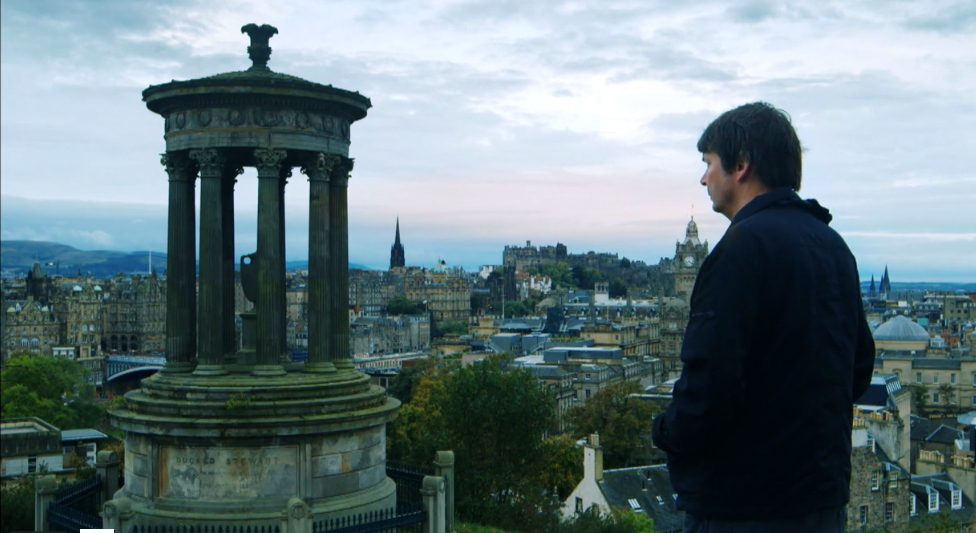
Crime novelist Ian Rankin looks at the city of Edinburgh.

Popular Scottish crime novelist Ian Rankin shares stories about his early days, (he wrote 16 books before he had a bestseller – such persistence!) talks about his creation police inspector John Rebus and takes us on a tour of “hidden Edinburgh” where there are “always new crime scenes to be discovered.” He says Edinburgh has all of the amenities of a large city while being conveniently compact. And it’s really the main character of his books, more than Rebus himself.

Tiny wooden dolls inisde tiny wooden coffins might be connected to notorious Edinburgh grave robbers and murderers Burke and Hare.

This tour includes a visit to an underground street, several graveyards, the Scottish Parliament, tales of cannibalism and bodysnatchers, the murderers Burke and Hare, the continuing mystery of 17 tiny coffins that date back to the 1830s, and the story of Deacon Brodie, the Edinburgh city councillor and cabinet-maker who was the inspiration for Robert Louis Stevenson’s novel The Strange Case of Dr. Jekyll and Mr. Hyde. (Stevenson set his story in London, though.) Sherlock Holmes author Arthur Conon Doyle was from Edinburgh, too, and he also set most of his stories in London.

Rankin reveals that in the first few Rebus books he set events in unnamed, fictional streets. Later he decided he might as well use real places, so he had Rebus working in a real police station, drinking in real pubs and living in the neighbourhood Rankin had lived in while attending university.


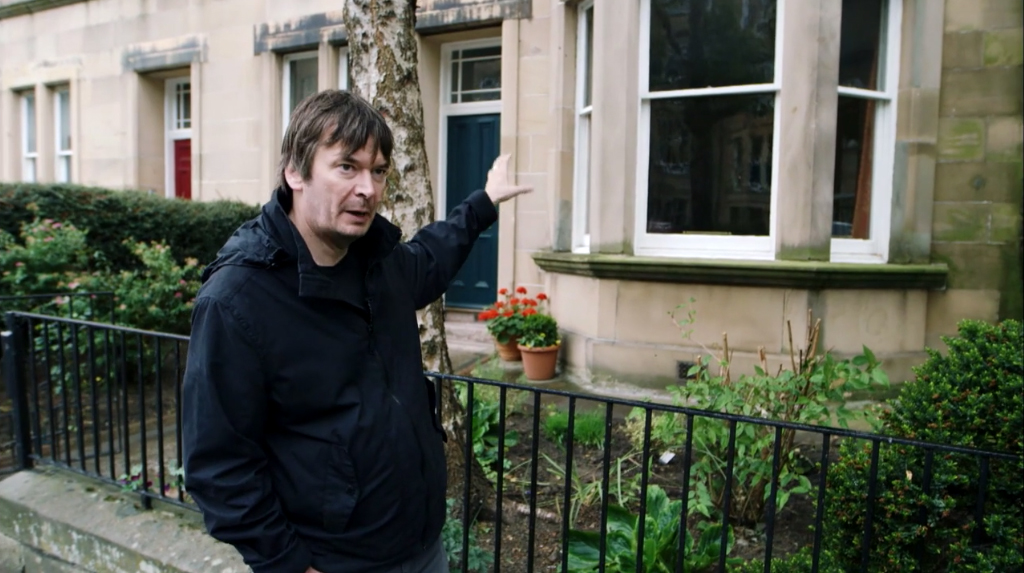
"That was my bedroom window," says writer Ian Rankin, pointing at the apartment he lived in during his student days. He decided that his character, police inspector John Rebus, would live across the street.
“That was my bedroom window,” says writer Ian Rankin, pointing at the apartment he lived in during his student days. He decided that his character, police inspector John Rebus, would live across the street.

Actor and historian Colin Brown runs Rebustours.com, which gives tourists a chance to visit the places mentioned in Rankin’s books. He mugs a bit while reading passages from the books. Rankin himself tags along with Brown for a while. Did the tourists even recognize him? I wasn’t certain. But I was sold on the attractions of Ediburgh. I’d be willing to check it out!
Wednesday, March 25, 2015, 6:30 p.m., at Grande Bibliothèque de BAnQ – Auditorium, 475 de Maisonneuve Blvd E.

Ian Rankin – My Edinburgh, Austria / 2013 / Color / 44 Min / English

Realisation: Günter Schilhan
Script: Günter Schilhan
Cinematography: Erhard Seidl
Sound: Albrecht Klinger
Editing: Günter Schilhan, Raimund Sivetz
Music: Franz Sommer
Narration: August Schmölzer, Stefan Suske, Günter Schilhan
Participation(s): Ian Rankin
Producer(s): Rosemarie Prasek
Production: ORF, 3sat
Distribution: 3sat

http://www.artfifa.com/en
The Festival International du Film sur l’Art, known as FIFA, runs until Sunday, March 29, 2015. Visit the web site http://www.artfifa.com for more information.

FIFA 2015 Review: The Man Who Saved the Louvre

This entrance to the Louvre Museum in Paris was named after Jacques Jaujard, the man who saved the museum's art from destruction during World War II.
This entrance to the Louvre Museum in Paris was named after Jacques Jaujard, the man who saved the museum’s art from destruction during World War II.

The Man Who Saved the Louvre is the intriguing story of Jacques Jaujard. In the late 1930s, with war in Europe looking more and more likely, Jaujard, director of the French National Museums, drew up an elaborate evacuation plan, to keep the country’s cultural heritage safe from bombs and Nazi art collectors, from Hitler on down. This was his own idea, no one asked him to do it.

Near the end of August 1939, 4,000 works of art were packed into crates, ready to be sent to châteaux in the countryside. Art from the Louvre included the Mona Lisa and the sculptures the Winged Victory of Samothrace and the Venus de Milo.

During World War II the art treasures of the Louvre were dispersed to a number of chateaux for safekeeping.

While many paintings were removed from their frames and rolled up, others were too delicate for that treatment. Géricault’s huge Raft of the Medusa was loaded onto an open truck, protected only by a tarpaulin. The painting was so large (five metres high, seven metres wide) that it knocked down power lines.

Museum staff members looked after the art works in their temporary homes throughout the war. They protected them from heat, cold and humidity, practiced fire drills every day, and wrote LOUVRE in big letters on the lawns of the châteaux to alert any Allied bombers to the treasures. Some items were moved as many as five times before the war was over.

Louvre warning
Warnings were placed on the ground to alert Allied bombers to the presence of art treasures.


Intrigue and a love interest is provided by one of Jaujard’s contacts in the French Resistance. The agent with the codename “Mozart,” turns out to be a glamourous former actress.

The film uses photos, archival footage, Jaujard’s notebooks and testimony from witnesses to tell the story. An animated version of Jaujard makes the occasional appearance as well.

The Man Who Saved the Louvre is presented in a more engaging way than another FIFA selection about art during World War II, the Austrian film Hitler’s Mountain Of Stolen Art. That film, which will also be shown on Wednesday, March 25 (at 6:30 p.m.) looks at a treasure trove of stolen art that was stashed in a salt mine in Altaussee, Austria.

Once he realized that he was losing the war, Hitler gave orders to blow up the mine and the art with it. His order was not carried out, and the filmmakers look at a number of candidates in an effort to figure out try to find out who saved the art. The film just seems to go around in circles and has far too many interviews where the translation is spoken and not given via subtitles.

The Man Who Saved the Louvre

France / 2014 / Color, B & W / 60 min / English with French subtitles, part of a double bill with:

Grandeur des petits musées
France / 2014 / Color / 47 min, / in French

Wednesday, March 25, 2015, at 4 p.m., at the Maxwell Cummings Auditorium, Montreal Museum of Fine Arts, 1379 Sherbrooke St. W.

The Festival International du Film sur l’Art, known as FIFA, runs until Sunday, March 29, 2015. Visit the web site www.artfifa.com for more information.