Director Guillermo del Toro with his Cheval Noir Award at the Fantasia International Film Festival in Montreal, Friday, July 15, 2016. The smiling guy behind Del Toro is festival programmer Mitch Davis. (Liz Ferguson photo)
On Friday afternoon, July 15, 2016, director Guillermo del Toro spoke with Fantasia Film Festival programmer Tony Timpone at a press conference where he also took questions from fans who are journalists, film profs, etc. Clearly, they were there because they wanted to hear his stories, not to do a job.
Del Toro is passionate about films, monsters, and his work. He’s really funny, too. (Not exactly news to those who are already his fans!)
Friday evening, Del Toro was given Fantasia’s Cheval Noir Award; then he appeared onscreen in the (excellent) documentary Creature Designers: The Frankenstein Complex, then he returned, again with Timpone, to share more insights and answer more questions.
I’ll post more details about his talks later, but here’s one of the things I particularly liked: Del Toro makes lots of Twitter posts about many kinds of art, but he only makes positive remarks, he doesn’t believe in tearing people or things down. He doesn’t mind criticizing politicians, though. (He tweets as @RealGDT.)
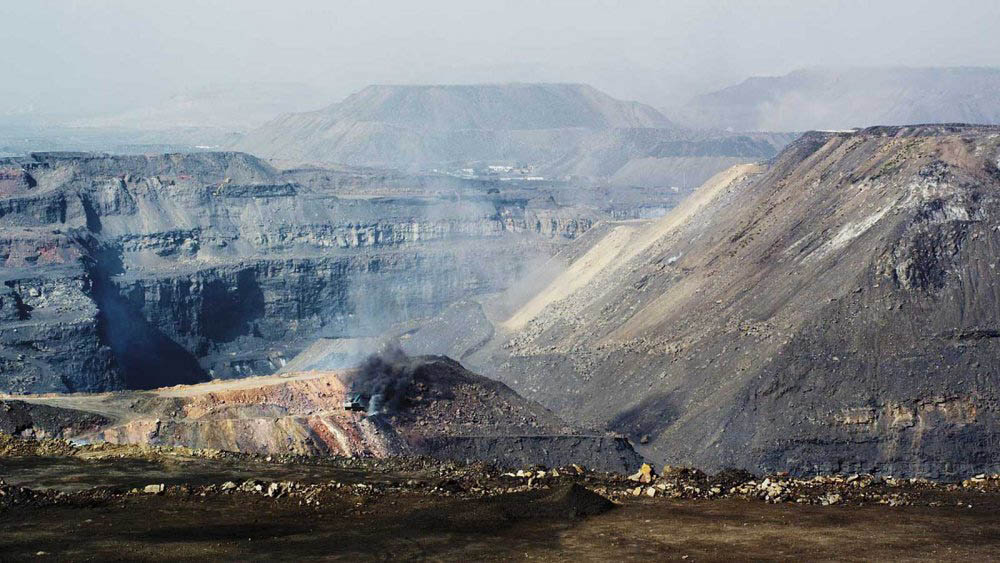
Zhao Liang’s documentary film Behemoth shows how parts of Inner Mongolia have been destroyed by coal mining.
RIDM, Montreal’s documentary film festival, takes place in November, but festival organizers keep the doc spirit alive throughout the year with monthly screenings at Cinema du Parc.
The selection for Thursday, May 26, 2016, is the Chinese film Behemoth, from director Zhao Liang.
Behemoth looks at the human and environmental devastation created by coal mining in Inner Mongolia. The landscape is scarred and ugly, while the men have blackened faces and hands. Imagine what their lungs must look like. We don’t see any chest X-rays in the trailer, but we do see them cough and struggle for breath. We see some hooked up to oxygen tanks, too.
The sooty face of a coal miner in Zhao Liang’s documentary film Behemoth.
That coal powers smoky, noisy, iron foundries and steel plants that glow with red-hot heat like a vision of hell. In fact, Zhao Liang took inspiration from Dante Alighieri’s Divine Comedy, which sees the Florentine poet travel to Hell, Purgatory, and Paradise. Behemoth uses excerpts from the poem in place of dialogue.
Foundry employees work with molten metal in Zhao Liang’s documentary film Behemoth.
I have read more than 10 reviews of Behemoth and they were all extremely enthusiastic. Here are quotes from a few of them.
Variety’s Jay Weissberg says Behemoth is: “stunningly lensed. . .impressively self-shot poetic exercise in controlled righteous outrage. . .”
In the New York Times, Amy Qin writes: “documentary combines with art film to produce a powerful testament to the human and environmental costs of coal mining and consumption in China, the world’s biggest user of coal and the leading emitter of greenhouse gases from coal.”
In Screen Daily,Lee Marshall writes: “Vast swathes of once-pristine Mongolian prairieland have, in the last couple of decades, become scarred and brutalised by open-cast coal mines, iron foundries and generating stations, with thousands of desperate Chinese migrant workers brought in to feed the insatiable demand for disposable, low-paid manpower to keep them operating. That’s the background to Zhao Liang’s remarkable, powerful film Behemoth (Beixi moshuo), a sort of ‘dream documentary’ set in this ravaged landscape but liberally inspired by Dante. Behemoth achieves much of its authority from the way the images comment wordlessly on a world in which humans are reduced to the status of servants of a vast, unfeeling industrial system.”
“. . .But it’s Behemoth’s final sequence, almost devoid of human figures, that is, paradoxically the most shocking. It shows a Mongolian ghost new-town, with its serried ranks of residential skyscrapers. These are all empty, we soon realise – as are the streets that surround them. Empty, that is, except for teams of migrant-worker street sweepers – one of whom chases after a drift of tumbleweed that has entered the shot, and tidies it away. Refreshingly undidactic, Behemoth leaves us to work out that, after hell and purgatory, this empty metropolis, made by the industrial monster that ravages the steppes, and the sweat and blood of those who serve it, is the film’s tragic, ironic heaven.”
Another Screen Daily writer, Wendy Ide, put Behemoth on her list of best films of 2015. She writes: “Behemoth (Beixi Moshuo) makes me forever grateful I write about films for a living and don’t have to pick bits of molten pig iron out of my skin at the end of each working day.”
In a scene from the documentary film B-Movie Lust & Sound in West-Berlin 1979-1989, Mark Reeder gives TV presenter Muriel Gray a tour of West Berlin in 1983.
B-Movie Lust & Sound in West-Berlin 1979-1989 – it’s long and unwieldy, but it’s also quite straightforward, unlike some film titles. It doesn’t need to be decoded or anything.
B-Movie is a documentary film with three directors (Klaus Maeck, Jörg Hoppe, Heiko Lange) and one guide – Mark Reeder, a musician and one-time record store employee from Manchester, England, whose interest in German music took him to Berlin in the late 1970s.
The directors had access to many film clips from the era, including some by Reeder himself, and they use Reeder’s experiences and his narration to tie everything together. Actor Marius Weber plays Reeder in some re-enactments. Mark Reeder is 58 now, but his voice still sounds youthful and enthusiastic, like that of a person still in his 20s.
And lest we think the film is only about looking backwards, Reeder told The New Statesman “Artists still come to Berlin searching for something, whether they stay for a few months or a few years. And this film is about inspiration. Not nostalgia.”
Footage includes day and night streetscapes, violent demonstrations, musical performances, interviews and visits to music clubs. (Reeder explains that typical night out might begin at midnight and end at 7 or 8 a.m.). German bands who play and talk include Malaria!, Shark Vegas, Einstürzende Neubauten, Die Tödliche Doris, Die Artze, and Die Toten Hosen.(Blixa Bargeld of Einstürzende Neubauten played with Nick Cave and the Bad Seeds between 1983 and 2003.) There is a brief glimpse of Nena, who had the hit 99 Luft Balloons. Musician Farin Urlaub appears, wearing a clerical collar.
Singer Eric Burdon appears with a rodent on his shoulder, artist Keith Haring paints the Berlin Wall, TV star David Hasselhoff sings while wearing a flashing-light jacket AND a piano key scarf – guess he’s not one of those “less is more” types.
These days, Tilda Swinton looks ageless to me, but we see a few seconds of her looking really young. Swinton appeared in the 1991 German film The Party: Nature Morte; presumably Reeder met her through his bit part in it. (His part was “Drunk.”)
In regard to artists from English-speaking countries, the Australian Nick Cave gets the most screen time. He lived in West Berlin for three years and stayed with Reeder until he found a place of his own.
West Berlin rents were cheap in those days, though Reeder and many others lived in “squats” and didn’t pay any rent at all. Nevertheless, a person needs some money to live on and Reeder earned his as the Berlin representative of British company Factory Records, as a record producer, a band manager, and dubbing porn films. In addition to The Party, he also appeared in Joan of Arc of Mongolia, and the horror film Nekromantik 2, directed by Jörg Buttgereit.
My one quibble with this film: Reeder has a fetish for uniforms, because they “hard-wearing, practical and they get people mad.” Some of them are Nazi uniforms, or the look like Nazi uniforms. For me, that’s just creepy and distasteful.
B-Movie Lust & Sound in West-Berlin 1979- 1989, is being shown at 7 pm, Thursday, May 5, 2016 at Cinema du Parc, 3575 av du Parc, as part of the Goethe Institute’s once-a-month Achtung Film series. It’s 92 minutes long, in German with English subtitles.
Tony Leung Chiu Wai, left, and Lau Ching Wan are the stars of the Hong Kong film The Longest Nite.
Lucky Montrealers can see a double bill of classic Hong Kong gangster films for a mere $10 tonight, Saturday, April 30, 2016, at the Cinémathèque Québécoise. That’s two for the price of one. (And these are indeed 35 mm films, not DVD projections.)
Too Many Ways To Be No. 1, from 1997, and The Longest Nite, from 1998, were shown in Montreal in the early days of the Fantasia International Film Festival, so tonight’s screenings will have an added nostalgia value for people who saw the films back then.
The very black comedy Too Many Ways To Be No. 1 is set in the months before Britain returned Hong Kong to China. Tense times! Petty criminal Kau, 32, hasn’t got very far in life and he’s contemplating his future. He’s wondering – should he accept a job taking stolen cars to the Chinese mainland, or not?
The film shows what would happen if he did; then shows a scenario in Taiwan that could only happen if he refused the mainland job. These crooks are not the cool, suave, well-dressed types one sees in many gangsters films – they’re loud, clumsy and clueless. Camera work is unusual, with one scene shot upside down and another that takes place in total darkness apart from the flashes coming from guns. Rob Larsen at drunkenfist.com says: “Far-removed from the slick, attractive style that is the stereotype of a Triad picture, Too Many Ways feels like it was shot by the love child of Samuel Beckett and Ringo Lam with a script provided by David Lynch.”
Shelly Kraicer says: “A gangster film, brilliantly written and photographed. . . it’s provocative and amusing at the same time (and manages to make the ‘experimentation’ of Pulp Fiction look like child’s play). Amazing camera work (hyper-actively circling, inverted and distorted, with a daringly warped colour scheme). . . The tone flips constantly: expect something hilariously violent/satirical/absurdist. . . I can’t recommend it highly enough: take a chance and see it, if you want something both entertaining and a bit challenging.”
Kau is played by Lau Ching Wan, other actors include Francis Ng, Cheung Tat Ming, Carman Lee, Elvis Tsui and Matt Chow.
Too Many Ways To Be No. 1 is from Johnnie To’s Milky Way Image Company and directed by Wai Ka-fai. It’s 90 minutes long, with Cantonese and Mandarin dialogue and English subtitles.
I might also point out that Too Many Ways To Be No. 1 seems to be out of print, so this is a rare chance to see it. In fact, people are asking for $2,143. to $3,062 for a DVD via amazon.ca. Ha! As if!
A person would have to be a VERY big fan to pay more than $2,000 for a DVD, don’t you think?
Lau Ching Wan is also in The Longest Nite, along with Tony Leung Chiu Wai. The film is set in Macao; Tony Leung plays a very crooked, very violent policeman who works for gangsters and Lau plays a burly, mysterious stranger whose shaved head makes him look extra scary. Unlike Too Many Ways To Be No. 1, there’s nothing funny about The Longest Nite. James Mudge of Beyond Hollywood says: “This is a bleak, nihilistic and brutal thriller which pulls no punches and whose complex plot shows an intelligence that is both ruthless and vicious. . . With its myriad twists and turns, the plot of “The Longest Nite” rivals “The Usual Suspects” in terms of intricacy. . .two rival gangs are attempting to negotiate a truce and join forces before the impending return of another, legendary gang boss. . . one of the gang leaders, Lung, learns that a contract has been taken out on his life, supposedly by Brother K, the other boss. Brother K denies this, and sends Sam (Tony Leung), a dirty cop who works for him, to investigate. . . it appears that there may be even more to the assassination plot than the simple killing of Lung.”
“The plot twists are quite unpredictable, and the tension gradually builds as the viewer is given often misleading hints as to where the story is going, rather than being force fed details via needless exposition. . . “The Longest Nite” is a classic Hong Kong thriller. . .A cunning film that is as cerebral as it is exciting and violent, this is a film all fans of Asian cinema should see.”
The Longest Nite is directed by Patrick Yau and Johnnie To, it’s 81 minutes long, in Cantonese with English subtitles.
Too Many Ways To Be No. 1 and The Longest Nite, 7 p.m., Saturday, April 30, 2016, at the Cinémathèque Québécoise, 335 de Maisonneuve Blvd. E., Montreal, Quebec H2X 1K1, across from the Berri-UQAM metro. Visit the Facebook page for more info.
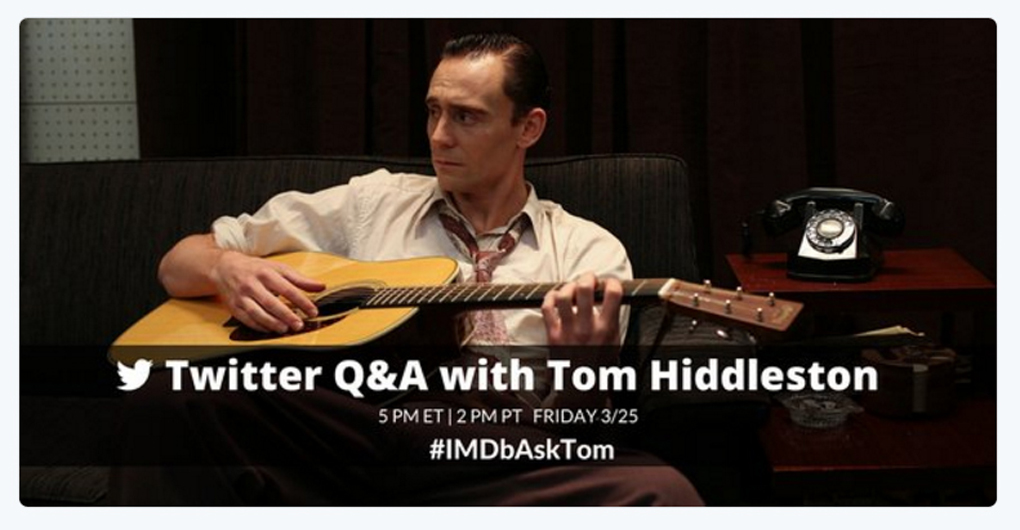
Actor Tom Hiddleston will take questions about his latest film, the Hank Williams bio pic I Saw the Light, via Twitter on Friday, March 25, 2016, at 5 p.m.
Got questions for Tom Hiddleston?Send them to #IMDbAskTom via Twitter. The popular British actor will respond to fans at 5 p.m. (Eastern Time) Friday, March 25, 2016.
Hiddleston is on what must be an exhausting tour, promoting his latest film, I Saw the Light, in which he plays influential U.S. country music singer Hank Williams (1923-1953). The film opens in New York, Los Angeles, and Nashville today, March 25, and expands to more cities in the U.S. and Canada on April 1.
Hiddleston has given print interviews and appeared on early-morning and late-night TV.Tonight, after his Twitter talk, he will answer questions at two New York screenings of I Saw The Light, then he’ll particpate in two more New York Q&A sessions on Saturday. I bet those screenings have been sold out for a long time!
British actor Tom Hiddleston will meet with his fans on Friday and Saturday, March 25 and 26, after New York screenings of his new film I Saw the Light.
For those who aren’t already fans: Hiddleston’s international fan base gets bigger every day. They follow his every move on the Internet, and many havetravelledhundreds, even thousands, of miles in hopes of seeing him on the set or at premieres.
In the last few weeks he’s been burning up the air waves as a spy, trying to bring down an evil arms dealer played by Hugh Laurie, on the BBC TV series The Night Manager, which is based on a book by John Le Carré. The show will come to the U.S. in April.
Of course, some fans have been smitten since 2008 when Hiddleston played curly-haired policeman Magnus Martinsson in the British TV series Wallander.
Hiddleston went on to roles in Thor, Midnight in Paris, War Horse, The Deep Blue Sea, The Avengers, Only Lovers Left Alive, Thor: The Dark World, Crimson Peak, High Rise and I Saw The Light.
In a scene from the film Homme de danse, Vincent Warren, right, watches as Arnab Bandyopadhyay demonstrates gestures from Indian classical dance.
Ballet dancer, ballet teacher, dance historian and archivist, Montrealer and Québecois by choice, Vincent Warren is, or has been, all of those things. He’s also a superb raconteur, and many of his stories are hilarious. He shares those stories in Un Homme de danse (A Man of Dance) a film directed by Marie Brodeur. Like many Montrealers, Warren speaks English and French and often switches from one to the other in mid-sentence. He wears a scarf with great panache, too!
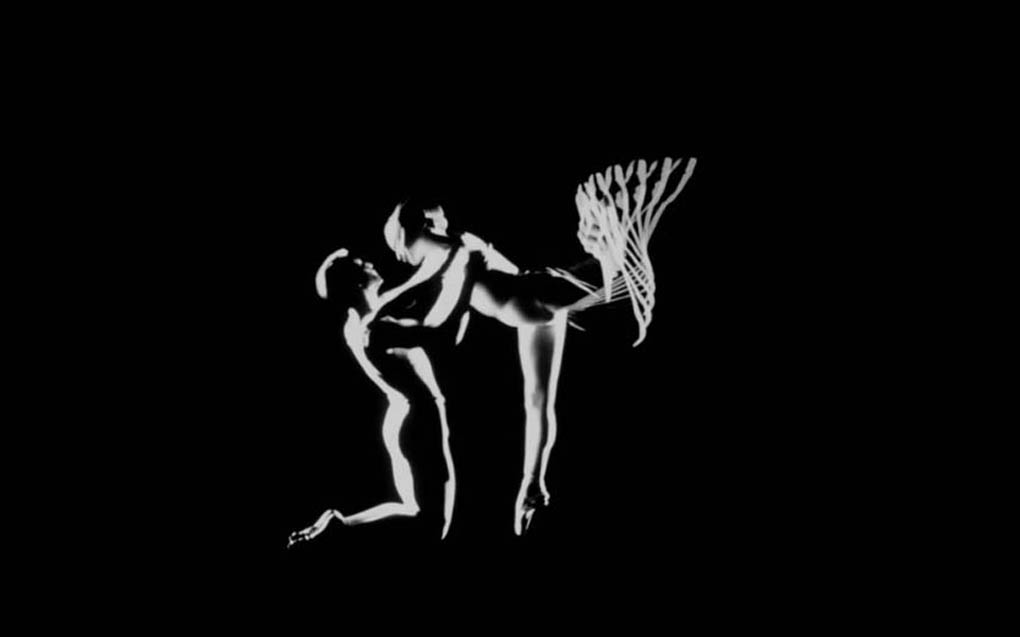
I didn’t know his name before seeing Homme de danse, but I soon realized that I had seen Warren dance many times; he is the male dancer in Pas de deux, an award-winning film that Norman McLaren made for the National Film Board of Canada in 1968. (The ballerina is Margaret Mercier and the choreography is by Ludmilla Chiriaeff.) With its mesmerizing multiple exposures, the film was ground-breaking for its time. If I had a nickel for every time I saw it back in my school days. . .
Vincent Warren and Margaret Mercier dance in Pas de deux, a film that Norman McLaren made for the National Film Board of Canada in 1968.
In yet another claim to fame, Warren danced the title role in the ballet Tommy, which choreographer Fernand Nault created for Les Grands Ballets Canadiens in 1970, using music from the rock opera of the same name by The Who. The work appealed to young audiences and encouraged young men to consider careers in ballet.
Warren was born into a large family in Jacksonville, Florida, a place where boys were expected to play football, as his own older brothers did. But Warren was entranced by dance when he saw the film The Red Shoes at age 11. (Read the Wikipedia entry for The Red Shoes here, reviews of The Red Shoes at the Internet Movie Database.) He read everything he could about ballet, and started a ballet scrapbook, which he still has to this day (take that, all you “toss-it-out” minimalists!) He paid for his first ballet lessons with money he earned as a paper boy, but he didn’t pay for long; male students were so rare, they had to be encouraged. (“Boys were always welcome.”)
A page from Vincent Warren’s ballet scrapbook. He was smitten by dance after he watched the 1948 film The Red Shoes.
After finishing high school Warren headed to New York where he received scholarships to the American Ballet Theater School (Rudolf Nuryev was in his class!) and then to the Metropolitan Opera Ballet School. He was hired by the Metropolitan Opera at a time when Maria Callas and Renata Tebaldi were performing there. Warren was a party animal, hanging out until the early-morning hours with the poet Frank O’Hara and his gang of abstract expressionist painters.
Warren also danced at the Sante Fe Opera Ballet, with an orchestra conducted by Igor Stravinsky. (Warren has a good Stravinsky story – but better you should hear it from him than from me.) In the summer, Warren worked in summer stock, where companies presented a new musical each week and performed as many as eight in one season.
In 1961 Warren joined Les Grands Ballets Canadiens, under the direction of Ludmilla Chiriaeff. He danced with the company until 1979, when he turned 40. He then taught performance and dance history until 1992 at École Supérieure de Danse du Québec, the school connected to Les Grands. The school had a tiny library with little more than 300 books. Warren donated thousands of his own books, magazines and prints to turn it into the best dance library in Canada. It’s now called Bibliothèque de la Danse Vincent-Warren, and it’s open to the public. “We want you to visit,” Warren said at the screening I attended.
Warren is not the only one who gets to tell stories – we also hear from dancers Véronique Landory, Annette av Paul, Anik Bissonnette, choreographers Brian Macdonald, Jeanne Renaud, Paul-André Fortier, Aileen Passloff, and journalist Linde Howe-Beck. Warren’s longtime friend, Peter Boneham, another American dancer and choreographer who made a home in Canada, is a real hoot. The two could probably form a comedy act if they wanted to.
Homme de danse might be a history lesson or a nostalgia fest, depending on the age and interests of the viewer. There’s footage of Place des Arts, so new that it’s still surrounded by rubble, a glimpse of former Montreal Mayor Jean Drapeau, colourful scenes at the World’s Fair, Expo 67, and excerpts from many ballets, too. I was surprised to learn that Radio-Canada used to present live ballet performances two to four times per week.
After living in a second-floor apartment in Mile End for 47 years, “like an old bear in his cave,” Warren decided to move to a ground-floor place. Director Brodeur filmed him as he packed up his possessions; it was a great idea, since so many of those objects sparked memories and stories.
Un Homme de danse (Man of Dance) directed by Marie Brodeur, will be shown as part of FIFA, Festival International du Film sur l’Art, on Sunday, March 20, 2016 at 5 p.m. in the Maxwell Cummings Auditorium of the Montreal Museum of Fine Arts, 1379 Sherbrooke St. W. Vincent Warren will attend the screening.
General admission tickets are $12.50; seniors (65 and older) pay $11; those 25 and younger pay $10; children 12 and younger pay $5.
For more information or to buy tickets online, visit www.artfifa.com
In July and August the Fantasia International Film Festival brings joy to Montreal film fans, and those who travel here, from far and wide, for that special Fantasia experience. Hors-festival, Fantasia also presents films at Cinéma du Parc on the third Thursday of the month. The Fantasia selection for February 18, 2016, the horror film The Witch, has been sold out since some time last week. That’s too bad for those who did not buy tickets in advance, because you couldn’t find a more enthusiastic group to watch a film with. Oh, well!
Montrealers can catch The Witch, in the original English, or dubbed into French, at various branches of the Cineplex Odeon chain, starting on Friday, February 19. In the downtown area, that means the Quartier Latin and ScotiaBank cinemas.
In this scene from the horror film The Witch, Thomasin (Anya Taylor-Joy) has heard disturbing sounds in the night. (Remstar Pictures)
The Witch has attracted lots of attention since its first screening at the 2015 Sundance Film Festival. It won the Directing Award at Sundance, First Feature Competition at the the 2015 London Film festival, Horror Jury Prize at the 2015 Austin Fantastic Fest Best Feature at the 2015 New Hampshire Film Festival. It’s also the “Most Anticipated of 2016” according to the Indiewire Critics’ Poll.
The film is set in New England of the 1630s. A family of recent immigrants is living on the edge of some scary woods. Life is is already very difficult, and when the youngest child, who’s just a baby, disappears under mysterious circumstances, things spiral downhill from there and family members turn on each other. Director Robert Eggers spent several years researching the era.
The young women who play sisters in the film Mustang have a great rapport and are very believable as siblings. (Metropole Films)
Mustang opens at the end of the school year – as our main characters, five sisters, are saying goodbye to their friends and teachers. In their school uniform of white blouses, loosely knotted ties and a-line skirts they look like girls you might see right here on the streets of Montreal. They seem happy, self-confident and they have long, glorious hair. (The kind of hair I always wanted to have in high school. . .sigh. All the cool girls had long hair. They were great at field hockey, too.)
About that title, Mustang, which might make one think of a Western, it’s all about that hair. In the press kit, Director Deniz Gamze Ergüven says “A mustang is a wild horse that perfectly symbolizes my five spirited and untamable heroines. Visually, even, their hair is like a mane and, in the village, they’re like a herd of mustangs coming through. And the story moves fast, galloping forward, and that energy is at the heart of the picture, just like the mustang that gave it its name.”
Back to the story: It’s a beautiful day, so the sisters decide to walk home instead of taking the school bus. The story is set in a seaside village on the Black Sea, and their walk takes them by a beach. This leads to some playful frolicking in the water with their male friends. Oh, oh.
By the time they get home, their grandmother has already heard about this indiscretion and she pretty much accuses them of engaging in an orgy. (What will the neighbours think? What will they say?) She also beats them, starting with the oldest one first, and working her way down chronologically. As outraged as she is, things only get worse when her son, the girls’ uncle Erol (Ayberk Pekcan) comes home. (Their parents have been dead for years.)
The life the sisters had known is over now. Grandma (Nihal Koldas) gathers up their telephones, their computer, confiscates books, makeup, and any other thing that might have a pernicious influence, and locks all of it in a cupboard. The sisters are driven to a local clinic and made to suffer the indignity of virginity tests.
Their home becomes a “wife factory.” Neighbourhood women in headscarves come in to instruct them in sewing, stuffing a duvet, cooking (they even make chewing gum!) and advanced window cleaning. They must wear muddy-coloured, long-sleeved dresses. Sometimes when the family is just hanging out, we can hear speeches on the TV about how women ought to behave.
Before we know it, the two oldest girls, Sonay (Ilayda Akdogan) and Selma (Tugba Sunguroglu), are serving coffee and cookies to the neighbourhood women. It’s a sort of an audition, or presentation of the merchandise, really. A woman will offer a son as a groom, then bring her husband in, that very same day, to confirm the engagement, with rings and red ribbons. The wishes and opinions of the future partners don’t seem to matter. At least Sonay manages to get engaged to the guy she’s already been seeing on the sly. Selma is not so lucky; she’s paired off with a guy who looks just as unenthusiastic as she does.
Ilayda Akdogan plays Sonay in a wedding scene from the film Mustang. (Metropole Films)
There’s an interlude at a soccer game that might remind some viewers of Jafar Panahi’s film Offside. The youngest girl, Lale (Gunes Sensoy), is a big soccer fan, but her uncle won’t take her to matches or even let her watch them on TV with him when his pals come over. But, after some violent incidents, the authorities decide that a coming match will only be open to women and young children. All the sisters welcome this chance to escape the wife factory and they join their friends for a raucous bus ride and a joyful game. (Turkey really did have some women-and-children only games in 2011, with 41,000 fans attending.)
After this outing, the walls around the house are made higher still, a tall wrought-iron gate is installed and bars are placed on the windows. The place really feels like a prison, now. However, all this “security” will come in mighty handy for some of the sisters later.
To my shock and surprise, when school starts again, none of the girls are allowed to return. (The actress playing Lale was 13 in real life, but she looked younger than that to me. I’m not sure how old she was supposed to be in the story.) No one comes to find out why they aren’t in school.
Throughout the film Lale has been watching, without saying a lot, but it’s obvious that she’s in no hurry to become a housewife. She’s plotting to rescue herself and her remaining single-but-already-engaged sister and we get to be a part of it. She might be young, but she’s very resourceful and she’s already found a good ally on “the outside.” An ally, mind you, not a prince or a knight, because she is not a helpless girl.
While some parts of the film are upsetting, maddening, even tragic, the bond the sisters have is wonderful to behold. Viewers who don’t have any sisters might well wish that they did. The actresses are so comfortable together they are very believable as sisters. Outdoors, they do gallop like mustangs, but at home they might tumble around playfully, or cuddle up together, like a bunch of kittens.
Hundreds of teenagers auditioned for parts in the film. Elit Iscan (Ece) was only one with previous acting experience, though you wouldn’t know it. Director Deniz Gamze Ergüven first saw Tugba Sunguroglu (Selma) on an airplane flight.
Ergüven was born in Turkey but she’s based in France now. She often moved between France and Turkey, and also spent time in the U.S. and in South Africa, where she earned an M.A. in African History.
The film was shot in the Black Sea village of Inebolu. It is 600 km from Istanbul, though in the story the sisters are 1,000 km from the big city. For them, it probably seems as far away as the moon.
Mustang was written by Deniz Gamze Ergüven and Alice Winocour.
I really enjoyed the film’s sound track. Most of the tunes were composed by Australian musician Warren Ellis, of Nick Cave and the Bad Seeds. Three tunes (or fragments of them) that Ellis recorded with Cave are in the film, though they are not on the Mustang sound track album. Those tunes are Home, Moving On, The Mother. Of the 12 tracks on the album ($9.99) 11 are by Warren Ellis, and one is from the Turkish band Baba Zula. (Here is a link to the Mustang soundtrack, at iTunes.) Coincidentally, Baba Zula played here in Montreal in October, 2015. Two other tunes, Yüksek Yüksek Tepeler (The Song of a Homesick Bride), performed by Selim Sesler, and Esrefoglu Hear My Words (Eyefoölu Al Haberi) performed by Ahmet (Dede) Yurt, are in the film, but not on the soundtrack. I think their tunes provided the lively dance music at a wedding reception. (Selim Sesler’s music is here, on iTunes; there’s a video of Ahmet Yurt on YouTube.
Mustang is a France-Turkey-Germany co-production For those who care about such things, Mustang is France’s entry for the foreign-language Oscar.
Mustang is in Turkish. In Montreal a version with English subtitles is being shown at Cinéma du Parc and Cineplex Forum. The version with French subtitles is being shown at Cinéma Beaubien, Cineplex Odeon Quartier Latin, and Méga Plex Pont Viau.
Around the World in 50 Concerts is a film about a world tour by the Royal Concertgebouw Orchestra. The documentary by Heddy Honigmann is the January selection for RIDM+, an offshoot of Montreal’s RIDM film festival.
RIDM, Montreal’s documentary film festival, takes place in November. But, to keep memories of the festival alive, and to give film fans a treat, RIDM+ presents a film on the last Thursday of the month.
January’s selection is Around the World in 50 Concerts. Filmmaker Heddy Honigmann accompanies the musicians of Amsterdam’s Royal Concertgebouw Orchestra on a world tour to celebrate the orchestra’s 125th anniversary. Despite the name, the film does not include excerpts from 50 concerts; most of the scenes were shot in Buenos Aires, Johannesburg and St. Petersburg.
There’s lots of praise for Around the World in 50 Concerts on the Internet. The Hollywood Reporter says it is “accessibly entertaining and suitable for audiences old and young, including those previously immune to classical music’s charms,” and the New York Times takes note of its “ecstatic impressionism, shot through with melancholy.”
On the web site of the New Zealand Film Festival: “It’s impossible to imagine a more appreciative observer of the venture than Honigmann. Her alertness to what drives musicians to dedicate their lives to performing is matched by a subtle understanding of the consolations that music can offer to any of us. And both are rendered all the more potent by her abiding sensitivity to exile, whether it be felt by a young flautist in his hotel room missing a son’s birthday halfway across the world; or by an elderly Russian who finds in Mahler’s Symphony No 8 a conduit to the vanished world of his mother who once heard it conducted by the composer himself.”
In POV Magazine, Marc Glassman says: “Honigmann is a true artist and arguably, the finest Dutch documentary director living today. (Like Canada, Holland has a fine documentary tradition, so that’s quite a statement).”
“Honigmann makes films that honour their subjects but go farther than most docs take us. In Around the World, she starts the film with the orchestra’s percussionist. What’s it like to play for only a minute in a symphony? The musician lights up and launches into a detailed explanation of how one should play the cymbals quite spectacularly—-but briefly—in the second movement of Bruckner’s 7th. The anticipation of the moment and the delight when he rises and adds his spectacular KLANG to the symphony is blissfully human.”
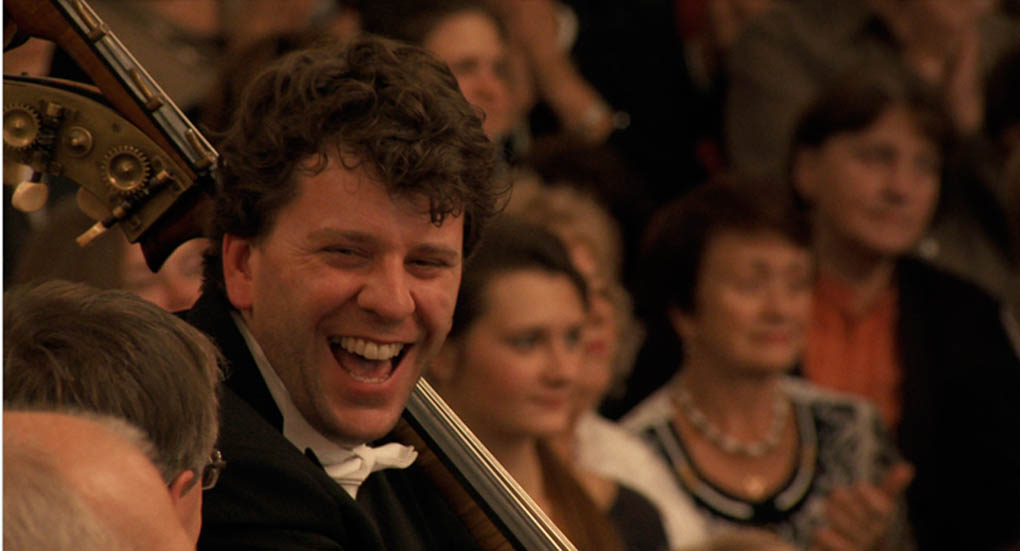
Members of the Royal Concertgebouw Orchestra share laughs in a scene from Around the World in 50 Concerts. The documentary by Heddy Honigmann is the January selection for RIDM+, an offshoot of Montreals RIDM film festival.
Ronnie Scheib of Variety writes: “Honigmann focuses on individual orchestra and audience members without fanfare, allowing them virtuoso riffs but never losing sight of the ensemble. . . Orchestra members, accustomed to her company, seem to spontaneously confide in her, telling her stories. Audience members, interviewed one-on-one in moving vehicles or in their homes, enter more fully into a dialogue with Honigmann, their exchanges very casual and conversational.” Reader Kazuhiro Soda added this enthusiastic comment to the Variety article: “I saw this film at MoMA. It was a masterpiece. It is definitely one of the best movies ever made about music but it’s much more. As always, Heddy showed us the best part of our humanity. She reminds us that there’s something beautiful in this world despite all the violence and miseries. One of the musicians in the film said that art is larger than politics. By watching the film, I truly believed it. Heddy’s approach to documentary is so classical but at the same time very modern and new.”
On his web site The Whole Note, Paul Ennis says: “The power of music to elevate, soothe and communicate is at the core of this moving documentary.” Ennis also gives a rundown of some of the music in the film: “Bruckner’s Seventh, Rachmaninov’s Paganini Variations, Tchaikovsky’s Fifth Symphony and Violin Concerto, Verdi’s Requiem, Mahler’s First, Second and Eighth among others.”
Check out the trailer for Around the World in 50 Concerts below. I noticed that here are lots of smiles in it.
A 15-minute short film, Le Son Du Silence, directed by Maxim Rheault, will be shown before Around the World in 50 Concerts. Laetitia Grou, the producer of Le Son Du Silence, will be there. Le Son Du Silence and Around the World in 50 Concerts, 8 p.m., Thursday, January 28, 2016, at Cinéma du parc, 3575 Ave du Parc.
Mina (Melody Wiggins) is the main character in the film Dangerous Men. After her boyfriend is murdered, she embarks on a killing spree to kill as many bad men as she can. (Drafthouse Films)
I’ve already written one blog post about the film Dangerous Men quoting some online articles and reviews. Now that I’ve seen a screener, I can give my own opinion.
While watching all by myself I burst out laughing on several occasions, but this is definitely a film to watch with a large group. I can imagine Dangerous Men going over really well in Fantasia’s longtime venue, the Hall Theatre of Concordia. I hope it works just as well at Cinéma du Parc.
So, what makes Dangerous Men funny, ridiculous or strange? Where to start? The script makes no sense, there’s bad dialogue, badly delivered, and several levels of bad acting on display. People talk to dead bodies; they also have long, rambling conversations with themselves. About eighty per cent of the male characters have moustaches, but the film was begun back in the day of detective show Magnum P.I. after all. (Google it if that doesn’t ring a bell.) There’s a living room bellydance performance when you’d least expect it. And just wait for the closeup view of a police badge, or the newscast set that looks like it was made from cardboard and duct tape.
The opening minutes of the film manage to be boring and puzzling at the same time. Scenes keep switching back and forth between two couples declaring their love for each other. Who are they and why should we care? It’s not clear if these “events,” such as they are, are happening at the same time, or if we are just switching between the two couples for the sake of variety.
In one night-time scene, a man in a black suit approaches a house. (Was it the filmmaker’s home? Woudn’t be surprised.) We just see this guy from the knees down, or from the back; the lighting is so strange that his shadow often looks like a second man. The way he’s filmed we assume he’s up to no good.
Later, when he is outside smoking (near his home, far from his home, who knows?) he interrupts the armed robbery of a liquour store. This is a way of letting us know that he’s a cop. I guess.
Before he interrupts that robbery, we see a woman, safe behind some shelves, and invisible to the two robbers, watch them pull a gun on the cashier and collect money. I thought she was a customer, but no, she was the store owner. As the robbers are about to leave, she confronts one of them with a yell, grabs his bag of loot and tries some laughably ineffective martial-arts moves on him. What kind of idiot would do that? Seriously? There will be lots more illogical behaviour before we’re through. The owner gets shot and falls down in a very unconvincing, theatrical way.
Turns out that the cop is named Dave. The other man is Daniel, his brother. Daniel and Mina tell Mina’s father that they want to get engaged. Mina’s father doesn’t look old enough to be her father – a big brother, maybe. Mostly, we see dad in profile or from the back, as if the actor didn’t really want to show his face.
The next day, Daniel and Mina hit the road. (Everything seems to be taking place in California, but Daniel and Mina have a car with New York state plates. I don’t know why.) They have a run-in with some thuggish bikers on a beach and Daniel ends up dead. Mina vows to get revenge on all the bad men in this world. (That would be most of them.) She embarks upon a killing spree. Many of the murders are presented in a visual shorthand – we see Mina’s shadow on a wrinkled sheet as she stabs the shadow of her anonymous victim. Saves money on actors and fake blood!
At one point Mina takes a train somewhere. . .I think. Well, we’re shown a train, which made me think she rode it. Then again, maybe it was just passing by and I filled in the blanks, incorrectly? Mina travels without luggage or even a handbag, yet she magically has several changes of clothes. She even has an off-the-shoulder sweatshirt like the one Jennifer Beale wore in Flashdance (1983). Not to mention, where does she stash her eyeshadsow, lipstick, mascara, teasing comb, etc?
After Daniel’s body is found, brother Dave tries to find the killer, even though his boss tells him he’s too close to the case to do that. Of course, Dave ignores his boss, doesn’t everybody? Dave seems mildly curious about the fact that Mina is missing, but not as worried as one might expect, since they had almost become in-laws and he had told his brother that he liked Mina very much. In that conversation, he mentions “wedding arrangements” and says arrangements in such a strange way, it sounds like English is not his first language. The director should have asked for another take!
Most of the things I describe above happened in the first few minutes, there are lots more ridiculous things to come. Fight scenes were clumsily absurd. During some of them I swear I heard someone saying “Whack, whack,” every time a fist connected with a body.
The music was funny for a few minutes and then became very annoying, verging on excruciating. The same riffs would be repeated for several minutes even when the mood of a scene had changed radically.
Neutral observation: The handguns in Dangerous Men are relatively small. If the film were made today, I imagine that they would be much larger and look scarier.
Watching Dangerous Men has made me appreciate the scripts, actors, sound tracks, continuity, etc. of mainstream movies much more, even the ones that are far from perfect.
Dangerous Men is (unintentionally) funny, but I did feel a bit sad about it, too. It was the passion project of John S. Rad (real name: Jahangir Salehi Yeganehrad) an Iranian who fled Iran for the U.S. in 1979, five days after the Shah left Iran himself. Supposedly, Rad made between three and 11 films in Iran, and he was also personal cameraman to the Shah. After Watching Dangerous men I have very serious doubts about that, but maybe no one watched his Iranian films, either. Or maybe they were shorts. Maybe he shot very short scenes for the Shah, too, and someone else edited them.
One review I read says that Dangerous Men looks like a film made by someone who had never seen one before, and I have to agree! Yet, Rad spent more than 20 years writing, shooting editing, etc. What did he learn in that time? I also wonder if he neglected his family and friends while devoting so much time to this project? He was a bit cavalier with the posssessions of others, too. A car that gets pushed down a steep hillside had belonged to his daughter; she only found out what happened to it when she watched the film.
I’m one of those people who feels obliged to read the credits. What’s in them? Mina (Melody Wiggins) and her boyfriend Daniel (Kelay Miller) are identified as Mina and Daniel. But Dave, Daniel’s brother, is just “Police Detective.” The actor is named Michael Gradilone but Michael is mispelled as Micheal. A character named Black Pepper in the film is simply “Head of Drug Dealers” in the credits. One “biker” was played by Gorge Derby. Is that a real name, or George mispelled?? I know Jorge is a name. Another actor is just “Terry,” and a camera operator is just “Felix.” I wouldn’t have wanted to give my full name, either.
.
. Dangerous Men, written, directed, edited, produced (etc.) by John S. Rad
In English, 80 minutes long.
Thursday, Jan. 21, 2016, at 9:15 p.m. at Cinéma du Parc, 3575 Ave du Parc














 Mostlymovies.ca