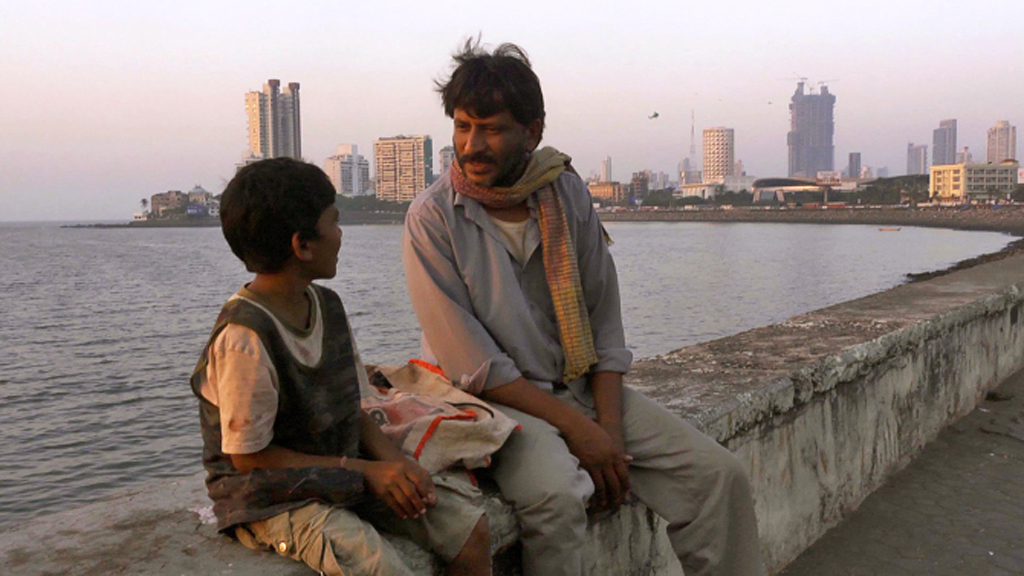
A scene from Richie Mehta’s Siddharth, one of the films that will be shown at the fifth edition of the South Asian Film Festival in Montreal.
The Kabir Centre will present the fifth edition of the South Asian Film Festival, beginning Friday, Sept, 11, 2015 with a screening of Siddharth, from Canadian director Richie Mehta.
Synopsis: “A working class father searches for his 12 year old son, who has failed to return after he had been sent to work in another town.”
In a review in Variety, Jay Weissberg wrote that the film was: “movingly handled. . .engrossing, multi-layered.” “Much of the film’s success lies in the excellent script and the superb performances. . .” Weissberg praised the work of Rajesh Tailang, as Siddharth’s father, Mahendra and Tannishtha Chatterjee as Siddharth’s mother, Suman.
“Mehta captures the noise and dust of the cities without the taint of Western poverty tourism, and he wraps things up on absolutely the right note.”
After the film, Richie Mehta will participate in a Q&A session via Skype. SIDDHARTH (2013) 82 min, in Hindi, with English subtitles.
Friday, September 11, 2015, 7 pm.
Cinema De Sève, Library Building (LB-125),
of Concordia University. 1400 de Maisonneuve Blvd. W.
Montreal (Metro Guy-Concordia).
Naoto Matsumura has a chat with one of the ostriches under his care in a scene from the Japanese documentary film Naoto Hirtoriki (Alone in Fukushima), which is being shown at the Festival des films du monde in Montreal. Naoto Matsumura looks after many of the animals that were abandoned after the 2011 meltdown of the nuclear power plant in Fukushima, Japan.
Naoto Hirtoriki (Alone in Fukushima) is a documentary portrait of Naoto Matsumura, a man who voluntarily looks after the (mostly) four-legged victims of the disaster at the Fukushima No. 1 nuclear power plant in March of 2011. These include dogs, cats, cows, and a pony. There are some wild boars prowling around, too, though they look like scroungers, not officially under his care. And then there are the two otherwordly ostriches, with their quizzical expression and powerful legs that can break ribs.
The nuclear plant went into meltdown after an earthquake and the resulting tsunami. Humans were quickly evacuated because the radiation leak made the area too dangerous for them to remain. Many people had no idea that they would be gone so long. They tied their dogs up and planned to come back for them within a day or so. But they were not allowed to come back, and shelters did not accept dogs and cats, in any case.
Some cattle were destroyed on orders of the government, others starved to death, but some were entrusted to Naoto Matsumura, and he continues to look after them to this day. In the beginning, he bought food for them with money from his small pension, now he also gets donations from supporters. He says he wishes the government would look after the animals, that would be the moral thing to do, and it would also increase knowledge about the effects of radiation. The animals are mammals, just like us, whatever happens to them might happen to humans, too.
On a technical level, Naoto Hirtoriki (Alone in Fukushima) is not perfect. Especially in the opening footage, some bright areas are bleached out, and throughout the film, the microphone picks up many distracting sounds – truck engines, and fierce winds among them. But heart is more important than technique – watch the film to see Naoto feeding and interacting with the animals and describing his feelings of obligation toward them. He tells us how the nuclear plant changed his town of Tomioka – at first it brought prosperity, and conspicuous consumption – a car for every family member! Then came the disaster. It could take 30 years to decontaminate the town; maybe it will never be safe again. He wonders if the decontamination work is really just for show. Naoto Hirtoriki (Alone in Fukushima)
Director : Mayu Nakamura
Cinematographer : Mayu Nakamura
Editor : Mayu Nakamura
Music : Saho Terao
Film production and Sales : Prod.: Mayu Nakamura, Omphalos Pictures,Tokyo 180-0002 (Japon), tél.: +80 (80) 3408 85 30 missyn510@aol.com.
Naoto Hirtoriki (Alone in Fukushima)
Saturday, Sept. 5, 2015 – 4 p.m. – Cinéma Quartier Latin 2, 350 Emery St., in Montreal. (Metro Berri-UQAM)
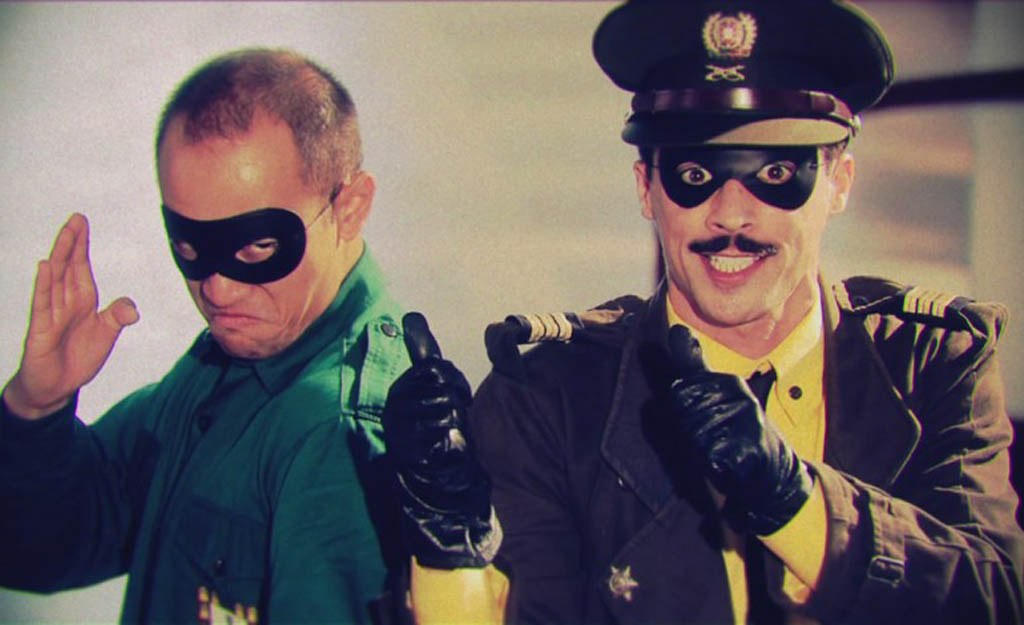
David Chan Cordeiro, left, plays Partridge Kick, and Gonalo Waddington plays the Falcon in a satirical film from Portugal, Capito Falco (The Portuguese Falcon). The film is being shown at Montreal’s Festival des films du monde.
UPDATE: I saw The Portuguese Falcon on Wednesday night, and I thought it was pretty funny! The audience seemed to enjoy it, too. I hope to write a proper review after, but just wanted to add this note, right now. On Thursday, Sept. 3, it will be shown at noon. If you work in the daytime, maybe your boss(es) would allow you to take a long lunch to watch it? It’s a thought!
Capitão Falcão (The Portuguese Falcon in English) is a satire on superheroes. Instead of defending truth and justice and the American Way, as such characters usually do, the Falcon and his sidekick defend the fascist regime of dictator António de Oliveira Salazar from commies and feminists in the 1960s.
The film was directed by João Leitão, and written by him and Nuria Leon Bernardo. Gonçalo Waddington plays the Falcon and David Chan Cordeiro plays Partridge Kick, who is more or less Robin to his Batman.
Here’s the synopsis from the web site of Festival des films du monde: “A parody of Portugal’s first superhero: Captain Falcon. A fearless defender of the fascist regime of the 1960s, Falcon, along with his Asian sidekick, Partridge Kick, defends his nation against various threats: evildoers, thieves, and above all, the Red Peril: communists! But one day, Lisbon, the capital, starts experiencing mysterious attacks, and no one is sure who’s behind it all. Will Captain Falcon save the country once again?”
I haven’t seen The Portuguese Falcon yet, but it sounds like good cheesy, goofy fun, the kind of thing more likely to be seen at Montreal’s Fantasia Film Festival. But we all like to laugh, don’t we?
The Portuguese Falcon, in Portuguese with English subtitles, is 106 minutes long.
This mysterious woman is one of the two main charcaters in the South Korean film It’s Really Kind of You.
It’s Really Kind of You is a Korean drama-thriller-mystery, which I saw at the Festival des films du monde / Montreal World Film Festival.
It’s hard for me to review it because I didn’t like it. On the other hand, I don’t like to be negative, I do enjoy Korean films in general, and I’m well aware that different people have different tastes. So, here goes!
First of all, I was confused because the film did not begin as I expected it to; a murder described in the film’s synopsis only took place once the film was well underway. Presumably, that was a flashback, though it COULD have been a dream, or a figment of one character’s imagination.
The plot is ingenious, but most of the characters range from unpleasant to despicable.
In the opening moments, the main character (played by Ok Ja-yeon, I think) is hitchhiking, in the dark, beside a country road. When a driver does stop for him, he seems so creepy and his manner is so odd, it’s hard to believe that anyone would want to give him a ride. He just stares for what seems like a very long time, then makes his request in a flat, robotic tone. He says that he was fishing and that he missed the last train; could the driver take him downtown? Well, I certainly wouldn’t! The actor conveys creepiness extremely well, but the story would be more believable if he could pretend to be charming, or at the very least relatively normal, now and then.
Nonetheless, Creepy Hitchhiking Man gets a ride from a guy who turns out to be a dog-breeder. They chat awkwardly for a while, then they fight and there’s an accident. A dishevelled woman who’s wearing just a slip shows up; she has a bruised face and haunted eyes; she does not speak. She seems traumatized and more than a little strange herself. She might, or might not, be mentally handicapped.
This woman will later be involved in some graphic sex scenes that are disturbing, go on for a long time, often take place at inappropriate times in inappropriate places, and are definitely not “artistic” in any way.
It’s difficult to say more without going into spoiler territory. The film could have ended much earlier than it did and still have been quite creepily effective. I’m sorry not to be more specific about the actors – the credits went by very quickly and I incorrectly assumed that I could find out later who played which role. The Montreal screening is a world premiere, so there isn’t much info about the film out there.
When the film was over, an audience member asked me: “Did that make any sense to you?” I told him that it did (more or less) make sense to me, but I did not like it.
BTW: An Internet search tells me that hitchhiking is not too common in South Korea. This film won’t do anything to make it more popular, that’s for sure!
It’s Really Kind of You, from South Korea, in Korean with English subtitles, 90 minutes
Director : So Jae-ick
Screenwriter : Pak Me-hyun
Cinematographer : Cho Choul-ho
Editor : Chol Hyun-sook
Cast : Ok Ja-yeon, Bae Tae-won, Choi Dae-hoon, Do Young-cha, Kim Young- hwan, Baeg Ae-gyeong, Kang In-chul
Music : Lee Jae-sin
Film production and Sales : Prod.: So Jae-ick, So-Film, #310-402, Shindo braenew 11, Yonghyun-dong, Uijeongby-si, Kyungki-do (Corée du Sud). tél.: +82 (10) 6221 07 53, jaeick10,hanmail.net.
It’s Really Kind of You will be shown on Wednesday, Sept, 2, 2015, at 6:30, in Theatre 12 of the Cinéma Quartier Latin, 350 Emery St., in Montreal. (Metro Berri-UQAM)
In the Chinese film Wolf Totem, Chen Zhen (played by William Feng Shaofeng) adopts a wolf pup, against the wishes of his Mongolian mentor.
Wolf Totem is a Chinese film with a Chinese cast, based on a Chinese book, shot by French director Jean-Jacques Annaud.
The 2004 novel Wolf Totem was an international best-seller. It was translated into more than 30 langauges, sold millions of copies, and won the Man Asia Literary Prize in 2007. It was based on the experiences of author Lu Jiamin (writing under the pen name of Jiang Rong) who lived among the semi-nomadic herders of Inner Mongolia for 11 years, beginning in the late 1960s. He was one of the millions of students who were sent to the countryside during the Cultural Revolution.
The landscapes in the Chinese film Wolf Totem are stunning.
The author’s alter ego, Chen Zhen, learns a lot about the herders’ traditional way of life, and the fear, respect and admiration they have for the wolves who share the grasslands with them. Some of the book’s dialogue sounds more like one-sided lectures than true conversations; even so, it’s a fascinating read. Politicians living far, far away make cringe-inducing decisions of the “this-will-not-end-well” kind – to set up large farms, to encourage the immigration of Han Chinese, and to slaughter all the wolves.
Chen Zhen (played by William Feng Shaofeng) develops a fascination with the wolves, and adopts a young pup, going against the wishes and advice of his Mongolian mentor, Bilig.
While an official announcement hasn’t yet been made, several news articles say that Wolf Totem will be China’s entry in the race for an Academy Award.
Wolf Totem has two Canadian connections. One is actor Shawn Dou, who plays Chen Zhen’s friend and colleague Yang Ke. He moved from China to Vancouver with his parents when he was 10 years old, and returned to China in 2008 to study acting.
During the filming of Wolf Totem, a wolf named Cloudy became very fond of director Jean-Jacques Annaud.
Animal trainer Andrew Simpson was an integral part of the film. He was born in Scotland, but has run his business, Instinct Animals for Film, from a ranch north of Calgary, Alberta, since 1994. While he and his partner, Sally Jo Sousa, work with many kinds of animals, they specialize in wolves. But North American and Eurasian wolves are quite different, so they could not use the wolves they already had. They spent more than three years in China, training Mongolian wolves for their roles in the film. They got five-week-old wolf pups from a zoo and raised them in their Beijing apartment, giving them their constant attention. You can read more about that process, and see photos of Simpson cuddling the wolf puppies, in this 2012 article from The Telegraph, which calls Simpson a “wolf whisperer.” A Calgary Herald article from last year indicates that after the film was completed, he brought 16 of the wolves to the Calgary ranch. In 2013 Simpson made Wolves Unleashed, a documentary about working with wolves; you can buy it from iTunes for $19.99
Director Jean-Jacques Annaud, left, and animal trainer Andrew Simpson with some of the trained wolves from the Chinese film Wolf Totem.
Wolf Totem, in Mandarin and Mongolian with English subtitles, will be shown as part of the Festival des films du monde / Montreal World Film Festival on:
Wolf Totem
Director : Jean-Jacques Annaud
Screenwriter : Alain Godard, Jean-Jacques Annaud, Lu Wei, John Collee. D’après le roman de/Based on the novel by: Jiang Rong
Cinematographer : Jean-Marie Dreujou
Editor : Reynald Bertrand
Cast : Feng Shaofeng, Shawn Dou, Ankhnyam Ragchaa, Yin Zhusheng, Basen Zhabu
Music : James Horner
Film production and Sales : Prod.: Max Wang, Xu Jianhai, China Film Co., Ltd. / Beijing Forbidden City Film Co., Ltd.
Festival des films du monde / Montreal World Film Festival continues until Sept. 7, 2015. Consult the festival’s web site for more information.
Bai Baihe, left, and Daniel Wu promote their film Go Away, Mr. Tumor. (Xinhua photo)
Go Away Mr. Tumor is a film full of laughs about a woman who is very ill. This might sound questionable, but the people in the cinema where I saw it (Cineplex Odeom Forum) seemed to like it a lot. It worked for me, too! On top of that, Go Away Mr. Tumor, is drawing huge audiences in China. (Variety says it earned “$29.7 million in four days.”
The main character in Go Away Mr. Tumor is Xiong Dun, aka Bearton – “Xiong like bear, Dun like Newton,” she says – a graphic artist who is 29 but fast approaching 30, and comparing herself to others who did great things at that age, or at least started to do them. (The long list includes computer guys Steve Jobs and Bill Gates, and writer Haruki Murakami.)
In the first few scenes, she is so very perky and quirky that I felt annoyed, and feared that I’d made a mistake by going to see the film. False alarm, though; things picked up quite quickly.
While entertaining her friends, in her very nice apartment, Xiong Dun (Bai Baihe, who also uses the name Fay Bai) collapses and ends up in a hospital. The first sight she sees upon waking are the eyes and long eyelashes of Dr. Liang (U.S. actor Daniel Wu.) All right then! Things are not so bad after all. They seem better still after he takes off his surgical mask.
Xiong spends more time dreaming and daydreaming about Dr. Liang, and figuring out how to get more of his attention, than she does thinking about her health problem, which turns out to be quite grave when her test results come back. She obviously thinks that being a patient is a pretty good thing; it allowed her to meet him, after all. There’s a delicate balance here; her craving for attention is almost puppyish, but she’s not pathetic in any way. And she’s quite cute, with her big eyes and gamine haircut. If not for those pesky doctor-patient taboos, who knows what might happen?
Daniel Wu plays Dr. Liang as a guy who’s very serious and very professional, but also very caring. He lives in a bit of a bubble though – he’s astonished to learn that his subordinates are afraid of him. He’s also very busy and mindful of all the proprieties. He gently explains to Xiong that it’s his job to look after her and her job to have faith in him. There doesn’t seem to be any possibilty of more than that. And yet. . .
The two characters do have a lovely rapport. Dr. Liang enjoys listening to Xiong’s stories about her childhood, and her rationale for her sunny outlook on life, even in the face of adversity. (Now and then, I did think that her optimism was a bit farfetched, but hey, some people really are like that. Also, yeah, that “trust me, have faith” thing is more than a little retro and patriarchal, but. . . )
Dream and fantasy sequences add much appeal to Go Away Mr. Tumor. Many are laugh-out loud hilarious, though with hindsight others don’t seem quite as funny as they had been.
In Xiong’s dreams, zombies are a metaphor for her illness. At first, she fights them alone, like a superhero in a video game, or a Marvel movie, wearing a cape, flying around via wirework and firing two guns at once like Chow Yun Fat in an old John Woo movie. Later, when a zombie has her in a chokehold, Dr. Liang appears, dressed all in black, armed with a crossbow, to save her with one well-timed, well-placed arrow. Pow! Peng! Cheers from the audience! (Spoiler, sorry!)
You want this guy on your side, right? Dr. Liang, (Daniel Wu) is prepared to go all out to protect the life of his patient.
Another scene mocks the international popularity of romantic Korean TV dramas. Xiong, wearing adorable furry earmuffs, stands in a park amidst falling snowflakes. As she starts to fall over backwards, in a slow motion swoon, Dr. Liang appears, clad in a quietly elegant camel-hair coat. He catches her gracefully with one arm while stopping the snowfall with a masterful, magical snap of his fingers. “Oppa!” Xiong exclaims. (It means “big brother,” but it’s also what Korean girls call their boyfriends, and what fans write on messageboards devoted to their crush. Don’t ask me how I know.) As a further nod to Korea’s powerful influence, Xiong gives Dr. Liang some Korean hand lotion, to repair the damage done by his frequent hand washing. (He keeps it in an office drawer with his British tea.) Korea has its share of medical dramas, the “trust me, have faith” likely appears there, too.
Dr. Liang (Daniel Wu) and his patient Xiong Dun (Bai Baihe) in the Chinese film, Go Away Mr Tumor. Xiong has watched lots of Korean TV dramas and she has a crush on Dr. Liang, so she imagines many scenes like this one.
Xiong’s friends are a loyal, supportive and entertaining bunch, with some quirks of their own. They visit her often in the hospital, and gleefully help her with an elaborate, spur-of-the-moment prank against her obnoxious ex-boyfriend.
The film is based on the real-life experiences of cartoonist Xiang Yao. (Xiong Dun/Bearton was her pen name, which she chose because bears were her favourite animal.) She had already written several comic books before she became ill; an article on the web site China.org.cn says that her other books were about “teenage love, weight-loss, living the single life and her lifelong idol Michael Jackson.”
Bears were Xiong Dun’s favourite animal. Could you tell?
Once she became sick she wrote an online comic to raise money for her treatment and share her ordeal with her fans. (While she is often seen sketching in the film, the book is not actually mentioned.) In addition to Go Away Mr Tumor, various articles have rendered the English translation of the book’s title as Go To the Devil, Mr. Tumor, Be Gone, Mr. Tumor, Get out, Mr. Tumor, even F*** Off, Mr. Tumor! The article goes on to say that “More than one million books of the cartoons were sold, and the series inspired millions of people with its optimism and courage.” It includes this quote from Xiang: “I hope my drawings can entertain people and bring positive energy to me and to others. I am happy and delighted that they can enjoy it.”
BTW: The actors chosen to play her loving parents look quite a bit like their real-life counterparts.
Go Away Mr. Tumor (Gun dan ba! Zhong liu jun)
125 min., in Mandarin with English subtitles.
Director: Han Yan
Cast: Bai Baihe, Daniel Wu, Zhang Zixuan, Li Yuan, Liu Ruilin, Cheng Yi, Liu Lili, Li Jianyi, Temur Mamisashvili, Joel Adrian
In Montreal, Go Away Mr. Tumor is being shown at Cineplex Odeon Forum Cinemas. It’s also being shown in Vancouver, Edmonton, Toronto, in several U.S. cities, and in New Zealand and Australia.
Bunta Sugawara as a gangster in the 1973 Japanese film Battles Without Honor and Humanity, which is being shown at the 2015 Fantasia Film Festival.
Battles Without Honor and Humanity! What an appropriate title! Many yakuza films would have us believe that there are rules to be obeyed, a code of conduct to be followed, that there is, in fact, honour among thieves. This film just laughs at such silly notions . . . beats them to a pulp, and throws them right out the window.
And the various rituals and ceremonies? When it’s time for someone to give up a finger, no one is quite sure how it’s supposed to be done. A woman says “I saw it in Osaka, once.”
Battles Without Honor and Humanity was made in 1973, though the story it tells begins just after World War II, in Hiroshima. Japan is under U.S. occupation, and U.S. soldiers are running wild and acting like animals. The local crooks almost look civilized in comparison, which is quite the feat.
The film mixes conventional scenes with parts that are like a vintage version of 60 Minutes, with a narrator describing feuds and alliances, and onscreen text telling us how and when certain people were killed.
Gangs struggle for supremacy within the city, and gangsters struggle for power within their gangs. A boss cries poor so he can get away with underpaying his underlings. There’s lots of yelling and arguing; fights are not elegantly choreographed. Not one of these guys seems like a criminal mastermind.
Frankly, I couldn’t keep track of all the lying, plotting and double crossing that was going on. I could have used a family tree and a score card. Maybe that’s because the film is based on the memoirs of a gangster and real life can be more complicated than fiction? Battles Without Honor and Humanity was also part of the lineup at the recent New York Asian Film Festival.
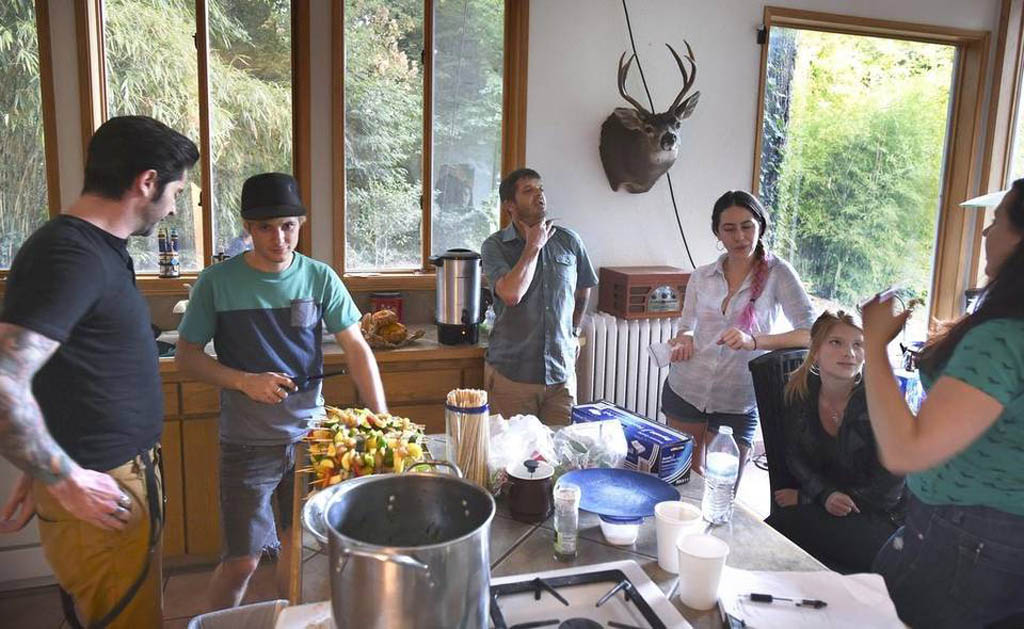
Nice kitchen! Photo by Tony Overman of the Olympian newspaper shows “Crew members (from left) Travis Johnny Ware, Brandon Roberts, Jason Stange, Lisa van Dam-Bates, Katie Hemming and Rose Hall discuss the night’s schedule for filming of the movie “Marla Mae” in Olympia on Tuesday, July 21, 2015.”
There are many articles on the Internet today about Jason Stange. He’s a convicted bank robber who broke his probation when he walked away from a halfway-house in July 2014; Stange was arrested on Friday, July 24, 2015, after he appeared in seven photos (!) accompanying a July 23 (online) article in Washington-state newspaper The Olympian, about low-budget horror film, Marla Mae, being shot in Centralia, Olympia and Tacoma. The article ran in the July 24 print edition of The Olympian.
Stange is an actor in the film, and while his name only appeared in the photo cutlines, not in the article itself, people who study that kind of thing will tell you that the first thing a newspaper reader looks at is the headline, and photos come right after.
I can’t help but wonder, WHAT was Stange thinking? Presumably, he did see the Olympian’s photographer, Tony Overman, taking the photos, and of course, Overman would have asked for the names of all the people in the photos.
Newspapers in many parts of the world have seen a decline in readership and advertising revenue, leading to layoffs and the widely held belief that “nobody reads newspapers anymore.” Did Stange believe that, too?
Screen grab from online edition of The News Tribune, of Tacoma, Washington. The article explains how a story in another local paper, The Olympian, led to the arrest of convicted bank robber Jason Stange, who had been a fugitive ever since breaking his parole conditions one year ago.
As for his role in the film itself, “15 minutes of fame” is a very well-worn concept by now. Maybe he thought that “filming while a fugitive” would be an extra cool and rebellious thing to do, a way to thumb his nose at the establishment, and an interesting footnote when they film is released. Oh, and his “professional name” is Jason Strange – an especially good name for horror roles, dont you think?
On the other hand, an article about Stange’s arrest, in the News Tribune of Tacoma, links to an arrest warrant which says that “(Stange) was ordered to pay a $4000 fine or face jail time. Mr. Stange reported he had no money to pay a fine and left.” So, maybe Stange was trying to earn the money to pay his fine. On the other, other hand, the film’s entire budget is only $8,000, so maybe not.
I learned of this story via The Guardian. A person using the name Eisenhorn made a comment there, saying: “Heh. The cynic in me says it might well have been one of the film’s producers who shopped him to the police, the resulting publicity being no bad thing :-)”
The people behind Marla Mae say they hope to release it next summer. Who knows, maybe it will turn up at Montreal’s own Fantasia International Film Festival, which is showing many kinds of genre films, including horror ones, right now. The Fantasia festival continues until Aug. 5, 2015.
Interest in horror film Marla Mae is up 43 per cent this week. Presumably, the arrest of cast member Jason Stange (he uses the name Strange on imdb.com) has something to do with that.
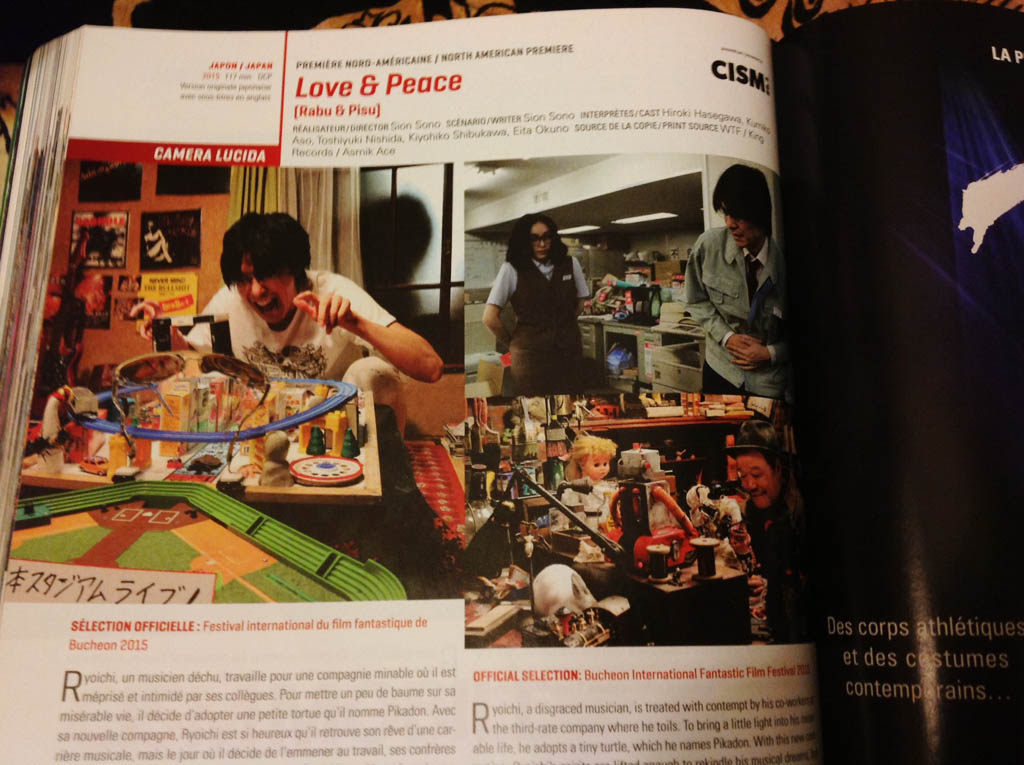
Page 248 of the Fantasia International Film Festival’s catalogue is devoted to the Sion Sono film Love & Peace.
Live blog post: I’m just recently home from watching Sion Sono’s film Love & Peace at the 2015 Fantasia International Film Festival. (North American premiere, BTW!) I want to write a few words about it while it is still fresh in my memory. (I will admit, I got a bit distracted by hunger – had to make a snack. . . then I had to make a photo to go with this post. . . also had a quick peek at Facebook, sorry!)
The thing I wanted to say about Love & Peace, besides the fact that it’s very enjoyable, is that the enthusiasm of the Fantasia audience added a lot to the experience. Like. . . salt, ketchup, vinegar, mayonnaise, or whatever thing you like to add to your French fries (frites). Or butter, jam, peanut butter on your toast. . . .that extra ingredient that makes things better.
I appreciate the huge screen and a great sound system in the Hall Theatre of Concordia University, but it’s the cheers, laughter and enthusiastic applause of the people around me that make it feel like an EVENT. For sure I would have laughed a lot if I had watched it at home on my computer, but it was so much better at Fantasia!
People applauded as soon as the name of writer and director Sion Sono appeared onscreen. They also cheered and applauded at certain key points during the film.
Love & Peace is about hopes, dreams, music and the love that pets have for their people, no matter what. Whether they deserve it or not.
Rena Nonen, left, and Masaki Suda are the main stars of Japanese film Princess Jellyfish. The film is based on the multiple-volume manga Kuragehime. Princess Jellyfish is being shown at the 2015 Fantasia Inernational Film Festival in Montreal.
NOTE: Princess Jellyfish will be shown at 4 p.m., Saturday, July 25, 2015, as part of the Fantasia International Film Festival in Montreal.
OMG!!! The plot of Princess Jellyfish is as unbelievable as your average fairy tale (or Japanese or Korean TV drama) but who cares? It’s so much fun! I was happy to make the old “leap of faith” and just go along for the ride. I can imagine the laughs and cheers in the Hall Cinema right now! Go see it if you can!
Princess Jellyfish is based on Kuragehime, a 15-volume manga that first appeared in November 2008. (An 11-episode anime was shown on Japanese TV in 2010.)
OK, that plot, as briefly as possible. Several nerdy women of assorted ages and interests live in Amamizukan, an old Tokyo apartment building. They call themelves The Sisterhood, though they could also be called otakus and NEETS (Not in Education, Employment or Training.)
Tsukimi (Rena Nonen, centre) with her fellow nerds in the Japanese film Princess Jellyfish. The film is based on the multiple-volume manga Kuragehime.
Our main character, Tsukimi (Rena Nonen) who wants to be an illustrator, is obsessed with jellyfish. The walls of her room are covered in sketches of them. Ms. Banba studies trains and their schedules. Chieko is interested in traditional Japanese culture and always wears kimono; Mayaya is into the epic Chinese historical novel Romance of the Three Kingdoms (and toys assocated with it). Lady Jiji likes “elderly dandies.” Mme. Juon Mejiro is the most important person in the building; she is a manga artist who is never seen. She’s like some kind of oracle – the residents slip questions under her door, and she answers the same way. She has banned men from the building. The others have no problem with that, because men make them so uncomfortable anyway. So do fashionistas. They turn to stone (petrify!) when in the presence of either.
Kuranosuke (Masaki Suda), the cross-dressing son of a politician, meets this gang after helping Tsukimi out of a jellyfish-related jam. She tells them that his name is Kurako; his clothes, makeup and wig are convincing enough that they accept him as a woman. Somewhat surprisingly, they don’t say anything about his deep voice until well into the film. Kuranosuke explains to Tsukimi that he wears women’s clothing because he cares about fashion and has no interest in going into politics. Under his wig he has fashionably blond hair; at school the girls flock around him, eager for his attention.
The nerds of Princess Jellyfish live here, in Amamizukan. Nice, isn’t it? They have to band together to keep the building from being demolished.
Developers want to tear down Amamizukan, and other nearby buildings, to improve the area, and make it all shiny and modern. (Some might wonder, “if it ain’t broke, why fix it?”)
Kuranosuke’s father assumes that supporting development will improve his political fortunes.
The Sisterhood is not happy about this at all, but they seem resigned to it; they have always felt powerless. Kuranosuke encourages them to make an effort to fight back, and not to just accept the decisions that others have made.
There are many themes in Princess Jellyfish. Among them: evil politicians and developers, which is connected to the old “you can’t fight City Hall” trope; feeling like an outcast, finding a place to fit in, the long-lasting scars of being bullied, longing for absent mothers. Some really old U.S. movies with Judy Garland and Mickey Rooney had a “we’ll put the show on right here in the barn!” trope and Princess Jellyfish has a modern approximation of that.
Note for K-drama fans: Chieko is in charge of the building while her mother is in Korea. As Chieko puts it, “she went there to chase Lee.” That would be actor Lee Byung-hun. In the manga Chieko’s mother is chasing Bae Yong-joon (Yon-sama) who became a huge star in Japan and elsewhere, because of his role in the popular Korean TV drama Winter Sonata. The Korea Times has more information about the Yon-sama phenomenon.
BTW: Masaki Suda plays Karuma Akabane in Assassination Classroom, another film, based on manga and anime, that was shown at Fantasia this year.














 Mostlymovies.ca