Clones? Doppelgangers?The cast of Rêveurs Définitifs seems increase, thanks to some visual trickery.
So what is this “Magie Nouvelle” (new magic) anyway? Based on my experience at the show Rêveurs Définitifs, now on at Montreal’s Théâtre St. Denis, it can include ethereal songs and dances, in whichdancerIngrid Estarque floats above the stage; a flying, ghostly orb; and multiple versions of the performers interacting with each other, thanks to holography, and other mysterious trickery.
Besides all that, there’s still room for more traditional elements, like doves appearing out of clean air, jokes, card tricks, and audience participation.
The songs are performed by local musical hero Patrick Watson, by the way, and pianist Isabelle Mathieu provides live music for many of the acts.
The show was created by Raphaël Navarro for the Théâtre du Pond-Point in Paris. Other performers include Éric Antoine, Étienne Saglio, Yann Frisch.
Don’t freak out if this “creature” flies over your head!
The show is entirely in French and I must confess that I did not catch every last joke during the card-trick section. Perhaps that’s because the performers were talking very quickly, or maybe I’m just a dumb anglo, who knows? The show is mostly a visual spectacle, so an attendee’s language skills (or lack thereof) don’t matter much at all. Even if you don’t speak French, don’t worry, you’ll be fine!
Those who do understand French can read more reviews of Rêveurs Définitifs on the web sites of La Presse, Montreal TV and Le Devoir.
The cast of Rêveurs Définitifs.
Rêveurs Définitifs is part of the Just for Laughs Festival Juste pour rire. There are performances every night at 8 p.m., at Théâtre St. Denis, 1594 St. Denis, until July 15, 2017. There will be a 4 p.m. show on July 15 as well, and three 4 p.m shows on July 20, 21 and 22. You can buy tickets online, or at the theatre.
Théâtre St. Denis is quite close to the Berri-UQAM metro station.
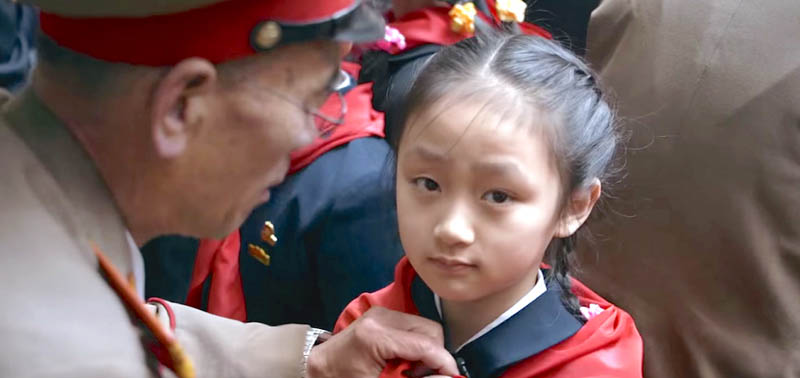
Zin-mi, right, and her friend smile in Under The Sun. It’s a cute photo, but sadly, it’s one of the few times anyone looks happy in the film. Even here, the girls are probably just pretending.
The subversive documentary film Under The Sun takes us to North Korea, where we observe 8-year-old Zin-mi as she eats with her parents in their apartment, attends school, joins the North Korean Children’s Union, and rehearses her part in a pageant that will celebrate “The Day of the Sun,” the birthday of Kim Il Sung, the grandfather of the current ruler, Kim Jong-un. The Day of the Sun (April 15) is the most important holiday of the entire year in North Korea.
We also visit the alleged workplaces of Zin-mi’s parents. (In an early meeting, Zin-mi had told filmmaker Vitaly Mansky that her father was a journalist and her mother worked in a cafeteria, but in the film they are seen as an engineer in a garment factory and a worker at a soy milk plant, respectively. Made me think of “I’m not a doctor, but I play one on TV.” Mom and her co-workers wear white uniforms with red aprons and cute, red rubber boots. This echoes the white shirts and red scarves of the members of the Children’s Union.)
Mansky wanted to make a film about day to day life North Korea, with co-operation from the government. He knew there would be restraints, but he got many more than he had expected. The script was written by the North Korean government. Government minders were always close by, telling people where to walk, what to say, to speak more loudly, to show more animation. “Look at her when she’s talking!” They would make people repeat dialogue over and over to achieve the appropriate level of breathless enthusiasm. Mansky had no freedom in choosing events or locations. He was not allowed to make small talk with any North Koreans in between shooting scenes. He had to show his footage to the government at the end of each day.
You might expect the resulting film to be as exciting as the “Bulgarian tractor epics” of the past. The thing that makes Under The Sun different is that Mansky kept his cameras running all day. He did not wait for the government chaperones to yell “action,” and did not stop filming when they said “cut.” Despite all the supervision, he did not hand over ALL of his footage for scrutiny. I’ve read different explanations for exactly how that worked, but one way or the other, he had secret copies that the authorities probably did not know about until the documentary was released. On the other hand, he made filming two trips to North Korea in 2014, but never received his visa for a planned third trip. So maybe they did have an inkling, after all.
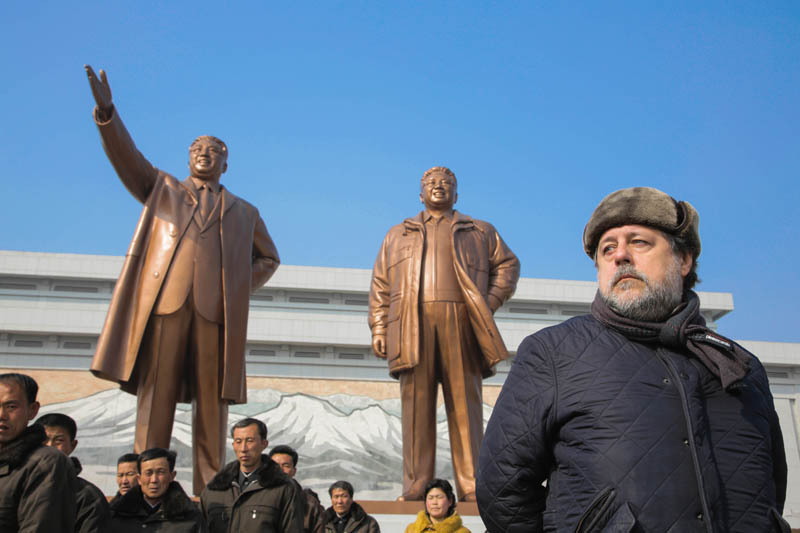
Documentary filmmaker Vitaly Manksy in in Pyongyang, North Korea, in 2014. Mansky is standing in front of one of the many monuments to North Korea’s founder, Kim Il-Sung, and his son, Kim Jong-Il.
A scene of garment workers celebrating their heroic production is exceedingly awkward and unnatural. In the first take, they have surpassed their government quota by 150 per cent. By the next take, the figure has grown to 200 per cent. Seriously, how dumb do they think we are?
Even seemingly ordinary, boring scenes of people crossing a square or boarding a bus were scripted and directed. When films are sold on DVD they often include a behind-the-scenes “Making Of” documentary. Under the Sun has made those scenes an integral part of the film, instead of setting them apart.
In their alleged apartment, Zin-mi and her parents sit in front of a table that’s crowded with luscious-looking food. Remember that North Korea is a country that has lost millions of citizens to famine. After Zin-mi and her father praise the health benefits of their national dish, kimchi, (several times) the table is carried out of the room, with most of the food untouched. What happened to it? Who ate it? Perhaps Zin-mi is perfectly healthy, but she is very slight and often looks tired. Too bad they didn’t let her eat some more.
In one of the most heartbreaking scenes of the film, Zin-mi is asked how she sees her future. She has nothing to say, and starts to cry.
Eight-year-old North Korean girl Zin-mi, the main character in Vitaly Mansky’s documentary Under The Sun, often looks tired and overwhelmed.
Needless to say, Under the Sun has not been shown officially in North Korea, though someone recorded a screening somewhere, and showed it to North Korean authorities. Those authorities contacted the Russian government, which had provided some of the film’s funding, and asked that the film be destroyed and Mansky be punished. Mansky was criticized, but he was not punished; his film was not seized. In fact, it won the FIPRESCI Prize at the Message to Man International Film Festival in St. Petersburg, Russia. And while eight theatres in Moscow refused to show it, 20 others did. In 2016, New York’s Museum of Modern Art cancelled its screening of the film, though it apologized later.
Vitaly Mansky was born in Ukraine, when it was part of the USSR. He spent most of his adult life in Russia, though he lives in Latvia now.
Random thoughts, observations and questions:
Though the Sun of the title refers to Kim Il Sung (Il Sung means “to realize the sun”) we don’t see much sunshine in the film at all. Some wintry scenes look foggy, but is it really fog, or air pollution?
Many scenes were shot in February. Mansky has said that it was very cold, even indoors. He lets us know by showing students warming their hands over a radiator in their classroom.
Every room we see, whether public or private, has portraits of North Korea’s founder, Kim Il-Sung, and his son, Kim Jong-Il. There are many huge murals and monuments to them in Pyongyang. How much did those photos and monuments cost? How much food could have been bought with that money?
In interviews, Mansky has speculated that many families do not live together. He thinks that many students live at their schools and he knows that many workers live at their factories. I’d like to know more about that.
Even though North Korea is cut off from the rest of the world, clunky, ugly platform shoes managed to get in.
North Korea is often demonized because it has nuclear weapons and an unpredictable leader. There has been some talk about bombing the place, “taking out Kim Jong-un,” etc. Films like Under The Sun add some nuance to the us-and-them narrative, and showing us the people who could be killed by those bombs.
Hope for the future? The huge monuments, the exercise instructions given over loud speakers, and the huge squares filled with robotic, marching people reminded me of scenes from China in the 1960s. Life in China might be far from perfect now, but it seems better than it was. Maybe things will improve for North Koreans, too? (Without the poisoned air and water of China?)
Choosing a girl to be the main character in this story might be the final irony. An article on the web site of Human Rights Watch says that “every day North Korean women face severe gender discrimination at work and home, and sexual harassment and violence that the authorities do nothing to stop.”
That name though….It’s a minor point, but the name Zin-mi was puzzling. In decades of watching Korean films I don’t remember anyone named Zin-mi. Articles about hangul, the Korean writing system, and hangul charts don’t show any symbols that correspond to “Z.” There are some online articles from South Korea that call her Jin-mi.
Under The Sun, directed by Vitaly Mansky
Russia, Latvia, Germany, Czech Republic, North Korea | 2016 | 106 minutes
In the original Korean, with English subtitles
Under The Sun was shown by RIDM+, January-to-May series of films presented by RIDM, the Montreal International Documentary Festival. RIDM will run from November 9 to 19, 2017.
French sociologist Irène Théry appears in the form of a stuffed bear in the documentary film La sociologue et l’ourson (The Sociologist and the Bear Cub).
It’s not every day that we can learn about the evolution of the family and changing social mores from a witty, articulate, stuffed bear. So why not take advantage of the opportunity and watch La sociologue et l’ourson?
In the fall of 2012, the video and filmmaking duo Étienne Chaillou et Mathias Théry set out to make a film about the debate over a proposed law that would allow same-sex marriage in France. The law, which had been one the campaign promises of recently elected President François Hollande, would also allow same-sex couples to adopt children. As part of their research for the film, Mathias Théry recorded many phone chats with his mother, Irène Théry, the sociologist of the title. She’s an academic who studies the family and human rights. She was also one of many experts who had advised the French government on the proposed law.
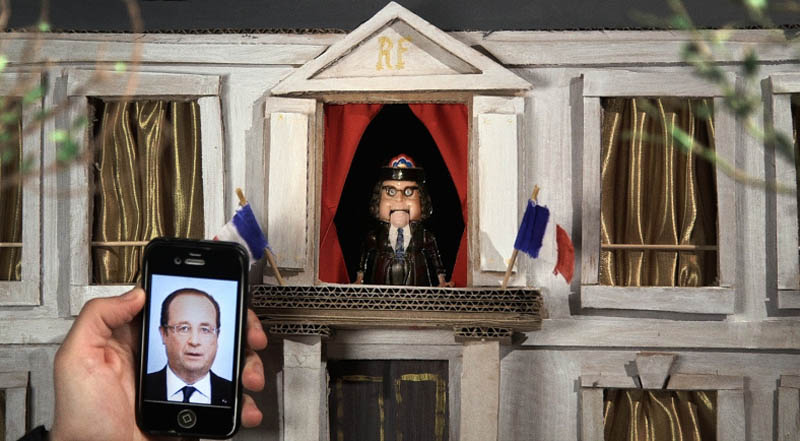
President François Hollande in the French documentary film La sociologue et l’ourson (The Sociologist and the Bear Cub).
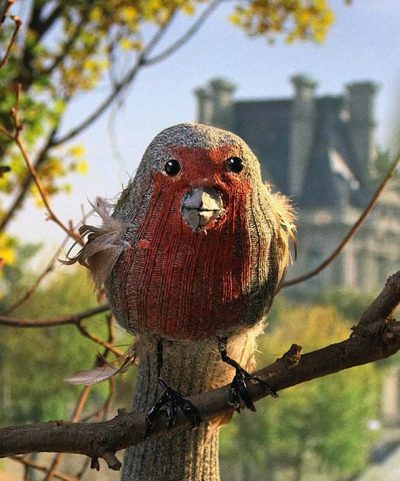
Chaillou et Théry wanted to use those chats in the film, but they had no video footage to go with it. What to do? I don’t imagine they wanted to use “Ken Burns technique” of panning over photos. They decided to use stuffed animals to represent Irène Théry and other participants. Irène Théry becomes a Mama Bear with swinging hair, (and Mathias Théry is her“ourson” – the bear cub, of the title.) President François Hollande looks like some kind of Lego figurine, while newscasters are depicted as birds of various kinds – some halfway realistic ones, along with others that are clearly made from grey socks. This introduces some humour into a situation that became more heated than the filmmakers had expected. Though Chaillou et Théry are on record as saying there is no particular meaning to the animals they chose viewers might wonder about that when they see that some lawyers are depicted as pigs.
In the French animated documentary La sociologue et l’ourson, reporters and newscasters appear as birds.
While there is some footage of the real life Irène Théry on public transit, appearing on TV, at demonstrations, etc., we mostly see her animal avatar in her office, her kitchen, riding taxis, etc., as she explains how much families have changed over the centuries, and how cruel French society once was toward unmarried mothers and their children. There are also some funny bits of a more personal nature, connected with her marriage, her husband, his fish stick errand, etc. I wonder if Chaillou et Théry are fans of the Muppets, because the puppet version of Irène sometimes tosses her hair in a way that makes me think of Miss Piggy.(Irène Théry is better looking, of course.)
Many people were against the proposed legislation, including religious leaders. Close to 2,000 mayors said they were unwilling to marry gay couples. Between October 2012 and May 2013 thousands of people attended demonstrations for and against same-ex marriage and adoption. Many of the “anti” demonstrations were led by a right-wing satirist and activist known as “Frigide Barjot.” (Her real name is Virginie Tellenne; Barjot means daffy, crazy, nuts, bonkers.) When Irène Théry attends thosedemonstrations, her gregarious nature and her network of connections become obvious. Many people come to greet her and more than once she is introduced to “my future husband.”
NOT A SPOILER! Anyone with an Internet connection and an interest in the news will likely know that the legislation did pass. There were 7,000 same sex marriages in 2013, 10,000 in 2014, 7,751 in 2015 and 7,000 in 2016. However, Marine Le Pen, leader of the right-wing Front national, has said that she would rescindthe law if she is elected president this year.
Mathias Théry and Étienne Chaillou, directors of La sociologue et l’ourson, will present their film in Montreal on Friday, April 7, 2017. Irène Théry will be there, too.
La sociologue et l’ourson begins its run at Cinéma Beaubien on Friday, April 7, 2017. Étienne Chaillou, Mathias Théry and Irène Théry will be there to introduce the 7 p.m. screening of the film and answer questions afterward. Will they bring some of their puppets with them? I hope so! When the film was shown by RIDM + at Cinéma du Parc last week, Chaillou and Théry talked to the audience via a glitchy Skype connection. It was the middle of the night for them, as they sat in their respective kitchens. They said they were looking forward to a “real discussion” when they arrived in Montreal.
Cinéma Beaubien is at 2396 Beaubien St E. Visit the Cinéma Beaubien web site for more information about the film and the screening.
Common Room of Hotel Dieu Hospital in 1911. (Wm. Notman photo)
The documentary film Le dernier souffle, au coeur de l’Hôtel-Dieu de Montréal (The Last Breath, at the Heart of the Hôtel-Dieu) is a powerful love letter to Hôtel-Dieu. You might just want to run over to the hospital to give the staff a collective hug. And if you watch it at Cinéma du Parc, you won’t have to run far, either!
Don’t wait too long, though. Director Annabel Loyola was prompted to begin the film after reading a distressing newspaper headline “Hôtel-Dieu to be sold” in March 2013. She wanted to “recreate. . .the distinctive universe of the Hôtel-Dieu,” and she has done so magnificently.
She introduces us to the hospital’s patients, doctors, nurses, volunteers, painters, carpenters, electricians, gardeners and cleaners. And the musical therapist, with her beautiful white harp! The staff members all seem like lovely, friendly people who enjoy their work and appreciate their co-workers. One woman has been a volunteer there for more 40 years. Two heart surgeons worked together so often, that they were listed on the operating room schedule as one person, with a hyphenated name. And then there are the “two Sylvains” in building services, who also worked together for decades. Patients share their joys, pain and fears.
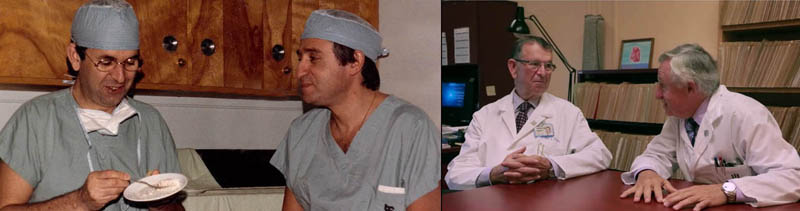
Then and now: Cardiac surgeons Ignacio Prieto and Fadi Basile have worked together at Hotel Dieu for 30 years. They would be listed on the operating room schedule under one hyphenated name – Dr. Basile-Prieto.
We even meet some non-human “employees” – the bees who pollinate the hospital’s apple orchard and garden. (I used to walk by the hospital almost every day and had no idea that there were beehives in there.)
Loyola returns to those bees many times. Maybe she just likes them and the surrounding garden, but I assume that she is telling us, in a subtle way, that the hospital and the beehive are both complex social organisms where individuals work hard for the good of the whole. Sometimes beehives and hospitals fall victim to things beyond their control, like pesticides, parasites, etc., in the case of the bees, and government decisions in the case of hospitals.
Loyola spent two years shooting the film, so we see the hospital in all seasons, from the lush greenery of summer to the depths of winter, when the beehives are buried under mounds of snow. She takes us to hospital areas, utilitarian or beautiful, calm and peaceful, that we might not otherwise notice or have access to. Images are carefully framed and the editing is impressive, too. Archival maps, engravings, paintings and photos complete the picture. (Like Jeanne Mance herself, Loyola was born in Langres, France. In 2010 she made La folle entreprise, sur les pas de Jeanne Mance / A Mad Venture, in the Footsteps of Jeanne Mance. Canal Savoir will show it five times in May. The station’s web site has more details.)
Fort Ville Marie, as it was in 1645.
As an organization, Hotel Dieu Hospital is as old as Montreal itself. On May 17, 1642, Paul Chomedey de Maisonneuve, and Jeanne Mance, accompanied by about 50 settlers from France, founded Fort Ville-Marie, where the St. Laurent and St. Pierre rivers meet. At first Jeanne Mance treated the sick from her own home; a separate building was built in 1645. It would be replaced many times in the years to come. In 1659 Jeanne Mance recruited three sisters from the Hospitalières de Saint-Joseph. These sisters ran the hospital after she died and members of their order continued to do so until the early 1960s. The hospital left St Paul St. in Old Montreal for its present location, on St. Urbain, in 1861. That area was then regarded as “the countryside” and blessed with fresher air to benefit the patients.
(BTW: Jeanne Mance lived until the age of 66 – that seems like a long life, considering the difficult conditions in the colony.)
Hôtel-Dieu was the city’s only hospital until the Montreal General Hospital opened, in 1821.
Religieuses de l Hotel-Dieu de Montreal, James Duncan, 1853.
The history of the hospital reflects that of Quebec in so many ways. The hospital was run by nuns until the early 1960s when the Quebec government took over. (Nursing sisters continued to work there, though.) In the 1960s, when female participation in the workforce was not as widespread as it is now, the stay-at-home wives of male doctors were encouraged to become hospital volunteers.
Le dernier souffle is interesting enough purely as a moving portrait of the hospital, as it was and as it is now, but it has extra poignancy because of the uncertain future of the buildings and grounds.
Since 1996, Hôtel-Dieu has been part of the Centre hospitalier de l’Université de Montréal (CHUM). By the end of 2017, the hospital’s staff and functions are supposed to move into the “superhospital” on St. Denis. Years ago, when this move was announced, there were fears (and anger) that the hospital grounds might be sold for luxury condos. Neighbours and fans of the hospital held rallies and created petitions advocating for community clinics and social housing instead. To this day, no concrete plans have been announced.
As a final indignity, the Hôtel-Dieu has been left out of all the brouhaha surrounding Montreal’s 375th anniversary.
In Brief: Le dernier souffle, au coeur de l’Hôtel-Dieu de Montréal (The Last Breath, at the Heart of the Hôtel-Dieu) is warm, loving, respectful, a marvel of editing and filmmaking.
Who is it for?: Anyone interested in other human beings, documentary film fans, history buffs, Montrealers, Québécois, Canadians.
I see what you did there: Right after a scene where a priest lights an incense censer, we see a beekeeper with his smoker, a device used to calm the bees so they won’t sting.
Filmmaker Annabel Loyola in the garden of Hotel Dieu Hospital. (Photo: Julie D’Amour)
Le dernier souffle, au coeur de l’Hôtel-Dieu de Montréal (The Last Breath, at the Heart of the Hôtel-Dieu)
72 minutes long; researched, written and directed by Annabel Loyola;
Camera: Tomi Grgicevic, Annabel Loyola; Editing: Emma Bertin; Original Music: Fabienne Lucet
Montreal screenings will take place Friday, April 7 to Thursday, April 13.
Cinémathèque québécoise
Everyday 6:15pm | Sunday April 9, 4:00pm
Screening and Q&A hosted by film crew, April 7 at 6:15pm
Screenings and Q&As hosted by filmmaker Annabel Loyola, April 7, 8, 9, 11 at 6:15pm
Debate with Christine Gosselin, conseillère d’arrondissement Jeanne-Mance district, Dinu Bumbaru, Héritage Montréal and Amir Khadir, Québec Solidaire, Sunday April 9, 4:00pm.
Cinéma du Parc (original French version with English subtitles)
Everyday 2:45pm, 7:10pm | Saturday April 8, 10:00am, 7:10pm | Sunday April 9, 10:50am, 2:45pm, 7:10pm
Screening and Q&A hosted by film crew, April 7, 7:10pm
Screenings and Q&As hosted by filmmaker Annabel Loyola, April 7, 8, 9, 11, 7:10pm
Debate with Dominique Daigneault, Coalition Sauvons l’Hôtel-Dieu, and Ron Rayside, architect, Hôtel-Dieu social and community project, April 11, 7:10pm
Visit the film’s web site for information about screenings in Coteau du Lac, Quebec City, Sherbrooke and Rimouski.
Rolf Lassgard plays the title character in A Man Called Ove.
The Swedish film A Man Called Ove is one of the five entries competing for an Academy Award as Best Foreign Language Film. It’s also nominated for a Best Makeup and Hairstyling Oscar.
Ove is only 59, but he looks much older. That’s what crankiness will do to you! Ove is a stickler for rules; his main purpose in life seems to be upholding them. Even the possibility that a rule might soon be broken raises his ire.
Every morning, Ove Lindahl (Rolf Lassgård) does the “rounds” in his suburban neighbourhood, even though he is no longer the head of the residents’ association. Cars parked (or driven) where they shouldn’t be, errant bicycles, cigarette butts, tiny dogs piddling where they should not, these are just a few of the things that get his goat. Ove even takes his suicide rope back, to a Home-Depot type place, to complain that it was not “suitable for all uses.” The man has chutzpah!
Why suicide? Grief, boredom, or feeling useless and rejected? I choose “all of the above.” Ove’s wife Sonja died within the past year and he misses her very much. Every day he visits her grave to promise her that he will join her soon. He recently lost his longtime job with the railroad, too. (The dialogue in that scene should make human resources people everywhere cringe.) Arguing with the neighbours and store clerks is just not enough to keep a man going. But when decent, friendly Patrick (Tobias Almborg), his wife Parvaneh (Bahar Pars), and their two little girls move in next door, they do provide many new distractions.
Bahar Pars plays Parvaneh, the friendly, lively neighbour of Ove (Rolf Lassgard).
A Man Called Ove is a crowd-pleasing tear jerker, with some jokes and pokes at smug, smirking bureaucrats. Some of those bureaucrats are just clueless, while others are truly evil.
Ove himself is not evil, he’s a sad, somewhat clumsy man, who has constructed a hard shell over his gooey centre. He’s a politically-correct crank – he does not hate gays, immigrants, or women, so he doesn’t have too far to go to redeem himself, as we know he eventually will. This is not one of those stories where a neo-Nazi sees the light and becomes a human-right lawyer. Too bad he’s so mean to retail clerks, though. As for his run-in with a clown. . . who really likes clowns, anyway?
The young adult Ove (Filip Berg) while socially inept in the extreme, wins the heart of school-teacher-to-be Sonja (Ida Engvoll). He is astounded by how many books she has when they move in together, but gamely sets to building more yet shelves when he realizes he did not make enough the first time. At first, we only see Sonja in relation to Ove, later we learn more about her life-changing goodness toward others. It might have been nice to see more of her, but the story IS A Man Called Ove, not a Woman Called Sonja.
When that same young adult Ove meets his neighbour Rune, it’s like finding another sort of love, as they run after the local rule-breakers with the joy of small children, or frolicking puppies.
Most people might guess the general direction the film will take and some might feel manipulated. While A Man Called Ove has its clichéd elements, I enjoyed it anyway, I’m not sorry I watched it; I don’t feel like I wasted my time. Be warned though: Reviews I read before seeing the film led me to expect a comedy about a cranky man. I was surprised by the many tragedies and injustices that were revealed in the flashbacks. While Ove’s life was not quite as bleak as that of the Biblical Job, he did suffer a lot, much more than I had expected, based on summaries and reviews I’d read before seeing the film.
Random info and musings: The film is based on Fredrik Backman’spopular novel; it’s been translated into many languages.
Makeup artist transforms actor Rolf Lassgard into the balding, cranky Ove. (Gala magazine photo)
Rolf Lassgård has played the detective Wallander on TV. In real life, he doesn’t look much like the worn-out Ove at all. Hence the nomination for a Best Makeup and Hairstyling Oscar.
Ida Engvoll, who plays Sonja, is slightly toothy. If she were a Hollywood star, would someone have suggested that she “fix” those teeth?I wouldn’t be surprised.
Ove was so lucky to meet his wife, who accepted him as he was. Would an awkward woman be so lucky? I wonder. Don’t think I have see a film like that yet.
Ove’s estranged friend Rune reminded me of one of the guys from TV show Trailer Park Boys.
The blue in Ove’s workplace made me think of the blue of Montreal’s metro system.
The film opens in the plant department of a store that looks like the Home Depot on Beaubien St.
Feline trivia: According to web site imdb.com, the large fluffy cat in the film is portrayed by two Ragdolls, both from Poland. In an interview after a screening in Seattle, director Hannes Holm said one cat was sleepy while the other was quite aggressive. More than once, crew members brought the wrong cat onto the set, with painful consequences. Holm also said that a Hollywood film would probably opt for CGI cats, but Swedish filmmakers don’t have that kind of money. When told that the film Inside Llewyn Davis used six cats, he said he couldn’t have afforded so many. The entire production budget for A Man Called Ove was a mere $350,000! Quite amazing!
In Montreal, A Man Called Ove is playing at Cineplex Odeon Forum, Cinéma du Parc, and Cinéma Beaubien. One hour, 56 minutes long, In Swedish with English subtitles at Forum and Cinéma du Parc, French subtitles at Cinéma Beaubien.
A Man Called Ove, written and directed by Hannes Holm, with Rolf Lassgård, Filip Berg, Ida Engvoll, Bahar Pars, Tobias Almborg, Poyan Kamiri, Borje Lundberg, Stefan Gödicke
Rojen Beritan in the documentary Gulistan Land of Roses. Much of the film was shot in the mountains of Iraq.
In the documentary Gulistan Land of Roses, Montreal filmmaker Zaynê Akyol puts puts names and faces on a struggle taking place far away from us – the fight against Islamic State, also known as IS, ISIS or Daesh. Specifically, she introduces us to some of the Kurdish women who are taking part in that fight.
We see them, among the trees of their mountain training camp, doing calesthenics, cleaning their weapons, attending open air political-education classes, sharing meals together in the grass. They look very serious, yet also elegant in their drapey shalwar. Some express their camaraderie in hair-braiding sessions.
They discuss the different attributes of U.S., Russian, and Iraqi bombs. They tell us about their weapons – where they’re from and the names they have given them. It doesn’t seem strange that such an important item be given a name.
We learn that equality for women is one of the tenets espoused in the writings and communiqués of their leader, Apo. Certainly, while they might miss their parents and siblings, none of these women are dreaming of wedded bliss or motherhood. In fact, one says that she has never met a happy housewife. “Every married woman leads a life of slavery.” “From what I’ve seen, married women are never happy.”
Rojen Beritan, centre, is one of many Kurdish women who are fighting against the Islamic State.
The foul-mouthed, sadistic drill sergeant is a staple of U.S. soldiers-in-training films, but the female drill sergeant in this film, who trains men, too, is a different kind of soldier. She doesn’t call anyone a maggot or make then do extra pushups. She does tell those who are impatient to start fighting right away that it would be unwise, and wasteful, to go into battle before one is fully prepared.
While the training area looks relatively bucolic, it is still a dangerous place. When that terrain was held by Saddam Hussein’s men they filled it with land mines, and many still remain. Furthermore, we learn that “if Iran attacks, this is their first target.” Same thing with Turkey. And then there’s Daesh, too. “We can be attacked from all sides.” On the other hand, even though we don’t see them, we’re told that every mountain and valley is guarded by “comrades” with heavy weapons.
Later, we also see the women on patrol and observation duty in a desert area near the town of Makhmur, 95 km southeast of Mosul. While plumes of smoke rise from the town, they watch the comings and goings of Daesh, through binoculars. Is Daesh watching them, too? Probably. Despite the relative quiet, there is a sense of constant danger. Akyol and her cameraperson are told they really ought to leave, but the film continues.
The philosophical Sozdar Cudi shares her thoughts in Gulistan Land of Roses.
A soldier named Sozdar Cudi gets much of the screen time Gulistan: Land of Roses, she is very thoughtful, philosophical even. If not for this war, what kind of life might she be leading? Would she be a politician, working for women’s rights? Maybe a poet?
The footage was shot in August 2014, but it remains 100% relevant because ISIS has not gone away.
After watching Gulistan: Land of Roses, I wanted to know more about these women and their fight.
My first question was: Are they still alive? I fear that some are not, but the PR people for the film could not say.
I wanted to know more about the Kurds, Kurdish woman, the Peshmerga, the towns of Makhmur and Sinjar. It seems that even as long ago as the early 1990s, 30 per-cent of the 17,000 armed Kurdish militants were women. Not surprisingly, Makhmur and Sinjar, like many others, have changed hands several times since 2014. You can read about the Kurdish women fighting ISIS in these articles from VICE, Reuters and the Independent.
And what of their often-quoted leader, Apo? He is Abdullah Öcalan, a Kurd from Turkey, and the co-founder of the PKK (Partiya Karkerên Kurdistanê, known as the Kurdistan Workers Party in English). He has been in prison since 1999. Many countries and organizations classify the PKK as a terrorist group, though the UN does not. Wikipedia has an entry on Öcalan. He has said “A country can’t be free unless the women are free.” Some of his writings about women in society can be read at the International Initiative website.
On a less serious note, I also bought some nettle tea. In the film, we see the women rinsing their hair with water containing nettle leaves. The Internet says that people of many cultures believe that it it is good for promoting hair growth, whether you drink it or apply it. Who knows? It can’t hurt, right?
Gulistan: Land of Roses was enjoyed by audiences at the HotDocs Festival in Toronto 2016, and at festivals in the U.S, France, Argentina and Switzerland. It won the Best Feature Film Award (International Competition) at the Milan Film Festival, the 2016 Doc Alliance Selection Award, which was presented at 2016 Locarno Film Festival, the Meilleur Espoir Québec / Canada Award 2016 at Montreal’s documentary film festival, RIDM.
Gulistan: Land of Roses (with English subtitles) is playing at Cinema du Parc until Feb 9.
Under the title Gulîstan, terre de roses it is playing at the Cinémathèque Québécoise, with French subtitles, until Feb. 16, 2017. The dialogue in the film is in Kurmanji and Turkish.
The film is a co-production of Mitosfilm, Peripheria Productions, and Canada’s National Film Board (NFB/ONF). If you can’t see it in a cinema, perhaps it will show up on TV or on the NFB web site some day. But I suggest you try to see it before then!
Ray Kroc, the main character in The Founder, did not found anything, despite his claims to the contrary made on his business card and elsewhere. He took a small, already existing chain founded by the McDonald brothers and took it national, then international, becoming filthy rich in the process.
Ray Kroc took advantage of Richard and Maurice McDonald and essentially ripped them off for billions of dollars.
While The Founder is not a thriller, I see it as a sort of slow-motion heist movie, albeit without any guns. It’s very well-made and Michael Keaton gives a compelling perfomance as Ray Kroc, but I was totally appalled at Kroc’s behaviour. Wouldn’t, couldn’t call him a hero. Not a nice man at all. And that old tradition of sealing a deal with a handshake, “my word is my bond,” etc., etc? Forget it. Not an honourable man, either. He also stole another man’s wife, though I guess she went willingly. He was often petty too, but I’ll leave those for viewers to discover for themselves.
At the beginning of the film, Kroc is selling mixers that make several milkshakes at a time. Selling one is hard enough, so when a place in California orders several, his curiosity leads him on a trip to San Bernadino (via the legendary Route 66) to see what kind of business is selling so many milkshakes. The McDonald brothers, called Dick (Nick Offerman) and Mac (John Carroll Lynch) in the film, are doing a roaring business at their hamburger-shakes-and fries stand.
Right after Kroc orders a burger, it is placed in front of him in a paper bag. Amazing! Where to eat it? Anywhere. In your car, on a bench, in the park. Plates, cutlery? None of that. . .Eat it with your hands, just as many people around him are doing, with ecstatic expressions on their faces.
John Carroll Lynch, left, as Mac McDonald, and Nick Offerman as Dick McDonald, in the film The Founder. (Photo: The Weinstein Company)
We’re meant to understand that this was a revolutionary thing at the time. The brothers are quite happy to show Kroc how their employees can work so quickly and efficiently, and reveal how much time they spent refining their methods and fine-tuning the layout of the kitchen. (All their employees were men, if I recall correctly.)
Kroc is very impressed and has visions of McDonald’s restaurants all over the U.S. He shouts “Franchise, franchise, franchise!” to the brothers. They say they’ve already tried that, but bad behaviour by franchisees makes them reluctant to continue expanding.
However, I did read on the Internet that expansion had just paused temporarily, because the person handling franchising for them had fallen ill. They just needed a new employee to continue the work. Kroc becomes that employee.
Dick, Mac and Kroc get along relatively well in person, but things start falling apart when they have to communicate via phone calls and letters. The brothers find Kroc too demanding and too impatient; Kroc is exasperated by their caution and slow decision making. The relationship becomes more and more strained. The brothers realize too late that they “let the fox into the henhouse.” Something has to give.
Michael Keaton as Ray Kroc, left, and Laura Dern as his first wife, Ethel. (Photo: The Weinstein Company)
Laura Dern has the thankless role of Kroc’s first wife, Ethel. She doesn’t get much screen time (just as Ethel probably didn’t get much alimony, either). Mostly she looks sad or worried, and why not? Her husband spends most of his time on the road and his previous schemes did not pan out. Kroc’s remarks to her indicate that he sees her as an unsupportive nag, but there’s no evidence of that at all.
The Founder does not even mention Wife No. 2 (Jane Dobbins Green,1963–1968), and the romancing of wife No. 3 (Joan Mansfield, from 1969 until 1984, when Kroc died) mostly takes place offscreen. Their future together is telegraphed by Kroc’s smitten look when he first sees her, seated at the piano in her husband’s fancy restaurant. To make things clearer still, they sing a duet together, while seated at that piano. They sound quite good, too. The song is “Pennies From Heaven.” Prophetic in another way. (Google tells me that lounge pianist was one of Kroc’s many former jobs.)
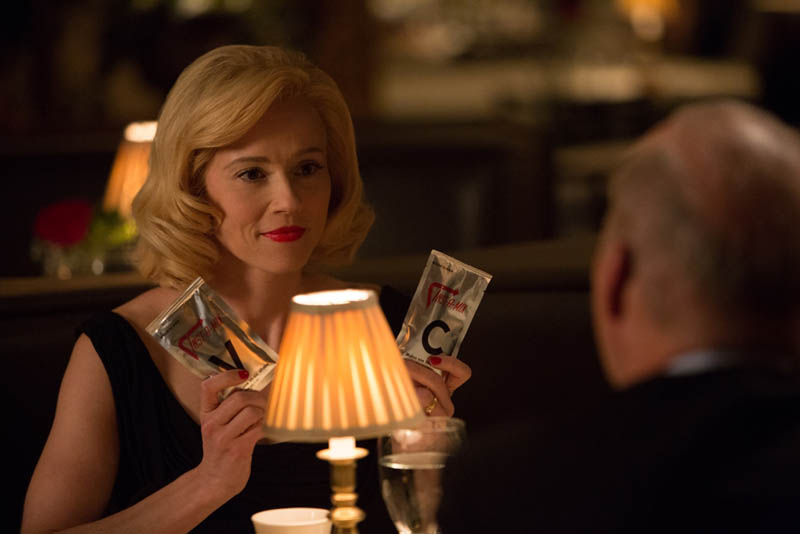
Linda Cardellini plays Joan, the woman who becomes Ray Kroc’s third wife. Here, she’s offering him a choice between vanilla or chocolate powdered milkshakes, with their stabilizers, emulsifiers. etc. “Delicious!” she says, claiming that they taste just the same as milkshakes made from ice cream and fresh milk.
On more than one occasion, Kroc talks about McDonald’s as a special place for U.S. families to gather; he expresses a wish that every town have one, and compares McDonalds to worthy institutions like churches and courthouses. (“McDonald’s can be the new American church!”) I wasn’t sure if that was just hype for the McDonald brothers and his potential investors, if it reflected his true beliefs, or if the scriptwriter Robert D. Siegel was pulling our collective legs.
We alll bring our own view and prejudices to the cinema, so a closing scene, showing Kroc practicing a speech honouring Ronald Reagan, was just another nail in the coffin. Apparently, he also made illegal donations to Richard Nixon, presumably to influence legislation on wage and price controls. On a less serious note, when asked to choose between a chocolate or vanilla ersatz milkshake, he takes the vanilla! So boring.
Ray Kroc died a very rich man. Some viewers might admire him and think he was so clever to outfox the McDonald brothers. I wonder if he had a clear conscience? His third wife gave a lot of that money away, so perhaps she didn’t have one. Could have been a tax dodge, too, of course.
I have no idea why, but Norman Greenbaum’s 1969 hit Spirit in the Sky plays during the closing credits of The Founder. It sounded great coming through the cinema’s sound system, and I enjoyed hearing it, but how is it connected to Ray Kroc’s story? If there is such a place as heaven, I would not expect to find Kroc in it.
The Founder: directed by John Lee Hancock; written by Robert D. Siegel; with Michael Keaton; Laura Dern; Nick Offerman; John Carroll Lynch; Linda Cardellini; Patrick Wilson; B. J. Novak.
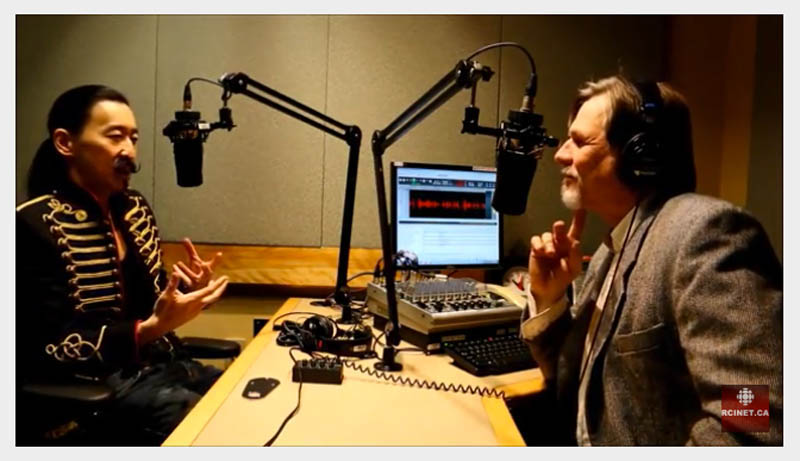
Playwright and performer Tetsuro Shigematsu, left, talks to Marc Montgonery of Radio Canada International. You can watch the video below this review.
Montrealers, do yourself a big favour and catch Tetsuro Shigematsu’s Empire of The Son at the Centaur Theatre. Saturday, Jan 14, 2017 is the last day you can see this tour-de-force. It’s storytelling at its best. The Vancouver Sun and the Georgia Straight said it was that city’s best show in 2015. I’m going to watch it again, myself.
This one-man show reminds me, in a very good way, of the work of the late monologue artist Spalding Gray, though Shigematsu is more animated, and doesn’t sit at a desk.
Shigematsu begins by telling us that he did not cry when his father died in 2015. Since crying seems to be the natural and expected thing for the modern, evolved man to do in our society, he wonders why he did not and could not? What’s wrong with him, anyway? Is it a guy thing? Is it a Japanese thing? (The Shigematsu family is descended from samurai, he says.)
He also feels regret for all the things that he did not say when he had the chance. His father had been sick for several years, but on the night when Shigematsu said “Why don’t you get some sleep, Dad,” he had no way of knowing that father would not regain consciousness again before he died.
Empire of The Son explores Shigematsu’s relationship with his father, and his father’s life before and after his own birth. (Shigematsu and his twin sister Hana are the youngest of five children.)
The Shigematsu family in London, before the birth of Tetsuro and his twin sister, Hana.
Ironies abound. Shigematsu’s father, Akira, was an announcer for the BBC in London, then for the CBC in Montreal. He explained current events to his listeners all over the world, but was extremely taciturn at home. Shigematsu’s father survived the horrors of the bombing of Hiroshima, had tea with Queen Elizabeth, and saw Marilyn Monroe sing Happy Birthday to John F Kennedy, but when Tetsuro asked him about any of those events he got short answers that indicated his father didn’t think any of it was that big a deal.
I was sad to learn that (Don’t-Call-Me-Akira) Shigematsu lost his position behind the microphone and spent his last days at the CBC delivering the mail, because of cutbacks initiated by the government of Brian Mulroney. But feelings of anger and outrage were even stronger than my sadness. Bah, Mulroney, Harper, good riddance to them! (Shigematsu did not make any kind of editorial comment about Mulroney, he didn’t say we should be angry, I came to that conclusion all by myself.)
Akira Shigematsu worked for the BBC in London before he moved to Montreal with his family.
Tetsuro, the son of a radio man, became a radio man himself, to his own surprise and amazement. How did that even happen? Fate? Osmosis? He doesn’t pose that question, but we can, if we like. (Tetsuro did want to use his father’s cool-looking, leather CBC satchel, but he hadn’t thought of doing his dad’s job.) Shigematsu shares some anecdotes about various CBC efforts to make his voice sound more “manly.”
Like much great art, Empire of The Son is both universal and particular. You might well cringe when Shigematsu relates some of the snarky, flippant things he said to his father in his teenage years. Did you say similar things yourself? Did someone say such things to you?
Chances are, viewers will be able to relate to many incidents, they will recognize themslves and their own family dynamics.
Years ago, I saw Rising Son, in which a younger Shigematsu talked about his father, his family, himself, experiences at school, stupid stereotypes about Asians, and a trip he took to Japan. It was a good show with lots of laughs, but Empire of The Son is on a whole other level of artistry. Is it corny and clichéd if it compare one to grape juice and one to wine? Yeah, probably. But it will have to do for now.
While death, dying and crying might sound sad and depressing Empire of The Son contains many light moments. While the show is mostly about Shigematsu and his father, he has some heartwarming, truly poetic things to say about his three sisters. You should hear them for yourself, I won’t spoil them.
Empire of The Son has some clever props that help to tell the story, something that Rising Son did not have. There’s a fascinating combination of high tech and low tech happening there. Shigematsu manipulates a digital camera to project images of a little bathtub, a tiny boat made from a paper and a toothpick, a miniature skateboard, or the destruction of Hiroshima itself, onto a screen behind him.
You might want to see Empire of The Son with parents, siblings or friends, depending on who might be available to you. If all your friends and family members are busy, do not hesitate, go by yourself. Don’t miss Empire of The Son. You will thank me later!
Budding writers and actors would appreciate it, too, I think.
Finally, I must point out that at a mere $16 tickets to Empire of The Son are a real steal. Theatre can be expensive, and tickets for this show cost $50 elsewhere. (In Vancouver, the entire run sold out before the show even opened.)
Empire of The Son of the Son will be at the Centaur Theatre Thursday, Jan. 12, Friday, Jan. 13, and Saturday Jan. 14, at 7:30.
The Centaur Theatre is in Old Montreal at 453 St. François-Xavier. Place d’Armes is the nearest metro station. At another time of year, I could say “run, don’t walk,” but that might be unwise, with the weather and the state of the sidewalks being unpredictable.
Empire of the Sun is a touring production of the Vancouver Asian Theatre. It will be at the Factory Theatre, in Toronto from Wednesday, Jan. 18, until Sunday, Jan 29, 2017.
Victor Ezenfis, Natacha Regnier, Fabrizio Rongione in Son of Joseph (Le Fils de Joseph).
Son of Joseph (Le Fils de Joseph) opens with scenes of Paris, people walking around, etc. Then we see two boys trying to torture a caged rat. I did wonder what kind of film I’d walked into. But those guys are just the idiotic classmates of Vincent, one of the main characters, and we don’t see much of them again. Just as well.
Teenage Vincent (Victor Ezenfis) lives in Paris with his single mother (Natacha Regnier), who’s an almost saintly nurse. In his bedroom he has a poster of Caravaggio’s 1603 painting, The Sacrifice of Isaac. Kinda gruesome!
Vincent’s mother has always refused to tell him who his father is, and on this particular day he is so enraged about it one wonders how his mother put up with him for so manyyears.
After rummaging through a rolltop desk, Vincent finds a letter that reveals his father’s identity. You’d think, if he was so determined to know, that he would have found that letter years ago, but never mind, I won’t argue about it.
Vincent bluffs his way into a book-launch party, meets some ditzy and pretentious characters on the literary scene, and gets a glimpse of his father, Oscar Pormenor (Mathieu Amalric) a man so monstrous he can’t even remember how many children he had with his wife. “Details bore me,” he says.
With his red tie, red scarf, wealth, scorn and libidinous attitude, Oscar Pormenor made me think of Donald Trump. (Sorry!) The more Vincent learns about him, the more horrified he becomes. He hatches a plan which is unwise, not to mention illegal, immoral, etc.
On the plus side, Vincent meets Joseph (Fabrizio Rongione), Oscar’s brother and pretty much his polar opposite. Joseph is a really great guy, even if he’s not a success in the business world. More likely he’s a great guy precisely because he’s not a success in the business world.
The people in Son of Joseph speak in a very stilted, serious and unnatural way, almost like. . .inexperienced actors. Of course, the actors are not inexperienced at all, declamation is just part of director Eugène Green’s style. (Apparently, Green has a cult following, just like Hong Sang-soo, whose film Yourself and Yours will be playing at the same time today, just a few blocks away. Both films are on the schedule of the Festival du nouveau cinéma.) At first I found this way of talking rather strange. I got used to it, though I never stopped noticing it, and it made the funny parts funnier still.
Son of Joseph is about serious things, like how to be a good person, the longing for family, connection, and acceptance, but it also offers beautiful Parisian scenery and many laughs as well.
Almost all the interior scenes take place in very old buildings with creaky wooden floors. My congratulations to the sound people for picking up (or maybe recreating) all those creaks.
Coffee and Films was the production company for Son of Joseph. Isn’t Coffee and Films a great name?
Son of Joseph (Le Fils de Joseph)
France, Belgium | 115 Minutes
In French with English subtitles
Written and directed by Eugène Green
With Victor Ezenfis, Natacha Regnier, Fabrizio Rongione, Mathieu Amalric, Maria de Medeiros, Julia de Gasquet, Jacques Bonnaffe
Lee You-young, centre, as Minjung, with two of her drinking buddies, in the Hong Sang-soo film Yourself and Yours.
Yourself and Yours, the latest film from Korean director Hong Sang-soo, looks at relationships in a way that’s insightful and hilarious. (Well, I thought it was hilarious.) I guess someone who has recently broken up with a significant other might feel differently.
After hearing gossip from a friend, Youngsoo (Kim Joo-hyuck) accuses his girlfriend Minjung (Lee You-young) of drinking with other men. Quite apart from the jealousy angle, he is upset because she had promised him to cut way back on her drinking.
An offended Minjung denies the accusations and suggests “taking a break.” Self-righteous Youngsoo replies (approximately) “You’re in the wrong and you’re upset with ME?”
Later, Youngsoo regrets his behaviour; he misses Minjung and when he can’t reach her, he fears that “taking a break” is her way of saying “break up.”
Youngsoo starts moping around pathetically. He tells his friends how much he loves Minjung, how special she is, that others don’t understand her, etc. All this might come from genuine love and regret, though I suspect it comes from loneliness or a feeling of having lost control of this situation, and his life in general. Who knows, really? Seeing her hadprobably become a habit for him, as well, and habits are notoriously hard to break.
There are several scenes of Minjung, or someone who looks just like Minjung, drinking with other men. When they first speak to her, they claim to know her from some other occasion. Some of them are rather agressive in their insistence that they know her; it verges on creepy. She says that she never saw them before, but does agree to drink with them now.
Minjung seems more humourous and interesting to know than Youngsoo is. Her daring, if slightly rude habit of telling men exactly what she thinks of them is not something we see too often in Korean films; it’s still a patriarchal place.
It’s likely that many of these scenes, maybe all of them, only take place in Youngsoo’s unsettled dreams or waking imagination. That would be consistent with Hong Sang-soo’s style, but I have other reasons for thinking so, too. Sharing those reasons might constitute “spoilers,” though, so I’ll keep them to myself for now.
You could have lots of fun dissecting those scenes, and the film in general, with friends after the film, maybe over a meal at a Korean restaurant. Have some soju! Sadly, you aren’t likely to find the milky alcoholic beverage ( 막걸리 makgeolli, makkoli, makgeoli, etc.) in Montreal restaurants. That’s the stuff that the characters in Yourself and Yours drink from metal bowls, when they’re not having beer or soju.
A little laugh of recognition for people who follow Korean pop culture: At some point, Minjung talks about her “ideal type.” In interviews, Korean singers and actors are always being asked about their ideal type. They usually name other singers and actors and then their fans have fun discussing these choices on the Internet.
I’d read several enthusiastic reviews before seeing Yourself and Yours, and assumed that I would enjoy it, but It actually surpassed my expectations. For those who have heard of Hong Sang-soo, but haven’t seen his work yet, Yourself and Yours would be an excellent place to start. His Montreal fans have probably bought their tickets already.













 Mostlymovies.ca