A writer (Yuko Takeuchi) and a student (Ai Hashimoto) seek information from a Buddhist priest in the Japanese film Inerasable, directed by Yoshihiro Nakamura. Inerasable is being shown at the Fantasia International Film Festival in Montreal.
A novelist (Yuko Takeuchi) has been writing short horror stories based on suggestions sent in by her readers. She gets a letter from Ms. Kubo (Ai Hashimoto), a student who has heard strange noises coming from her bedroom; swishing noises that sound like someone sweeping the tatami.
The nameless author remembers getting a similar letter a few years ago. . .when she finds it, she discovers that it was from a tenant in the same building. And that woman’s young daughter had acted as if she could see something. . . up near the ceiling. Then Kubo learns that another former resident of the building committed suicide shortly after moving somewhere else. (His landlady has a creepy story about the last time she saw him.)
Kubo and the writer start working together, trying to figure out what drove the man to kill himself. They look at old photos, land records and maps, and talk to old timers in the neighbourhood to learn about previous buildings where Kubo’s apartment block now stands, and the people who lived and sometimes died in them.
They go farther and farther back in time, and travel to other cities, too. They hear stories of apparent madness, fatal accidents, murder, and more suicides, all connected in some way. Restless spirits seem to be everywhere.
At one point, a young man who knows all about the ghost stories, rumours and gossip on Kyushu Islandcasually mentions that the locals think just hearing those stories will leave you cursed. Oh, oh! “Ah, a classic ghost story rule!” (or words to that effect) says the writer’s husband, knowingly.
Director Yoshihiro Nakamura also made Fish Story (2009), Golden Slumber (2010) See You Tomorrow, Everyone (2013) and The Snow White Murder Case (2014), which were all shown at previous editions of Fantasia. See Inerasable at the Fantasia international Film Festival on Friday, July 22, 2016, at 5 pm in the Hall Theatre of Concordia University, 1455 de Maisonneuve Blvd. W.
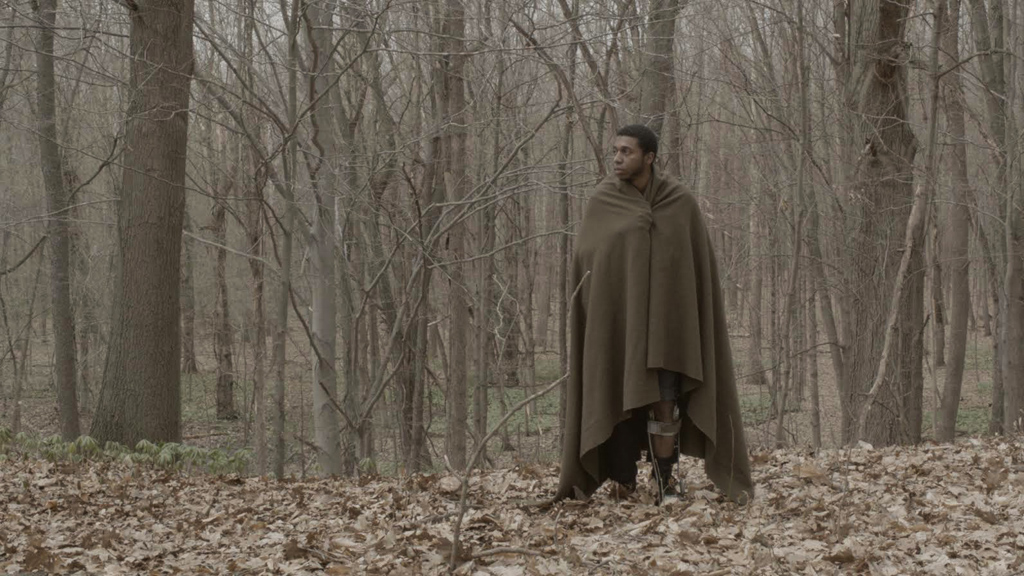
Ty Hickson plays would-be alchemist Sean in The Alchemist Cookbook, written and directed by Joel Potrykus. The film is being shown at the Fantasia International Film Festival in Montreal.
Sean (Ty Hickson) is a young man living in an old-fashioned trailer in the middle of the leafless woods, with his cat, Kaspar, as his only companion. Sean spends his days eating Doritos and cooking mysterious substances in his makeshift lab. With the gas mask and all, you might think he’s running a drug lab, but no, the quantities are way too small for that and he’s trying new things all the time.
A chat with his friend Cortez (Amari Cheatom), and the film’s title itself tell us what Sean’s really up to; the age-old quest to “turn dross into gold.” And he does have a book of some sort. It might contain recipes – or they might be closer to spells, incantations. And about that cat – have you heard of “familiars”?
Even though Sean has a gas mask, he doesn’t always wear it. Who knows what nefarious things he might be taking into his lungs and his brain? We’re given a clue that his hold on reality might have been weak to begin with – he takes medication for something, and he’s devastated when Cortez forgets to bring more. Because of this, we can’t know if the events we see onscreen are real or just Sean’s interpretations of reality.
Sean likes to play his music loud while working and he has wide ranging tastes that include rap, opera and Christmas tunes that sound like they were taped off the radio back in the 1940s. He’s got the Christmas lights to go with them, too!
Sometimes Sean sits in a rowboat on a small lake, sometimes he sets traps for small animals. (Are opussums weird looking, or what?) We have no idea how long Sean has been out there in the woods, and by now, maybe he doesn’t either, though there are a lot of scratches on a tree, that might or might not mark the passage of time. They could just as well be messages to the creatures that live in the woods. We don’t know what those creatures are but we hear them bellow now and then.
The Alchemist Cookbook doesn’t have a lot of conventional plot, but actor Ty Hickson can hold our attention very well without one. His interactions with Amari Cheatom spice things up further.
The Alchemist Cookbook, written and directed by Joel Potrykus, with Ty Hickson, Amari Cheatom, 82 minutes long, in English. See it at the Fantasia International Film Festival Thursday, July 21, 2016. at 5:10 at the J.A. de Sève Theatre of Concordia University, 14500 de Maisonneuve Blvd. W.
DirectorJoel Potrykus will be there to answer questions, discuss his influences, and maybe challenge audience members to do something out of the ordinary.
Nawazuddin Siddiqui plays a serial killer in the Indian film Psycho Raman (also known as Raman Raghav 2.0) The fim is being shown at the Fantasia International Film Festival in Montreal.
Psycho Raman (aka Raman Raghav 2.0) is one tense film. Ramanna is a serial killer, and actor Nawazuddin Siddiqui gives a bone-chilling performance in the part. He kills people because he likes to – men, women, children, it doesn’t matter, he doesn’t make any distinctions. The things that he says, and the look in his eyes when he says them, are extremely unsettling.There’s no telling what he might do next. And when he makes circles with his fingers and looks through them, as you would with binoculars. . .all I can say is Eeek! (The pose reminded me of the poster for The Look of Silence, Joshua Oppenheimer’s second documentary about genocide in Indonesia.) Ramanna takes his alias from Raman Raghav, a real-life serial killer in the 1960s.
The character is so disturbing that I felt uneasy watching him, as if my very presence in the theatre was some kind of approval for his (fictional) actions.
We see Ramanna swing a tire iron, and other weapons, but, mercifully, we don’t see them land on his victims. (And that’s just fine with me!) The guy is totally terrifying all the same – a perfect example of less is more.
Raghavan (Vicky Kaushal) is a crooked, violent, doped-up policeman, who got his position via family connections. The guy is so addicted and so callous that he snorts cocaine at the scene of a triple murder. One night, Ramanna sees Raghav kill someone for no reason. He’s convinced that they’re kindred spirits and wants to meet Raghav, maybe even work together? The film switches back and forth between their two worlds.
Ramanna keeps tracks of his victims in a little notebook. There’s no indication that Raghavan does the same, but I couldn’t help but wonder who had the bigger body count.
Like several other films in this year’s Fantasia lineup, Psycho Raman was well received at the Cannes Film Festival.
Psycho Raman (Raman Raghav 2.0), directed by Anurag Kashyap, written by Anurag Kashyap and Vasan Bala.
Cast: Nawazuddin Siddiqui, Vicky Kaushal, Vipin Sharma, Amruta Subhash, Sobhita Dhulipala, Ashok Lokhande, Harssh A. Singh
127 minutes long, in Hindi with English subtitles.
See Psycho Raman on Wednesday, July 20, 2016, at 5 p.m., in the de Seve Theatre of Concordia University, 1400 de Maisonneuve Blvd. W.
“An old stranger appears in a peaceful rural village, but no one knows when or why. As mysterious rumours begin to spread about this man, the villagers drop dead one by one. They grotesquely kill each other for inexplicable reasons. The village is swept by turmoil and the stranger is subjected to suspicion.”
– Synopsis from the press kit for The Wailing.
Dread, murder, unexplainable events, irrational behaviour, gossip, rumours, nightmares, fear of the other, a large, fierce dog, big, black crows and mesmerizing rituals. That’s what you get in Korean horror film The Wailing (aka Goksung, 곡성).
I’ve wanted to see it ever since I read the rave reviews from the Cannes Film Festival. It did not disappoint! (The Cannes critics liked director Na Hong-jin’s earlier films The Chaser and The Yellow Sea, too.)
The Wailing is set in the beautiful, misty mountains of rural Korea, where people still live in old-fashioned homes with tile roofs. It looks like the kind of place where nothing much happens from one decade to the next.
A string of gruesome murders disrupts the tranquility and we watch as policeman Jeon Jong-gu (Kwak Do-won) tries to figure out if and how they could be connected. While a newspaper headline blames the disorienting effects of poisonous wild mushrooms for the first murders, Jong-gu wonders if some kind of virus might be going around? (The presumed perpetrators all had horrible rashes.)
There’s a lot of rain in The Wailing; it increases the feeling of dread.
Then there’s gossip about a strange Japanese man (Jun Kunimura) who lives in the forest. Some people are convinced that he’s evil, and responsible for the deaths, directly or indirectly. Supposedly he’s been seen wandering in the woods, half naked, chomping on dead animals. One woman says he’s a ghost, feeding on the spirits of the living. Any stranger could come under suspicion in an isolated community, but Japan’s earlier occupation of Korea would further complicate the way the locals view this interloper. Whoever or whatever he might be, a visit to his dwelling proves that he’s not just your everyday recluse.
Policeman Jeon Jong-gu is neither the suave, super cop of some films, nor the corrupt, crooked one of others, rather he’s an Everyman type; pudgy, and a bit of a doofus. After he gets a pre-dawn call to investigate the first murder scene he lets his wife and mother-in-law talk him into eating breakfast first – a few minutes more or less won’t make any difference to the dead, right? His boss and the other cops are not impressed when he finally shows up. Slacker!
Jong-gu seems rather indifferent to his wife (then again, this is not a romantic comedy) but he dotes on his cute young daughter, Hyojin (Kim Hwan-hee). Then she develops a rash too, and starts acting so much out of character that possession seems like a real possibility. When Jong-gu looks at her school notebook, it’s full of strange scribblings and scary drawings. (Have you seen The Babadook?) It also looks like it’s been mauled by a creature with long, sharp claws.
A mudang (shaman) is called in. The shaman is played by Hwang Jung-min and he’s great. I’ve seen shamanic rituals in many other Korean films but the ones here are exceptional, especially the second, longer, night-time one. (I read an article online that some people on the film set thought Hwang really was possessed.)
Hwang Jung-min plays a mudang, or shaman in the Korean film The Wailing.
The Wailing is NOT one of those films where the villain confesses everything, or some expert explains it all before the credits roll. If you go with friends you could have some very interesting post-film discussions about what really happened, who was good and who was evil. The Internet is full of contradictory theories, with some people essentially saying “I’m right because I’m Korean!”
If you read those theories, bear in mind that director Na Hong-jin told the Korea Times: “I mulled over the ending and decided I had to leave it open.”
A final note: Sadly, we Montrealers don’t get to see many Korean films outside of film festivals. If you like the sound of The Wailing try to see it at Fantasia because it will be more impressive there, on a big screen, with a great sound system and the famous, enthusisatic Fantasia audience. Furthermore, some scenes take place at night or in murky interiors – you’ll be able to see them much better in the cinema.
The film is 156 minutes long, but doesn’t feel like it.
The Wailing
Goksung
곡성
Director: Na Hong-Jin
Writer: Na Hong-Jin
Cast: Kwak Do-won, Hwang Jung-min, Jun Kunimura, Kim Hwan-hee, Chun Woo-hee
In Korean with English subtitles, 156 minutes long, showing at the Fantasia International Fim Festival Monday, July 18, 2016 at 9:35 p.m., in the hall Theatre, 1455 de Maisonneuve Blvd. W., Montreal.
Director Guillermo del Toro with his Cheval Noir Award at the Fantasia International Film Festival in Montreal, Friday, July 15, 2016. The smiling guy behind Del Toro is festival programmer Mitch Davis. (Liz Ferguson photo)
On Friday afternoon, July 15, 2016, director Guillermo del Toro spoke with Fantasia Film Festival programmer Tony Timpone at a press conference where he also took questions from fans who are journalists, film profs, etc. Clearly, they were there because they wanted to hear his stories, not to do a job.
Del Toro is passionate about films, monsters, and his work. He’s really funny, too. (Not exactly news to those who are already his fans!)
Friday evening, Del Toro was given Fantasia’s Cheval Noir Award; then he appeared onscreen in the (excellent) documentary Creature Designers: The Frankenstein Complex, then he returned, again with Timpone, to share more insights and answer more questions.
I’ll post more details about his talks later, but here’s one of the things I particularly liked: Del Toro makes lots of Twitter posts about many kinds of art, but he only makes positive remarks, he doesn’t believe in tearing people or things down. He doesn’t mind criticizing politicians, though. (He tweets as @RealGDT.)
Wrestlers from the Acadmie de Lutte Estrienne are among the entertainment options at ShazamFest 2016.
ShazamFest is an annual summer event that combines music, food, circus arts, skateboarding, and local artisans, to name just a few of its ingredients. It takes place from Thursday, July 14, through to Sunday, July 17 in Barnston Ouest in the Eastern Townships. Camping facilities are available.
The entertainment lineup includes Michelle Bourque The Blacksmiths, Old Time Honey & Cirquantique, Blue Mushroom Sirkus Psyshow, Bloodshot Bill, Gypsy Kumbia Orchestra and Kiriaki.
Skateboarding at an earlier edition of ShazamFest. Photo by Claude Dufresne.
This year marks ShazamFest’s eleventh edition. The event was founded by Ziv Przytyk, a guy who’s full to bursting with energy, warmth, enthusiasm and optimism – truly amazing soul. Przytyk holds ShazamFest on land adjoining the organic farm that his parents established many years ago (and that’s another story unto itself.) ShazamFest just got bigger and more popular over the years; many participants have been coming since the very beginning.
A ticket to ShazmFest includes use of this camp site among the trees. Claude Dufresne photo from the ShazamFest web site.
Advance tickets for Thursday are $10, they’re $15 at the gate. Tickets for Friday are $40 and $45; Saturday $45 and $55; Sunday is free. A family pass (two adults and two teens) for the whole weekend is $175 in advance and $200 at the gate. People who arrive on bicycles can get a 20 % discount. (More info about tickets here.)
If cycling isn’t convenient and you don’t have a car either, a shuttle bus will leave Montreal at 6 p.m. Friday, July 15. It will leave ShazamFest at 7 p.m. on Sunday July 17 for the trip back to the city.
Zhao Liang’s documentary film Behemoth shows how parts of Inner Mongolia have been destroyed by coal mining.
RIDM, Montreal’s documentary film festival, takes place in November, but festival organizers keep the doc spirit alive throughout the year with monthly screenings at Cinema du Parc.
The selection for Thursday, May 26, 2016, is the Chinese film Behemoth, from director Zhao Liang.
Behemoth looks at the human and environmental devastation created by coal mining in Inner Mongolia. The landscape is scarred and ugly, while the men have blackened faces and hands. Imagine what their lungs must look like. We don’t see any chest X-rays in the trailer, but we do see them cough and struggle for breath. We see some hooked up to oxygen tanks, too.
The sooty face of a coal miner in Zhao Liang’s documentary film Behemoth.
That coal powers smoky, noisy, iron foundries and steel plants that glow with red-hot heat like a vision of hell. In fact, Zhao Liang took inspiration from Dante Alighieri’s Divine Comedy, which sees the Florentine poet travel to Hell, Purgatory, and Paradise. Behemoth uses excerpts from the poem in place of dialogue.
Foundry employees work with molten metal in Zhao Liang’s documentary film Behemoth.
I have read more than 10 reviews of Behemoth and they were all extremely enthusiastic. Here are quotes from a few of them.
Variety’s Jay Weissberg says Behemoth is: “stunningly lensed. . .impressively self-shot poetic exercise in controlled righteous outrage. . .”
In the New York Times, Amy Qin writes: “documentary combines with art film to produce a powerful testament to the human and environmental costs of coal mining and consumption in China, the world’s biggest user of coal and the leading emitter of greenhouse gases from coal.”
In Screen Daily,Lee Marshall writes: “Vast swathes of once-pristine Mongolian prairieland have, in the last couple of decades, become scarred and brutalised by open-cast coal mines, iron foundries and generating stations, with thousands of desperate Chinese migrant workers brought in to feed the insatiable demand for disposable, low-paid manpower to keep them operating. That’s the background to Zhao Liang’s remarkable, powerful film Behemoth (Beixi moshuo), a sort of ‘dream documentary’ set in this ravaged landscape but liberally inspired by Dante. Behemoth achieves much of its authority from the way the images comment wordlessly on a world in which humans are reduced to the status of servants of a vast, unfeeling industrial system.”
“. . .But it’s Behemoth’s final sequence, almost devoid of human figures, that is, paradoxically the most shocking. It shows a Mongolian ghost new-town, with its serried ranks of residential skyscrapers. These are all empty, we soon realise – as are the streets that surround them. Empty, that is, except for teams of migrant-worker street sweepers – one of whom chases after a drift of tumbleweed that has entered the shot, and tidies it away. Refreshingly undidactic, Behemoth leaves us to work out that, after hell and purgatory, this empty metropolis, made by the industrial monster that ravages the steppes, and the sweat and blood of those who serve it, is the film’s tragic, ironic heaven.”
Another Screen Daily writer, Wendy Ide, put Behemoth on her list of best films of 2015. She writes: “Behemoth (Beixi Moshuo) makes me forever grateful I write about films for a living and don’t have to pick bits of molten pig iron out of my skin at the end of each working day.”
In a scene from the documentary film B-Movie Lust & Sound in West-Berlin 1979-1989, Mark Reeder gives TV presenter Muriel Gray a tour of West Berlin in 1983.
B-Movie Lust & Sound in West-Berlin 1979-1989 – it’s long and unwieldy, but it’s also quite straightforward, unlike some film titles. It doesn’t need to be decoded or anything.
B-Movie is a documentary film with three directors (Klaus Maeck, Jörg Hoppe, Heiko Lange) and one guide – Mark Reeder, a musician and one-time record store employee from Manchester, England, whose interest in German music took him to Berlin in the late 1970s.
The directors had access to many film clips from the era, including some by Reeder himself, and they use Reeder’s experiences and his narration to tie everything together. Actor Marius Weber plays Reeder in some re-enactments. Mark Reeder is 58 now, but his voice still sounds youthful and enthusiastic, like that of a person still in his 20s.
And lest we think the film is only about looking backwards, Reeder told The New Statesman “Artists still come to Berlin searching for something, whether they stay for a few months or a few years. And this film is about inspiration. Not nostalgia.”
Footage includes day and night streetscapes, violent demonstrations, musical performances, interviews and visits to music clubs. (Reeder explains that typical night out might begin at midnight and end at 7 or 8 a.m.). German bands who play and talk include Malaria!, Shark Vegas, Einstürzende Neubauten, Die Tödliche Doris, Die Artze, and Die Toten Hosen.(Blixa Bargeld of Einstürzende Neubauten played with Nick Cave and the Bad Seeds between 1983 and 2003.) There is a brief glimpse of Nena, who had the hit 99 Luft Balloons. Musician Farin Urlaub appears, wearing a clerical collar.
Singer Eric Burdon appears with a rodent on his shoulder, artist Keith Haring paints the Berlin Wall, TV star David Hasselhoff sings while wearing a flashing-light jacket AND a piano key scarf – guess he’s not one of those “less is more” types.
These days, Tilda Swinton looks ageless to me, but we see a few seconds of her looking really young. Swinton appeared in the 1991 German film The Party: Nature Morte; presumably Reeder met her through his bit part in it. (His part was “Drunk.”)
In regard to artists from English-speaking countries, the Australian Nick Cave gets the most screen time. He lived in West Berlin for three years and stayed with Reeder until he found a place of his own.
West Berlin rents were cheap in those days, though Reeder and many others lived in “squats” and didn’t pay any rent at all. Nevertheless, a person needs some money to live on and Reeder earned his as the Berlin representative of British company Factory Records, as a record producer, a band manager, and dubbing porn films. In addition to The Party, he also appeared in Joan of Arc of Mongolia, and the horror film Nekromantik 2, directed by Jörg Buttgereit.
My one quibble with this film: Reeder has a fetish for uniforms, because they “hard-wearing, practical and they get people mad.” Some of them are Nazi uniforms, or the look like Nazi uniforms. For me, that’s just creepy and distasteful.
B-Movie Lust & Sound in West-Berlin 1979- 1989, is being shown at 7 pm, Thursday, May 5, 2016 at Cinema du Parc, 3575 av du Parc, as part of the Goethe Institute’s once-a-month Achtung Film series. It’s 92 minutes long, in German with English subtitles.
Tony Leung Chiu Wai, left, and Lau Ching Wan are the stars of the Hong Kong film The Longest Nite.
Lucky Montrealers can see a double bill of classic Hong Kong gangster films for a mere $10 tonight, Saturday, April 30, 2016, at the Cinémathèque Québécoise. That’s two for the price of one. (And these are indeed 35 mm films, not DVD projections.)
Too Many Ways To Be No. 1, from 1997, and The Longest Nite, from 1998, were shown in Montreal in the early days of the Fantasia International Film Festival, so tonight’s screenings will have an added nostalgia value for people who saw the films back then.
The very black comedy Too Many Ways To Be No. 1 is set in the months before Britain returned Hong Kong to China. Tense times! Petty criminal Kau, 32, hasn’t got very far in life and he’s contemplating his future. He’s wondering – should he accept a job taking stolen cars to the Chinese mainland, or not?
The film shows what would happen if he did; then shows a scenario in Taiwan that could only happen if he refused the mainland job. These crooks are not the cool, suave, well-dressed types one sees in many gangsters films – they’re loud, clumsy and clueless. Camera work is unusual, with one scene shot upside down and another that takes place in total darkness apart from the flashes coming from guns. Rob Larsen at drunkenfist.com says: “Far-removed from the slick, attractive style that is the stereotype of a Triad picture, Too Many Ways feels like it was shot by the love child of Samuel Beckett and Ringo Lam with a script provided by David Lynch.”
Shelly Kraicer says: “A gangster film, brilliantly written and photographed. . . it’s provocative and amusing at the same time (and manages to make the ‘experimentation’ of Pulp Fiction look like child’s play). Amazing camera work (hyper-actively circling, inverted and distorted, with a daringly warped colour scheme). . . The tone flips constantly: expect something hilariously violent/satirical/absurdist. . . I can’t recommend it highly enough: take a chance and see it, if you want something both entertaining and a bit challenging.”
Kau is played by Lau Ching Wan, other actors include Francis Ng, Cheung Tat Ming, Carman Lee, Elvis Tsui and Matt Chow.
Too Many Ways To Be No. 1 is from Johnnie To’s Milky Way Image Company and directed by Wai Ka-fai. It’s 90 minutes long, with Cantonese and Mandarin dialogue and English subtitles.
I might also point out that Too Many Ways To Be No. 1 seems to be out of print, so this is a rare chance to see it. In fact, people are asking for $2,143. to $3,062 for a DVD via amazon.ca. Ha! As if!
A person would have to be a VERY big fan to pay more than $2,000 for a DVD, don’t you think?
Lau Ching Wan is also in The Longest Nite, along with Tony Leung Chiu Wai. The film is set in Macao; Tony Leung plays a very crooked, very violent policeman who works for gangsters and Lau plays a burly, mysterious stranger whose shaved head makes him look extra scary. Unlike Too Many Ways To Be No. 1, there’s nothing funny about The Longest Nite. James Mudge of Beyond Hollywood says: “This is a bleak, nihilistic and brutal thriller which pulls no punches and whose complex plot shows an intelligence that is both ruthless and vicious. . . With its myriad twists and turns, the plot of “The Longest Nite” rivals “The Usual Suspects” in terms of intricacy. . .two rival gangs are attempting to negotiate a truce and join forces before the impending return of another, legendary gang boss. . . one of the gang leaders, Lung, learns that a contract has been taken out on his life, supposedly by Brother K, the other boss. Brother K denies this, and sends Sam (Tony Leung), a dirty cop who works for him, to investigate. . . it appears that there may be even more to the assassination plot than the simple killing of Lung.”
“The plot twists are quite unpredictable, and the tension gradually builds as the viewer is given often misleading hints as to where the story is going, rather than being force fed details via needless exposition. . . “The Longest Nite” is a classic Hong Kong thriller. . .A cunning film that is as cerebral as it is exciting and violent, this is a film all fans of Asian cinema should see.”
The Longest Nite is directed by Patrick Yau and Johnnie To, it’s 81 minutes long, in Cantonese with English subtitles.
Too Many Ways To Be No. 1 and The Longest Nite, 7 p.m., Saturday, April 30, 2016, at the Cinémathèque Québécoise, 335 de Maisonneuve Blvd. E., Montreal, Quebec H2X 1K1, across from the Berri-UQAM metro. Visit the Facebook page for more info.
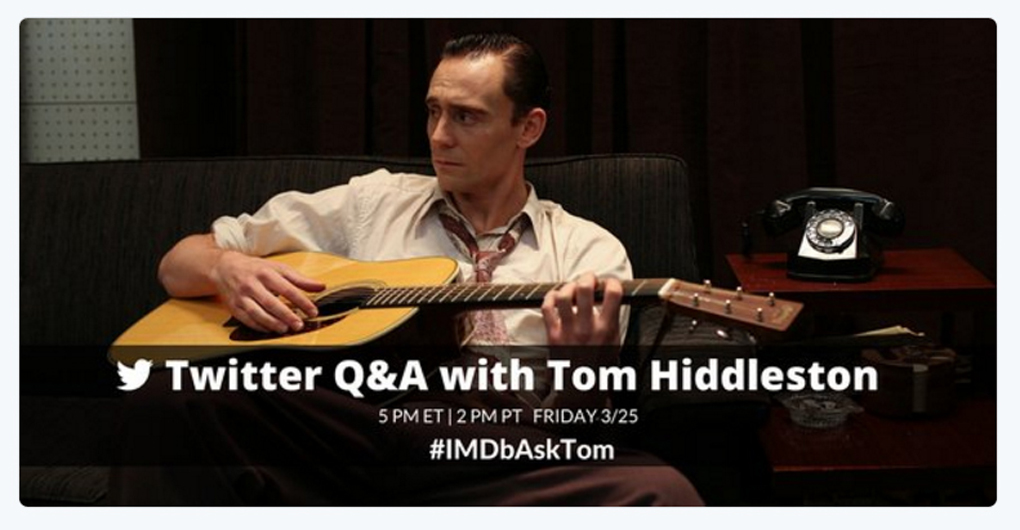
Actor Tom Hiddleston will take questions about his latest film, the Hank Williams bio pic I Saw the Light, via Twitter on Friday, March 25, 2016, at 5 p.m.
Got questions for Tom Hiddleston?Send them to #IMDbAskTom via Twitter. The popular British actor will respond to fans at 5 p.m. (Eastern Time) Friday, March 25, 2016.
Hiddleston is on what must be an exhausting tour, promoting his latest film, I Saw the Light, in which he plays influential U.S. country music singer Hank Williams (1923-1953). The film opens in New York, Los Angeles, and Nashville today, March 25, and expands to more cities in the U.S. and Canada on April 1.
Hiddleston has given print interviews and appeared on early-morning and late-night TV.Tonight, after his Twitter talk, he will answer questions at two New York screenings of I Saw The Light, then he’ll particpate in two more New York Q&A sessions on Saturday. I bet those screenings have been sold out for a long time!
British actor Tom Hiddleston will meet with his fans on Friday and Saturday, March 25 and 26, after New York screenings of his new film I Saw the Light.
For those who aren’t already fans: Hiddleston’s international fan base gets bigger every day. They follow his every move on the Internet, and many havetravelledhundreds, even thousands, of miles in hopes of seeing him on the set or at premieres.
In the last few weeks he’s been burning up the air waves as a spy, trying to bring down an evil arms dealer played by Hugh Laurie, on the BBC TV series The Night Manager, which is based on a book by John Le Carré. The show will come to the U.S. in April.
Of course, some fans have been smitten since 2008 when Hiddleston played curly-haired policeman Magnus Martinsson in the British TV series Wallander.
Hiddleston went on to roles in Thor, Midnight in Paris, War Horse, The Deep Blue Sea, The Avengers, Only Lovers Left Alive, Thor: The Dark World, Crimson Peak, High Rise and I Saw The Light.














 Mostlymovies.ca