FIFA 2016 Review: Un Homme de danse

In a scene from the film Homme de danse, Vincent Warren, right, watches as Arnab Bandyopadhyay demonstrates gestures from Indian classical dance.

Ballet dancer, ballet teacher, dance historian and archivist, Montrealer and Québecois by choice, Vincent Warren is, or has been, all of those things. He’s also a superb raconteur, and many of his stories are hilarious. He shares those stories in Un Homme de danse (A Man of Dance) a film directed by Marie Brodeur. Like many Montrealers, Warren speaks English and French and often switches from one to the other in mid-sentence. He wears a scarf with great panache, too!

I didn’t know his name before seeing Homme de danse, but I soon realized that I had seen Warren dance many times; he is the male dancer in Pas de deux, an award-winning film that Norman McLaren made for the National Film Board of Canada in 1968. (The ballerina is Margaret Mercier and the choreography is by Ludmilla Chiriaeff.) With its mesmerizing multiple exposures, the film was ground-breaking for its time. If I had a nickel for every time I saw it back in my school days. . .
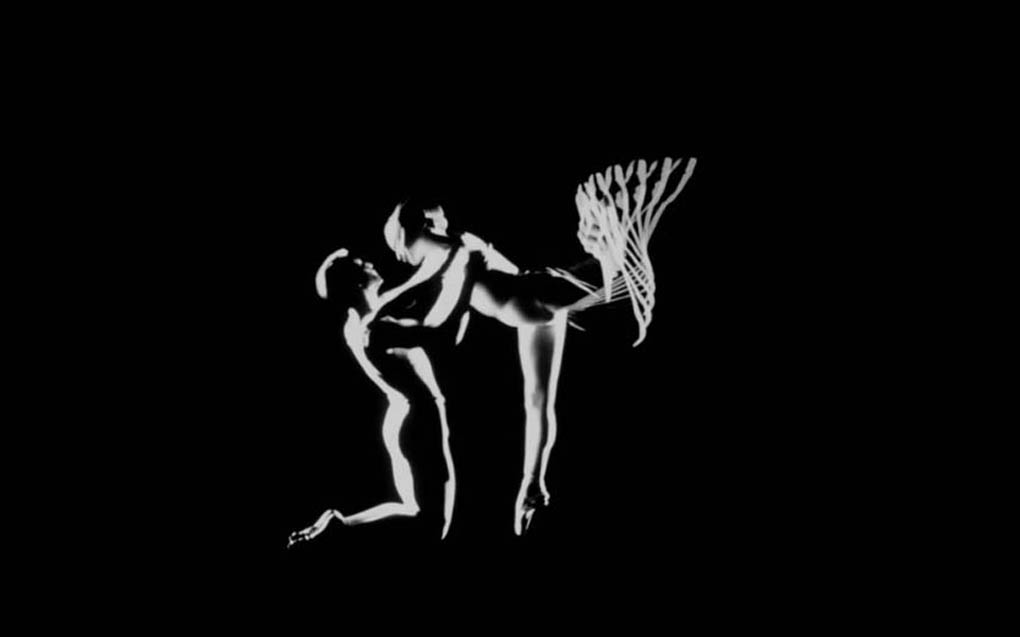
Vincent Warren and Margaret Mercier dance in Pas de deux, a film that Norman McLaren made for the National Film Board of Canada in 1968.

In yet another claim to fame, Warren danced the title role in the ballet Tommy, which choreographer Fernand Nault created for Les Grands Ballets Canadiens in 1970, using music from the rock opera of the same name by The Who. The work appealed to young audiences and encouraged young men to consider careers in ballet.


Warren was born into a large family in Jacksonville, Florida, a place where boys were expected to play football, as his own older brothers did. But Warren was entranced by dance when he saw the film The Red Shoes at age 11. (Read the Wikipedia entry for The Red Shoes here, reviews of The Red Shoes at the Internet Movie Database.) He read everything he could about ballet, and started a ballet scrapbook, which he still has to this day (take that, all you “toss-it-out” minimalists!) He paid for his first ballet lessons with money he earned as a paper boy, but he didn’t pay for long; male students were so rare, they had to be encouraged. (“Boys were always welcome.”)

A page from Vincent Warren's ballet scrapbook. He was smitten by dance after he watched the 1948 film The Red Shoes.
A page from Vincent Warren’s ballet scrapbook. He was smitten by dance after he watched the 1948 film The Red Shoes.

After finishing high school Warren headed to New York where he received scholarships to the American Ballet Theater School (Rudolf Nuryev was in his class!) and then to the Metropolitan Opera Ballet School. He was hired by the Metropolitan Opera at a time when Maria Callas and Renata Tebaldi were performing there. Warren was a party animal, hanging out until the early-morning hours with the poet Frank O’Hara and his gang of abstract expressionist painters.

Warren also danced at the Sante Fe Opera Ballet, with an orchestra conducted by Igor Stravinsky. (Warren has a good Stravinsky story – but better you should hear it from him than from me.) In the summer, Warren worked in summer stock, where companies presented a new musical each week and performed as many as eight in one season.

In 1961 Warren joined Les Grands Ballets Canadiens, under the direction of Ludmilla Chiriaeff. He danced with the company until 1979, when he turned 40. He then taught performance and dance history until 1992 at École Supérieure de Danse du Québec, the school connected to Les Grands. The school had a tiny library with little more than 300 books. Warren donated thousands of his own books, magazines and prints to turn it into the best dance library in Canada. It’s now called Bibliothèque de la Danse Vincent-Warren, and it’s open to the public. “We want you to visit,” Warren said at the screening I attended.

Warren is not the only one who gets to tell stories – we also hear from dancers Véronique Landory, Annette av Paul, Anik Bissonnette, choreographers Brian Macdonald, Jeanne Renaud, Paul-André Fortier, Aileen Passloff, and journalist Linde Howe-Beck. Warren’s longtime friend, Peter Boneham, another American dancer and choreographer who made a home in Canada, is a real hoot. The two could probably form a comedy act if they wanted to.

Homme de danse might be a history lesson or a nostalgia fest, depending on the age and interests of the viewer. There’s footage of Place des Arts, so new that it’s still surrounded by rubble, a glimpse of former Montreal Mayor Jean Drapeau, colourful scenes at the World’s Fair, Expo 67, and excerpts from many ballets, too. I was surprised to learn that Radio-Canada used to present live ballet performances two to four times per week.

After living in a second-floor apartment in Mile End for 47 years, “like an old bear in his cave,” Warren decided to move to a ground-floor place. Director Brodeur filmed him as he packed up his possessions; it was a great idea, since so many of those objects sparked memories and stories.

Un Homme de danse (Man of Dance) directed by Marie Brodeur, will be shown as part of FIFA, Festival International du Film sur l’Art, on Sunday, March 20, 2016 at 5 p.m. in the Maxwell Cummings Auditorium of the Montreal Museum of Fine Arts, 1379 Sherbrooke St. W. Vincent Warren will attend the screening.

General admission tickets are $12.50; seniors (65 and older) pay $11; those 25 and younger pay $10; children 12 and younger pay $5.

For more information or to buy tickets online, visit www.artfifa.com

Montreal’s debut screening of The Witch on Thursday is sold out

Intense Excitement
In July and August the Fantasia International Film Festival brings joy to Montreal film fans, and those who travel here, from far and wide, for that special Fantasia experience. Hors-festival, Fantasia also presents films at Cinéma du Parc on the third Thursday of the month. The Fantasia selection for February 18, 2016, the horror film The Witch, has been sold out since some time last week. That’s too bad for those who did not buy tickets in advance, because you couldn’t find a more enthusiastic group to watch a film with. Oh, well!

Montrealers can catch The Witch, in the original English, or dubbed into French, at various branches of the Cineplex Odeon chain, starting on Friday, February 19. In the downtown area, that means the Quartier Latin and ScotiaBank cinemas.

In this scene from the horror film The Witch, Thomasin (Anya Taylor-Joy) has heard disturbing sounds in the night. (Remstar Pictures)

The Witch has attracted lots of attention since its first screening at the 2015 Sundance Film Festival. It won the Directing Award at Sundance, First Feature Competition at the the 2015 London Film festival, Horror Jury Prize at the 2015 Austin Fantastic Fest Best Feature at the 2015 New Hampshire Film Festival. It’s also the “Most Anticipated of 2016” according to the Indiewire Critics’ Poll.

The film is set in New England of the 1630s. A family of recent immigrants is living on the edge of some scary woods. Life is is already very difficult, and when the youngest child, who’s just a baby, disappears under mysterious circumstances, things spiral downhill from there and family members turn on each other. Director Robert Eggers spent several years researching the era.

Mustang Review: Turkish sisters struggle to maintain their independence


The young women who play sisters in the film Mustang have a great rapport and are very believable as siblings. (Metropole Films)

Mustang opens at the end of the school year – as our main characters, five sisters, are saying goodbye to their friends and teachers. In their school uniform of white blouses, loosely knotted ties and a-line skirts they look like girls you might see right here on the streets of Montreal. They seem happy, self-confident and they have long, glorious hair. (The kind of hair I always wanted to have in high school. . .sigh. All the cool girls had long hair. They were great at field hockey, too.)

About that title, Mustang, which might make one think of a Western, it’s all about that hair. In the press kit, Director Deniz Gamze Ergüven says “A mustang is a wild horse that perfectly symbolizes my five spirited and untamable heroines. Visually, even, their hair is like a mane and, in the village, they’re like a herd of mustangs coming through. And the story moves fast, galloping forward, and that energy is at the heart of the picture, just like the mustang that gave it its name.”

Back to the story: It’s a beautiful day, so the sisters decide to walk home instead of taking the school bus. The story is set in a seaside village on the Black Sea, and their walk takes them by a beach. This leads to some playful frolicking in the water with their male friends. Oh, oh.

By the time they get home, their grandmother has already heard about this indiscretion and she pretty much accuses them of engaging in an orgy. (What will the neighbours think? What will they say?) She also beats them, starting with the oldest one first, and working her way down chronologically. As outraged as she is, things only get worse when her son, the girls’ uncle Erol (Ayberk Pekcan) comes home. (Their parents have been dead for years.)

The life the sisters had known is over now. Grandma (Nihal Koldas) gathers up their telephones, their computer, confiscates books, makeup, and any other thing that might have a pernicious influence, and locks all of it in a cupboard. The sisters are driven to a local clinic and made to suffer the indignity of virginity tests.

Their home becomes a “wife factory.” Neighbourhood women in headscarves come in to instruct them in sewing, stuffing a duvet, cooking (they even make chewing gum!) and advanced window cleaning. They must wear muddy-coloured, long-sleeved dresses. Sometimes when the family is just hanging out, we can hear speeches on the TV about how women ought to behave.

Before we know it, the two oldest girls, Sonay (Ilayda Akdogan) and Selma (Tugba Sunguroglu), are serving coffee and cookies to the neighbourhood women. It’s a sort of an audition, or presentation of the merchandise, really. A woman will offer a son as a groom, then bring her husband in, that very same day, to confirm the engagement, with rings and red ribbons. The wishes and opinions of the future partners don’t seem to matter. At least Sonay manages to get engaged to the guy she’s already been seeing on the sly. Selma is not so lucky; she’s paired off with a guy who looks just as unenthusiastic as she does.

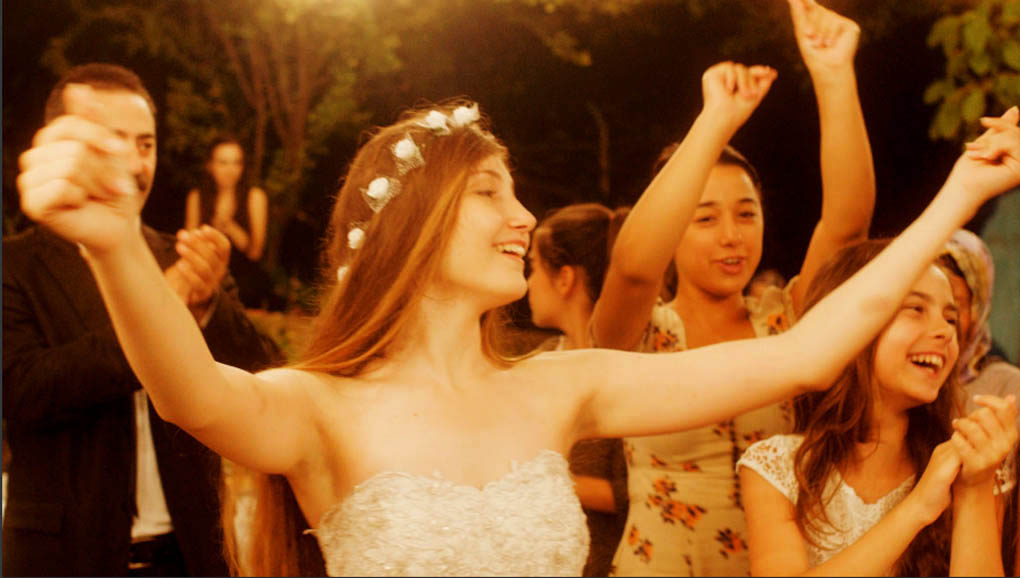
Ilayda Akdogan plays Sonay in a wedding scene from the film Mustang. (Metropole Films)

There’s an interlude at a soccer game that might remind some viewers of Jafar Panahi’s film Offside. The youngest girl, Lale (Gunes Sensoy), is a big soccer fan, but her uncle won’t take her to matches or even let her watch them on TV with him when his pals come over. But, after some violent incidents, the authorities decide that a coming match will only be open to women and young children. All the sisters welcome this chance to escape the wife factory and they join their friends for a raucous bus ride and a joyful game. (Turkey really did have some women-and-children only games in 2011, with 41,000 fans attending.)

After this outing, the walls around the house are made higher still, a tall wrought-iron gate is installed and bars are placed on the windows. The place really feels like a prison, now. However, all this “security” will come in mighty handy for some of the sisters later.

To my shock and surprise, when school starts again, none of the girls are allowed to return. (The actress playing Lale was 13 in real life, but she looked younger than that to me. I’m not sure how old she was supposed to be in the story.) No one comes to find out why they aren’t in school.

Throughout the film Lale has been watching, without saying a lot, but it’s obvious that she’s in no hurry to become a housewife. She’s plotting to rescue herself and her remaining single-but-already-engaged sister and we get to be a part of it. She might be young, but she’s very resourceful and she’s already found a good ally on “the outside.” An ally, mind you, not a prince or a knight, because she is not a helpless girl.

While some parts of the film are upsetting, maddening, even tragic, the bond the sisters have is wonderful to behold. Viewers who don’t have any sisters might well wish that they did. The actresses are so comfortable together they are very believable as sisters. Outdoors, they do gallop like mustangs, but at home they might tumble around playfully, or cuddle up together, like a bunch of kittens.

Hundreds of teenagers auditioned for parts in the film. Elit Iscan (Ece) was only one with previous acting experience, though you wouldn’t know it. Director Deniz Gamze Ergüven first saw Tugba Sunguroglu (Selma) on an airplane flight.

Ergüven was born in Turkey but she’s based in France now. She often moved between France and Turkey, and also spent time in the U.S. and in South Africa, where she earned an M.A. in African History.

The film was shot in the Black Sea village of Inebolu. It is 600 km from Istanbul, though in the story the sisters are 1,000 km from the big city. For them, it probably seems as far away as the moon.

Mustang was written by Deniz Gamze Ergüven and Alice Winocour.


I really enjoyed the film’s sound track. Most of the tunes were composed by Australian musician Warren Ellis, of Nick Cave and the Bad Seeds. Three tunes (or fragments of them) that Ellis recorded with Cave are in the film, though they are not on the Mustang sound track album. Those tunes are Home, Moving On, The Mother. Of the 12 tracks on the album ($9.99) 11 are by Warren Ellis, and one is from the Turkish band Baba Zula. (Here is a link to the Mustang soundtrack, at iTunes.) Coincidentally, Baba Zula played here in Montreal in October, 2015. Two other tunes, Yüksek Yüksek Tepeler (The Song of a Homesick Bride), performed by Selim Sesler, and Esrefoglu Hear My Words (Eyefoölu Al Haberi) performed by Ahmet (Dede) Yurt, are in the film, but not on the soundtrack. I think their tunes provided the lively dance music at a wedding reception. (Selim Sesler’s music is here, on iTunes; there’s a video of Ahmet Yurt on YouTube.

Mustang is a France-Turkey-Germany co-production For those who care about such things, Mustang is France’s entry for the foreign-language Oscar.

Mustang is in Turkish. In Montreal a version with English subtitles is being shown at Cinéma du Parc and Cineplex Forum. The version with French subtitles is being shown at Cinéma Beaubien, Cineplex Odeon Quartier Latin, and Méga Plex Pont Viau.


RIDM+ Documentary night takes us Around the World in 50 Concerts


Around the World in 50 Concerts is a film about a world tour by he Royal Concertgebouw Orchestra. The documentary by Heddy Honigmann is the January selection for RIDM+, an offshoot of Montreal's RIDM film festival.
Around the World in 50 Concerts is a film about a world tour by the Royal Concertgebouw Orchestra. The documentary by Heddy Honigmann is the January selection for RIDM+, an offshoot of Montreal’s RIDM film festival.

RIDM, Montreal’s documentary film festival, takes place in November. But, to keep memories of the festival alive, and to give film fans a treat, RIDM+ presents a film on the last Thursday of the month.

January’s selection is Around the World in 50 Concerts. Filmmaker Heddy Honigmann accompanies the musicians of Amsterdam’s Royal Concertgebouw Orchestra on a world tour to celebrate the orchestra’s 125th anniversary. Despite the name, the film does not include excerpts from 50 concerts; most of the scenes were shot in Buenos Aires, Johannesburg and St. Petersburg.

There’s lots of praise for Around the World in 50 Concerts on the Internet. The Hollywood Reporter says it is “accessibly entertaining and suitable for audiences old and young, including those previously immune to classical music’s charms,” and the New York Times takes note of its “ecstatic impressionism, shot through with melancholy.”
On the web site of the New Zealand Film Festival: “It’s impossible to imagine a more appreciative observer of the venture than Honigmann. Her alertness to what drives musicians to dedicate their lives to performing is matched by a subtle understanding of the consolations that music can offer to any of us. And both are rendered all the more potent by her abiding sensitivity to exile, whether it be felt by a young flautist in his hotel room missing a son’s birthday halfway across the world; or by an elderly Russian who finds in Mahler’s Symphony No 8 a conduit to the vanished world of his mother who once heard it conducted by the composer himself.”
In POV Magazine, Marc Glassman says: “Honigmann is a true artist and arguably, the finest Dutch documentary director living today. (Like Canada, Holland has a fine documentary tradition, so that’s quite a statement).”

“Honigmann makes films that honour their subjects but go farther than most docs take us. In Around the World, she starts the film with the orchestra’s percussionist. What’s it like to play for only a minute in a symphony? The musician lights up and launches into a detailed explanation of how one should play the cymbals quite spectacularly—-but briefly—in the second movement of Bruckner’s 7th. The anticipation of the moment and the delight when he rises and adds his spectacular KLANG to the symphony is blissfully human.”

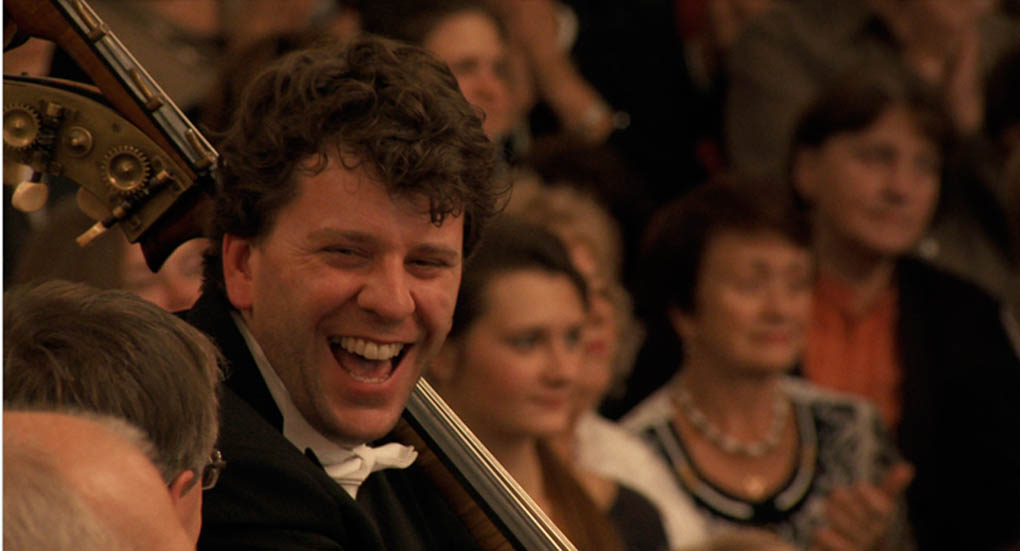
Members of the Royal Concertgebouw Orchestra share laughs in a scene from Around the World in 50 Concerts. The documentary by Heddy Honigmann is the January selection for RIDM+, an offshoot of Montreals RIDM film festival.

Ronnie Scheib of Variety writes: “Honigmann focuses on individual orchestra and audience members without fanfare, allowing them virtuoso riffs but never losing sight of the ensemble. . . Orchestra members, accustomed to her company, seem to spontaneously confide in her, telling her stories. Audience members, interviewed one-on-one in moving vehicles or in their homes, enter more fully into a dialogue with Honigmann, their exchanges very casual and conversational.” Reader Kazuhiro Soda added this enthusiastic comment to the Variety article: “I saw this film at MoMA. It was a masterpiece. It is definitely one of the best movies ever made about music but it’s much more. As always, Heddy showed us the best part of our humanity. She reminds us that there’s something beautiful in this world despite all the violence and miseries. One of the musicians in the film said that art is larger than politics. By watching the film, I truly believed it. Heddy’s approach to documentary is so classical but at the same time very modern and new.”
On his web site The Whole Note, Paul Ennis says: “The power of music to elevate, soothe and communicate is at the core of this moving documentary.” Ennis also gives a rundown of some of the music in the film: “Bruckner’s Seventh, Rachmaninov’s Paganini Variations, Tchaikovsky’s Fifth Symphony and Violin Concerto, Verdi’s Requiem, Mahler’s First, Second and Eighth among others.”

Check out the trailer for Around the World in 50 Concerts below. I noticed that here are lots of smiles in it.

A 15-minute short film, Le Son Du Silence, directed by Maxim Rheault, will be shown before Around the World in 50 Concerts. Laetitia Grou, the producer of Le Son Du Silence, will be there.
Le Son Du Silence and Around the World in 50 Concerts, 8 p.m., Thursday, January 28, 2016, at Cinéma du parc, 3575 Ave du Parc.

Buy tickets online here.


Review: Dangerous Men

Mina (Melody Wiggins) is the main character in the film Dangerous Men. After her boyfriend is murdered, she embarks on a killing spree to kill as many bad men as she can. (Drafthouse Films)


I’ve already written one blog post about the film Dangerous Men quoting some online articles and reviews. Now that I’ve seen a screener, I can give my own opinion.

While watching all by myself I burst out laughing on several occasions, but this is definitely a film to watch with a large group. I can imagine Dangerous Men going over really well in Fantasia’s longtime venue, the Hall Theatre of Concordia. I hope it works just as well at Cinéma du Parc.

So, what makes Dangerous Men funny, ridiculous or strange? Where to start? The script makes no sense, there’s bad dialogue, badly delivered, and several levels of bad acting on display. People talk to dead bodies; they also have long, rambling conversations with themselves. About eighty per cent of the male characters have moustaches, but the film was begun back in the day of detective show Magnum P.I. after all. (Google it if that doesn’t ring a bell.) There’s a living room bellydance performance when you’d least expect it. And just wait for the closeup view of a police badge, or the newscast set that looks like it was made from cardboard and duct tape.

The opening minutes of the film manage to be boring and puzzling at the same time. Scenes keep switching back and forth between two couples declaring their love for each other. Who are they and why should we care? It’s not clear if these “events,” such as they are, are happening at the same time, or if we are just switching between the two couples for the sake of variety.

In one night-time scene, a man in a black suit approaches a house. (Was it the filmmaker’s home? Woudn’t be surprised.) We just see this guy from the knees down, or from the back; the lighting is so strange that his shadow often looks like a second man. The way he’s filmed we assume he’s up to no good.

Later, when he is outside smoking (near his home, far from his home, who knows?) he interrupts the armed robbery of a liquour store. This is a way of letting us know that he’s a cop. I guess.

Before he interrupts that robbery, we see a woman, safe behind some shelves, and invisible to the two robbers, watch them pull a gun on the cashier and collect money. I thought she was a customer, but no, she was the store owner. As the robbers are about to leave, she confronts one of them with a yell, grabs his bag of loot and tries some laughably ineffective martial-arts moves on him. What kind of idiot would do that? Seriously? There will be lots more illogical behaviour before we’re through. The owner gets shot and falls down in a very unconvincing, theatrical way.

Turns out that the cop is named Dave. The other man is Daniel, his brother. Daniel and Mina tell Mina’s father that they want to get engaged. Mina’s father doesn’t look old enough to be her father – a big brother, maybe. Mostly, we see dad in profile or from the back, as if the actor didn’t really want to show his face.

The next day, Daniel and Mina hit the road. (Everything seems to be taking place in California, but Daniel and Mina have a car with New York state plates. I don’t know why.) They have a run-in with some thuggish bikers on a beach and Daniel ends up dead. Mina vows to get revenge on all the bad men in this world. (That would be most of them.) She embarks upon a killing spree. Many of the murders are presented in a visual shorthand – we see Mina’s shadow on a wrinkled sheet as she stabs the shadow of her anonymous victim. Saves money on actors and fake blood!

At one point Mina takes a train somewhere. . .I think. Well, we’re shown a train, which made me think she rode it. Then again, maybe it was just passing by and I filled in the blanks, incorrectly? Mina travels without luggage or even a handbag, yet she magically has several changes of clothes. She even has an off-the-shoulder sweatshirt like the one Jennifer Beale wore in Flashdance (1983). Not to mention, where does she stash her eyeshadsow, lipstick, mascara, teasing comb, etc?

After Daniel’s body is found, brother Dave tries to find the killer, even though his boss tells him he’s too close to the case to do that. Of course, Dave ignores his boss, doesn’t everybody? Dave seems mildly curious about the fact that Mina is missing, but not as worried as one might expect, since they had almost become in-laws and he had told his brother that he liked Mina very much. In that conversation, he mentions “wedding arrangements” and says arrangements in such a strange way, it sounds like English is not his first language. The director should have asked for another take!

Most of the things I describe above happened in the first few minutes, there are lots more ridiculous things to come. Fight scenes were clumsily absurd. During some of them I swear I heard someone saying “Whack, whack,” every time a fist connected with a body.

The music was funny for a few minutes and then became very annoying, verging on excruciating. The same riffs would be repeated for several minutes even when the mood of a scene had changed radically.

Neutral observation: The handguns in Dangerous Men are relatively small. If the film were made today, I imagine that they would be much larger and look scarier.

Watching Dangerous Men has made me appreciate the scripts, actors, sound tracks, continuity, etc. of mainstream movies much more, even the ones that are far from perfect.

Dangerous Men is (unintentionally) funny, but I did feel a bit sad about it, too. It was the passion project of John S. Rad (real name: Jahangir Salehi Yeganehrad) an Iranian who fled Iran for the U.S. in 1979, five days after the Shah left Iran himself. Supposedly, Rad made between three and 11 films in Iran, and he was also personal cameraman to the Shah. After Watching Dangerous men I have very serious doubts about that, but maybe no one watched his Iranian films, either. Or maybe they were shorts. Maybe he shot very short scenes for the Shah, too, and someone else edited them.

One review I read says that Dangerous Men looks like a film made by someone who had never seen one before, and I have to agree! Yet, Rad spent more than 20 years writing, shooting editing, etc. What did he learn in that time? I also wonder if he neglected his family and friends while devoting so much time to this project? He was a bit cavalier with the posssessions of others, too. A car that gets pushed down a steep hillside had belonged to his daughter; she only found out what happened to it when she watched the film.

I’m one of those people who feels obliged to read the credits. What’s in them? Mina (Melody Wiggins) and her boyfriend Daniel (Kelay Miller) are identified as Mina and Daniel. But Dave, Daniel’s brother, is just “Police Detective.” The actor is named Michael Gradilone but Michael is mispelled as Micheal. A character named Black Pepper in the film is simply “Head of Drug Dealers” in the credits. One “biker” was played by Gorge Derby. Is that a real name, or George mispelled?? I know Jorge is a name. Another actor is just “Terry,” and a camera operator is just “Felix.” I wouldn’t have wanted to give my full name, either.

.

.
Dangerous Men, written, directed, edited, produced (etc.) by John S. Rad
In English, 80 minutes long.
Thursday, Jan. 21, 2016, at 9:15 p.m. at Cinéma du Parc, 3575 Ave du Parc


Fantasia presents the bizarre, mesmerizing mayhem of Dangerous Men, Thursday, January 21 at Cinéma du Parc

Poster for the cult fim Dangerous Men (Drafthouse Films)
Poster for the cult film Dangerous Men (Drafthouse Films)

Fantasia? In the chill of January? Yes, indeed. Montreal’s exuberant genre fim fest officially takes place in July and August, but like the documentary film festival RIDM Fantasia looks after its many fans in the off-season, too.

On the third Thursday of each month Fantasia will show a film at Cinema du Parc. (RIDM uses the fourth Thursday.)

What’s on tap this month? Dangerous Men is a little-seen U.S. revenge flick that took more than two decades to make. It was only shown in four theatres on its release in 2005, and that was because the filmmaker, John S. Rad, paid to have it shown.

Evidently, Dangerous Men is not your usual slick blockbuster; it falls into the “so bad/weird/strange/insane, it’s good” category. It was appealing enough that Drafthouse Films invested in its restoration, and now Dangerous Men is on a bit of a world tour to an assortment of cities that include Fort Collins, Colorado, Seattle, Ottawa, London and Bristol (the ones in England) and Melbourne (Australia).

Drafthouse says “It’s a pulse-pounding, heart-stopping, brain-devouring onslaught of ’80s thunder, ’90s lightning, and pure filmmaking daredevilry from another time and/or dimension. Blades flash, blood flows, bullets fly and synthesizers blare as the morgue overflows with the corpses of DANGEROUS MEN.”

The synopsis from Drafthouse: “After Mina witnesses her fiancé’s brutal murder by beach thugs, she sets out on a venomous spree to eradicate all human trash from Los Angeles. Armed with a knife, a gun, and an undying rage, she murders her way through the masculine half of the city’s populace. A renegade cop is hot on her heels, a trail that also leads him to the subhuman criminal overlord known as Black Pepper.”

CinemaBlend says Dangerous Men is as “ridiculous and insane as you think it is, but also disturbingly entertaining. ”

Rolling Stone calls it a “mesmerizing, incomprehensibly riveting movie,” and says that watching it is “an exuberant, surreal experience.”

The Hollywood Reporter says “its awful glory. . .”would make Ed Wood green with envy.” “The pacing is bizarre; the dialogue is laughably atrocious; the production values are non-existent; the acting is embarrassing; the fight scenes are ineptly staged, with loud sound effects failing to compensate for the fact that no blows are landed; and the synthesizer-heavy musical score sounds left over from a ’70s porn film. ”

The AV Club says that: “Dangerous Men is a singular movie-going experience (in a good way).” “Ridiculous, artless, and wildly entertaining, Dangerous Men is more than the sum of its fascinatingly misguided parts, although it will take a special sort of moviegoer to truly appreciate (or endure, depending on your perspective) its charms.”

IndieWire says “the bonkers trailer. . . “plays like the best action film Ed Wood ever made.”

IndieWire also compares it to Roar, another old film released by Drafthouse. It features the many large felines owned by Melanie Griffith’s parents Tippi Hendren and Noel Marshall. Roar was shown at Fantasia 2015. (Read my review here, if you like.)
Rad is certainly a great short and punchy name. The filmmaker’s real name was Jahangir Salehi Yeganehrad. He was an Iranian who fled Iran for the U.S. five days after the Shah left himself. Rolling Stone says he was a multi-millionaire engineer and importer/exporter who had also been personal cameraman to the Shah. Rad made between three and 11 films in Iran, depending on which sources which sources you believe. Vanity Fair and the Hollywood Reporter say he was an architect and filmmaker.

Apparently Rad showed an early version of the film in 1984 or 1985, but the unfavoruable reaction led him to re-work it. Vanity Fair says he might have added footage that he’d shot for a different film.

Dangerous Men was still not big hit when Rad showed it again in 2005, though Vanity Fair says that it did catch “the attention of adventurous filmgoers like Hadrian Belove (now the founder and executive creative director of the nonprofit cinema Cinefamily), who rallied enough like-minded movie buffs to sell out a single screening.”

“By my standards, I think Dangerous Men is the apex predator of outsider cinema,” Belove said. “Usually, no matter how special and strange and surprising these movies are, there’s a moment where you sort of settle in. Where you go, O.K., I get it. I know you, Birdemic. I get what you are. . . . But Dangerous Men keeps transforming and becoming a different movie. By the time you get to that freeze-frame at the end—they do a freeze-frame for the final credits—and not a single person in that frame was a character in the movie 20 minutes earlier.”

IMDB lists it as an Action, Adventure, Comedy. Probably Rad would be displeased by the comedy designation. Rolling Stone says: “Even Rad’s family isn’t sure where the line between intentional and unintentional humor lies in the film. ‘He was trying to give a message, but I don’t think it came out the way he wanted to,’ (Rad’s daughter Samira) Wenzel says. ‘He would get insulted very quickly if someone would laugh at a section of the movie. When my daughter laughed at a scene, he thought that was very unacceptable. I’m still trying to analyze where he was coming from.’ ”

Dangerous Men, written, directed, edited, produced (etc.) by John S. Rad
In English, 80 minutes long.
Thursday, Jan. 21, 2016, at 9:15 p.m. at Cinéma du Parc, 3575 Ave du Parc

Montreal has a Korean film drought – without festivals we’d hardly see any at all

Kim Yun Seok, left, and Kang Dong Won in the Korean film The Priests. (CJ Entertainment)

Montreal is a great city in many ways, though not so much when it comes to watching Korean films, in a cinema, where many of us stilll prefer to see them. Thank goodness, we can see some during film festivals, if they fit our schedules and they don’t sell out.

China Lion has been bringing us films from China on a regular basis (thank you very much!) and there is at least one Indian film, often several, being shown at Cineplex Odeon Forum each week. But good luck with Korean films. And Korean film fans are not limited to people with Korean roots, far from it. A quick Internet search will verify that.
Anyway, this post is prompted by the North American release of a Korean film called The Priests. Starting on Friday, Dec. 4, 2015, it’s being shown in Toronto, Vancouver, and several U.S. cities, but it won’t be coming to Montreal. It sounds like it has a lot in common with The Exorcist, though set in a new century and a different city. That’s neither here nor there for me, I want to see it because I like the two main stars, Kang Dong Won and Kim Yun Seok.
I wrote more about The Priests at the Korea Canada blog, a blog about Korean culture.

Kang Dong Won and Kim Yun Seok last worked together in a fantasy-comedy called Woochi, which was shown here at Fantasia Film Festival in 2010. I reviewed Woochi for the (now defunct) Cine Files blog at the Montreal Gazette. My Woochi blog post lives on, though little cyberbots did scrub my name off it.

Meanwhile, here are some more photos from the film. The trailer, with English subtitles,  is at the end of this post.

Kang Dong Won,left, and Kim Yun Seok in the Korean film The Priests. What is that, under Kang Dong Won's nose? Not quite a milk moustache. . .is is part of the ritual to oust the demon? (CJ Entertainment photo)
Kang Dong Won,left, and Kim Yun Seok in the Korean film The Priests. What is that, under Kang Dong Won’s nose? Not quite a milk moustache. . .is is part of the ritual to oust the demon? (CJ Entertainment photo)


In a screen grab from an interview on Korean TV, actor Kang Dong Won talks about wearing a cassock, while praying the role of a seminary student, in the film The Priests.
In a screen grab from an interview on Korean TV, actor Kang Dong Won talks about wearing a cassock, while playing the role of a seminary student, in the film The Priests.


Actor Kang Dong Won and a cute little piglet take a break during the filming of the Korean movie The Priests. (CJ Entertainment photo)


Question: Would you like to see more Korean films in Montreal? Let me know!

For shame! Newpaper in Argentina suggests it’s time to forget about the ‘Dirty War’

Employees of the newspaper La Nacion in Buenos Aires, Argentina, want everyone to know that they do not agree with an editorial printed on Monday, Nov. 23, 2015, that suggested it was time to stop prosecuting people who committed murder and other human rights abuses during Argentina's Dirty War, between 1976 and 1983. (La Nacion photo)
Employees of the newspaper La Nacion in Buenos Aires, Argentina, want everyone to know that they do not agree with an editorial printed on Monday, Nov. 23, 2015, that suggested it was time to stop prosecuting people who committed murder and other human rights abuses during Argentina’s Dirty War, between 1976 and 1983. (La Nacion photo)

Here in Canada, many people were outraged when the Postmedia newspaper chain forced all of its papers to run pre-election editorials in favour of the Conservative party, even when local employees did not agree with the stance.
Something infinitely worse has happened in Argentina. The Washington Post reports that, on Monday, Nov. 23, 2015, one day after the right-of-centre candidate Mauricio Macri was elected president, the newspaper La Nacion printed an editorial saying it’s time to forget about “vengeance” against the perpetrators of Argentina’s “Dirty War.” “One day after citizens voted for a new government, the desire for revenge should be buried once and for all.” Of course, the trials are about justice, not revenge. The unnamed writer seemed to think that the guilty should be able to escape punishment based on their advanced age alone.

Horrified journalists at the paper distanced themselves from the editorial; they posed in the newsroom with signs saying that they condemned it. La Nacion printed the photo and an article about the disagreement.
Between 1976 and 1983, up to 30,000 people were jailed, tortured and “disappeared” by the military junta in Argentina. The victims were men, women and children. Some were thrown from air force planes into the ocean while still alive.Sometimes pregnant women were allowed to give birth before being killed, as many as 500 children were given to military families, told nothing about their real parents or what had happened to them. Some only learned the truth as adults, thanks to the persistance of the grandmothers who kept looking for them. A New York Times article in 2011, about a woman who was raised by the man who killed her parents, said 105 children had been found so far. In September of this year, the BBC reported that another child of the disappeared had been indentified.

Investigations into the kidnappings and murders began in 1983 with the return to civilian rule; nine junta leaders were tried, convicted and sentenced in 1985. A law passed in 1986 was aimed at stopping further trials, when that didn’t work, a 1987 law gave immunity to all but the highest ranking military officers. Trials stopped in 1987, then, in 1989 and 1990, President Carlos Menem freed approximately 1,200 officers who had been imprisoned.

In 2001 the Federal Court in Buenos Aires found the amnesty laws invalid, and trials began again. Congress annulled the laws in 2003, and the Argentine Supreme Court declared them unconstitutional in 2005. In 2007 a judge ruled that the pardons were unconstitutional as well.

I was writing a review of the documentary Drone when I noticed the Washington Post story – maybe some day people will be prosecuted for using them, too. Chile had its own “Dirty War” though apparently it did not steal children. On Saturday, at the RIDM film festival, I watched the Chilean film Le bouton de nacre, which is partly about the disappeared of that country. The segment was horrific; I can’t imagine anyone feeling forgiving after watching it.

RIDM 2015 Review: The Unknown Photographer

This screengrab from the Unknown Photographer web site show the videos that can be watched even after the RIDM documentary film festival is over. (Since it is just a screengrab, clciking on the arrows won't do anything.
This screengrab from the Unknown Photographer web site show the videos that can be watched even after the RIDM documentary film festival is over. (Since it is just a screengrab, clicking on the arrows won’t do anything.

Like the Polar Sea 360° project, The Unknown Photographer has one component that you can explore with an Oculus virtual reality headset for the duration of RIDM, and several other parts that you can enjoy at home whenever you choose to do so.

The Unknown Photographer is a co-production between the National Film Board of Canada and Turbulent, with the financial support of Canada Media Fund. It was inspired by a thick album of World War I photos that was found in an abandoned building in Morin Heights. Some accounts say the building was a home, some say it was a barn, but in Looking For Fletcher Wade Moses, a film on the project’s web site, filmmaker Philippe Baylaucq says he found it in a sort of “haunted house” when he was still a teenager. That story is better yet, no? He felt it was a treasure that needed to be saved, so he took it, and eventually gave it to photographer Bertrand Carrière, who made Looking For Fletcher Wade Moses.

The album belonged to Fletcher Wade Moses, but despite lots of research into the man’s life, including talks with his daughter and grandson, Carrière was not able to determine if he had taken the photos or not. While he was interested in Fletcher Wade Moses, he was more interested in the photos and the landscapes they depicted. He was shocked by the devastation, with entire cities reduced to rubble. He realized that most of the photos had been taken in the last years of the war, on the Western Front. He went to France to see what those places looked like years later.

Precisely because it was impossible to identify the photographer (or photographers) the virtual reality part of the project is a work of imagination and conjecture. In fact, the narrator who leads us through the experience is unsure of just who he is or where he is, though he does “remember the war.” (Julian Casey provides the voice of the English version; François Papineau provides the French one.)

This barren battlefield is seen in the virtual-reality component of The Unknown Photographer.

Considering the present date and when the war was (1914-1918) he could well be speaking to us from the hereafter. Participants in the virtual reality experience can choose their trajectory through their head movements and by moving a joystick. They can move through a barren landscape of blackened trees, climbing down into trenches or up hillsides. They can navigate a huge, dark, museum-like space, and drift through photographic cubes that tumble from the sky, a bit like Tetris. A strange figure, upright, with the antlered head of a deer, makes frequent appearances. What is he? Some kind of spirit animal? A shaman? An ancestral memory from our cavemen days?

The parts that can be watched at home include videos about the “Vest Pocket Kodak: The Soldiers’ Camera,” and “Postcards and Letters in Times of War.”

This is the setup for experiencing The Unknown Photographer in the UXdoc Space at the Cinematheque Quebecoise. Does it look like plugging into The Matrix?

The Unknown Photographer, (Le Photographe Inconnu)
Directed by Loïc Suty
Country : Quebec
Year : 2015
Language : English, French
Runtime : 120 Min
Platform : Réalité Virtuelle / Virtual Reality (Oculus Rift)
Production : Marc Beaudet, Benoît Beauséjour, Claire Buffet, Louis-Richard Tremblay
Technical Direction : Osman Zeki
Sound : Martin Fish
Contact (Distribution) Élise Labbé, Office National Du Film Du Canada
e.labbe@onf.ca
Cinémathèque Québécoise – Salle Norman Mclaren (Salle UXdoc), 335 de Maisonneuve Blvd. E. (For the virtual reality part)
(For the virtual reality part)
Visit unknownphotographer.nfb.ca for online components.
RIDM (Rencontres internationales du documentaire de Montréal) runs from Nov. 12-22, 2015. Visit the web site ridm.qc.ca for more information.

RIDM 2015 Review: Llévate mis amores (All of Me)

In a scene from the film LlŽevate mis amores, a member of the group Las Patronas holds bags of food for Central American migrants travelling north on a freight train.
In a scene from the film LlŽévate mis amores, a member of the group Las Patronas holds bags of food for Central American migrants travelling north on a freight train.

Llévate mis amores (All of Me) is a film about a group of Mexican women known as Las Patronas, after La Patrona, their village in Veracruz state. They’re poor in possessions, but rich in humanity and love. Even though they have very little themselves, they work hard to help people who have even less than they do.

Since 1995 they have been preparing food and water for migrants from Central America who ride freight trains through Mexico into the U.S. The trains are called La Bestia (the Beast), or sometimes, the Train of Death, because people can die if they fall off. The migrants are victims of a bad economy and globalization – there isn’t enough work in their home countries and they can only travel via freight trains because passenger service ended when the Mexican railroads were privatized in the 1990s. A train might have as many as 800 riders, with some inside the boxcars cars, others on the roof or even hanging precariously between the cars. The train is not the only danger on the trip – there are crooked police, thieves, kidnappers, human traffickers and extortionists.

Every day the women cook huge pots of rice and beans and make tortillas over wood fires. They pack the food in plastic bags and fill recycled bottles with water. When they hear the whistle of an approaching train, they rush to the tracks to toss the food and water to the migrants, who hold their hands out eagerly. They never know when the trains will come or how many there might be.

In this scene from the documentary film LlŽevate mis amores (All of Me), a Central American migrant is able to call her mother, thanks to the helpful women known as Las Patronas.
In this scene from the documentary film LlŽévate mis amores (All of Me), a Central American migrant is able to call her mother, thanks to the helpful women known as Las Patronas.

Some migrants jump off the train for the food, and then they can’t get back on. When that happens, they are driven to the next place that the train stops or slows down. That’s not all that La Patronas do. They have taken injured migrants to hospitals, and on those occasions when doctors or hospitals refused to help, they have nursed them back to health themselves. They lend people cellphones so they can check in with their families.

When the director asks the women to describe themselves the younger ones talk of their hopes for the future (to be a lawyer or a journalist) while the older ones talk about their pasts – one had an abusive husband who was murdered, another had a potential husband who stayed up north too long, yet another was pulled out of school at a young age because someone told her father that the vaccinations given to students would cause sterility. One woman liked to sing and dance; she had wanted to be in a band. Some worked in the fields, others worked as maids; those with children want them to have a better life.

Llévate mis amores (All of Me) is truly inspirational; long before it was over I was wondering what I could do to make the world a better place. It was great to see the screening sell out, too. You can buy tickets online to make sure that you get in. Director Arturo González Villaseñor will be at the screening to answer questions after the film. When asked if the film will be available for rent or purchase he said that it probably will be eventually, but for now it’s still making the rounds of film festivals.
Llévate mis amores (All of Me)Sunday, Nov. 22, 2015, 9:15 p.m., Excentris (Salle Cassavetes), 3536 St Laurent Blvd.

RIDM (Rencontres internationales du documentaire de Montréal) runs from Nov. 12-22, 2015. Visit the web site ridm.qc.ca for more information.