Marlon Brando, left, and Johnny Depp signed on to make the film Divine Rapture in 1995, but the film could not be completed. The documentary Bally Brando explains what went wrong.
Film producer Barry Navidi has worked with actors Marlon Brando, Johnny Depp, John Hurt, Michael Caine, Sean Connery, Anthony Hopkins, Debra Winger and Al Pacino, to name a few. He worked with Pacino on The Merchant of Venice, Salomé and Wilde Salomé. He must have so many interesting stories to tell.
Navidi was born in Iran, and according a recent-ish article in Variety, he hopes to make a Hollywood production there some day.
According to that same article, his next project is a film about the artist Modigliani. Navidi told reporter Nick Vivarelli: “Right now we are casting; we are going to have a couple of big stars. If all goes well we will start shooting early next year in Budapest. There is potential for a cameo role for Al (Pacino). But he is also creatively involved: He is going to help me cast the movie, and he gave the writer a lot of notes.”
Divine Rapture, Navidi’s 1995 project with Winger, Hurt, Depp and Brando, was an ill-fated one. It was a story about an Irish woman who seemed to have risen from the dead. Debra Winger was set to play the woman, Brando would be the parish priest. The residents of Ballycotton, Ireland, hoped that the film would make their town a tourist attraction, but it was not to be. About 24 minutes of film were shot over 10 days before it was discovered that the company backing the film didn’t seem to have any money.
Bally Brando, a 50-minute documentary about the disaster, will be shown before Navidi speaks. The film is in English, and directed by Brendan J Byrne. Navidi will speak for about 40 minutes.
Bally Brando and Master Class with Barry Navidi, free admission
Wednesday, Oct. 14, 2015, 5 p.m.
Cinémathèque Québécoise, Salle Fernand Seguin
355 de Maisonneuve Blvd E. (metro Berri-UQAM)
Tom Hiddleston plays a drunken Dr. Robert Laing in this scene from the film High-Rise. It’s based on a novel by J.G. Ballard and directed by Ben Wheatley. The film is being shown at the Festival du nouveau cinema in Montreal.
The film High-Rise is being shown twice as part of Montreal’s Festival du nouveau cinéma. The first screening was very close to being sold out – I could only see a few empty seats in the large theatre.
What was the attraction? The direction by Ben Wheatley, a story based on a 1975 novel by J.G. Ballard, or British actor Tom Hiddleston? All of the above?
I’d bet on Hiddleston. During a scene that showed Hiddleston sunbathing, naked apart from a strategically placed newspaper, at least one person in the audience let out a loud whoop. (I assumed it came from a friend who had told me she’d be there, but when I wrote her an email later she said no, she had not been able to attend, after all.)
OK, then, what about the plot? The film opens with a very dishevelled Hiddleston. His white shirt is dirty and covered in blood, but he’s still wearing a tie. A dog’s leg is turning on a spit. In voice over, he recites the novel’s opening sentence: “Later, as he sat on his balcony eating the dog, Dr. Robert Laing reflected on the usual events that had taken place within this huge apartment building during the previous three months.” Then the words “three months earlier” appear onscreen.
Almost everything happens inside the high rise of the title. The building is a concrete monster looming over the landscape. It’s an apartment block, the first of many; others are under construction nearby. There’s lots of exposed concrete inside, too, which gives the place a cold, brutal and primitive look.
With a gym, a swimming pool and a well stocked supermarket, there’s no need for tenants to go out if they don’t want to. Of course, some people do have jobs to go to, and in the morning they stride purposefully through the expansive lobby to the equally expansive parking lot, where they climb into their cars.
The rich people have the upper floors, while the less well off, the families with their noisy, messy children, live on the lower floors. It’s like a vertical Snowpiercer. (Wish I could be the first to put that in writing.) Unlike the train passengers, the lower classes are not being held prisoner in the building, though. On the other hand, when everything start going to hell in a handbasket, no one considers leaving.
The building was designed by Anthony Royal (Jeremy Irons). A symbolic name, I assume. Royal lives on the top floor (the 50th) and has a huge rooftop terrace with grass, trees, a goat, a horse, and who knows what else. Sometimes Royal’s wife wanders around up there dressed like Little Bo-Peep. Royal wears a white, high-collared, shirt-jacket thingy which looks like a cross between white-hunter explorer gear and a retro space-captain uniform.
This photo, originally from the Screen Daily web site shows director Ben Wheatley, centre, and actor Jeremy Irons, right.
Tom Hiddleston’s Robert Laing, a man who is looking to “start over, begin afresh.” We never find out exactly what he means by that. As a doctor who lectures at a nearby hospital, Laing falls somewhere in the middle on the social scale, though his suits look quite nice and he obviously has aspirations to move up. He is mocked and insulted by some, for that very ambition.
Far from being a well-oiled machine, the building is plagued by power failures and elevator breakdowns, because “the building is still settling in.” That’s the official explanation and people repeat if often, in an effort to reassure themselves that the problems are only temporary.
But things just get worse instead of better and the social hierarchy starts to fall apart as well, with the lower orders objecting to the lordly behaviour of their “betters.” There are raiding parties, kidnappings and murder. (The Lord of the Flies vibe was strengthened for me by Hiddleston’s trousers – they were rolled up to the knee, approximating the shorts of British schoolboys.)
Luke Evans plays glowering Richard Wilder in the fim High-Rise.
Philandering TV cameraman Richard Wilder (Luke Evans) wants to capture all the goings on in a documentary. He’s far from an impartial observer, though, he instigates much of the mayhem himself.
Elisabeth Moss, of Mad Men fame, plays Wilder’s very patient, very pregnant wife. (They already have several children.)
Sienna Miller plays multitasking Charlotte Melville. She’s the mother of a geeky son, Toby; she’s Wilder’s lover, and Royal’s assistant, (though that isn’t very clear in the film) but she still manages to find time in her busy days and nights to get to know Hiddleston’s Dr. Laing a little better.
Many of Hiddleston’s fans read the book while they waited for the film to come out. Viewers who have done that will be at a distinct advantage, because the chaos seems to arrive too quickly in the film.
Extra details for the Tom Hiddleston fan-girls: You will see: Steely Tom, Sarcastic Tom, Shirtless Tom, Tom in a suit, Tom in the shower, Tom in nothing and “beardy Tom.” In scenes set in a mirrored elevator, you can see multiple Toms (just as there were multiple Lokis in a scene in the film Thor).
Together again: The film is a reunion for Jeremy Irons and Tom Hiddleston who played father and son in the Shakespeare play Henry IV, Part 1, which was shown on the BBC and PBS. Read more about High-Rise on the FNC web site. You can buy tickets there, too.
High-Rise, in English, 112 minutes.
Directed by Ben Wheatley, written by Amy Jump, J.G. Ballard, with Tom Hiddleston, Jeremy Irons, Sienna Miller, Elisabeth Moss, Luke Evans.
Wednesday, Oct. 14, 2015, 18:15
Program #186
Cinéma du Parc 1, 3575 Ave. du Parc
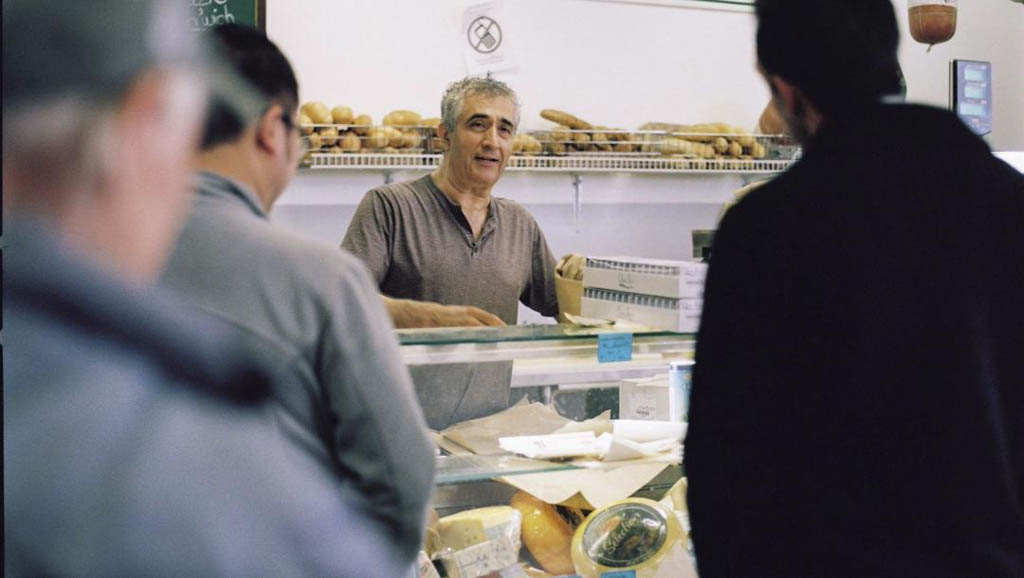
Vancouver deli owner Salam Kahil is the star of the documentary film The Sandwich Nazi. The film was directed and edited by Lewis Bennett. It’s one of many films being shown at Montreal’s Festival du nouveau cinema. (Photo by Rommy Ghaly)
The Sandwich Nazi is a documentary portrait of Vancouver deli owner Salam Kahil. His customers call him Sal. Anyone who thinks Canadians are dull and boring has not met this guy.
Sal has a dirty mouth and a big heart. Viewers can assess some of his other parts in the last moments of the film.
Sal was born into a large family in Lebanon. He left home at an early age for assorted reasons. He lived in 18 countries before coming to Canada in 1979 and he has the photos to prove it. I didn’t hear him name our city, but it looks like he lived here in Montreal for a while.
When he was no longer “young and pretty” he went into the deli buiness, with La Charcuterie Delicatessen, a “Scandinavian place with a French name” being the most recent one. In addition to sandwiches, he sells imports you probably won’t find at your local supermarket. Customers are fond of the pickled asparagus from Denmark. When someone calls to ask if he has “Norwegian cooking chocolate” he says there’s probably some in the back. (You can see that chocolate on the La Charcuterie’s web site and lots more – Viking Bread, Norwegian fishballs, many cheeses, condiments, cookies, candy and sweets, including the very yummy Anthon Berg Marzipan Plum in Madeira. The site includes a recipe for Danish meatballs! )
(Looking at that website made me want to visit Montreal’s La Vieille Europe on St. Laurent, since it might have some of those things.)
Sal has many stories to tell, most of them crude. He says he used to be a male escort who could be hired by men or women. He says he has also been a very successful sperm donor (twins!) for women who did not have (or want) a male partner.
He tells these stories to his customers as he prepares their sandwiches. They’re an extra garnish, you might say. Are they all true? Are some exaggerated? Who knows? Who cares?
The sandwiches themselves are HUGE. Sal says they’re the best in the world and his customers seem to agree. Don’t go the film on an empty stomach.
The film’s title is a reference to the “soup Nazi” from the Seinfeld TV show. That guy made great soup but customers could be banished forever if they did not obey his many rules. Sal has rules, too; payment is cash only and he demands politeness and respect from his clients. For the most part, he seems to get it. We only hear one or two banishment stories.
As far as I can recall, the “soup Nazi” did not have any redeeming qualities beyond his culinary talents. In contrast, Sal and his army of volunteers prepare meals and distribute them to the poor and the homeless of Vancouver’s Downtown Eastside on a regular basis. He treats those people with warmth and respect and they are obviously happy to see him and his food. He feeds the volunteers, as well. We learn about many other good deeds in the film.
The documentary was made over several years. On more than one occasion, Sal says he will return to Lebanon to visit his family, even naming a departure date. But he doesn’t go. When he’s finally ready to make the trip, the film crew wants to accompany him, but his family says no. Sal documents things himself, and shares his footage with the filmmaker and viewers upon his return. This includes a hair-raising, high-speed drive through a sniper-infested area – not something that happens on your average vacation.
Al Pacino can be seen as King Herod in the films Wilde Salome and Salome. The films will be presented, twice, as a double bill at the Festival du nouveau cinema in Montreal.
In 2006 Al Pacino presented a staged reading of the Oscar Wilde play Salomé in Los Angeles. He played King Herod, a role he had played several times before, and the then-unknown Jessica Chastain played Salomé. The actors wore modern dress.
Pacino filmed the play, for a theoretical eventual release. That film is simply called Salomé. (Though back then he was going to call it “Salomaybe.”)
He filmed the rehearsals of Salomé and background material on Oscar Wilde – that film is called Wilde Salomé. It includes remarks about Wilde from Gore Vidal and Bono, among other people, and trips to Wilde’s birthplace in Dublin, his former home in London and the Paris hotel where Wilde died in Nov. 30, 1900 at the young age of 46. We see the infamous wallpaper from his famous quotation: “My wallpaper and I are fighting a duel to the death. One or the other of us has to go.”
As a director, Pacino does not hesitate to show himself acting petulant, confused or even ridiculous, as when he stands in the Mojave Desert with a camel.
He’s very funny, too. He says that during the play’s run no one will be asked to turn off their cellphones, because many of the attendees will be doctors or dentists and people might need to reach them in emergencies. He goes on to add that only doctors and dentists could afford the high ticket prices charged by the theatre and that those high prices were not set by him.
Jessica Chastain is the revelation of Wilde Salomé, she’s just luminous. Pacino’s cranky and querulous interpretation of Herod seems a bit weird, but maybe he has his reasons.
I think Wilde Salomé could appeal to just about anyone. Filmmakers, acting students, fans of Oscar Wilde, Al Pacino and Jessica Chastain would find it especially entertaining. That probably covers a lot of people!
Wilde Salomé is being presented along with Salomé (which I have not seen yet), and BONUS! before they begin, attendees will be treated to video Al Pacino recorded just for them. It’s approximately 23 minutes long, and seems to have been made relatively off the cuff. Looking at his hands I wondered if the jewelry he wore as King Herod came from the costume dept. or from his own personal collection.
The Korean peninsula is in the spotlight as the Festival du nouveau cinéma shows three films made by South Koreans, four made by North Koreans and one documentary shot (mostly) in North Korea by a British company with an American subject (Dennis Rodman) and an Irish narrator.
Former basketball star Dennis Rodman was demonized by some people because he went to North Korea, several times, and met with dictator Kim Jong-un. Montreal’s Festival du nouveau cinema will show the documentary, Dennis Rodman’s Big Bang In Pyongyang, which takes us along for the ride.
Finally, the documentary, Dennis Rodman’s Big Bang In Pyongyang, gives us an inside view of the several visits the controversial former basketball made to North Korea. Read more about it here.
The Festival du nouveau cinéma runs until Oct. 18, 2015 in several theatres in downtown Montreal. Consult the FNC web site for schedules, synopses and to buy tickets.
A scene from The Tale of Chun Hyang. The popular Korean folk tale has been told in films and on television many, many times. The Festival du nouveau cinema in Montreal is showing a version made in North Korea in 1980.
Some of the films being shown at the Festival du nouveau cinéma will go into general release here in Montreal within the next few days weeks or months. But others fall into the “now-or-never” category. Unless you are a cinema scholar or have good connections, chances are you won’t be able to see them again. The Tale of Chun Hyang, being shown just once, on Saturday Oct.10, 2015, is one of these “now-or-never” films.
The Tale of Chun Hyang is a Korean folk tale that has been put on film many, many times. (Two thousand times according to the FNC program!) So far, I’ve only seen the one directed by Im Kwon Taek, in 2000. (Guess I’m a slacker!)
But the version being shown at FNC was made in 1980, in North Korea. While that country makes many films, we can’t see them very often.
Im’s film was visually stunning, so I’m wondering how this North Korean version, directed by Yun Ryong-gu and Yu Won-jun will play out.
The Romeo and Juliet story is often invoked when describing The Tale of Chun Hyang to Westerners. It’s only a rough approximation though. (SPOILER: Chun Yang has a much happier ending.) The conflict here is not so much between families as between classes. Many nobles and officials do what they please with the country, its assets and the people lower down on the social scale than they are. And women have the worst deal of all, as happens so often in fairy tales. See The Tale of Chun Hyang with your friends and you could probably have some interesting arty and political discussions afterwards.
Chun Hyang is the beautiful daughter of a woman who became the second wife of an official.
Mongryong, the young, handsome, honest decent son of an official falls in love with her and marries her in secret. Then he has to go away to study for his career advancement and he cannot take Chun Hyang with him. She suffers greatly in his absence. When she refuses to become the mistress of a newly arrived official, she is thrown into prison and threatened with execution, but she values her love and loyalty more than she values her own life. (A topic for further discusion, as well.)
The Tale of Chun Hyang
Directed by: Yun Ryong-gu and Yu Won-jun
Screenplay: Kim Sung-Gu, Paek In-Jun
Cast: Kim Yong-Suk, Choe Sun-Gyu, Yong Suk-Kim
In Korean with French subtitles.
Saturday, Oct.10, 2015, 5 p.m
Program #88
Salle Fernand Seguin of the Cinémathèque Québécoise, 355 de Maisonneuve Blvd. E.
Click to read more about The Tale of Chun Hyang on the FNC web site.
Concordia professor Clarence Bayne (left), director Mina Shum and producer Selwyn Jacob across the street from the Henry F. Hall Building of Concordia University. (National Film Board of Canada photo.)
“Sirens reverberated through downtown Montreal as fire trucks and police cars rushed towards the three-year-old Hall Building. Surrounded by riot police clashing with protestors, the ninth floor of the jewel of Sir George Williams University was on fire. Black smoke billowed from open windows and onlookers watched with horror and disbelief.” (Excerpt from an anniversary article by Justin Giovannetti in the student newspaper The Link, Feb. 10, 2009.)
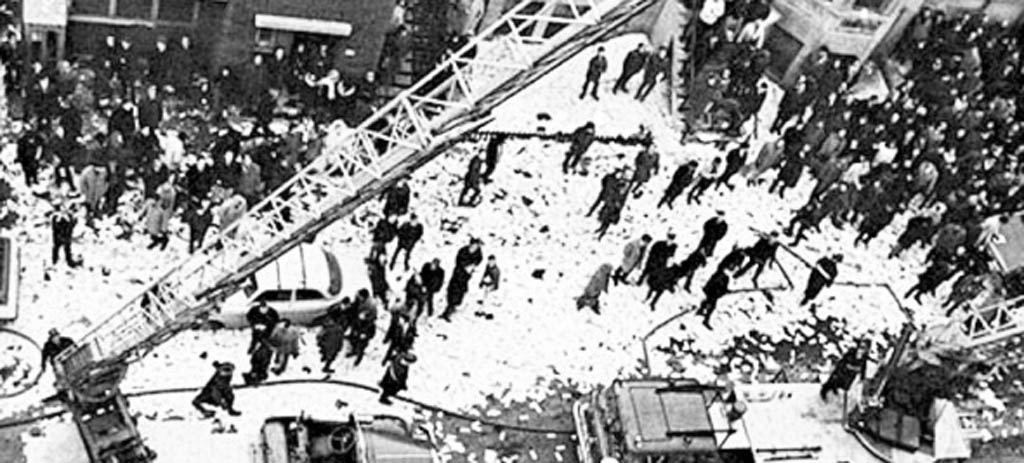
It’s known in local lore as the “Sir George Williams computer riot.” In May 1968, a biology professor at Sir George Williams University was accused of racism against his Caribbean students. After months passed without action from the university administration, students occupied the ninth floor computer centre in February of 1969. Eventually, computers were trashed, windows were broken, and punch cards floated down onto the snowy street below. The riot squad moved in; someone started a fire. The damage was in the millions of dollars.
Computer punch cards and other paper litters the ground below the Henry F. Hall Building of Concordia University in February, 1969. (Concordia Archives photo via Nationa Film Board of Canada web site.)
On Friday, Oct. 9, 2015 we Montrealers will have a rare opportunity involving time, memory and (physical space). In the ground floor in Room H-110 of the Henry F. Hall Building, of Concordia University, we can watch a documentary about the events that took place all those years ago, just a few storeys above. (Before the occupation, a committee to discuss the complaints against the teacher had taken place in H-110 itself.)
Among the people who attend tonight, some will have little to no knowledge of what happened, some will have watched footage on the nightly news back in the day, some might have been part of the occupation. Some might be second-generation Concordia students.
What will it feel like? I can’t imagine, but I intend to find out. I’m sure there will be many interesting questions and comments. Director Mina Shum and members of the Concordia Caribbean Student Union will be among the guests at the screening.
Ninth Floor was shown at the Toronto Internationl Film Festival (TIFF) and received positive reviews. Some U.S. writers expressed surprise and disappointment that Canada is not always the kinder, more gentle nation that we (and they) might like to think that we are.
For those who cannot go on Friday, Oct. 9, there will be another screening at noon on Friday, Oct. 16, 2015, in the J. W. McConnell Building across the street.
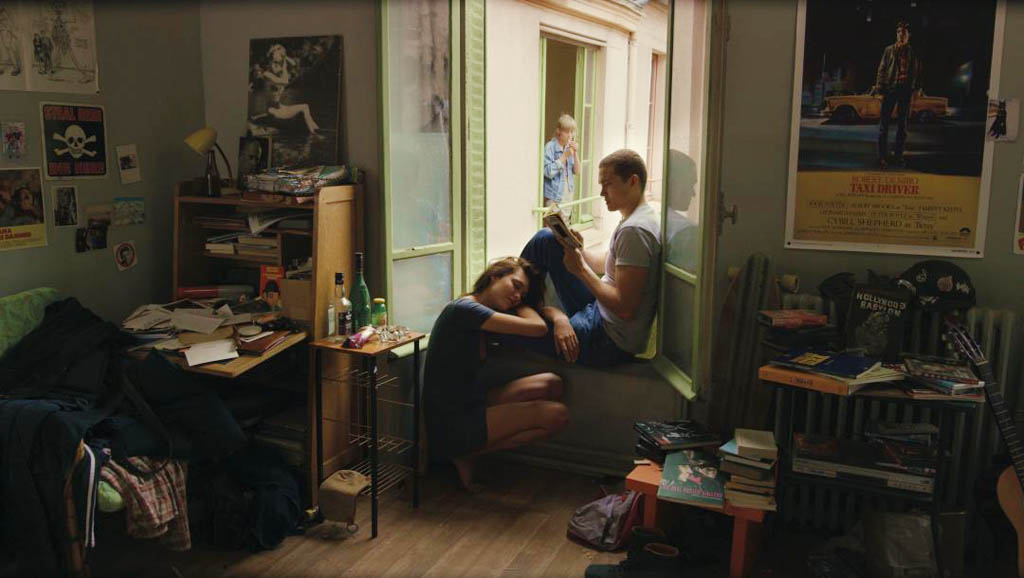
In this scene from Gaspar Noe’s film Love, Electra (Aomi Muyock) and her boyfriend Murphy (Karl Glusman) relax in their Paris apartment. New neighbour Omi (Klara Kristin) can be seen through the window.
“Well, that’s two hours of my life I’ll never get back.” It’s not a very original complaint (sorry!) but that’s what I was thinking, long before Love, the latest film from Gaspar Noé, was over. I wasn’t able to appreciate it. And it’s actually two hours and 14 minutes long, strictly speaking.
The film is called Love, but “Clueless Jerk,” might be a more apt title.
The main male character is an American in Paris named Murphy (Karl Glusman). His girlfriend, dark-haired Electra (Aomi Muyock), left him because he got another woman pregnant.
The film opens with Murphy and Electra having sex. Is that Murphy’s dream in the present day, or is that Noé telling us that they used to be a couple? Could be either, I guess. His phone rings and Murphy wakes up. He is in the same room (though it has different decor now) and the woman in the bed beside him is blonde. It’s New Year’s Day and the call is from Electra’s mother. She has not heard from her daughter for two or three months and she’s worried. Does Murphy know where she is?
There’s lots of voice over as we hear Murphy’s thoughts, which are not very interesting and (when it comes to the blonde, the mother of his child), quite rude and crude.
As the story unfolds we see that Murphy behaved very badly on many, many occasions. He wishes he could turn back time, though there’s no indication he would have behaved differently. In his mind, he declares his love for Electra, over and over. I was not convinced. Is he even serious about that, or is it just a story he’s telling himself, now that something bad might have happened to Electra, and she might be permantently out of his reach?
There are so many sex scenes in Love. I hear that you can see that kind of thing on the Internet, at home, for free. No need to go to the cinema! There isnt much laughter between this couple, though. What kind of relationship is that?
Love is in 3D, which added nothing to the experience for me, except for a scene where Murphy blows smoke rings, which was cool for a few seconds.
If you are already a Gaspar Noe fan, Love might be for you, especially since he will be in town to present the film.
LOVE, 134 Min, VOSTF
Written and directed by Gaspar Noé
Cast: Aomi Muyock, Karl Glusman, Klara Kristin, Juan Saavedra
Thursday, Oct. 8, 2015 at 8 p.m.
Concordia University, Alumni Auditorium (H-110), Hall Building, 1455 de Maisonneuve Blvd. W., Montréal, QC
Montrealers can see the important documentary film about climate change, This Changes Everything, at 7 p.m., on Monday, Oct. 5, 2015, at Concordia University (1455 de Maisonneuve Blvd. W., Room H-110) thanks to the organization Cinema Politica. Writer Naomi Klein and director Avi Lewis will be there. Suggested donation is $10 – $20. That’s probably all the information many of you will need. For others, I hope the review below will make you want to see it.
It’s all about the story – the story that we’ve been told, the story that we tell ourselves, the story that we believe. That story might be so firmly engrained in us that we never even think about it, or question it.
And that story is, that the Earth is a machine, and that mankind can and should manipulate its levers. The unfortunate results of that thinking can be seen all around us.
Changing the story is the first step toward changing our lives, our future and the life of this planet that we all depend upon.
After some opening shots of hurricanes, parched earth, polar bears and crumbling, tumbling ice bergs, This Changes Everything takes us to the ugly and monstrous tars sands of Fort McMurray, “the largest industrial project on Earth.” Would the citizens of any large city like Calgary, Edmonton, Vancouver, Toronto or Montreal accept such a huge and destructive project if it were in their own backyard? Somehow I doubt it. But the tar sands are far away and the local population is small. Later in the film, such a place is called a “sacrifice zone.”
One worker claims: “If not for the oil sands, there’d be nothing to come here for.” Then the camera shows us some stunning scenery – a majestic river flowing through a pine forest.It might be difficult for the average person to get up there, but many people would enjoy seeing it, or just knowing that such a place exists.
When we’re told that $150 to $200 billion would be invested there over the next decade, I couldn’t help but wonder what could be accomplished if that kind of money was spent on sustainable development instead.
The abuse of the English language and the twisted metaphors used by some of the people in this film – you have to hear them to believe them. I predict gasps, laughter, boos and hisses at various points during the screening of This Changes Everything.
One guy has the nerve to frame the tar sands project this way: “We’re cleaning up one of the largest oil spills on earth.” There are claims that the area will be brought back to its original state 20 years from now. Tailing ponds will be cleaned and, “you’ll be able to drink the water.” I’d really like to believe that, but I just can’t.
Meanwhile, the Beaver Lake Cree Nation has filed a court case to stop any further exploration, since the oil sands are under their traditional land and the present project has already done so much damage to their lives.
I won’t describe the whole film in detail, but I will say that it visits activists in Montana, New York state, India, Greece, China and Germany. People are standing up, complaining, saying “No!” to rampant development, demanding their rights and a new way of doing things.
While Klein does not present Germany as a perfect place, she produces some impressive statistics (30 per cent of Germany’s electricity comes from renewables, emissions are down, employment is up, etc.) Could Canada do the same? Especially if we can elect a new government in a few weeks?
Speaking of our country, as a Canadian, I’m embarrassed and distressed to see a Canadian mining company throwing its weight around in Greece, eager to get its corporate mitts on the gold there. My apologies to you, people of Halkidiki. And shame on you, mayor of Halkidiki, who dismissed the intimidation and arrests of protestors when he said: “the police don’t knock on doors without a reason; they don’t knock on yours or mine.”
This woman in Halkidiki, Greece, opposes a Canadian gold mine in her area.
This Changes Everything, the film, is a companion piece to Naomi Klein’s book This Changes Everything: Capitalism vs. the Climate. They were created at the same time, the film is not based on the book.
I think it’s quite wise that the subhead, “Capitalism vs. the Climate” is not attached to the film – why alienate some of your potential audience right off the bat? As far as I can recall, the word “market,” as a synonym for capitalism, is not heard until 27 minutes into the film, and capitalism itself is not mentioned until 45 minutes in, when Greek activist Mary Christianou identifies it as the core problem. She’s initially reluctant to even say so on camera, because: “I don’t know if it helps the struggle.”
In reviewing the book, some writers suggest that “neo-liberalism” is more to blame for many of our present ills than capitalism alone. Abandoning the belief that all the resources of the Earth, the metals, the coal, the gas and the oil must be extracted, and that the Earth itself is just a machine that we can be trusted to run, seem like easier first steps on the path to change.
This screen grab from the documentary film This Changes Everything shows India buried under “Proposed Coal-Fired Power Plants.”
This Changes Everything will be shown on Monday, Oct. 5, 2015, 7 p.m., at
1455 de Maisonneuve West, Room H110, Concordia University, Montreal, QC.
Naomi Klein and Avi Lewis will be there for a Q&A session after the film.
Manos Sucias (Dirty Hands) is a taut tale set in Buenaventura, on the Pacific coast of Colombia. Within the first few minutes we see several tough-looking guys and many serious weapons. (There’s even a little kid nonchalantly cleaning a revolver.) Buenaventura is obviously a dangerous place, and a quick Google search will confirm that, with headlines like: Colombian City’s New Face and Violent Underbelly Collide; Colombian port city terrorised by criminal gangs – BBC News; Welcome to Buenaventura, Colombia’s most violent city.
There are 400,000 people Buenaventura, though we only see a handful of them, in the roughest, poorest parts of town.
Our main characters are Jacobo (Jarlin Martinez) and his younger brother Delio (Cristian Advincula). They’ve been estranged for years but end up working on the same drug run for Don Valentin. It’s the first time that Delio has done this kind of thing; Jacobo is an old hand who plans to move to Bogota once the job is done. That made me suspect that things might not go well for these guys. Just think of all the films have been made about that one last heist, or the cop who is one week, or even one day away from his retirement.
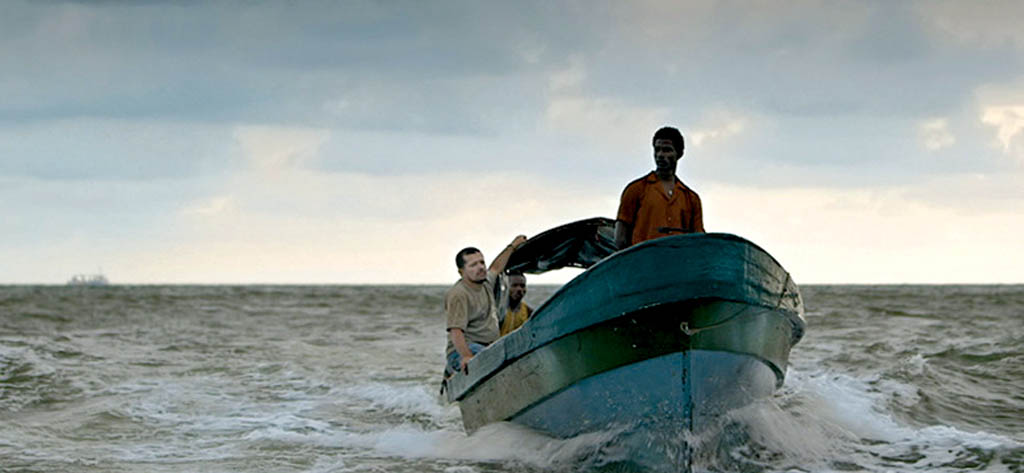
Jacobo and Delio will help a man named Miguel (Hadder Blandon) to pilot a small, battered fishing boat north towards Panama. This will take several days. Attached to the boat is a “torpedo” filled with 100 kg of cocaine in small packets. All of the packets will be weighed at the checkpoint, the guys are told. Point taken, no need to elaborate further.
The torpedo is fitted with a tracking device just in case it comes loose from the boat. (Cough.) Miguel has a cellphone, a GPS locator, and a gun. Delio has a machete that he uses to open coconuts, among other things. Seeing these items, one wonders if, or more likely when, they will be used, and in what circumstances.
Jarlin Martinez plays Jacobo in Manos Sucias, a film from Colombia that’s being shown at the 2015 Montreal International Black Film Festival.
During their trip they will have to worry about running into guerrillas, the military, the paramilitaries, and anyone else who might have designs on their cargo. These people will feel entitled to take anything they might have, including their lives. There’s nothing dashing or glamourous here. Just danger and dread.
Soccer and racism are recurring themes in Manos Sucias. Before the trip, Jacobo watches an informal game with an old friend. When told about the plan to move to Bogota, the friend says there are no blacks there, or hardly any. They’re only able to get the most horrible jobs, and it’s freezing there, too. Later, Jacobo, Delio and Miguel sit around a campfire, talking about the great soccer stars of the past. Seems like your typical male bonding stuff, until the white Miguel spoils the mood and makes some racist remarks to the Afro-Colombian brothers.
When some unexpected events take Miguel out of the picture, Jacobo and Delio continue with the mission. What else can they do? But what will happen afterwards? (They HAD been told that this would be the “easiest job you ever had.” “Like a paid vacation.” Ha!)
The music Manos Sucias is worth mentioning. Haunting tunes from Grupo Gualajo make use of soaring women’s voices and a marimba.
Fans of Colombian salsa might nod their heads (I did, anyway) when Jacobo has one of those “kids, these days!” chats with his brother, disparaging the rap music that Delio admires and suggesting that he listen to “something good,” like Grupo Niche, Nemus del Pacifico, or Orquesta Guayacan.
Manos Sucias (Dirty Hands) U.S.A./Colombia, 2014, 82 minutes, in Spanish with English subtitles
Directed by Josef Kubota Wladyka, with Cristian Advincula, Jarlin Martinez, Manuel David Riascos, Hadder Blandon. Spike Lee was an executive producer
Sunday, Oct. 4, 2015, at 5 p.m.
At the Former NFB Cinema, 1564 St. Denis
Admission is $10













 Mostlymovies.ca