FIFA 2015 Review: Microtopia, a film about tiny homes, gets an extra Sunday screening

Ana Rewakowicz's Sleeping Bag Dress expands to become a kind of cocoon, in the documentary film Microtopia.
Ana Rewakowicz’s Sleeping Bag Dress expands to become a kind of cocoon, in the documentary film Microtopia.

Previous screenings of Microtopia at the Festival International du Film sur l’Art (FIFA) were sold out; an extra screening has been added for Sunday March 29, 2015. Another film, Strange and Familiar: Home and Architecture on Fogo Island, will be shown with it, as part of a double bill.

Microtopia is about possibilities, news ways of thinking and living. It features tiny houses, micro dwellings, and a VERY portable shelter – the Sleeping Bag Dress.

Montreal artist Ana Rewakowicz arranges her Sleeping Bag Dress, in the documentary film Microtopia. Note the Farine Five Roses sign in the background.

In northern California, Jay Shafer is living in his fourth tiny (and tidy) house. He built it himself. It’s made of dark wood and from the outside it looks like something a surbanite might put in the backyard as a place to store the lawnmower or where children can play house. The exposed wood on the inside gives it a warm and cosy look. Burners for cooking hang on the wall when not in use, to free up counter space.

Shafer explains that in the U.S., there are regulations that specify a minimum size for rooms in a house. He got around this restriction by putting his dwelling on wheels; strictly speaking, it is no longer a house.

Jay Shafer's tiny house in the documentary film Microtopia. It is being shown on Sunday, March 29, at FIFA, Montreal's Festival of Films on Art.
Jay Shafer’s tiny house in the documentary film Microtopia. It is being shown on Sunday, March 29, at FIFA, Montreal’s Festival of Films on Art.

Jennifer Siegel makes homes from former shipping containers, or long-haul trucks. These look relatively spacious compared to Shafer’s home.

In Mexico, Richart Sowa built his own floating island on a base of wooden pallets and reclaimed plastic bottles. (“Boats rock but island roll,” he says.) It is quite ramshackle, compared to Shafer’s construction.


Richart Sowa built his own island in Mexico, using wooden pallets and plastic bottles, lots of plastic bottles. Sowa is one of several participants in the documentary film Microtopia.

Greek architect Aristide Antonas proposes making a home from old tanker trucks, though he admits living in one might feel like being in prison.

In Denmark, Ion Sorvin shows a sort of plastic igloo that one call roll along the sidewalk and then “park” on the road, between cars. He’s also made a more spacious creation – a “walking house.”

Dre Wapenaar of the Netherlands hangs pod-like tents from trees. He had designed them with the thought that eco-activists could use them while carrying out “actions” to save forests, but before he could contact any such activists, a campsite owner offered to buy them.

Dre Wapenaar of the Netherlands designed these tree tents. Rockabye baby!


There’s even a Montreal segment! Artist Ana Rewakowickz, who’s originally from Poland, demonstrates the Sleeping Bag Dress within sight of the famous Five Roses Flour sign.

And that brings me to one of my quibbles about the film. During the opening credits, we see the names faces and dwellings of the participants while they say a few words. That’s the last time we see their names.

They rarely say where they are, either. Three people were obviously in the U.S., and two of them were in deserts, though it was not clear if it was the same desert, or what state they were in. I had to Google Sowa to find out where his island was. Maybe I should recognize Copenhagen when I see it, but I had to Google Sorvin, too.

The artists and architects in the film talk about reusing and recycling, shrinking their environmental footprints, and ask how much stuff and how much space do we really need, etc?

A fascinating topic, though one size would definitely not fit all. Claustrophobics need not apply! It’s interesting to note that, the occasional drawing aside, we never see more than one person at a time in these dwellings. Few of these people could tell their friends “Drop by anytime!”

I cannot agree with Jennifer Siegel’s statement that we can keep all our memories on our hard drives now, and therefore we can get by with very few physical things. Speak for yourself, lady! There must be a happy medium, no?
Microtopia
Sweden / 2013 / Color / 52 min / English

Strange and Familiar: Home and Architecture on Fogo Island
Canada⎢ Katherine Knight, Marcia Connolly⎢ 2014 ⎢ 52 min
Cinquième Salle of Place des Arts, 175 Ste. Catherine St. W.

Microtopia
Realisation: Jesper Wachtmeister
Cinematography: Kenneth Svedlund
Sound: Jesper Wachtmeister, Kenneth Svedlund
Editing: Jesper Wachtmeister, Oscar Willey
Music: Benny Nilsen
Producer(s): Jesper Wachtmeister, Jonas Kellagher
Production: Solaris Filmproduktion, Eight Millimetres AB
Distribution: Autlook Filmsales

The Festival International du Film sur l’Art, known as FIFA, runs until Sunday, March 29, 2015. Visit the web site www.artfifa.com for more information.

FIFA 2015 Review: Donald Duck documentary is really two films in one


Image from the documentary film Donald Duck Ð Le Vilain Petit Canard En Nous, which is being shown in Montreal at FIFA, the Festival International du Film sur l'Art.
Image from the documentary film Donald Duck Ð Le Vilain Petit Canard En Nous, which is being shown in Montreal at FIFA, the Festival International du Film sur l’Art.

Ninety minutes devoted to Walt Disney’s film and comic book character Donald Duck? Yessireebob!

In truth, Donald Duck – Le Vilain Petit Canard En Nous, is more like two films, awkwardly cobbled together. For about the first 30 minutes, it’s all about The Donald. Apparently, he is really big in Europe. Every week, to this very day, in some European countries, one person in four reads about Donald Duck. Who knew?

Asssorted people from France, Germany and Scandinavia talk about their first encounter with the cranky fowl and what he means to them.

After World War II, Donald Duck was part of an effort to de-Nazify German children. In translating the comics into German Erika Fuchs made them more literary, witty and thoughtful than the originals.

Gottfried Helnwein of Germany is one of the many artists who appears in the documentary film Donald Duck Ð Le Vilain Petit Canard En Nous, which is being shown in Montreal at FIFA, the Festival International du Film sur l'Art.
Gottfried Helnwein of Germany is one of the many artists who appears in the documentary film Donald Duck Ð Le Vilain Petit Canard En Nous, which is being shown in Montreal at FIFA, the Festival International du Film sur l’Art.

Donald Duck fans (Donaldistes in French, if I heard correctly) have yearly conferences where they present serious papers about him.

Among the statements made by assorted talking heads: Donald Duck is never satisfied, he always wants more. He wants fame and recognition. He is ordinary, naive, but not an idiot. We can all identify with him; he can be a clown, evil or generous. He never wins, but he never gives up. Okay then.

Then, the film turns to winners and losers and success, with segments about the Razzie Awards (it’s a rather long segment), the Funny or Die comedy-video website, life coaches, the tradition of the village idiot, and an excerpt from the German version of the TV show The Office. To be honest, this second part was not that interesting for me.

Donald Duck - always full of big dreams! Image from the documentary film Donald Duck Ð Le Vilain Petit Canard En Nous, which is being shown in Montreal at FIFA, the Festival International du Film sur l'Art.
Donald Duck – always full of big dreams! Image from the documentary film Donald Duck Ð Le Vilain Petit Canard En Nous, which is being shown in Montreal at FIFA, the Festival International du Film sur l’Art.

Pet peeve: This film is made for French audience. When anyone is speaking a language other than French, a translator talks on top of them. No subtitles. Two people talking at once. Annoying in the extreme. There should be a law, I say!
Donald Duck – Le Vilain Petit Canard En Nous (Germany / 2014 / Color / 90 Min / French, English, German with French translation), Friday, March 27, 2015 at 6:30 pm at the Cinematheque Québecoise, 335 de Maisonneuve Blvd. E,

Donald Duck – Le Vilain Petit Canard En Nous
Realisation: Edda Baumann-Von Broen
Script: Edda Baumann-von Broen
Cinematography: Edda Baumann-von Broen
Participation(s): Jean-Pierre Dionnet, Gottfried Helnwein, Øyvind Holen
Producer(s): Hasko Baumann
Production: Avanti Media Plus
Distribution: Avanti Media Plus
The Festival International du Film sur l’Art, known as FIFA, runs until Sunday, March 29, 2015. Visit the web site www.artfifa.com for more information.

FIFA 2015: Looking at Gustave Courbet’s The Painter’s Studio as a puzzle and a history lesson

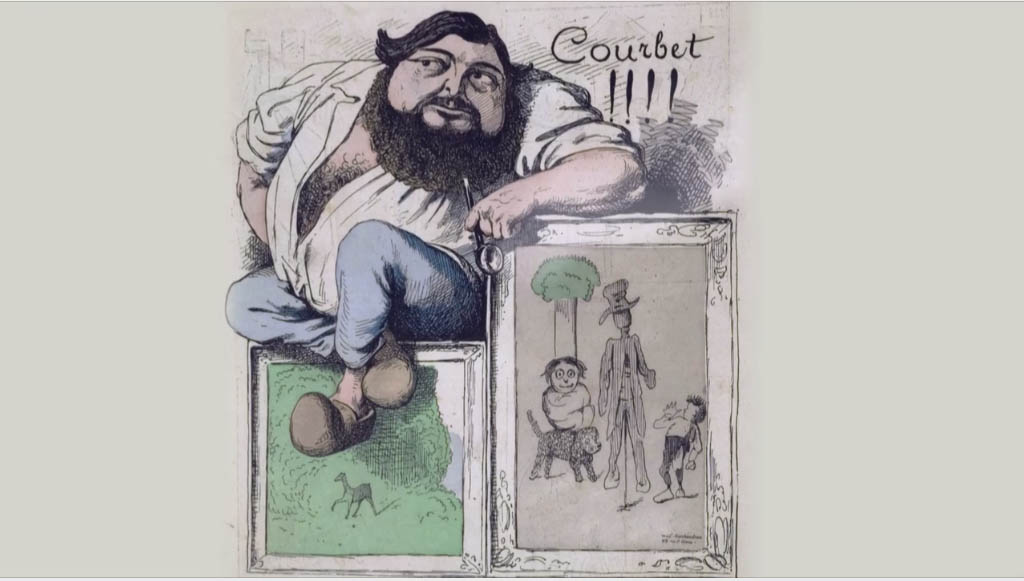
Caricature of painter Gustave Courbet from the documentary film Les Petits Secrets Des Grands Tableaux – Courbet, L’atelier Du Peintre


French painter Gustave Courbet (1819-1877) was admired by some and mocked by others. He was self taught, which earned him the scorn of academicians. He hobnobbed with the rich and powerful though he sided with workers and disadvantaged.

The 26 minute film takes a quick look at Courbet’s life and works before turning to his large and crowded work with the long name – The Painter’s Studio: A Real Allegory of a Seven Year Phase in my Artistic and Moral Life.

The Painter's Studio: A Real Allegory of a Seven Year Phase in my Artistic and Moral Life, by Gustave Courbet.
The Painter’s Studio: A Real Allegory of a Seven Year Phase in my Artistic and Moral Life, by Gustave Courbet.

Courbet created it for a salon at the 1855 Paris World Fair (or Exposition Universelle des produits de l’Agriculture, de l’Industrie et des Beaux-Arts de Paris 1855 to give its full name). The jury refused to accept this painting, though eleven of his other works were shown. (These days, the painting hangs in the Musée d’Orsay.)

In examining the many possible reasons for this refusal, the filmmakers tell us about the many styles that appear in the painting – portraits, still life, history painting – and the people in it, who include George Sand, Charles Baudelaire, Pierre-Joseph Proudhon, and the Emperor Napoleon III himself. He had been elected president of France but later staged a coup d’etat and declared himself emperor. In the painting he is portrayed as a hunter wearing tall leather boots. Censorship was so strong at this time that the mere mention of “boots” could result in a prison sentence.

This film is filled with a wealth of detail and historical information.

Les Petits Secrets Des Grands Tableaux – Courbet, L’atelier Du Peintre will be shown as part of a double bill with Beatus: The Spanish Apocalypse, which is 90 minutes long, on Friday, March 27, 2015 at 1:30 p.m. at the Musée des beaux-arts de Montréal – Maxwell-Cummings Auditorium, 1379 Sherbrooke St. W.

Les Petits Secrets Des Grands Tableaux – Courbet, L’atelier Du Peintre
France / 2014 / Color / 26 Min / French
Realisation: Clément Cogitore
Script: Thomas Cheysson, Elisabeth Couturier
Editing: Erwann Chabot, Julien Ngo Trong
Music: Roque Rivas
Narration: Clémentine Célarié
Producer(s): Sophie Goupil, Daniel Khamdamov
Production: Les Poissons Volants, ARTE France, Les petits secrets des grands tableaux
Distribution: ARTE France

The Festival International du Film sur l’Art, known as FIFA, runs until Sunday, March 29, 2015. Visit the web site www.artfifa.com for more information.
FIFA 2015 Review: Ian Rankin – My Edinburgh

Crime novelist Ian Rankin looks at the city of Edinburgh.

Popular Scottish crime novelist Ian Rankin shares stories about his early days, (he wrote 16 books before he had a bestseller – such persistence!) talks about his creation police inspector John Rebus and takes us on a tour of “hidden Edinburgh” where there are “always new crime scenes to be discovered.” He says Edinburgh has all of the amenities of a large city while being conveniently compact. And it’s really the main character of his books, more than Rebus himself.

Tiny wooden dolls inisde tiny wooden coffins might be connected to notorious Edinburgh grave robbers and murderers Burke and Hare.

This tour includes a visit to an underground street, several graveyards, the Scottish Parliament, tales of cannibalism and bodysnatchers, the murderers Burke and Hare, the continuing mystery of 17 tiny coffins that date back to the 1830s, and the story of Deacon Brodie, the Edinburgh city councillor and cabinet-maker who was the inspiration for Robert Louis Stevenson’s novel The Strange Case of Dr. Jekyll and Mr. Hyde. (Stevenson set his story in London, though.) Sherlock Holmes author Arthur Conon Doyle was from Edinburgh, too, and he also set most of his stories in London.

Rankin reveals that in the first few Rebus books he set events in unnamed, fictional streets. Later he decided he might as well use real places, so he had Rebus working in a real police station, drinking in real pubs and living in the neighbourhood Rankin had lived in while attending university.


"That was my bedroom window," says writer Ian Rankin, pointing at the apartment he lived in during his student days. He decided that his character, police inspector John Rebus, would live across the street.
“That was my bedroom window,” says writer Ian Rankin, pointing at the apartment he lived in during his student days. He decided that his character, police inspector John Rebus, would live across the street.

Actor and historian Colin Brown runs Rebustours.com, which gives tourists a chance to visit the places mentioned in Rankin’s books. He mugs a bit while reading passages from the books. Rankin himself tags along with Brown for a while. Did the tourists even recognize him? I wasn’t certain. But I was sold on the attractions of Ediburgh. I’d be willing to check it out!
Wednesday, March 25, 2015, 6:30 p.m., at Grande Bibliothèque de BAnQ – Auditorium, 475 de Maisonneuve Blvd E.

Ian Rankin – My Edinburgh, Austria / 2013 / Color / 44 Min / English

Realisation: Günter Schilhan
Script: Günter Schilhan
Cinematography: Erhard Seidl
Sound: Albrecht Klinger
Editing: Günter Schilhan, Raimund Sivetz
Music: Franz Sommer
Narration: August Schmölzer, Stefan Suske, Günter Schilhan
Participation(s): Ian Rankin
Producer(s): Rosemarie Prasek
Production: ORF, 3sat
Distribution: 3sat

http://www.artfifa.com/en
The Festival International du Film sur l’Art, known as FIFA, runs until Sunday, March 29, 2015. Visit the web site http://www.artfifa.com for more information.

FIFA 2015 Review: The Man Who Saved the Louvre

This entrance to the Louvre Museum in Paris was named after Jacques Jaujard, the man who saved the museum's art from destruction during World War II.
This entrance to the Louvre Museum in Paris was named after Jacques Jaujard, the man who saved the museum’s art from destruction during World War II.

The Man Who Saved the Louvre is the intriguing story of Jacques Jaujard. In the late 1930s, with war in Europe looking more and more likely, Jaujard, director of the French National Museums, drew up an elaborate evacuation plan, to keep the country’s cultural heritage safe from bombs and Nazi art collectors, from Hitler on down. This was his own idea, no one asked him to do it.

Near the end of August 1939, 4,000 works of art were packed into crates, ready to be sent to châteaux in the countryside. Art from the Louvre included the Mona Lisa and the sculptures the Winged Victory of Samothrace and the Venus de Milo.

During World War II the art treasures of the Louvre were dispersed to a number of chateaux for safekeeping.

While many paintings were removed from their frames and rolled up, others were too delicate for that treatment. Géricault’s huge Raft of the Medusa was loaded onto an open truck, protected only by a tarpaulin. The painting was so large (five metres high, seven metres wide) that it knocked down power lines.

Museum staff members looked after the art works in their temporary homes throughout the war. They protected them from heat, cold and humidity, practiced fire drills every day, and wrote LOUVRE in big letters on the lawns of the châteaux to alert any Allied bombers to the treasures. Some items were moved as many as five times before the war was over.

Louvre warning
Warnings were placed on the ground to alert Allied bombers to the presence of art treasures.


Intrigue and a love interest is provided by one of Jaujard’s contacts in the French Resistance. The agent with the codename “Mozart,” turns out to be a glamourous former actress.

The film uses photos, archival footage, Jaujard’s notebooks and testimony from witnesses to tell the story. An animated version of Jaujard makes the occasional appearance as well.

The Man Who Saved the Louvre is presented in a more engaging way than another FIFA selection about art during World War II, the Austrian film Hitler’s Mountain Of Stolen Art. That film, which will also be shown on Wednesday, March 25 (at 6:30 p.m.) looks at a treasure trove of stolen art that was stashed in a salt mine in Altaussee, Austria.

Once he realized that he was losing the war, Hitler gave orders to blow up the mine and the art with it. His order was not carried out, and the filmmakers look at a number of candidates in an effort to figure out try to find out who saved the art. The film just seems to go around in circles and has far too many interviews where the translation is spoken and not given via subtitles.

The Man Who Saved the Louvre

France / 2014 / Color, B & W / 60 min / English with French subtitles, part of a double bill with:

Grandeur des petits musées
France / 2014 / Color / 47 min, / in French

Wednesday, March 25, 2015, at 4 p.m., at the Maxwell Cummings Auditorium, Montreal Museum of Fine Arts, 1379 Sherbrooke St. W.

The Festival International du Film sur l’Art, known as FIFA, runs until Sunday, March 29, 2015. Visit the web site www.artfifa.com for more information.

Cinema Politica Mondays: Documentary Children 404 shows how anti-gay law endangers Russian LGBT teens

Image from the Russian documentary film Children 404

Countries are often called Motherland or Fatherland. How sad is it when a country can’t love and accept all of her children equally? How sad is it when flesh-and-blood parents turn their backs on their own children and say things like: “You are not normal, you are sick, why did I ever give birth to you?” Or worse yet: “You are a son of Satan!”

The documentary film Children 404 presents compelling evidence that homophobia is rampant in Russia, and that a law passed in 2013 has encouraged anti-gay vigilantes while also keeping many already wary and isolated teens in the closet.

This law bans propaganda about “non-traditional sexual relationships,” aimed at minors. In effect, that means that it’s illegal to offer support to gay teens – to tell them that they are normal, that they are not freaks of nature, and that they are “not the only one” – that there are many other people around the world just like them.

The film is named for the web site Children 404 (Deti-404 in Russian) which serves as an online meeting place for teens who might not have anywhere else to go. It was created by journalist Elena Kilmova; after she wrote an article about LGBT (lesbian, gay, bisexual or transgender) youth, she received email from a teen who had been suicidal until she read the article.

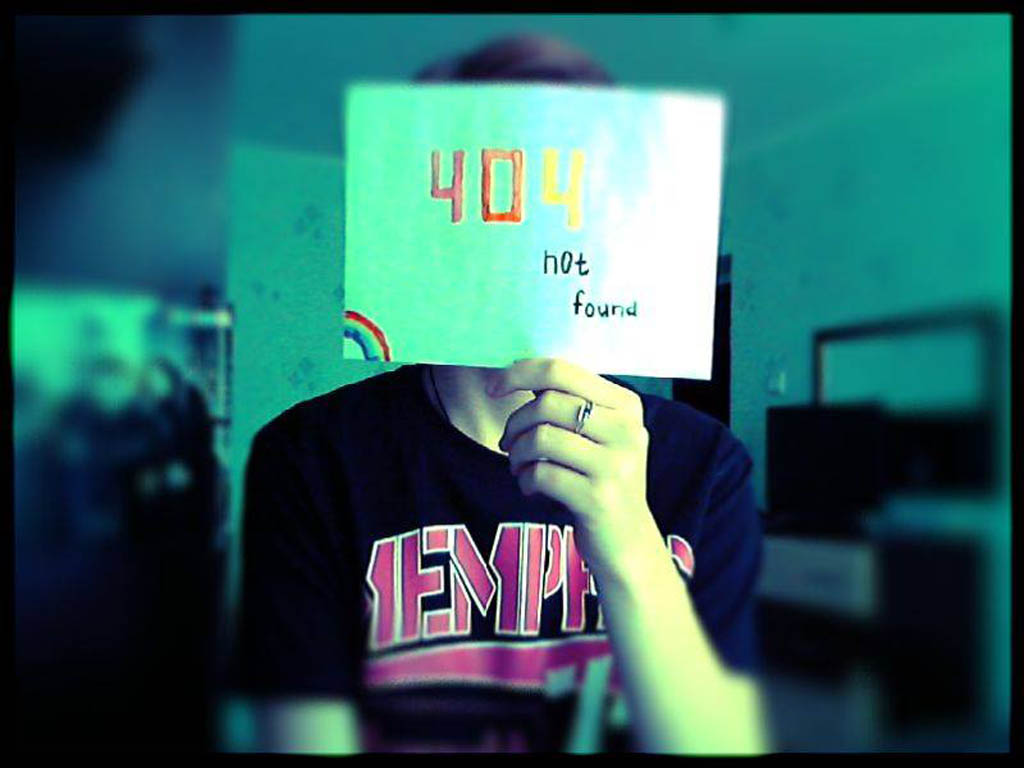
The name is inspired by “Error 404, page not found” a message that often comes up on the Internet. Klimova chose it because Russian society is seemingly telling gay teens that they don’t even exist. It gives then a chance to say “We are here!”

not found

More than 22,000 joined the group; 1,364 shared their stories.The film features excerpts from the messages posted on the site. Many are heart-rending, filled with sadness and despair. One mocks the idea that anyone would possibly “choose” to be gay. “Hey kids, be gays! Everyone hates us, humiliates us, beats us up – this is so cool!”

Few teens dare to tell their parents about their orientation, for fear of being thrown out of the house. The father who accepts his daughter and is proud that she is different is a rare exception.

A Guardian article about Error 404 quotes a “16-year-old from a small town ‘which isn’t even on the map’.” He says “Our school is considered progressive, but it is quite normal for teachers to say that homosexuals will burn in hell.”

Another Guardian article from 2013 says that “an MP in the Siberian region of Zabaikalsk called for a law allowing gays to be publicly flogged by Cossacks.”

Elena Klimova was 25 when the film was made. She doesn’t look much older than a teenager herself, which is remarkable considering the stress she must have been under for years. She reveals that she and her partner lost their jobs because of their orientation. They were both told to resign. Almost all the same-sex couples she knows want to leave Russia, but she does not want to go. She looks forward to a future when the present-day situation will be described as the “stone age,” and she hopes that it won’t take decades to arrive.

Klimova has been taken to court twice over the web site, in the most recent case, she was fined 50,000 rubles, approximately $740 U.S. An online notice from Amnesty International, dated March 18, 2015, says the the “Prosecutor’s Office in one of St Petersburg’s districts had submitted a request to have the Children 404 group. . .closed down.” Readers are urged to support Klimova by writing to Russian officials in protest.

Elena Klimova, founder of the Russian web site Children 404, which gives gay teens a place to express themselves and seek advice and support.

Forty-five members of Error 404 participated in the filmmaking, with some sharing footage shot on their cellphones. But an articulate young man named Pasha receives the most screen time. When he visits his former school, the presence of a cameraman doesn’t stop students from yelling insults and throwing things at him. What do they do when they aren’t being recorded?

Pasha says that one of his teachers had said that gay people “should be burned and banished,” and that the school social worker and psychologist told him he was the one with a problem, because he couldn’t accept homophobes. “If you find love for them, they will find love for you,” they said. As if.

Rather than follow their surreal advice, Pasha’s solution is to move to Canada, home of his idol, Justin Bieber(!) He says “I am convinced that after seven years I will have a family, small kids and a house.” He also says that he plans to study journalism and possibly enter politics. He’s obviously a strong, smart and very determined guy, though I wonder if he has checked the price of Toronto real estate lately, or the sorry employment prospects for journalists in North America. All the same, I wish him the very best in his life here.

I have a suggestion, too. There’s a scene at a memorial to Lenin where Pasha sings a slightly fractured version of O, Canada. It sounds like he’s singing “We stand on guard for free.” Once he learns all the words, why not invite him to sing the anthem at some public event?

Pasha Romanov visits a friend before leaving Russia for Canada, in a scene from the Russian documentary Children 404. (Romanov now calls himself Justin, in honour of Justin Bieber.)

The web site Queer Russia says that vigilantes and policemen with machine guns tried to disrupt the premiere of Children 404 in Moscow last year. Police “checked the IDs of the audience, looking for minors and writing down passport data of some people.”

I’ve been asked to include this information: “Cinema Politica is presenting the Quebec premiere screening of CHILDREN 404 on Monday, March 23, 2015. Directors Askold Kurov and Pavel Loparev will be in attendance all the way from Russia for a Q&A after the screening! The event is co-presented with Radical Queer Semaine, Concordia Documentary Centre, Simone de Beauvoir Institute, and Queer Concordia.
More information can be found about Children 404 here:

While I wasn’t asked to share this info, I am happy to tell you that Cinema Politica was instrumental in getting the film made. The CP web site says “Cinema Politica co-founders Svetla Turnin and Ezra Winton, along with CP Board Member and Concordia University Research Chair in Sexual Representation and in Documentary Thomas Waugh and his colleague Ryan Conrad, launched an Indiegogo campaign to raise essential funds for this project. We eventually surpassed our goal and were able to raise $11,575 U.S. towards the making of CHILDREN 404!” The film’s credits says that all the money usedto make it came from crowdfunding. You might notice that some names appear several times, too.
CHILDREN 404
Directed by Askold Kurov and Pavel Loparev / Russia / 2014 / 70 ‘ / Russian / English subtitles
Monday, March 23, 2015, 7 p.m.
Concordia University, 1455 de Maisonneuve Blvd., W., Room H-110
Montreal, Quebec
Canada

Directors Askold Kurov and Pavel Loparev will be there. (I predict that the first question they’re asked will be “What can we do to help?”)
Suggested admission is $5 to $10.

Lost and Love movie review: Hong Kong superstar Andy Lau plays a heartbroken father determined to find his lost son

Lei Zekuan (Andy Lau) passes out fliers with photos of his missing son in a scene from the Chinese film Lost and Love. (China Lion Film Distribution)

Even though I’m a longtime fan of Hong Kong movie star Andy Lau, I didn’t know that he has made more than 140 films. Busy, busy man!

The versatile actor with the killer cheekbones is equally at home as a handsome, well-dressed guy in frothy rom-coms, as a gangster or cop in crime stories, or as a swashbucking hero in period costume epics.

In Lost and Love (Shi Gu), Lau’s character, Lei Zekuan, is not glamourous, but he is heroic all the same, in his own quiet way.

For 15 years, farmer Lei his been searching for his son, Lei Da, who was abducted while Lei and his wife were working in their orchard. The boy was under his grandmother’s care; someone ran off with him when her back was turned for a moment.

While Lau’s character is sad and subdued, but he’s stubborn, too, determined to carry on and never give up. And he’s not so absorbed in his own quest that he can’t sympathize with others who are in the same boat.

Despite all the paranoia about “stranger danger,” children in North America are more likely to be abducted by a divorced or separated parent who disagrees with a child custody ruling. In China, however, many children are abducted by strangers and sold to carry on the family name, work in the family business, and, eventually, support their new “parents” when old age comes. China’s one child policy and its preference for boys makes child trafficking a lucrative business. In fact, the film’s press notes say that human trafficking (of women and children) is a $30 billion business in China.

And, according to an article on the web site Women of China, before a recent change in legislation, people who bought women or children were only “sentenced to a maximum of three years imprisonment, or detained or put under control for a short time. Most of the buyers only receive a verbal warning, if they did not abuse the women and children before the authorities found them.”

Lost and Love opens with a photo of a beautiful baby, then we see a distraught young woman in a busy intersection – “My child is missing, have you seen her?” she asks, while brandishing photos of her daughter; some do speak with her briefly (“Where did you lose her?” “You should try the Internet,”) while others just hurry by on their way to wherever.

Then the scene switches to Lau, as a weary-looking Lei; he’s one of many men standing on the open deck of a moving ferry. His face is dark from the sun and there are grey hairs in his beard and mustache. No fancy clothes here. He still has his famous sharp cheekbones, though. Lei slumps over his motorcycle, awkwardly trying to nap while his fellow passengers examine the large fabric banner attached to the bike, which shows a photo of his son as a baby, along with details of his disappearance.

One man tells Lei his quest is useless, and he should give up, another man that there’s no way a father could stop looking for his child. Nearby passengers get caught up in the argument and almost come to blows; Lei just waits for the ferry to dock so he can continue his search.

Zeng Shuai (Jing Boran)  repairs Lei Zekuan's damaged motorcycle in a scene from the Chinese film Lost and Love. (China Lion Film Distribution)
Zeng Shuai (Jing Boran) repairs Lei Zekuan’s damaged motorcycle in a scene from the Chinese film Lost and Love. (China Lion Film Distribution)

In an accident that is suggested rather than shown, Lei and his motorcycle sustain some damage. The bike is repaired by young Zeng Shuai (Jing Boran) who reveals that he was abducted himself. Of course, this is very convenient for the plot, but considering how widespread the problem is, it doesn’t seem like such a farfetched development.

Zeng yearns to see his parents again and wonders if they are looking for him, too. He’s distressed, because even in his dreams he can’t see his mother’s face; he can only remember her long braid, a bridge and a bamboo grove. He has practical concerns, too, as a stolen child, without an all-important ID card, he couldn’t continue his education, he can’t marry, he can’t even take a train.

Lei and Zeng hit the road together. China’s major cities might be drowning in air pollution, but there is still some astounding greenery to be seen in the countryside. While they travel, something like a father-son bond develops between them; it’s charming to watch, but they also bicker a lot, which tried my patience. That’s my only complaint about this film, really.

China is huge and so is its population. Trying to find one person seems like an impossible task, but that’s where the power of social media comes in. Lei and Zeng make frequent visits to Internet cafes where they exchange information with people all over China. A woman tells Lei about a teen who might be his son. Hundreds of photos of bridges are sent to Zeng. (The film’s credits mention a real-life organization called Baby Come Home, which has more than 100,000 volunteers across China. Read an English language story about it here, visit the Baby Come Home web site here.)

Tony Leung Ka-Fai, left has a cameo role as a policeman.
Tony Leung Ka-Fai, left, in a cameo role as a policeman, gives Andy Lau directions in the Chinese film Lost and Love. (China Lion Film Distribution)

Tony Leung Ka-Fai and Sandra Ng make cameo appearances in Lost and Love as a police officer and a baby trafficker, respectively.

Lost and Love is written and directed by Peng Sanyuan. She’s a novelist who has also written TV shows, this is the first time she has directed a film.

Lost and Love is in Mandarin with English and Chinese subtitles. It opens on Friday, March 20, 2015. In Montreal it will be shown at:
Cineplex Odeon Forum Cinemas, 2313 Ste. Catherine St. W. Montreal, QC H3H 1N2

Lost and Love will be shown in the Canadian cities of Toronto, Calgary, Edmonton and Vancouver. In the U.S. it will be shown in New York State, Washington State, California, Illinois, Maryland, Massachusetts and Michigan. More information about Canadian and U.S. screenings is available here.
Information about Lost and Love screenings in Australia and New Zealand here.


Cinema Politica Mondays: Righteous pranksters The Yes Men are coming to Montreal! Meet them and see their latest film!

If you’re already familiar with The Yes Men, the following information might be all you need from me: 7 p.m., Monday, March 16, 2015, Room H-110, Concordia University.

For the rest of you. . . The Yes Men are bringing the latest documentary about themselves, The Yes Men Are Revolting, to Montreal. This is the third film about them, so they must be pretty interesting, right? Right! And the film was invited to the Toronto Film Festival in 2014 and the Berlin Film Festival this year.

The Yes Men are multi-talented multi-taskers. They are authors, activists, co-conspirators, inspired impersonators, performance artists, political pranksters, practical jokers, rabble rousers, social-justice warriors. Or, to put it more briefly, they’re “the good guys.” (Well, I think so, and I know that many others do, too.)

The Yes Men are Andy Bichlbaum and Mike Bonnano, though they are aided and abetted by hundreds of like minded souls. They use humour, chutzpah and their considerable wits to expose injustice. They hope that their antics will shame corporations or politicians into doing the right thing.

The Yes Men are canny users of the media. They often get their message out through phony web sites, phony press releases, or at press conferences where they impersonate someone in a position of authority.

Their most audacious prank was on BBC TV in 2004. On the 20th anniversary of a deadly chemical leak in Bhopal, India, Bichlbaum impersonated a “Dow Chemical spokesman” who said that the company would take full responsibility for the disaster and spend $12 billion on clean up and compensation. (Dow Chemical had bought Union Carbide in 2001, but refused to accept any responsibility for the victims or for cleaning up the site, which was still contaminated, 20 years after the leak.)

At least 8,000 people died within 72 hours of the gas leak at a Union Carbide plant, 15,000 more died in the following years, and 100,000 had debilitating illnesses “for which treatment is largely ineffective.”

The hoax got lots of international attention, though sadly it did not prompt Dow Chemical to change its stance.

The Yes Men have impersonated representatives of the World Trade Organization, Halliburton,
U.S. Chamber of Commerce and U.S. Dept. of Housing and Urban Development. They even have “Canadian content.” During a Climate Change Summit in Copenhagen they created several fake web sites that said Environment Canada was committed to making huge reductions in greenhouse gases, and that Canada would pay $13 billion in compensation to African countries that were adversely affected by climate change. They spoofed an oil and gas conference in Calgary, and they put Justin Bieber’s face on an asthma inhaler. (That was on a web site created to mock greenwashing by coal companies. You can read the post I wrote about it here.)
When reviewing the previous films, The Yes Men (2003) and The Yes Men Fix the World (2009) some critics wrote that they would have liked to know more about what makes the Yes Men tick, what prompts their activism. While I’ve not seen The Yes Men Are Revolting, reviews I’ve read indicate that we do learn more about the day-to-day lives of the duo and how their political work has an impact on their family relationships.

There is no fixed price for admission to the screening of The Yes Men Are Revolting, it’s a pay what you can situation, though the suggested price is $5 to $10.
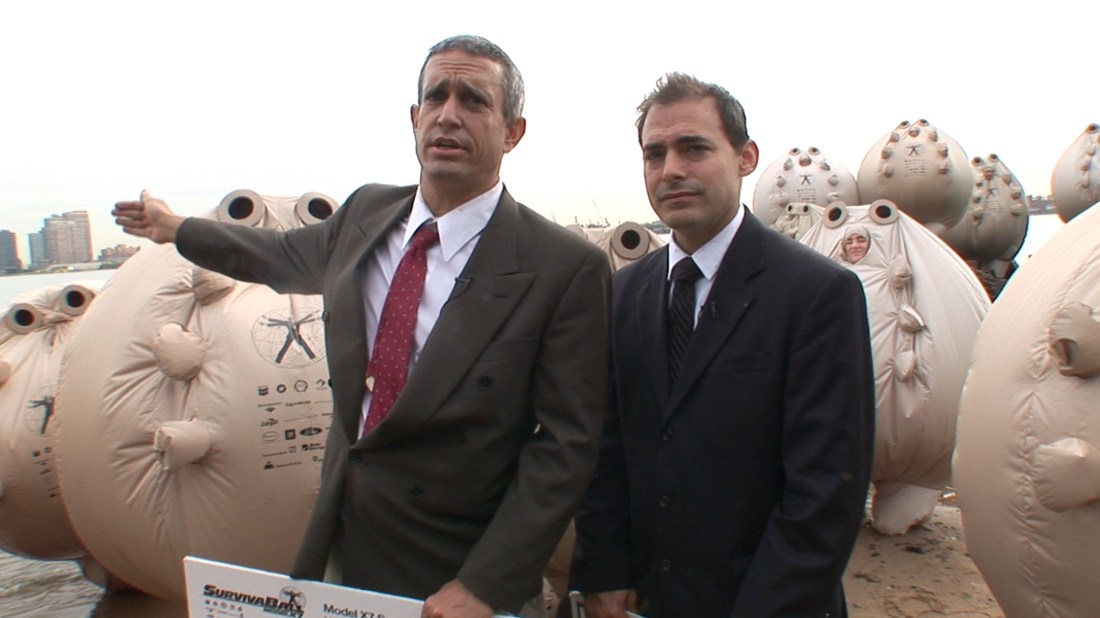
I suggest bringing some extra cash, in case there is some The Yes Men merchandise for sale. Their online store has T-shirts, DVDs, posters, books, spoof editions of New York Times, New York Post AND “one Survivaball: Couture for Climate Calamity. Extremely Limited Edition – $10,000.00” I suspect that the last item is a joke. The thing does exist, but are they really selling it? Maybe we will find out on Monday night.

The Yes Men Are Revolting, directed by Laura Nix & The Yes Men / United States / 2014 / 90 ‘ / in English

Screening, with The Yes Men in attendance, at 7 p.m., Monday, March 16, 2015, 1455 de Maisonneuve West, Room H110, Concordia University, Montreal

The Facebook Event page is here.

Learn more about The Yes Men here.

Learn more about Cinema Politica here.