Review of Window Horses: The Poetic Persian Epiphany of Rosie Ming

Ann Marie Fleming's animated film Window Horses: The Poetic Persian Epiphany of Rosie Ming is incredibly colourful.
Ann Marie Fleming’s animated film Window Horses: The Poetic Persian Epiphany of Rosie Ming is incredibly colourful.

It is cold here in Montreal. We had the first snow of the season on Monday the same day that I saw Ann Marie Fleming’s animated film, Window Horses: The Poetic Persian Epiphany of Rosie Ming. It was like the proverbial breath of fresh air – warm, welcoming, colourful, joyful, musical, magical, mesmerising and marvelous! It’s about the love of family, love for words and music and other good things. It’s also about more complicated stuff like history, dissent, exile, reconciliation and finding your own voice. So many elements, but they all work together well, as in a symphony, or (corny reference, sorry) a beautiful carpet. Window Horses is a treat for the eyes and ears that will touch your heart. (Not exaggerating!)

The film’s French title is La vie en Rosie : L’épopée persane de Rosie Ming – a different cultural reference, while the alliteration remains.

Rosie Ming is a young Vancouver woman of Chinese and Iranian parentage. She was raised by her loving Chinese grandparents and still lives with them. (Rosie has the voice of actress Sandra Oh and a stick-figure body. That body is the alter ego of director Ann Marie Fleming. The other characters look like more conventional human beings.)

Rosie loves Paris even though she has never been there. After self publishing a slender book of her poems (My Eye Full, Poems by a Person Who Has Never Been to France) Rosie is surprised to receive an invitation to a poetry festival in Iran.

Her best friend Kelly (voice of Ellen Page) tells Rosie that she MUST make the trip. (Kelly did not even know that Rosie wrote poetry, so she’s a bit hurt that Rosie kept that info to herself.)
Rosie Ming is drawn as a stick figure in the film Window Horses: The Poetic Persian Epiphany of Rosie Ming. Rosie loves Paris, but there's a map of Iran under her Paris poster.
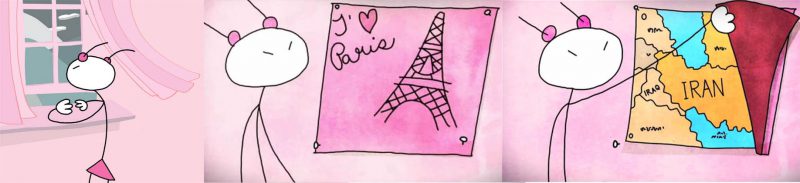
Rosie Ming is drawn as a stick figure in the film Window Horses: The Poetic Persian Epiphany of Rosie Ming. Rosie loves Paris, but there’s a map of Iran under her Paris poster.

Rosie’s grandparents are happy that their little girl has been honoured; they are less enthusiastic when they learn that the event is in Iran. But once Rosie has decided to go, they can’t dissuade her. (Grandpa Stephen is played by Eddy Ko, Grandma Gloria is played by Nancy Kwan. THE Nancy Kwan, of The World of Susie Wong, Flower Drum Song, etc.)

As the airplane starts its descent to the airport, all the women cover their hair with scarves. Rosie outdoes them, going full chador. (Throughout her visit, she is told: “You don’t have to do that, you know.”)

When Rosie tells the customs officer that she is attending a poetry festival in Shiraz, he says that he is a poet, too. Everyone in Iran is a poet!

Even though she is quite young and has only written one book, Rosie is treated with warmth and respect by everyone at the festival, apart from snarky German guest Dietmar, who usually has his nose buried in his phone.

Don McKellar and Sandra Oh enjoy themselves recording the voices of Dietmar and Rosie, for the film Window Horses: The Poetic Persian Epiphany of Rosie Ming.

(Canadian actor and director Don McKellar provides the voice of Dietmar. “I have angst. I’m doomed,” he says.) Other guests include Chinese exile Di Di and U.S. poet Taylor Mali. (Mali is a real-life person.)

Rosie knows about Rimbaud, Baudelaire and other French poets; in Shiraz her hosts introduce her to the verses of Iranian poets Rumi, Hafiz (also spelled Hafez) and Saadi. The last two were both sons of Shiraz.

Window Horses is full of beautiful sequences; here are two. We hear the call to prayer coming from a minaret. The sounds are represented by colourful ribbons that fly through the air. Soon an enraptured Rosie is floating with them. (This sequence was made Kevin Langdale, who is the lead animator and designer of the entire film.) A sequence describing the life of Hafiz is exceptional, with complicated paper cut-outs, whirling calligraphy, etc. Bahram Javaheri, a Vancouver-based Iranian filmmaker, made the cutouts and Michael Mann assembled and animated them using Adobe’s After Effects software.

The Iranian poet Hafiz, right, listens to his father recite poetry in a scene from Ann Marie Fleming's animated film Window Horses: The Poetic Persian Epiphany of Rosie Ming. Bahram Javaheri, a Vancouver-based Iranian filmmaker, made the paper cutouts and Michael Mann assembled and animated them using After Effects software.
The Iranian poet Hafiz, right, listens to his father recite poetry in a scene from Ann Marie Fleming’s animated film Window Horses: The Poetic Persian Epiphany of Rosie Ming. Bahram Javaheri, a Vancouver-based Iranian filmmaker, made the paper cutouts and Michael Mann assembled and animated them using After Effects software.

(People come from all over Iran to visit the tomb of Hafiz; Rosie visits it, too. We learn that Iranians consult books of his poetry to answer questions about their lives – open any page, and his ancient words will have meaning in the present-day situation. This made me think of people consulting the I-Ching back in the 1960s.)

Rosie does not know much Mandarin beyond “ni hao,” yet she is moved to tears by Di Di’s untranslated poem. Even though she does not know the words, she feels their meaning and the emotions behind them. In a flashback scene, Rosie’s parents meet and bond immediately over their shared love for Rumi. When Rosie’s father recites a Rumi poem in Farsi, Rosie’s mother cries crystal tears.

When Rosie's parents meet, her future mother, Caroline, is reading a book by Rumi. Caroline cries when Rosie's future father recites a Rumi poem in Farsi.
When Rosie’s parents meet, her future mother, Caroline, is reading a book by Rumi. Caroline cries when Rosie’s future father recites a Rumi poem in Farsi.

Despite much warmth and happiness in Rosie’s life, and in her visit to Shiraz, there is an undercurrent of melancholy, with gusts to bitterness. Her mother is dead, and her father abandoned her when she was 7 years old. How could he do that? Many people in Shiraz knew her father, and they tell her he was a very good man. At first, Rosie does not want to hear anything about him, but then she, and we, make some surprising discoveries about him. To reveal more would be to spoil things.

Window Horses is among the two opening films of Les Sommets du cinéma d’animation, 15th edition, at the Cinémathèque Québécoise. It will be shown Wednesday, Nov. 23, 2016. at 7 p.m. (Oooops, the screening is now sold out.) Window Horses will get a general release in Canada in 2017.

Read more about Window Horses on the Cinémathèque’s web site.

RIDM 2016: Sundance Now has got a deal for you!

Here are just a few of the music documentaries available from Sundance Now.

Going to Montreal’s documentary film festival RIDM today? It’s the festival’s last day for this year.

If you go, consider having a chat with the people from Sundance Now. They have tables at all or most of the RIDM locations.

You can get a 37-day free trial of the video-on-demand service from them. If you sign up on the Internet you will only get one week. Sundance Now specializes in documentaries, but it has fiction films, and TV shows, too. You can watch them on iOS, Apple TV, Android, Roku,
Chromecast, or the web.

While it doesn’t have as many films as Netflix does, (not yet anyway) once a film is added to the Sundance Now collection, it remains in it – it isn’t deleted a few weeks or months later. That’s a plus, right?

If you don’t like the service, just cancel it before the 37 days are up.

RIDM 2016: Review of documentary film El Futuro Perfecto

In a scene from the hybrid documentary El Futuro Perfecto, Zhang Xiaobin, centre, and her fellow students in a Spanish language class prove that they understand the meaning of the word "ojos."
In a scene from the hybrid documentary El Futuro Perfecto, Zhang Xiaobin, centre, and her fellow students in a Spanish language class prove that they understand the meaning of the word “ojos.”

Xiaobin is a young woman of 17 who moves from China to Buenos Aires to join her parents.

Signing up for Spanish lessons allows her to make friends, expand her horizons and contemplate many possible futures.

Each student in the class is given a Spanish name (she gets Beatriz). They can play at new identities – a nurse from Barcelona, a business woman from Colombia, a lawyer from Montevideo.

They read questionable statements from their text book, “If I marry a rich man, I won’t have to work.” (Tsk, tsk!)

They practice mildly stilted dialogue exercises, inviting each other to meals or to the movies. Outside the classroom, Xiaobin uses those phrases when talking to Vijay, an immigrant programmer from India, and they really do go places together. They still act like they’re practicing, though. They order orange juice, and then decide to leave a few minutes later without even tasting it. “Should we go? “Let’s go.” The audience in the cinema laughs.

After the film, a friend said that the person who played Vijay was not a good actor. I’m not sure about that. I think he might have played his part exactly the way director Nele Wohlatz wanted him to.

The dialogues in their text books will sound familiar to anyone who’s ever taken a language class, but some of the overwrought things Vijay says sound like they’re from a melodramatic telenovela.

Kitty content: After a few dialogues about cats, kittens start to appear in the homes of some of the students.

El Futuro Perfecto is not a typical documentary at all. It’s some sort of hybrid thing – drama/documentary/improv, based on the real-life experience of star Zhang Xiaobin. Many parts are quite funny, too. I would have been happy to spend more time in the world of El Futuro Perfecto, but it’s only 65 minutes long. Maybe writer/director Wohlatz and her cast said every thing that they wanted to say within that time frame. If so, kudos to them for not dragging things out.

Learn more about El Futuro Perfecto or buy tickets on the web site of RIDM, Montreal’s documentary film festival.
El Futuro Perfecto, 65 minutes long, in Spanish and Mandarin with English subtitles.
Director: Nele Wohlatz
Cast: Zhang Xiaobin , Saroj Kumar Malik , Jiang Mian , Wang Dong Xi , Nahuel Pérez Biscayart
Producer: Cecilia Salim
Cinematography: Roman Kasseroller, Agustina San Martín
Sound: Nahuel Palenque
Editing: Ana Godoy
Production: Murillo Cine

El Futuro Perfecto
Sunday, Nov. 20 at 2:30 p.m., Cinémathèque Québécoise, Salle Principale, 335 de Maisonneuve Blvd E.

RIDM 2016: Review of the documentary film Mrs. B. A North-Korean Woman (Madame B. histoire d’une Nord-Coréenne)

The woman who is the subject of Jero Yun's documentary film Mrs. B. A North-Korean Woman (Madame B. histoire d'une Nord-Coréenne), in one of her happier moments.
The woman who is the subject of Jero Yun’s documentary film Mrs. B. A North-Korean Woman (Madame B. histoire d’une Nord-Coréenne), in one of her happier moments.

If Madame B had a Facebook page, she’d have to choose the “it’s complicated” option for sure. I felt sympathy and sadness as I learned more about her story.

Poverty, politics, distance, dictatorship, love, loneliness, children – any one one of those things could make a life more complicated, but what if you stir them all together? And what if the things you want now are not the same things you thought you wanted yesterday?

When Madame B was planning her escape from North Korea to China, she thought that she would work there for about one year, then return to her husband and two sons with the money she had earned.

Things didn’t work out like that. The people who smuggled her out of North Korea sold her to a poor, elderly Chinese couple, to work on their farm and be a wife to one of their four sons. (The parents explain that they could not afford a Chinese wife for all of their sons. I did wonder about the famous “one-child policy,” but it was only introduced in 1980 and there were many exceptions, too.)

Madame B accepted that situation as a temporary thing, with running away as her backup plan. In time she came to realize that her new (common-law) husband was a pretty decent guy; she grew fond of her in-laws too, and vice versa. When we meet her, she has been part of this Chinese family for nine years.

All the same, Madame B. is not happy with the status quo and she hatches a new plan that will see her, her sons, her Chinese husband and her North Korean ex- husband all living a better life in South Korea. It seems that all that could be possible with enough time, money and the right connections. (I don’t know if Madame B.. is legally divorced from her North Korean husband, but it is clear from watching the film that, in her mind and heart, he is definitely an “ex,” it’s all over between them, whether he likes it or not.)

She will go south first, and once she has been given identity papers and an apartment, she will then officially marry her Chinese husband and bring him in as a foreign spouse.

I don’t want to spell out all the twisty turny details of the film (there are lots of them, but you should see them for yourself), but the voyage from China to Seoul, in cars, buses, trucks, and on foot, is tremendously long and convoluted – imagine travelling from Montreal to Los Angeles, or maybe Mexico City, when your ultimate destination is actually New York. The filmmaker, Jero Yun, made that trip with Madame B. and her fellow escapees.

There are surprises, unexpected setbacks, resentment, stubborness and other bad feelings. On top of that, it seems that South Korean security agents assume that all defectors are North Korean spies unless they can prove otherwise. A cloud of suspicion still hangs over Madame B, her sons and her ex, even though they were interrogated many times and passed lie detector tests.

Many people in China and North Korea probably think that life would be wonderful and all their problems would disappear if only they could get into South Korea. This film shows that things are not that simple, that no matter how hopeful or resourceful people might be, the deck is truly stacked against them.

Read more about the film and buy tickets online on the web site of the RIDM film festival.

Mrs. B. A North-Korean Woman (Madame B. histoire d’une Nord-Coréenne)
Country : France
Year : 2015
V.O : Korean, Cantonese
Subtitles : French, English
Duration : 70 Min
Director: Jero Yun
Cinematography : Jero Yun, Tawan Arun
Editing : Nadia Ben Rachid, Pauline Casalis, Sophie Pouleau, Jean-Marie Lengelle
Production : Guillaume De La Boulaye, Jae Keun Cha
Sound Design : Jero Yun, Tawan Arun

See Mrs. B. A North-Korean Woman (Madame B. histoire d’une Nord-Coréenne) Sunday, Nov. 20, 2016 at 2:30 p.m., Pavillon Judith Jasmin Annexe – Salle Jean-Claude Lauzon (the former NFB/ONF, 1564 St. Denis)
Screening presented with French subtitles

RIDM 2016: Review of documentary film NUTS!

The documentary NUTS! uses animation, photos, old film footage and newspaper clippings to tell the story of medical charlatan Dr. J.R. Brinkley.

The documentary film NUTS! tells the story of Dr. J.R. Brinkley (1885-1942). He became a very wealthy man by selling his alleged medical expertise, along with his dubious potions and questionable procedures.

J.R. Brinkley was a pioneer in three fields – medicine, business and radio. He became rich and famous as the “goat-gland doctor.” He claimed to cure impotence and infertility by implanting goat testicles, or pieces of them, into his male patients, who then went on to father “miracle babies.” A public relations man saw to it that articles about Brinkley appeared in newspapers across the U.S. It was suggested that one of these miracle babies might grow up to be another Lincoln, Edison or Shakespeare. Men flocked to Brinkley’s clinic in the tiny town of Milford, Kansas for the surgery and paid hundreds of dollars for it.

Brinkley gave health advice, sexual and otherwise, on his own radio station, KFKB, which was one of only four commercial stations in the U.S. at the time. He received thousands of letters from listeners and answered them on a show he called Medical Question Box, which ran several times per day. He recommended his own elixirs, which could be ordered from the station or bought from many pharmacists. KFKB grew from 500 watts in 1923 to 5,000 in 1927. In between his talks, the station ran lectures, French lessons, and played country music instead of the staid “potted palm music” of more conventional stations. This increased the popularity of country music.

NUTS! artfully combines animation with archival footage, photos, and newspaper articles about Brinkley. He’s often seen in a white suit, like Col. Sanders of Kentucky Fried Chicken fame. Like a wealthy entrepreneur of our own day, Brinkley also ventured into politics. He ran for governor of Kansas twice, and got lost of votes. When his broadcasting license and his license to practice medicine were revoked in Kansas, he moved to Texas where he built a palatial estate and set up a one-million-watt radio station over the border in Mexico. (Many years later, the DJ Wolfman Jack would broadcast his shows from that station.)

Brinkley bought fancy cars, airplanes, three yachts and even hired a filmmaker to document a family cruise to the Galapagos Islands. Brinkley, wife Minnie and son John are seen toting guns and looming over dead creatures. They caught five turtles, too. Green Turtle Soup!

Most of the film describes Brinkley’s life as just one roaring success after another, the same way his prolific biographer-for-hire Clement Wood did in the book The Life of a Man. The only thing that kept his life from being totally perfect were some little skirmishes with hidebound naysayers in the American Medical Association and elsewhere who were determined to halt the course of progress, etc., etc. They called him a quack.

The financial success was real, but unfortunately for many of his patients, Brinkley WAS a quack, much better at selling than he was at surgery, but somehow it took years for the general public to find that out. He had gone to medical school, but it was an unaccredited one, and he did not complete the course.

In 1939, in a very unwise move, Brinkley took his nemesis, the editor of the Journal of the American Medical Association, Morris Fishbein, to court, accusing him of libel. Brinkley lost the case and his reputation was shattered. Injured patients (or their survivors) sued him for damages. By 1941 he was bankrupt, and in 1942 he died of a heart attack.

NUTS! is quite fascinating just as it is, but I would have liked to know more about all the harm Brinkley did. The Internet helps with that, though. A review of the book The Fraudulent Life of John Brinkley, by Pope Brock says that hundreds of his patients died. That being the case, I find it amazing that he couldn’t be stopped sooner.

We might like to think that we live in a more sophisticated age these days, but there are all too many quacks out there, and the Internet is even more powerful tool than a one-million-watt radio station.

Minor Canadian connections that don’t appear in the film: When he was separated from his first wife, Brinkley kidnapped his young daughter and fled to an unspecified location in Canada, for an unspecified period of tiime. Later, after he achieved fame and fortune, Brinkley liked to fish in Nova Scotia. Oh, not particularly a Canadian thing, but Brinkley was also a bigamist.
NUTS!
Country : United States
Year : 2016
Duration : 79 min.
Director: Penny Lane
Editing : Penny Lane, Thom Stylinski
Production : Caitlin Mae Burke, Penny Lane, James Belfer, Daniel Shepard
Writer : Thom Stylinski
Sound Design : Tom Paul

You can see NUTS! Saturday, Nov. 19, 3:30 p.m. as part of RIDM, Montreal documentary film festival.
Cinémathèque Québécoise – Salle Principale
Director Penny Lane will attend the screening, which will be presented with French subtitles.

Last minute news! RIDM Honours Leonard Cohen with free screening of 1965 documentary about Montreal’s late poet and musician

Caffeine and music! Two of life's essentials. Leonard Cohen with coffee and a harmonica, in a shot from the 1965 NFB documentary film, Ladies and Gentlemen. . .Mr. Leonard Cohen.
Caffeine and music! Two of life’s essentials. Leonard Cohen with coffee and a harmonica, in a shot from the 1965 NFB documentary film, Ladies and Gentlemen. . .Mr. Leonard Cohen.

Tonight, Friday, Nov. 18, 2016, at 7 p.m., RIDM, Montreal’s documentary film festival, in association with with the National Film Board of Canada (NFB/ONF), will present a free screening of the 1965 NFB documentary, Ladies and Gentlemen… Mr. Leonard Cohen by Donald Brittain and Don Owen.

In the black-and-white film, a 20-year-old Cohen returns to Montreal “to renew his neurotic affiliations.” The film includes scenes of streets that have probably changed a lot since those days. An email from RIDM says the film is a “casual portrait” of Cohen. “We see him reading his poetry for a rapt audience, alone at home, or socializing with family and friends.”

The film will be shown, free of charge, at RIDM Headquarters (3450, St. Urbain St., near the corner Sherbrooke St.). “A limited number of seats will be available,” (because the rooms are not huge!) The atmosphere will be very special, I’m sure!
Read more about RIDM on the festival’s web site, ridm.qc.ca

Leonard Cohen in his bath tub. Notice the Esquire magazine. Product placement? What's that on the window ledge? Could it be. . .a transistor radio? Ask an old person.
Leonard Cohen in his bath tub. Notice the Esquire magazine. Product placement? What’s that on the window ledge? Could it be. . .a transistor radio? Ask an old person.


RIDM 2016: Review of documentary film The Great Wall

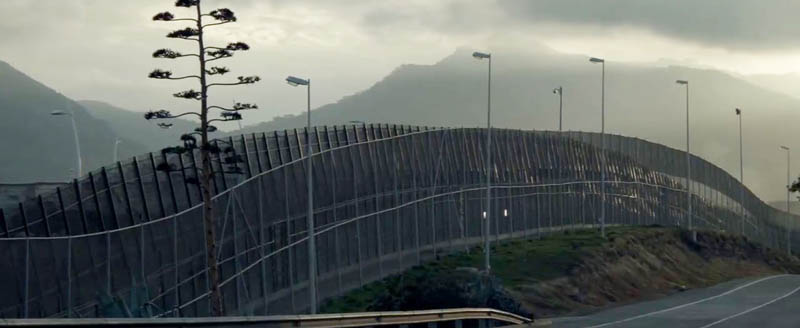
An image from the documentary The Great Wall, whch is being shown at the 2016 RIDM documentary film festival in Montreal. For me, the curves of this fence suggest the dragon-like undulations of The Great Wall of China.

The Great Wall is about walls and borders, old and new. The old one is the Great Wall of China, as described by Franz Kafka, in his short story Building The Great Wall of China, which was written in 1917, though not published until 1931. (Coincidentally, I happened to read it a few weeks before I heard of this film. Everyone seems to call it a short story, but it reads more like a philosophical essay to me. )

The short story’s nameless narrator is someone who worked on the wall himself, thouands of years ago; he muses about why it was built the way it was – in many unconnected pieces of 1,000 metres each, with great gaps in between. He declares that it was dysfunctional and the authorities must have known that, so they must have intended it to be dysfunctional. . .but again, why?

The film’s narrator, Nicola Creighton, reads excerpts from Kafka, in the original German, while we look at walls and very tall fences marking borders in Europe and North Africa. Those North African scenes were shot in Melilla, a small chunk of Morocco that Spain has held on to since 1497.

Because I had read the story recently, I caught a change that had been made to Kafka’s words. He wrote: “Against whom was the great wall to provide protection? Against the people of the north.” The film narration says “people of the south.” This north-south change occurs several times in the narration.

Walls and fences alone are not enough to keep the “others” out. There are watchers in the sky, in airplanes, surveillance cameras with night vision, and the kind of towers you see in films about prisons and concentration camps.

Often, it is not clear where we are in the world, though palm trees hint at a hot climate. Is that because one border often looks like another? Is it because some refugees/migrants don’t always know where they are, either? Should we think of it as a metaphor, more than anything?

Sometimes, the forces of law and order give us a clue: what does it say on the back of their uniforms? POLICE, POLIZEI or GUARDIA CIVIL? In Greece, their shields say POLICE, but there is another word writen in Greek alphabet.

Some scenes start in one country and end in another (far as I could tell). The Great Wall was shot in 11 countries; I did not recognize all of them. One city had a large, strange, ugly building. I want to learn the story of that. (As in, who are the guilty parties?)

There are scenes of huge skyscrapers in big cities, with pedestrians in suits walking around looking powerful and purposeful. My thought about that was, those buildings are another kind of wall or border, that will succeed in keeping strangers out. It’s likely that few migrants will be able to enter them, except perhaps as cleaners.

The music in the film gives an air of menace to many scenes. On the other hand, we often hear birds singing. My interpretation of that: birds are almost everywhere, they sing on good days and bad, they can go to any place that the wind and their wings will take them, unlike humans, they know no borders.

Coincidence: This was the second time this week that I have seen Maersk shipping lines onscreen. The other time was in a documentary about the “boat people” who fled Vietnam 40 years ago. Some of them were rescued by a Maersk ship.

At 72 minutes, The Great Wall felt a bit longer than it is. Some viewers might find their interest flagging toward the end. Or not. I’m not sorry that I went. There’s lots of food for thought in the film.
The Great Wall, 2015, from Ireland.
Director: Tadhg O’Sullivan
Camera: Feargal Ward
In German with English subtitles

The Great Wall is being shown as part of RIDM, Montreal’s Documentary film festival. See it at 8:30 pm, Friday, Nov. 18, at Cinéma du Parc, 3575 Ave du Parc. You can read more about it, and buy tickets on the RIDM web site. The trailer below looks very dark. Most of the scenes in the film are not like that.

You can see three Isabelle Huppert films at Cinemania this weekend

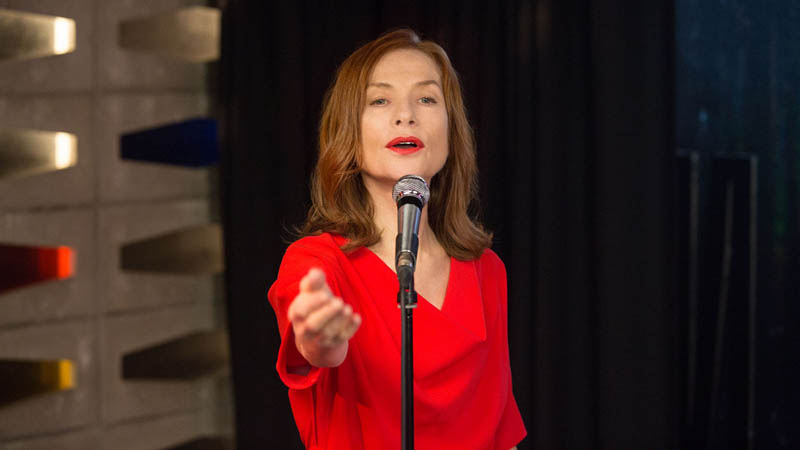
In the film Souvenir, Isabelle Huppert plays a singer who lost a contest to ABBA in her younger days. Souvenir is being shown at the Cinemania film festival in Montreal.

Jonathan Romney of the Guardian/Observer has said “No festival should be without a superb Huppert performance. . .”

During the last weekend of this year’s film festival, Cinemania will show three Isabelle Huppert films– L’Avenir (Things To Come), Souvenir, and Elle, the same three that were shown in Toronto in September. (Added bonus – Cinemania tickets are much cheaper than those at TIFF!)

All three films have English subtitles. They will be shown at the beautifully restored Imperial cinema on Bleury St.

RIDM 2016: Film suggestions for Friday, Nov. 11

An image from Deborah Stratman's film Illinois Parables. The documentary is being shown at Montreal's RIDM film festival.
An image from Deborah Stratman’s film The Illinois Parables. The documentary is being shown at Montreal’s RIDM film festival.

RIDM (Rencontres Internationales Du Documentaire De Montréal) is Montreal’s documentary film festival. It runs from Nov. 10 until Nov. 20, 2016. The festival’s (English) home page is ridm.qc.ca/en. Here are my three suggestions for tonight, Friday, Nov. 11, based on the descriptions in the festival’s catalogue and reviews from the Internet. I have not seen these films yet myself, but I intend to.
The Illinois Parables will only be shown once, so it’s now or never!
From RIDM: “A suite of Midwestern parables questioning the historical role belief has played in ideology and national identity.”

Michael Pattison has a VERY enthusiastic review on the web site RogerEbert.com. He has certainly convinced me! Here are some extracts: “The best film I saw at this year’s Berlinale was Deborah Stratman’s “The Illinois Parables.” . . . Her latest project, an hour-long essay film, traces the history of “America’s most average state” (and its fifth most populous) from the seventh century to the mid-1980s, all weaved together from an inescapably present-day vantage point. . . .Stratman’s rhythms are seductive, her chosen histories fascinating, her modes of address playfully demanding. She employs archival imagery (moving and still), witness testimony, verbal and dramatic re-enactment, voice-over, on-screen text, and her own 16mm footage—which, in capturing present-day pockets of the eponymous state in richly colored analog, makes the whole thing feel like a document from another age. “I see no hierarchy between these modes,” the filmmaker remarked, “and I’m interested in the poetic sparks created when one style abuts another.”

From Erika Balsom’s interview with director Deborah Stratman on the web site of the British Film Institute:
“I love infrastructure, and I love the way that stories can be hidden or embedded in places without the landscape necessarily giving them up. I like that landscape is coy, but seductive as well. I love pilgrimage, and going to see what it feels like to be in different places. I like how Simon Schama, Rebecca Solnit and John McPhee write at the intersection of geography and history. I’m interested in how the landscape can contain a politics. It contains anything, can hold everything – maybe that’s why it’s so important to me.”

There are other positive reviews for The Illinois Parables out there, I’ve just chosen to link to these two.
The Illinois Parables is 60 minutes long. Friday, Nov. 11, 19/7 p.m.
Cinémathèque Québécoise – Salle Fernand-Seguin

An image from the documentary film INAATE/SE/ [it shines a certain way. to a certain place./it flies.falls./]. The film is being shown at the RIDM  film festival in Montreal.
An image from the documentary film INAATE/SE/ [it shines a certain way. to a certain place./it flies.falls./]. The film is being shown at the RIDM film festival in Montreal.
INAATE/SE/ [it shines a certain way. to a certain place./it flies.falls./].
You can see this curiously named film on Friday at 9 p.m., or Sunday, Nov. 13 at 5:30 p.m. (If you do an Internet search on INAATE/SE/ I suggest that you put it within quotation marks, or your browser might be unhappy.)
From the film’s Vimeo page: “Adam Khalil and Zack Khalil’s new film re-imagines an ancient Ojibway story, the Seven Fires Prophecy, which both predates and predicts first contact with Europeans. A kaleidoscopic experience blending documentary, narrative, and experimental forms, INAATE/SE/ transcends linear colonized history to explore how the prophecy resonates through the generations in their indigenous community within Michigan’s Upper Peninsula. With acute geographic specificity, and grand historical scope, the film fixes its lens between the sacred and the profane to pry open the construction of contemporary indigenous identity.”
Leo Goldsmith at Brooklyn Rail writes:  “the Khalil Brothers . . .eschew all documentary convention, unleashing a full audiovisual arsenal against the traumatic circularity of history. . .(with) “animated fantasias, satirical remixing, goofy humor, and psychedelic interludes—all of which amounts to a cinematic language that’s utterly uncategorizable: dynamic, hilarious, angry, and sensorially overwhelming, but never passive.”

INAATE/SE/ [it shines a certain way. to a certain place./it flies.falls./].: 9 pm, Salle JA de Seve, Concordia University.

An image from David Lynch: The Art Life. The documentary is being shown at Montreal's RIDM film festival.
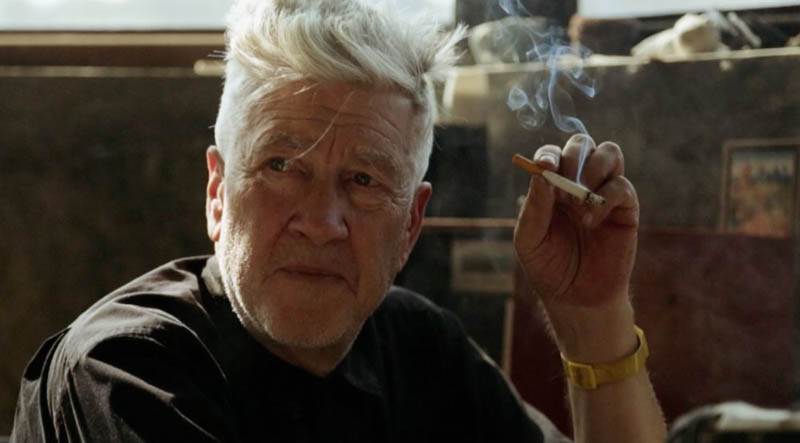
An image from David Lynch: The Art Life. The documentary is being shown at Montreal’s RIDM film festival.

David Lynch: The Art Life: 9:30 p.m. at Concordia University, Friday Nov. 11 and Sunday, Nov. 13 at 8:30 p.m, at Cinematheque Quebecoise.
Deborah Young, Hollywood Reporter: “Although it is more about painting than his filmmaking, David Lynch, The Art Life will entrance the director’s fans and, who knows, inspire budding, out-of-the-box creators in an artistic coming-of-age tale, told in his own words and deliberate tones. . .Kept company by his toddler daughter, Lynch works on new paintings and artwork in his studio in the hills above Hollywood, where he recounts unsettling stories from his past that resonate with the haunting quality of his films.”
Nick James, on the web site of the British Film Institute: “Lynch, mostly in voiceover, narrates his life more thoroughly, poignantly and evocatively than I’ve ever heard from him before.”
Guy Lodge of Variety has this to say about David Lynch: The Art Life:
“Nominally focused on the celebrated filmmaker’s lesser-known dabblings in fine art, “The Art Life” emerges as a more expansive study of Lynch’s creative impulses and preoccupations, as he relates first-hand the formative experiences that spurred and shaped a most unusual imagination.”

“(Jon) Nguyen and his team were previously responsible for 2007’s similarly fond, close-quarters doc “Lynch,” which followed the director through the completion of . . . “Inland Empire,” a decade ago. They know their subject intimately by this point, and not just in an interpersonal sense: “The Art Life’s” own construction is colored by an understanding of Lynch’s aesthetic, from the serenely brooding, grainy textures of Jason S.’s camerawork to the thrumming, Badalamenti-channeling menace of Jonatan Bengta’s score, which moves from swarming synths to sparse, dripping-tap keyboard plinks.”

David Lynch: The Art Life: 9:30 p.m. in the Hall Building at Concordia University.

FNC 2016 Review of Son of Joseph (Le Fils de Joseph)

Victor Ezenfis, Natacha Regnier, Fabrizio Rongione in Son of Joseph (Le Fils de Joseph).

Son of Joseph (Le Fils de Joseph) opens with scenes of Paris, people walking around, etc. Then we see two boys trying to torture a caged rat. I did wonder what kind of film I’d walked into. But those guys are just the idiotic classmates of Vincent, one of the main characters, and we don’t see much of them again. Just as well.

Teenage Vincent (Victor Ezenfis) lives in Paris with his single mother (Natacha Regnier), who’s an almost saintly nurse. In his bedroom he has a poster of Caravaggio’s 1603 painting, The Sacrifice of Isaac. Kinda gruesome!

Vincent’s mother has always refused to tell him who his father is, and on this particular day he is so enraged about it one wonders how his mother put up with him for so many  years.

After rummaging through a rolltop desk, Vincent finds a letter that reveals his father’s identity. You’d think, if he was so determined to know, that he would have found that letter years ago, but never mind, I won’t argue about it.

Vincent bluffs his way into a book-launch party, meets some ditzy and pretentious characters on the literary scene, and gets a glimpse of his father, Oscar Pormenor (Mathieu Amalric) a man so monstrous he can’t even remember how many children he had with his wife. “Details bore me,” he says.

With his red tie, red scarf, wealth, scorn and libidinous attitude, Oscar Pormenor made me think of Donald Trump. (Sorry!) The more Vincent learns about him, the more horrified he becomes. He hatches a plan which is unwise, not to mention illegal, immoral, etc.

On the plus side, Vincent meets Joseph (Fabrizio Rongione), Oscar’s brother and pretty much his polar opposite. Joseph is a really great guy, even if he’s not a success in the business world. More likely he’s a great guy precisely because he’s not a success in the business world.

The people in Son of Joseph speak in a very stilted, serious and unnatural way, almost like. . .inexperienced actors. Of course, the actors are not inexperienced at all, declamation is just part of director Eugène Green’s style. (Apparently, Green has a cult following, just like Hong Sang-soo, whose film Yourself and Yours will be playing at the same time today, just a few blocks away. Both films are on the schedule of the Festival du nouveau cinéma.) At first I found this way of talking rather strange. I got used to it, though I never stopped noticing it, and it made the funny parts funnier still.

Son of Joseph is about serious things, like how to be a good person, the longing for family, connection, and acceptance, but it also offers beautiful Parisian scenery and many laughs as well.

Almost all the interior scenes take place in very old buildings with creaky wooden floors. My congratulations to the sound people for picking up (or maybe recreating) all those creaks.

Coffee and Films was the production company for Son of Joseph. Isn’t Coffee and Films a great name?

Son of Joseph (Le Fils de Joseph)
France, Belgium | 115 Minutes
In French with English subtitles
Written and directed by Eugène Green
With Victor Ezenfis, Natacha Regnier, Fabrizio Rongione, Mathieu Amalric, Maria de Medeiros, Julia de Gasquet, Jacques Bonnaffe

Sunday, Oct.16, 2016
Program #281 15:15
Cinéma du Parc 2, as part of the Festival du nouveau cinéma.