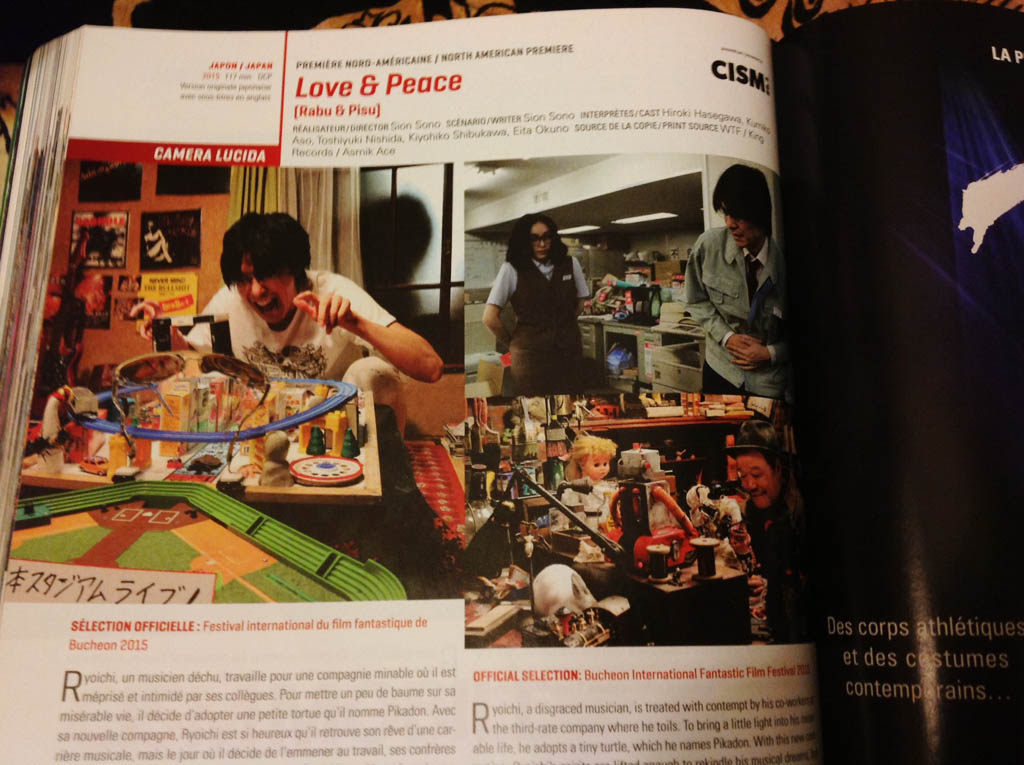
Page 248 of the Fantasia International Film Festival’s catalogue is devoted to the Sion Sono film Love & Peace.
Live blog post: I’m just recently home from watching Sion Sono’s film Love & Peace at the 2015 Fantasia International Film Festival. (North American premiere, BTW!) I want to write a few words about it while it is still fresh in my memory. (I will admit, I got a bit distracted by hunger – had to make a snack. . . then I had to make a photo to go with this post. . . also had a quick peek at Facebook, sorry!)
The thing I wanted to say about Love & Peace, besides the fact that it’s very enjoyable, is that the enthusiasm of the Fantasia audience added a lot to the experience. Like. . . salt, ketchup, vinegar, mayonnaise, or whatever thing you like to add to your French fries (frites). Or butter, jam, peanut butter on your toast. . . .that extra ingredient that makes things better.
I appreciate the huge screen and a great sound system in the Hall Theatre of Concordia University, but it’s the cheers, laughter and enthusiastic applause of the people around me that make it feel like an EVENT. For sure I would have laughed a lot if I had watched it at home on my computer, but it was so much better at Fantasia!
People applauded as soon as the name of writer and director Sion Sono appeared onscreen. They also cheered and applauded at certain key points during the film.
Love & Peace is about hopes, dreams, music and the love that pets have for their people, no matter what. Whether they deserve it or not.
Rena Nonen, left, and Masaki Suda are the main stars of Japanese film Princess Jellyfish. The film is based on the multiple-volume manga Kuragehime. Princess Jellyfish is being shown at the 2015 Fantasia Inernational Film Festival in Montreal.
NOTE: Princess Jellyfish will be shown at 4 p.m., Saturday, July 25, 2015, as part of the Fantasia International Film Festival in Montreal.
OMG!!! The plot of Princess Jellyfish is as unbelievable as your average fairy tale (or Japanese or Korean TV drama) but who cares? It’s so much fun! I was happy to make the old “leap of faith” and just go along for the ride. I can imagine the laughs and cheers in the Hall Cinema right now! Go see it if you can!
Princess Jellyfish is based on Kuragehime, a 15-volume manga that first appeared in November 2008. (An 11-episode anime was shown on Japanese TV in 2010.)
OK, that plot, as briefly as possible. Several nerdy women of assorted ages and interests live in Amamizukan, an old Tokyo apartment building. They call themelves The Sisterhood, though they could also be called otakus and NEETS (Not in Education, Employment or Training.)
Tsukimi (Rena Nonen, centre) with her fellow nerds in the Japanese film Princess Jellyfish. The film is based on the multiple-volume manga Kuragehime.
Our main character, Tsukimi (Rena Nonen) who wants to be an illustrator, is obsessed with jellyfish. The walls of her room are covered in sketches of them. Ms. Banba studies trains and their schedules. Chieko is interested in traditional Japanese culture and always wears kimono; Mayaya is into the epic Chinese historical novel Romance of the Three Kingdoms (and toys assocated with it). Lady Jiji likes “elderly dandies.” Mme. Juon Mejiro is the most important person in the building; she is a manga artist who is never seen. She’s like some kind of oracle – the residents slip questions under her door, and she answers the same way. She has banned men from the building. The others have no problem with that, because men make them so uncomfortable anyway. So do fashionistas. They turn to stone (petrify!) when in the presence of either.
Kuranosuke (Masaki Suda), the cross-dressing son of a politician, meets this gang after helping Tsukimi out of a jellyfish-related jam. She tells them that his name is Kurako; his clothes, makeup and wig are convincing enough that they accept him as a woman. Somewhat surprisingly, they don’t say anything about his deep voice until well into the film. Kuranosuke explains to Tsukimi that he wears women’s clothing because he cares about fashion and has no interest in going into politics. Under his wig he has fashionably blond hair; at school the girls flock around him, eager for his attention.
The nerds of Princess Jellyfish live here, in Amamizukan. Nice, isn’t it? They have to band together to keep the building from being demolished.
Developers want to tear down Amamizukan, and other nearby buildings, to improve the area, and make it all shiny and modern. (Some might wonder, “if it ain’t broke, why fix it?”)
Kuranosuke’s father assumes that supporting development will improve his political fortunes.
The Sisterhood is not happy about this at all, but they seem resigned to it; they have always felt powerless. Kuranosuke encourages them to make an effort to fight back, and not to just accept the decisions that others have made.
There are many themes in Princess Jellyfish. Among them: evil politicians and developers, which is connected to the old “you can’t fight City Hall” trope; feeling like an outcast, finding a place to fit in, the long-lasting scars of being bullied, longing for absent mothers. Some really old U.S. movies with Judy Garland and Mickey Rooney had a “we’ll put the show on right here in the barn!” trope and Princess Jellyfish has a modern approximation of that.
Note for K-drama fans: Chieko is in charge of the building while her mother is in Korea. As Chieko puts it, “she went there to chase Lee.” That would be actor Lee Byung-hun. In the manga Chieko’s mother is chasing Bae Yong-joon (Yon-sama) who became a huge star in Japan and elsewhere, because of his role in the popular Korean TV drama Winter Sonata. The Korea Times has more information about the Yon-sama phenomenon.
BTW: Masaki Suda plays Karuma Akabane in Assassination Classroom, another film, based on manga and anime, that was shown at Fantasia this year.



 Mostlymovies.ca