Django review: Go for the music – ignore the plot

Reda Kateb, centre, plays jazz guitarist Django Reinhardt in the film Django, directed by Etienne Comar.

The French film Django presents the life of renowned jazz guitarist Django Reinhardt during the last years of World War II in Occupied France. The music is wonderful, but the plot is disappointing. It features a fictional, generic, femme fatale while all but ignoring Dietrich Schulz-Koehn, a real-life Luftwaffe officer who loved the very music that the Nazis criticized as degenerate. Schulz-Koehn wrote about jazz and even supervised recording sessions under the name Dr. Jazz. More than once he helped Reinhardt and other musicians get out of trouble. Wouldn’t you want to know more about such a conundrum? (Director Stanley Kubrick had hoped to make a film about Schulz-Koehn. The Atlantic wrote an article about that.)

Many German officers attend jazz concerts in Paris, despite that degenerate label. (Signs warn that they’d better not try any dancing, though.) Django (played by Reda Kateb) does not mind playing for Nazis. Music is all he knows and he has to make a living, after all. He also declares “It’s not my war.” On the other hand, he’s in no rush to leave the familiarity of France for an extensive tour of Germany, and the idea of playing for Minister of Propaganda Joseph Goebbels and other bigwigs holds no appeal at all, especially since solos, syncopation, quick tempos and other musical flourishes are strictly controlled, when not banned altogether. (Does that fall under the “banality of evil?”)

Django’s manager reminds Django and his bandmates that saying “No” to the Germans is a very dangerous thing to do. The fictional femme fatale, Louise de Klerk (Cécile de France) points out that travelling into the heart of Nazi darkness would also be dangerous. There’s no happy solution to this problem.

After a certain amount of dithering in Paris, Django and his entourage head for the border in hopes of crossing into neutral Switzerland. It’s a closely watched border, though, so they must wait (and wait and wait) while hoping that members of the Resistance will deign to help them eventually. The film pretty much grinds to a halt at this point. Django plays in local bars to earn some food money, sometimes hiding his face under a hat, sometimes not. It seems extremely foolhardy considering his fame and unique style.

(SPOILER!) In one laughably silly scene Django is being chased by tracking dogs, so he lies down in the snow and sprinkles a few handfuls of the white stuff on top of himself. Somehow, I don’t think that would fool the dogs at all.

As many viewers will already know, Django did indeed survive the war, but as far as I can tell, the film fudges his escape attempt. The implication is that he made it into Switzerland and presumably stayed there until the war was over, but in fact, the Swiss border guards would not let him in.

What I did not know before seeing this film: Django Reinhardt could also play huge honking church organs and compose for them, too.

Things I learned later from Google: Django Reinhardt was touring England with his Quintette du Hot-Club de France when England declared war on Germany on Sept. 3, 1939. Django returned to France immediately, but the Quintette’s violinist, Stéphane Grappelli, stayed in England until the war was over.

In regard to spending the war in France, Django said: “It is better to be frightened in your own country than in another one.”

In France during the war you could trade a Django Reinhardt record for two kg of butter on the black market. Django Reinhardt died May 16, 1953 at the relatively young age of 43.

Django is 115 minutes long

Director: Étienne Comar.

Screenplay: Étienne Comar and Alexis Salatko, based on the novel Folles de Django by Alexis Salatko.

With: Reda Kateb, Cécile de France, Beata Balya, BimBam Merstein, Gabriel Mirété, Vincent Frade, Johnny Montreuil, Raphaël Dever, Patrick Mille, Xavier Beauvois (In French, German, English, Romani dialogue)

Music by the Rosenberg Trio.

In Montreal, Django is playing, with English subtitles, at the Quartier Latin Cinema, 350 rue Emery, H2X 1J1.

Django Reinhardt’s music, as performed by Nomad O Swing, Eclectic Django and Denis Chang, can often by heard at Montreal Jazz Bar Diese Onze, 4115-A, rue St. Denis, H2W 2M7.

Rêveurs Définitifs brings magic and mystery to Just For Laughs Festival

Clones? Doppelgangers?The cast of Rêveurs Définitifs seems increase, thanks to some visual trickery.

So what is this “Magie Nouvelle” (new magic) anyway? Based on my experience at the show Rêveurs Définitifs, now on at Montreal’s Théâtre St. Denis, it can include ethereal songs and dances, in which  dancer  Ingrid Estarque floats above the stage; a flying, ghostly orb; and multiple versions of the performers interacting with each other, thanks to holography, and other mysterious trickery.

Besides all that, there’s still room for more traditional elements, like doves appearing out of clean air, jokes, card tricks, and audience participation.

The songs are performed by local musical hero Patrick Watson, by the way, and pianist Isabelle Mathieu provides live music for many of the acts.

The show was created by Raphaël Navarro for the Théâtre du Pond-Point in Paris. Other performers include Éric Antoine, Étienne Saglio, Yann Frisch.

Don’t freak out if this “creature” flies over your head!

The show is entirely in French and I must confess that I did not catch every last joke during the card-trick section. Perhaps that’s because the performers were talking very quickly, or maybe I’m just a dumb anglo, who knows? The show is mostly a visual spectacle, so an attendee’s language skills (or lack thereof) don’t matter much at all. Even if you don’t speak French, don’t worry, you’ll be fine!

Those who do understand French can read more reviews of Rêveurs Définitifs on the web sites of La Presse, Montreal TV and Le Devoir.

The cast of Rêveurs Définitifs.

Rêveurs Définitifs is part of the Just for Laughs Festival Juste pour rire. There are performances every night at 8 p.m., at Théâtre St. Denis, 1594 St. Denis, until July 15, 2017. There will be a 4 p.m. show on July 15 as well, and three 4 p.m shows on July 20, 21 and 22. You can buy tickets online, or at the theatre.

Théâtre St. Denis is quite close to the Berri-UQAM metro station.

Kedi Review: A warm, lyrical documentary about the street cats of Istanbul

A cat from the documentary film Kedi looks wise and regal.

Kedi is a delightful documentary film about the street cats of Istanbul, Turkey, and their human friends. It’s just lovely. The cats are elegant and endearing, the humans are eloquent and kind. (As you might guess, Kedi is the Turkish word for cat.)

Turkish-American filmmaker Ceyda Torun lived in Istanbul until she was 11 years old. Her fond memories of the city’s cats led her to make Kedi. She shows cats strolling, snoozing, and snacking, cajoing, climbing, and cuddling, playful, preening, and pouncing, watching, waiting and leaping. There are males and females; some with kittens, some are long-haired, others short-haired; they are tabby, calico, marmalade, or black-and-white. The cats make themselves at home on sidewalks, in doorways, at outdoor cafés and markets and down at the wharf. They seem to be everywhere, like the little dishes of food and water that people leave out for them.

Some Istanbul cats hang out at cafes, where the owners and the customers are happy to see them and feed them.

Cats have lived in Istanbul for thousands of years. The theory is that the population was regularly augmented by cats arriving on trading ships; they would leap out for a little rest and relaxation and not did not always find their way back to their home ship before it left the port. Cats lived on ships to keep rats and mice out of the cargo and the food supply; no doubt the sailors appreciated their company, too.

Torun introduces us to seven cats, revealing their personalities, special quirks and exploring their day-to-day routine. We also meet the people who help them and love them. In many cases, this help goes beyond just providing food – one man says that everyone in his neighbourhood has running tabs with at least one veterinarian, often several. Another man regularly carries antibiotic drops for cats with infected eyes. Among those who feed them is a woman who goes above and beyond by cooking 20 pounds of chicken every day!

Sari walks purposefully through the streets of Istanbul, in the documentary film Kedi.


Sari’s kittens are waiting for her. They’re hungry!

People provide shelters for the cats, too. Some are just cardboard boxes, but one impressive structure looked like a townhouse for multiple cats.

Because of silly stereotypes about women and cats, it’s refreshing that so many of the “cat people” in Kedi are men. In particular, a fisherman shares stories about the low points in his life and how a cat helped him to recover.

Cat-loving cartoonist Bulent Ustun makes a brief appearance, though his name only appears on the credits, not onscreen next to his face. The animated film Bad Cat (also known as Bad Cat Serafettin) is based on his graphic novel Kotu Kedi Sarafettin. Bad Cat was shown at Montreal’s Fantasia Film Festival in 2016. Kedi and Bad Cat might make a great double bill, something to think about when Kedi is available for purchase. Bad Cat is definitely not family friendly the way Kedi is, though. You couldn’t call Serafettin a model citizen.

Cinematographers Alp Korfali and Charlie Wupperman do a fine job of keeping up with the cats, whether they’re scampering over rooftops, climbing trees or barrelling down the street. (I read somewhere that some footage was shot with miniature cameras mounted on remote-controlled toy cars.)

Kedi is a bit of a travelogue too, with images of Hagia Sophia, the Blue Mosque, Galata Tower, sunshine on sparkling waves and soaring seagulls worthy of a tourism brochure. Neighbourhoods visited include Cihangir, Kandilli, Karakoy, Nisantasi, and Samatya, since that’s where the profiled cats live.

Kedi will probably boost tourist visits to Istanbul.

In addition to music that Kira Fontana composed for the film, there are tunes from assorted Turkish artists including Mavi Isiklar who were sometimes called the Turkish Beatles. Here’s a link to the film’s tunes at imdb. While I didn’t look for all of them yet, I found some videos on YouTube.

I’d read many positive reviews before seeing Kedi and it totally lived up to expectations. I felt calm, happy and light-hearted after seeing it. You might find it as beneficial as yoga or meditation. I’m tempted to say, you’d have to be a curmudgeon not to like it, but maybe that would be going too far.

If you don’t live with a cat already, Kedi might put you in the mood to get one, or more. You might want to visit Istanbul as well, but consider checking government travel advisories before doing that.

In Montreal, Kedi is playing at Cinéma du Parc with English subtitles and at Cinema Beaubien (2396 Beaubien E. H2G 1N2) with French subtitles. It is 79 minutes long.


Review: Documentary Under The Sun shows that ‘normal, everyday life’ is a foreign concept in North Korea

Zin-mi, right, and her friend smile in Under The Sun. It’s a cute photo, but sadly, it’s one of the few times anyone looks happy in the film. Even here, the girls are probably just pretending.

The subversive documentary film Under The Sun takes us to North Korea, where we observe 8-year-old Zin-mi as she eats with her parents in their apartment, attends school, joins the North Korean Children’s Union, and rehearses her part in a pageant that will celebrate “The Day of the Sun,” the birthday of Kim Il Sung, the grandfather of the current ruler, Kim Jong-un. The Day of the Sun (April 15) is the most important holiday of the entire year in North Korea.

We also visit the alleged workplaces of Zin-mi’s parents. (In an early meeting, Zin-mi had told filmmaker Vitaly Mansky that her father was a journalist and her mother worked in a cafeteria, but in the film they are seen as an engineer in a garment factory and a worker at a soy milk plant, respectively. Made me think of “I’m not a doctor, but I play one on TV.” Mom and her co-workers wear white uniforms with red aprons and cute, red rubber boots. This echoes the white shirts and red scarves of the members of the Children’s Union.)

Mansky wanted to make a film about day to day life North Korea, with co-operation from the government. He knew there would be restraints, but he got many more than he had expected. The script was written by the North Korean government. Government minders were always close by, telling people where to walk, what to say, to speak more loudly, to show more animation. “Look at her when she’s talking!” They would make people repeat dialogue over and over to achieve the appropriate level of breathless enthusiasm. Mansky had no freedom in choosing events or locations. He was not allowed to make small talk with any North Koreans in between shooting scenes. He had to show his footage to the government at the end of each day.

You might expect the resulting film to be as exciting as the “Bulgarian tractor epics” of the past. The thing that makes Under The Sun different is that Mansky kept his cameras running all day. He did not wait for the government chaperones to yell “action,” and did not stop filming when they said “cut.” Despite all the supervision, he did not hand over ALL of his footage for scrutiny. I’ve read different explanations for exactly how that worked, but one way or the other, he had secret copies that the authorities probably did not know about until the documentary was released. On the other hand, he made filming two trips to North Korea in 2014, but never received his visa for a planned third trip. So maybe they did have an inkling, after all.

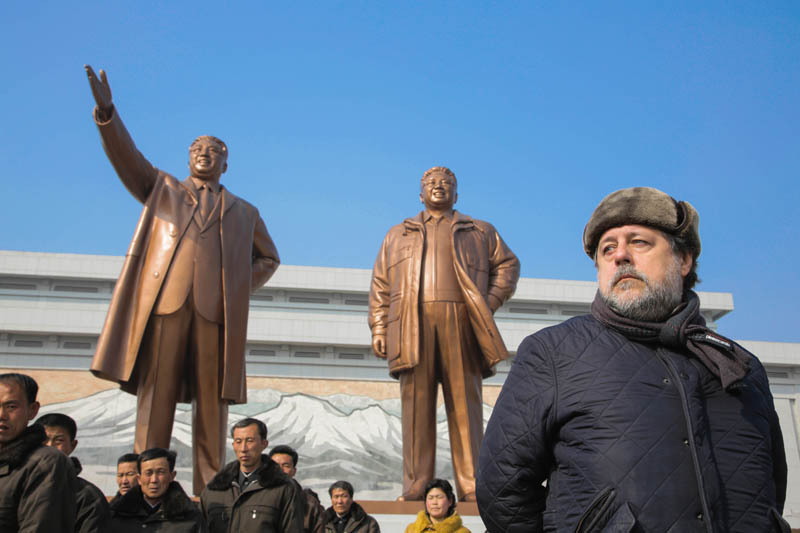
Documentary filmmaker Vitaly Manksy in in Pyongyang, North Korea, in 2014. Mansky is standing in front of one of the many monuments to North Korea’s founder, Kim Il-Sung, and his son, Kim Jong-Il.

A scene of garment workers celebrating their heroic production is exceedingly awkward and unnatural. In the first take, they have surpassed their government quota by 150 per cent. By the next take, the figure has grown to 200 per cent. Seriously, how dumb do they think we are?

Even seemingly ordinary, boring scenes of people crossing a square or boarding a bus were scripted and directed. When films are sold on DVD they often include a behind-the-scenes “Making Of” documentary. Under the Sun has made those scenes an integral part of the film, instead of setting them apart.

In their alleged apartment, Zin-mi and her parents sit in front of a table that’s crowded with luscious-looking food. Remember that North Korea is a country that has lost millions of citizens to famine. After Zin-mi and her father praise the health benefits of their national dish, kimchi, (several times) the table is carried out of the room, with most of the food untouched. What happened to it? Who ate it? Perhaps Zin-mi is perfectly healthy, but she is very slight and often looks tired. Too bad they didn’t let her eat some more.

In one of the most heartbreaking scenes of the film, Zin-mi is asked how she sees her future. She has nothing to say, and starts to cry.

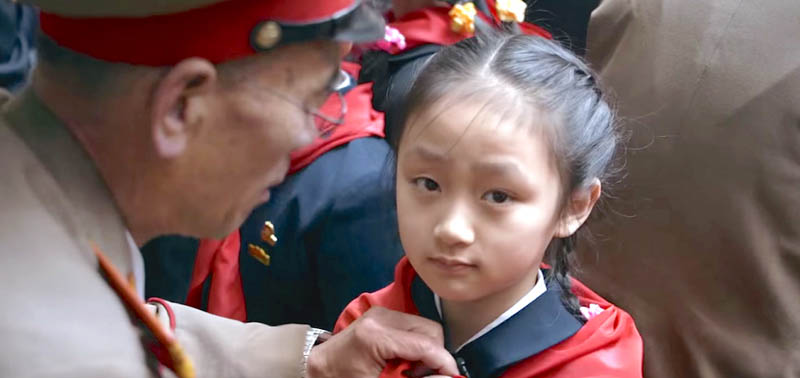
Eight-year-old North Korean girl Zin-mi, the main character in Vitaly Mansky’s documentary Under The Sun, often looks tired and overwhelmed.

Needless to say, Under the Sun has not been shown officially in North Korea, though someone recorded a screening somewhere, and showed it to North Korean authorities. Those authorities contacted the Russian government, which had provided some of the film’s funding, and asked that the film be destroyed and Mansky be punished. Mansky was criticized, but he was not punished; his film was not seized. In fact, it won the FIPRESCI Prize at the Message to Man International Film Festival in St. Petersburg, Russia. And while eight theatres in Moscow refused to show it, 20 others did. In 2016, New York’s Museum of Modern Art cancelled its screening of the film, though it apologized later.

Vitaly Mansky was born in Ukraine, when it was part of the USSR. He spent most of his adult life in Russia, though he lives in Latvia now.

Random thoughts, observations and questions:

Though the Sun of the title refers to Kim Il Sung (Il Sung means “to realize the sun”) we don’t see much sunshine in the film at all. Some wintry scenes look foggy, but is it really fog, or air pollution?

Many scenes were shot in February. Mansky has said that it was very cold, even indoors. He lets us know by showing students warming their hands over a radiator in their classroom.

Every room we see, whether public or private, has portraits of North Korea’s founder, Kim Il-Sung, and his son, Kim Jong-Il. There are many huge murals and monuments to them in Pyongyang. How much did those photos and monuments cost? How much food could have been bought with that money?

In interviews, Mansky has speculated that many families do not live together. He thinks that many students live at their schools and he knows that many workers live at their factories. I’d like to know more about that.

Even though North Korea is cut off from the rest of the world, clunky, ugly platform shoes managed to get in.

North Korea is often demonized because it has nuclear weapons and an unpredictable leader. There has been some talk about bombing the place, “taking out Kim Jong-un,” etc. Films like Under The Sun add some nuance to the us-and-them narrative, and showing us the people who could be killed by those bombs.

Hope for the future? The huge monuments, the exercise instructions given over loud speakers, and the huge squares filled with robotic, marching people reminded me of scenes from China in the 1960s. Life in China might be far from perfect now, but it seems better than it was. Maybe things will improve for North Koreans, too? (Without the poisoned air and water of China?)
Choosing a girl to be the main character in this story might be the final irony. An article on the web site of Human Rights Watch says that “every day North Korean women face severe gender discrimination at work and home, and sexual harassment and violence that the authorities do nothing to stop.”

That name though….It’s a minor point, but the name Zin-mi was puzzling. In decades of watching Korean films I don’t remember anyone named Zin-mi. Articles about hangul, the Korean writing system, and hangul charts don’t show any symbols that correspond to “Z.” There are some online articles from South Korea that call her Jin-mi.

Under The Sun, directed by Vitaly Mansky
Russia, Latvia, Germany, Czech Republic, North Korea | 2016 | 106 minutes
In the original Korean, with English subtitles

Under The Sun was shown by RIDM+, January-to-May series of films presented by RIDM, the Montreal International Documentary Festival. RIDM will run from November 9 to 19, 2017.


Movie review: Le dernier souffle is a love letter to Hôtel-Dieu Hospital

Common Room of Hotel Dieu Hospital in 1911. (Wm. Notman photo)

The documentary film Le dernier souffle, au coeur de l’Hôtel-Dieu de Montréal (The Last Breath, at the Heart of the Hôtel-Dieu) is a powerful love letter to Hôtel-Dieu. You might just want to run over to the hospital to give the staff a collective hug. And if you watch it at Cinéma du Parc, you won’t have to run far, either!

Don’t wait too long, though. Director Annabel Loyola was prompted to begin the film after reading a distressing newspaper headline “Hôtel-Dieu to be sold” in March 2013. She wanted to “recreate. . .the distinctive universe of the Hôtel-Dieu,” and she has done so magnificently.

She introduces us to the hospital’s patients, doctors, nurses, volunteers, painters, carpenters, electricians, gardeners and cleaners. And the musical therapist, with her beautiful white harp! The staff members all seem like lovely, friendly people who enjoy their work and appreciate their co-workers. One woman has been a volunteer there for more 40 years. Two heart surgeons worked together so often, that they were listed on the operating room schedule as one person, with a hyphenated name. And then there are the “two Sylvains” in building services, who also worked together for decades. Patients share their joys, pain and fears.

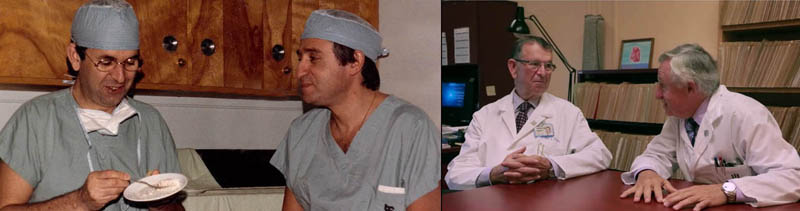
Then and now: Cardiac surgeons Ignacio Prieto and Fadi Basile have worked together at Hotel Dieu for 30 years. They would be listed on the operating room schedule under one hyphenated name – Dr. Basile-Prieto.

We even meet some non-human “employees” – the bees who pollinate the hospital’s apple orchard and garden. (I used to walk by the hospital almost every day and had no idea that there were beehives in there.)

Loyola returns to those bees many times. Maybe she just likes them and the surrounding garden, but I assume that she is telling us, in a subtle way, that the hospital and the beehive are both complex social organisms where individuals work hard for the good of the whole. Sometimes beehives and hospitals fall victim to things beyond their control, like pesticides, parasites, etc., in the case of the bees, and government decisions in the case of hospitals.

Loyola spent two years shooting the film, so we see the hospital in all seasons, from the lush greenery of summer to the depths of winter, when the beehives are buried under mounds of snow. She takes us to hospital areas, utilitarian or beautiful, calm and peaceful, that we might not otherwise notice or have access to. Images are carefully framed and the editing is impressive, too. Archival maps, engravings, paintings and photos complete the picture. (Like Jeanne Mance herself, Loyola was born in Langres, France. In 2010 she made La folle entreprise, sur les pas de Jeanne Mance / A Mad Venture, in the Footsteps of Jeanne Mance. Canal Savoir will show it five times in May. The station’s web site has more details.)

Fort Ville Marie, as it was in 1645.

As an organization, Hotel Dieu Hospital is as old as Montreal itself. On May 17, 1642, Paul Chomedey de Maisonneuve, and Jeanne Mance, accompanied by about 50 settlers from France, founded Fort Ville-Marie, where the St. Laurent and St. Pierre rivers meet. At first Jeanne Mance treated the sick from her own home; a separate building was built in 1645. It would be replaced many times in the years to come. In 1659 Jeanne Mance recruited three sisters from the Hospitalières de Saint-Joseph. These sisters ran the hospital after she died and members of their order continued to do so until the early 1960s. The hospital left St Paul St. in Old Montreal for its present location, on St. Urbain, in 1861. That area was then regarded as “the countryside” and blessed with fresher air to benefit the patients.

(BTW: Jeanne Mance lived until the age of 66 – that seems like a long life, considering the difficult conditions in the colony.)

Hôtel-Dieu was the city’s only hospital until the Montreal General Hospital opened, in 1821.

Religieuses de l Hotel-Dieu de Montreal, James Duncan, 1853.

The history of the hospital reflects that of Quebec in so many ways. The hospital was run by nuns until the early 1960s when the Quebec government took over. (Nursing sisters continued to work there, though.) In the 1960s, when female participation in the workforce was not as widespread as it is now, the stay-at-home wives of male doctors were encouraged to become hospital volunteers.

Le dernier souffle is interesting enough purely as a moving portrait of the hospital, as it was and as it is now, but it has extra poignancy because of the uncertain future of the buildings and grounds.

Since 1996, Hôtel-Dieu has been part of the Centre hospitalier de l’Université de Montréal (CHUM). By the end of 2017, the hospital’s staff and functions are supposed to move into the “superhospital” on St. Denis. Years ago, when this move was announced, there were fears (and anger) that the hospital grounds might be sold for luxury condos. Neighbours and fans of the hospital held rallies and created petitions advocating for community clinics and social housing instead. To this day, no concrete plans have been announced.

As a final indignity, the Hôtel-Dieu has been left out of all the brouhaha surrounding Montreal’s 375th anniversary.

In Brief: Le dernier souffle, au coeur de l’Hôtel-Dieu de Montréal (The Last Breath, at the Heart of the Hôtel-Dieu) is warm, loving, respectful, a marvel of editing and filmmaking.
Who is it for?: Anyone interested in other human beings, documentary film fans, history buffs, Montrealers, Québécois, Canadians.
I see what you did there: Right after a scene where a priest lights an incense censer, we see a beekeeper with his smoker, a device used to calm the bees so they won’t sting.

Filmmaker Annabel Loyola in the garden of Hotel Dieu Hospital. (Photo: Julie D’Amour)

Le dernier souffle, au coeur de l’Hôtel-Dieu de Montréal (The Last Breath, at the Heart of the Hôtel-Dieu)
72 minutes long; researched, written and directed by Annabel Loyola;
Camera: Tomi Grgicevic, Annabel Loyola; Editing: Emma Bertin; Original Music: Fabienne Lucet

Montreal screenings will take place Friday, April 7 to Thursday, April 13.

Cinémathèque québécoise
Everyday 6:15pm | Sunday April 9, 4:00pm

Screening and Q&A hosted by film crew, April 7 at 6:15pm
Screenings and Q&As hosted by filmmaker Annabel Loyola, April 7, 8, 9, 11 at 6:15pm
Debate with Christine Gosselin, conseillère d’arrondissement Jeanne-Mance district, Dinu Bumbaru, Héritage Montréal and Amir Khadir, Québec Solidaire, Sunday April 9, 4:00pm.

Cinéma du Parc (original French version with English subtitles)
Everyday 2:45pm, 7:10pm | Saturday April 8, 10:00am, 7:10pm | Sunday April 9, 10:50am, 2:45pm, 7:10pm

Screening and Q&A hosted by film crew, April 7, 7:10pm
Screenings and Q&As hosted by filmmaker Annabel Loyola, April 7, 8, 9, 11, 7:10pm
Debate with Dominique Daigneault, Coalition Sauvons l’Hôtel-Dieu, and Ron Rayside, architect, Hôtel-Dieu social and community project, April 11, 7:10pm

Visit the film’s web site for information about screenings in Coteau du Lac, Quebec City, Sherbrooke and Rimouski.

OMG! Action-packed Commando 2 opens on Friday, March 3, in Montreal!

Vidyut Jammwal as Captain Karanvir Singh Dogra in the film Commando 2: The Black Money Trail

In the summer of 2013, Montreal’s Fantasia Film Festival showed an Indian action film called Commando. Fantasia fans loved it. (Me, too!)

The headline for my Montreal Gazette blog post was handed to me on a silver platter when I heard a (female) audience member exclaim “That’s the sexiest man I’ve seen in my life!” She was referring to the star of Commando, Vidyut Jammwal.

Jammwal plays a super-skilled, extremely fit Indian soldier who is captured and brutally tortured by another state, in some faraway outpost. Of course, he escapes his tormentors. I wrote that his “skills include, but are certainly not limited to: punching, kicking, stabbing, setting traps, swinging on vines, running up walls (or people) leaping off rooftops, cliffs and bridges, over cars or through the windows of their open doors, etc., etc.”

“He gives good glare, where the bad guys are concerned, but is also ready with great smouldering looks, when the heroine (Pooja Chopra) needs one. Multi-talented!”

The film’s subhead “A One Man Army,” was an understatement, if anything.

If ever a film was crying out for a sequel, it was Commando. And now. . .  it’s almost here! Commando 2: The Black Money Trail,  opens in Montreal (and many other places, I’m sure!) on Friday, March 3, 2017. Whoohoo! The film is about money-laundering on a massive scale, along with a double kidnapping in Malaysia.

Vidyut Jammwal in the action film Commando 2.

Take a look at the exceptional action choreography in the trailer below. (More than 16 MILLION people have already watched it since January 23, 2017!) The action is even more impressive than what we saw in the first film. The leaps, spins, the tumbles! Good grief! How does Jammwal slip through that tiny window? He has been studying Kalaripayattu, a martial art from the Indian state of Kerala since he was three years old. That probably helps!

In an interview with the Hindustan Times, Jammwal said “Commando 2 will be the biggest action film in recent times.” “We created a new genre of action, where no cables and wires were used. It will be a visual spectacle.” I believe it! I’m also thinking, maybe it’s time to redefine the concept of a “chick flick.” We don’t necessarily need female bonding, singalongs, weddings, alcohol, flowers, fancy food or clothes, you know?

I usually avoid opening weekends, because the films often sell out and audiences can be too unruly, but in this instance. . .I don’t think I’ll have the patience to wait five whole days until (my unofficial name for it) “Cheapo Tuesday.”

Commando 2: The Black Money Trail, written by Ritesh Shah, directed by Deven Bhojani, starring Vidyut Jammwal, Adah Sharma, Freddy Daruwala, Thakur Anoop Singh, Esha Gupta, Adil Hussain, Suhail Nayyar.


Film Review: A Man Called Ove

Rolf LassgŒrd plays the title character in A Man Called Ove.
Rolf LassgaŒrd plays the title character in A Man Called Ove.

The Swedish film A Man Called Ove is one of the five entries competing for an Academy Award as Best Foreign Language Film. It’s also nominated for a Best Makeup and Hairstyling Oscar.

Ove is only 59, but he looks much older. That’s what crankiness will do to you! Ove is a stickler for rules; his main purpose in life seems to be upholding them. Even the possibility that a rule might soon be broken raises his ire.

Every morning, Ove Lindahl (Rolf Lassgård) does the “rounds” in his suburban neighbourhood, even though he is no longer the head of the residents’ association. Cars parked (or driven) where they shouldn’t be, errant bicycles, cigarette butts, tiny dogs piddling where they should not, these are just a few of the things that get his goat. Ove even takes his suicide rope back, to a Home-Depot type place, to complain that it was not “suitable for all uses.” The man has chutzpah!

Why suicide? Grief, boredom, or feeling useless and rejected? I choose “all of the above.” Ove’s wife Sonja died within the past year and he misses her very much. Every day he visits her grave to promise her that he will join her soon. He recently lost his longtime job with the railroad, too. (The dialogue in that scene should make human resources people everywhere cringe.) Arguing with the neighbours and store clerks is just not enough to keep a man going. But when decent, friendly Patrick (Tobias Almborg), his wife Parvaneh (Bahar Pars), and their two little girls move in next door, they do provide many new distractions.

Bahar Pars plays Parvaneh, the friendly, lively neighbour of Ove (Rolf LassgaŒrd).

A Man Called Ove is a crowd-pleasing tear jerker, with some jokes and pokes at smug, smirking bureaucrats. Some of those bureaucrats are just clueless, while others are truly evil.

Ove himself is not evil, he’s a sad, somewhat clumsy man, who has constructed a hard shell over his gooey centre. He’s a politically-correct crank – he does not hate gays, immigrants, or women, so he doesn’t have too far to go to redeem himself, as we know he eventually will. This is not one of those stories where a neo-Nazi sees the light and becomes a human-right lawyer. Too bad he’s so mean to retail clerks, though. As for his run-in with a clown. . . who really likes clowns, anyway?

The young adult Ove (Filip Berg) while socially inept in the extreme, wins the heart of school-teacher-to-be Sonja (Ida Engvoll). He is astounded by how many books she has when they move in together, but gamely sets to building more yet shelves when he realizes he did not make enough the first time. At first, we only see Sonja in relation to Ove, later we learn more about her life-changing goodness toward others. It might have been nice to see more of her, but the story IS A Man Called Ove, not a Woman Called Sonja.

When that same young adult Ove meets his neighbour Rune, it’s like finding another sort of love, as they run after the local rule-breakers with the joy of small children, or frolicking puppies.

Most people might guess the general direction the film will take and some might feel manipulated. While A Man Called Ove has its clichéd elements, I enjoyed it anyway, I’m not sorry I watched it; I don’t feel like I wasted my time. Be warned though: Reviews I read before seeing the film led me to expect a comedy about a cranky man. I was surprised by the many tragedies and injustices that were revealed in the flashbacks. While Ove’s life was not quite as bleak as that of the Biblical Job, he did suffer a lot, much more than I had expected, based on summaries and reviews I’d read before seeing the film.

Random info and musings: The film is based on Fredrik Backman’s  popular novel; it’s been translated into many languages.

Makeup artist transforms actor Rolf LassgŒrd into the balding cranky Ove. (Gala magazine photo)
Makeup artist transforms actor Rolf LassgaŒrd into the balding, cranky Ove. (Gala magazine photo)

Rolf Lassgård has played the detective Wallander on TV. In real life, he doesn’t look much like the worn-out Ove at all. Hence the nomination for a Best Makeup and Hairstyling Oscar.

Ida Engvoll, who plays Sonja, is slightly toothy. If she were a Hollywood star, would someone have suggested that she “fix” those teeth?  I wouldn’t be surprised.

Ove was so lucky to meet his wife, who accepted him as he was. Would an awkward woman be so lucky? I wonder. Don’t think I have see a film like that yet.

Ove’s estranged friend Rune reminded me of one of the guys from TV show Trailer Park Boys.

The blue in Ove’s workplace made me think of the blue of Montreal’s metro system.

The film opens in the plant department of a store that looks like the Home Depot on Beaubien St.

Feline trivia: According to web site imdb.com, the large fluffy cat in the film is portrayed by two Ragdolls, both from Poland. In an interview after a screening in Seattle, director Hannes Holm said one cat was sleepy while the other was quite aggressive. More than once, crew members brought the wrong cat onto the set, with painful consequences. Holm also said that a Hollywood film would probably opt for CGI cats, but Swedish filmmakers don’t have that kind of money. When told that the film Inside Llewyn Davis used six cats, he said he couldn’t have afforded so many. The entire production budget for A Man Called Ove was a mere $350,000! Quite amazing!

In Montreal, A Man Called Ove is playing at Cineplex Odeon Forum, Cinéma du Parc, and Cinéma Beaubien. One hour, 56 minutes long, In Swedish with English subtitles at Forum and Cinéma du Parc, French subtitles at Cinéma Beaubien.

A Man Called Ove, written and directed by Hannes Holm, with Rolf Lassgård, Filip Berg, Ida Engvoll, Bahar Pars, Tobias Almborg, Poyan Kamiri, Borje Lundberg, Stefan Gödicke

Movie Review Gulistan: Land of Roses


Rojen Beritan in the documentary Gulistan Land of Roses. Much of the film was shot in the mountains of Iraq.


In the documentary Gulistan Land of Roses, Montreal filmmaker Zaynê Akyol puts puts names and faces on a struggle taking place far away from us – the fight against Islamic State, also known as IS, ISIS or Daesh. Specifically, she introduces us to some of the Kurdish women who are taking part in that fight.

We see them, among the trees of their mountain training camp, doing calesthenics, cleaning their weapons, attending open air political-education classes, sharing meals together in the grass. They look very serious, yet also elegant in their drapey shalwar. Some express their camaraderie in hair-braiding sessions.

They discuss the different attributes of U.S., Russian, and Iraqi bombs. They tell us about their weapons – where they’re from and the names they have given them. It doesn’t seem strange that such an important item be given a name.

We learn that equality for women is one of the tenets espoused in the writings and communiqués of their leader, Apo. Certainly, while they might miss their parents and siblings, none of these women are dreaming of wedded bliss or motherhood. In fact, one says that she has never met a happy housewife. “Every married woman leads a life of slavery.” “From what I’ve seen, married women are never happy.”

Rojen Beritan, centre, is one of many Kurdish women who are fighting against the Islamic State.

The foul-mouthed, sadistic drill sergeant is a staple of U.S. soldiers-in-training films, but the female drill sergeant in this film, who trains men, too, is a different kind of soldier. She doesn’t call anyone a maggot or make then do extra pushups. She does tell those who are impatient to start fighting right away that it would be unwise, and wasteful, to go into battle before one is fully prepared.

While the training area looks relatively bucolic, it is still a dangerous place. When that terrain was held by Saddam Hussein’s men they filled it with land mines, and many still remain. Furthermore, we learn that “if Iran attacks, this is their first target.” Same thing with Turkey. And then there’s Daesh, too. “We can be attacked from all sides.” On the other hand, even though we don’t see them, we’re told that every mountain and valley is guarded by “comrades” with heavy weapons.

Later, we also see the women on patrol and observation duty in a desert area near the town of Makhmur, 95 km southeast of Mosul. While plumes of smoke rise from the town, they watch the comings and goings of Daesh, through binoculars. Is Daesh watching them, too? Probably. Despite the relative quiet, there is a sense of constant danger. Akyol and her cameraperson are told they really ought to leave, but the film continues.

The philosophical Sozdar Cudi shares her thoughts in Gulistan Land of Roses.

A soldier named Sozdar Cudi gets much of the screen time Gulistan: Land of Roses, she is very thoughtful, philosophical even. If not for this war, what kind of life might she be leading? Would she be a politician, working for women’s rights? Maybe a poet?

The footage was shot in August 2014, but it remains 100% relevant because ISIS has not gone away.

After watching Gulistan: Land of Roses, I wanted to know more about these women and their fight.

My first question was: Are they still alive? I fear that some are not, but the PR people for the film could not say.

I wanted to know more about the Kurds, Kurdish woman, the Peshmerga, the towns of Makhmur and Sinjar. It seems that even as long ago as the early 1990s, 30 per-cent of the 17,000 armed Kurdish militants were women. Not surprisingly, Makhmur and Sinjar, like many others, have changed hands several times since 2014. You can read about the Kurdish women fighting ISIS in these articles from VICE, Reuters and the Independent.

And what of their often-quoted leader, Apo? He is Abdullah Öcalan, a Kurd from Turkey, and the co-founder of the PKK (Partiya Karkerên Kurdistanê‎, known as the Kurdistan Workers Party in English). He has been in prison since 1999. Many countries and organizations classify the PKK as a terrorist group, though the UN does not. Wikipedia has an entry on Öcalan. He has said “A country can’t be free unless the women are free.” Some of his writings about women in society can be read at the International Initiative website.

On a less serious note, I also bought some nettle tea. In the film, we see the women rinsing their hair with water containing nettle leaves. The Internet says that people of many cultures believe that it it is good for promoting hair growth, whether you drink it or apply it. Who knows? It can’t hurt, right?

Gulistan: Land of Roses was enjoyed by audiences at the HotDocs Festival in Toronto 2016, and at festivals in the U.S, France, Argentina and Switzerland. It won the Best Feature Film Award (International Competition) at the Milan Film Festival, the 2016 Doc Alliance Selection Award, which was presented at 2016 Locarno Film Festival, the Meilleur Espoir Québec / Canada Award 2016 at Montreal’s documentary film festival, RIDM.

Gulistan: Land of Roses (with English subtitles) is playing at Cinema du Parc until Feb 9.
Under the title Gulîstan, terre de roses it is playing at the Cinémathèque Québécoise, with French subtitles, until Feb. 16, 2017. The dialogue in the film is in Kurmanji and Turkish.

The film is a co-production of Mitosfilm, Peripheria Productions, and Canada’s National Film Board (NFB/ONF). If you can’t see it in a cinema, perhaps it will show up on TV or on the NFB web site some day. But I suggest you try to see it before then!

Movie Review: The Founder

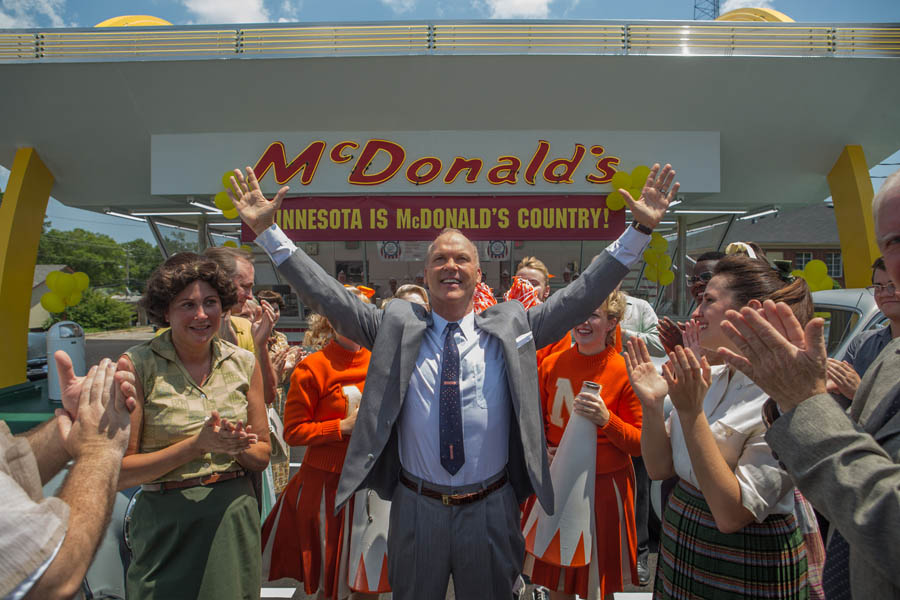
the-founder-michael-keaton

Ray Kroc, the main character in The Founder, did not found anything, despite his claims to the contrary made on his business card and elsewhere. He took a small, already existing chain founded by the McDonald brothers and took it national, then international, becoming filthy rich in the process.

Ray Kroc took advantage of Richard and Maurice McDonald and essentially ripped them off for billions of dollars.

While The Founder is not a thriller, I see it as a sort of slow-motion heist movie, albeit without any guns. It’s very well-made and Michael Keaton gives a compelling perfomance as Ray Kroc, but I was totally appalled at Kroc’s behaviour. Wouldn’t, couldn’t call him a hero. Not a nice man at all. And that old tradition of sealing a deal with a handshake, “my word is my bond,” etc., etc? Forget it. Not an honourable man, either. He also stole another man’s wife, though I guess she went willingly. He was often petty too, but I’ll leave those for viewers to discover for themselves.

At the beginning of the film, Kroc is selling mixers that make several milkshakes at a time. Selling one is hard enough, so when a place in California orders several, his curiosity leads him on a trip to San Bernadino (via the legendary Route 66) to see what kind of business is selling so many milkshakes. The McDonald brothers, called Dick (Nick Offerman) and Mac (John Carroll Lynch) in the film, are doing a roaring business at their hamburger-shakes-and fries stand.

Right after Kroc orders a burger, it is placed in front of him in a paper bag. Amazing! Where to eat it? Anywhere. In your car, on a bench, in the park. Plates, cutlery? None of that. . .Eat it with your hands, just as many people around him are doing, with ecstatic expressions on their faces.

John Carroll Lynch, left, as Mac McDonald, and Nick Offerman as Dick McDonald, in the film The Founder. (Photo: The Weinstein Company)

We’re meant to understand that this was a revolutionary thing at the time. The brothers are quite happy to show Kroc how their employees can work so quickly and efficiently, and reveal how much time they spent refining their methods and fine-tuning the layout of the kitchen. (All their employees were men, if I recall correctly.)

Kroc is very impressed and has visions of McDonald’s restaurants all over the U.S. He shouts “Franchise, franchise, franchise!” to the brothers. They say they’ve already tried that, but bad behaviour by franchisees makes them reluctant to continue expanding.

However, I did read on the Internet that expansion had just paused temporarily, because the person handling franchising for them had fallen ill. They just needed a new employee to continue the work. Kroc becomes that employee.

Dick, Mac and Kroc get along relatively well in person, but things start falling apart when they have to communicate via phone calls and letters. The brothers find Kroc too demanding and too impatient; Kroc is exasperated by their caution and slow decision making. The relationship becomes more and more strained. The brothers realize too late that they “let the fox into the henhouse.” Something has to give.

Michael Keaton as Ray Kroc, left, and Laura Dern as his first wife, Ethel. (Photo: The Weinstein Company)

Laura Dern has the thankless role of Kroc’s first wife, Ethel. She doesn’t get much screen time (just as Ethel probably didn’t get much alimony, either). Mostly she looks sad or worried, and why not? Her husband spends most of his time on the road and his previous schemes did not pan out. Kroc’s remarks to her indicate that he sees her as an unsupportive nag, but there’s no evidence of that at all.

The Founder does not even mention Wife No. 2 (Jane Dobbins Green,1963–1968), and the romancing of wife No. 3 (Joan Mansfield, from 1969 until 1984, when Kroc died) mostly takes place offscreen. Their future together is telegraphed by Kroc’s smitten look when he first sees her, seated at the piano in her husband’s fancy restaurant. To make things clearer still, they sing a duet together, while seated at that piano. They sound quite good, too. The song is “Pennies From Heaven.” Prophetic in another way. (Google tells me that lounge pianist was one of Kroc’s many former jobs.)

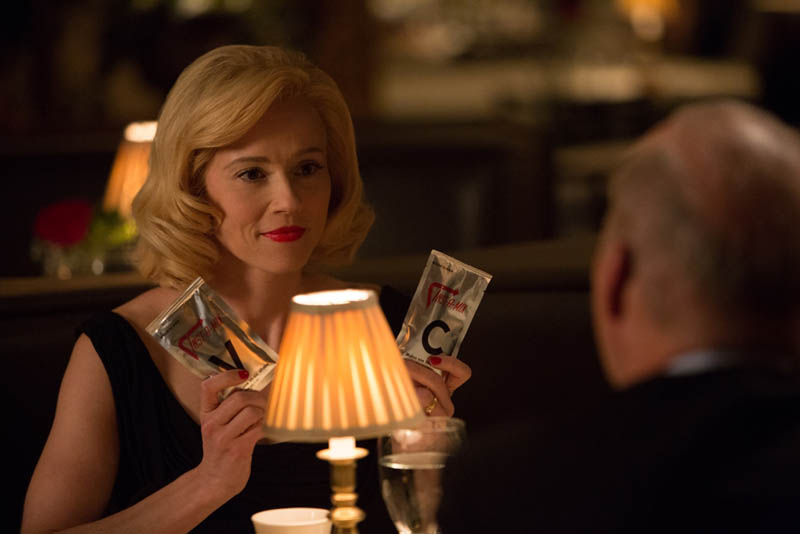
Linda Cardellini plays Joan, the woman who becomes Ray Kroc's third wife. Here, she's offering him a choice between vanilla or chocolate powdered milkshakes, with their stabilizers, emulsifiers. etc. "Delicious!" she says, claiming that they taste just the same as milkshakes made from ice cream and fresh milk.
Linda Cardellini plays Joan, the woman who becomes Ray Kroc’s third wife. Here, she’s offering him a choice between vanilla or chocolate powdered milkshakes, with their stabilizers, emulsifiers. etc. “Delicious!” she says, claiming that they taste just the same as milkshakes made from ice cream and fresh milk.

On more than one occasion, Kroc talks about McDonald’s as a special place for U.S. families to gather; he expresses a wish that every town have one, and compares McDonalds to worthy institutions like churches and courthouses. (“McDonald’s can be the new American church!”) I wasn’t sure if that was just hype for the McDonald brothers and his potential investors, if it reflected his true beliefs, or if the scriptwriter Robert D. Siegel was pulling our collective legs.

We alll bring our own view and prejudices to the cinema, so a closing scene, showing Kroc practicing a speech honouring Ronald Reagan, was just another nail in the coffin. Apparently, he also made illegal donations to Richard Nixon, presumably to influence legislation on wage and price controls. On a less serious note, when asked to choose between a chocolate or vanilla ersatz milkshake, he takes the vanilla! So boring.

Ray Kroc died a very rich man. Some viewers might admire him and think he was so clever to outfox the McDonald brothers. I wonder if he had a clear conscience? His third wife gave a lot of that money away, so perhaps she didn’t have one. Could have been a tax dodge, too, of course.

I have no idea why, but Norman Greenbaum’s 1969 hit Spirit in the Sky plays during the closing credits of The Founder. It sounded great coming through the cinema’s sound system, and I enjoyed hearing it, but how is it connected to Ray Kroc’s story? If there is such a place as heaven, I would not expect to find Kroc in it.

The Founder: directed by John Lee Hancock; written by Robert D. Siegel; with Michael Keaton; Laura Dern; Nick Offerman; John Carroll Lynch; Linda Cardellini; Patrick Wilson; B. J. Novak.

Hong Kong superstar Andy Lau was injured in Thailand and his fans are worried

Hong Kong actor Andy Lau at the Golden Horse Film Awards in Taipei, Taiwan, November 23, 2013 AFP/Getty Images)


Hong Kong singer and actor Andy Lau Tak-wak has been injured in Thailand and his fans all over the world are worried about his condition. (I include myself among those fans.)

Lau, 55, was filming a commercial in Khao Lak, Thailand On Tuesday, Jan. 17, 2017. Something spooked the horse he was riding and Lau was thrown to the ground. Some reports say that the horse stepped on his waist, which sounds very serious. Nevertheless, Lau’s PR people said that everything is under control and that there’s nothing to worry about.
Reuters quoted Lau’s blog: “There was an accident when I was shooting for a commercial in Thailand on January 17. I fell from a horse and this lacerated my pelvic bone. Right now a medical team is taking proper care of me. I am doing well. Please do not worry. Thank you for your well wishes.”

Lau was flown back to Hong Kong for surgery. Hong Kong police stopped traffic so that his ambulance could get from the airport to Hong Kong Sanatorium and Hospital as quickly as possible. However, the Hong Kong newspaper The Standard said that: “Lau had to wait inside the ambulance for about 10 to 20 minutes as the hospital entrance was blocked by a large group of journalists who awaited him.”

A video on the web site of the South China Morning Post shows dozens, possibly even hundreds, of those journalists and photographers surrounding the ambulance.

The Standard said that it might take three months for Lau to recover. It also mentioned another mishap with a horse during the filming of The Warlords. “In 2007, Lau jumped off a horse after failing to stop it when he was shooting The Warlords. He was nearly trampled upon by other horses from behind.”

Andy Lau rides a horse in the 2007 Film The Warlords.

The South China Morning Post quoted “retired broadcaster Cheung Man-sun” who said that “Lau is the pride of Hong Kong and well regarded among the Chinese communities around the world. He is one of the most hard-working personalities in the industry. . .”

Fans of Hong Kong cinema will already know Lau’s work. For others. . . Andy Lau started out on TV, then moved to films. He is versatile, being equally at home with romantic comedies or criminal capers set in the modern day. He has played crooks and cops, and plays both at the same time in Infernal Affairs (2002), the film that Martin Scorsese remade as The Departed, in 2006. He has also appeared in many historical films, playing both military men and an early philosophical peacenik.

One of his most recent films is The Great Wall, directed by Zhang Yimou. The film is controversial in some quarters because Matt Damon is in it. However, in many countries, Andy Lau will be a bigger box-office draw more than Damon will. (Contrary to expectations, Damon does not “save China” in the film.) Coincidentally, in The Departed, Damon played a crook who infiltrated the police force, which was Lau’s role in Infernal Affairs.

Lau also worked with Zhang Yimou for House of Flying Daggers (2004). Other directors Lau has worked with include Johnnie To, Tsui Hark, Wong Kar-Wai, Feng Xiaogang, Ann Hui, Gordon Chan, and Sammo Hung.

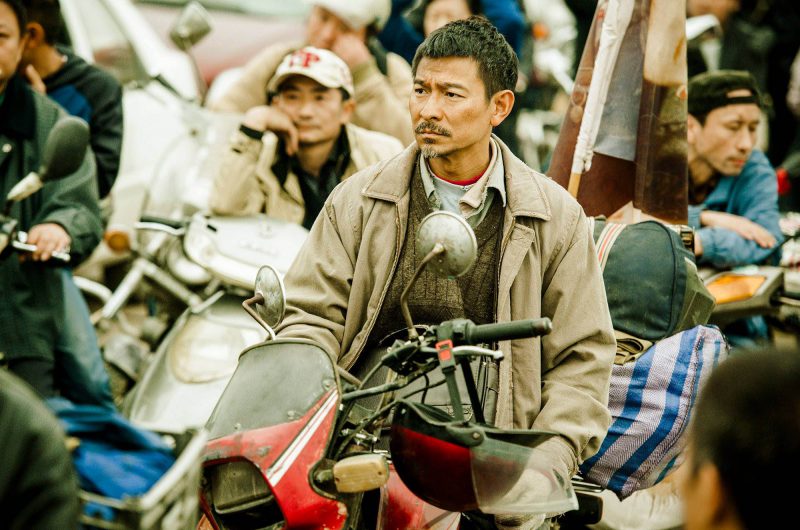
In the film Lost and Love (2015) Andy Lau plays a man who travels thousands of miles throughout China, looking for his son, who was kidnapped as a young child.


Andy Lau’s films have been shown at film festivals in Cannes, Venice, Busan, Shanghai, Hong Kong, San Francisco, Toronto, and at Montreal’s Fantasia International Film Festival. Many get a general release in North America, as well. (Here in Montreal, Cineplex Forum often shows Chinese films.)

Here are the names of just a few of Andy Lau’s many films. (Visit imdb.com for a full list of Andy Lau’s films.)
My Beloved Bodyguard (2016); Saving Mr. Wu (2015); Lost and Love (2015); Blind Detective (2013); Firestorm (2013); Cold War (2012); What Women Want (2011); A Simple Life (2011); Detective Dee and the Mystery of the Phantom Flame (2010); The Warlords (2007); A World Without Thieves (2004); Infernal Affairs 3 (2003); Running on Karma (2003); Infernal Affairs (2002); Saviour of the Soul (1991); Days of Being Wild (1990); As Tears Go By (1988)

The web site for Andy Lau’s fans is called Andy World Club.

Lau, or at least his Chinese given name, Tak-Wah, is even featured in the popular Korean TV drama Goblin. One character, Deok-hwa (it sounds the same as Tak-Wah) was given that name because his uncle likes Andy Lau.

Actors Andy Lau, left, Xu Jinglei, Takeshi Kaneshiro, Jet Li and director Peter Chan at a press conference for the movie The Warlords, in Beijing, Dec. 6, 2007. (Xinhua/Lu Xin)


Oh, I almost forgot! Andy Lau also has a local, Montreal connection. . .sort of. At the Golden Horse Awards in 2012, Montreal director Yung Chang won the Golden Horse Award for Best Documentary. In the photo below, Andy Lau greets Qi Moxiang, a retired boxer and boxing coach, who is the main focus of Chang’s film, China Heavyweight. Everyone connected to the film was thrilled to meet Lau.

Hong Kong actor Andy Lau, left, shakes hands with Qi Moxiang at the 2012 Golden Horse Awards in Taipei, Taiwan. Qi is the main character in the documentary China Heavyweight, by Canadian director Yung Chang.