FIFA 2015 Review: Microtopia, a film about tiny homes, gets an extra Sunday screening

Ana Rewakowicz's Sleeping Bag Dress expands to become a kind of cocoon, in the documentary film Microtopia.
Ana Rewakowicz’s Sleeping Bag Dress expands to become a kind of cocoon, in the documentary film Microtopia.

Previous screenings of Microtopia at the Festival International du Film sur l’Art (FIFA) were sold out; an extra screening has been added for Sunday March 29, 2015. Another film, Strange and Familiar: Home and Architecture on Fogo Island, will be shown with it, as part of a double bill.

Microtopia is about possibilities, news ways of thinking and living. It features tiny houses, micro dwellings, and a VERY portable shelter – the Sleeping Bag Dress.

Montreal artist Ana Rewakowicz arranges her Sleeping Bag Dress, in the documentary film Microtopia. Note the Farine Five Roses sign in the background.

In northern California, Jay Shafer is living in his fourth tiny (and tidy) house. He built it himself. It’s made of dark wood and from the outside it looks like something a surbanite might put in the backyard as a place to store the lawnmower or where children can play house. The exposed wood on the inside gives it a warm and cosy look. Burners for cooking hang on the wall when not in use, to free up counter space.

Shafer explains that in the U.S., there are regulations that specify a minimum size for rooms in a house. He got around this restriction by putting his dwelling on wheels; strictly speaking, it is no longer a house.
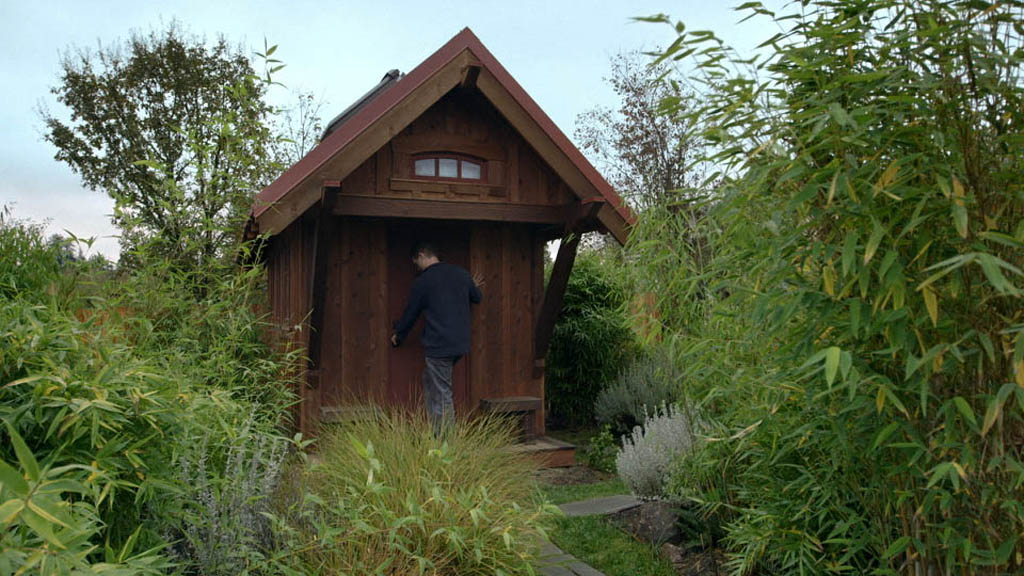
Jay Shafer's tiny house in the documentary film Microtopia. It is being shown on Sunday, March 29, at FIFA, Montreal's Festival of Films on Art.
Jay Shafer’s tiny house in the documentary film Microtopia. It is being shown on Sunday, March 29, at FIFA, Montreal’s Festival of Films on Art.

Jennifer Siegel makes homes from former shipping containers, or long-haul trucks. These look relatively spacious compared to Shafer’s home.

In Mexico, Richart Sowa built his own floating island on a base of wooden pallets and reclaimed plastic bottles. (“Boats rock but island roll,” he says.) It is quite ramshackle, compared to Shafer’s construction.


Richart Sowa built his own island in Mexico, using wooden pallets and plastic bottles, lots of plastic bottles. Sowa is one of several participants in the documentary film Microtopia.

Greek architect Aristide Antonas proposes making a home from old tanker trucks, though he admits living in one might feel like being in prison.

In Denmark, Ion Sorvin shows a sort of plastic igloo that one call roll along the sidewalk and then “park” on the road, between cars. He’s also made a more spacious creation – a “walking house.”

Dre Wapenaar of the Netherlands hangs pod-like tents from trees. He had designed them with the thought that eco-activists could use them while carrying out “actions” to save forests, but before he could contact any such activists, a campsite owner offered to buy them.
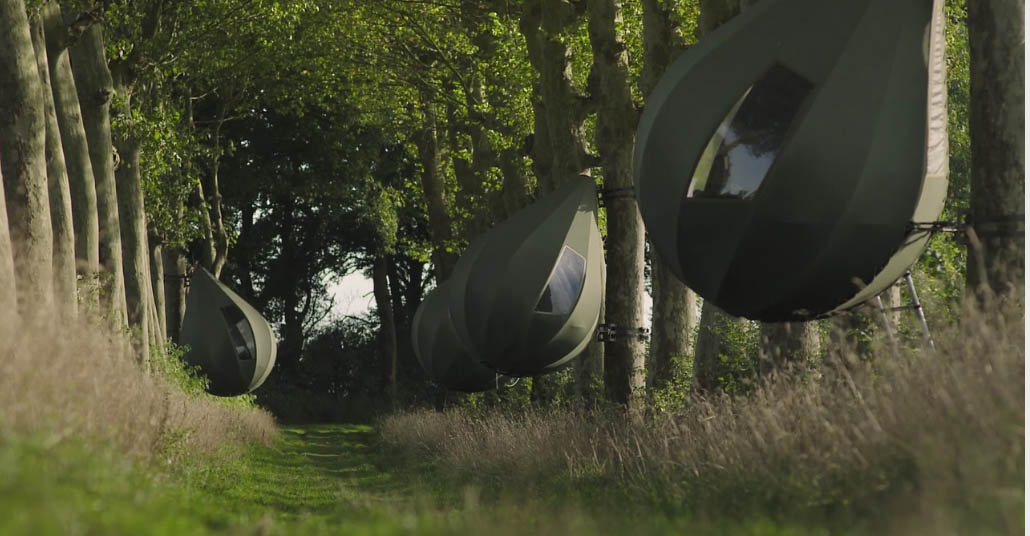
Dre Wapenaar of the Netherlands designed these tree tents. Rockabye baby!


There’s even a Montreal segment! Artist Ana Rewakowickz, who’s originally from Poland, demonstrates the Sleeping Bag Dress within sight of the famous Five Roses Flour sign.

And that brings me to one of my quibbles about the film. During the opening credits, we see the names faces and dwellings of the participants while they say a few words. That’s the last time we see their names.

They rarely say where they are, either. Three people were obviously in the U.S., and two of them were in deserts, though it was not clear if it was the same desert, or what state they were in. I had to Google Sowa to find out where his island was. Maybe I should recognize Copenhagen when I see it, but I had to Google Sorvin, too.

The artists and architects in the film talk about reusing and recycling, shrinking their environmental footprints, and ask how much stuff and how much space do we really need, etc?

A fascinating topic, though one size would definitely not fit all. Claustrophobics need not apply! It’s interesting to note that, the occasional drawing aside, we never see more than one person at a time in these dwellings. Few of these people could tell their friends “Drop by anytime!”

I cannot agree with Jennifer Siegel’s statement that we can keep all our memories on our hard drives now, and therefore we can get by with very few physical things. Speak for yourself, lady! There must be a happy medium, no?
Microtopia
Sweden / 2013 / Color / 52 min / English

Strange and Familiar: Home and Architecture on Fogo Island
Canada⎢ Katherine Knight, Marcia Connolly⎢ 2014 ⎢ 52 min
Cinquième Salle of Place des Arts, 175 Ste. Catherine St. W.

Microtopia
Realisation: Jesper Wachtmeister
Cinematography: Kenneth Svedlund
Sound: Jesper Wachtmeister, Kenneth Svedlund
Editing: Jesper Wachtmeister, Oscar Willey
Music: Benny Nilsen
Producer(s): Jesper Wachtmeister, Jonas Kellagher
Production: Solaris Filmproduktion, Eight Millimetres AB
Distribution: Autlook Filmsales

The Festival International du Film sur l’Art, known as FIFA, runs until Sunday, March 29, 2015. Visit the web site www.artfifa.com for more information.

FIFA 2015 Review: Donald Duck documentary is really two films in one


Image from the documentary film Donald Duck Ð Le Vilain Petit Canard En Nous, which is being shown in Montreal at FIFA, the Festival International du Film sur l'Art.
Image from the documentary film Donald Duck Ð Le Vilain Petit Canard En Nous, which is being shown in Montreal at FIFA, the Festival International du Film sur l’Art.

Ninety minutes devoted to Walt Disney’s film and comic book character Donald Duck? Yessireebob!

In truth, Donald Duck – Le Vilain Petit Canard En Nous, is more like two films, awkwardly cobbled together. For about the first 30 minutes, it’s all about The Donald. Apparently, he is really big in Europe. Every week, to this very day, in some European countries, one person in four reads about Donald Duck. Who knew?

Asssorted people from France, Germany and Scandinavia talk about their first encounter with the cranky fowl and what he means to them.

After World War II, Donald Duck was part of an effort to de-Nazify German children. In translating the comics into German Erika Fuchs made them more literary, witty and thoughtful than the originals.

Gottfried Helnwein of Germany is one of the many artists who appears in the documentary film Donald Duck Ð Le Vilain Petit Canard En Nous, which is being shown in Montreal at FIFA, the Festival International du Film sur l'Art.
Gottfried Helnwein of Germany is one of the many artists who appears in the documentary film Donald Duck Ð Le Vilain Petit Canard En Nous, which is being shown in Montreal at FIFA, the Festival International du Film sur l’Art.

Donald Duck fans (Donaldistes in French, if I heard correctly) have yearly conferences where they present serious papers about him.

Among the statements made by assorted talking heads: Donald Duck is never satisfied, he always wants more. He wants fame and recognition. He is ordinary, naive, but not an idiot. We can all identify with him; he can be a clown, evil or generous. He never wins, but he never gives up. Okay then.

Then, the film turns to winners and losers and success, with segments about the Razzie Awards (it’s a rather long segment), the Funny or Die comedy-video website, life coaches, the tradition of the village idiot, and an excerpt from the German version of the TV show The Office. To be honest, this second part was not that interesting for me.

Donald Duck - always full of big dreams! Image from the documentary film Donald Duck Ð Le Vilain Petit Canard En Nous, which is being shown in Montreal at FIFA, the Festival International du Film sur l'Art.
Donald Duck – always full of big dreams! Image from the documentary film Donald Duck Ð Le Vilain Petit Canard En Nous, which is being shown in Montreal at FIFA, the Festival International du Film sur l’Art.

Pet peeve: This film is made for French audience. When anyone is speaking a language other than French, a translator talks on top of them. No subtitles. Two people talking at once. Annoying in the extreme. There should be a law, I say!
Donald Duck – Le Vilain Petit Canard En Nous (Germany / 2014 / Color / 90 Min / French, English, German with French translation), Friday, March 27, 2015 at 6:30 pm at the Cinematheque Québecoise, 335 de Maisonneuve Blvd. E,

Donald Duck – Le Vilain Petit Canard En Nous
Realisation: Edda Baumann-Von Broen
Script: Edda Baumann-von Broen
Cinematography: Edda Baumann-von Broen
Participation(s): Jean-Pierre Dionnet, Gottfried Helnwein, Øyvind Holen
Producer(s): Hasko Baumann
Production: Avanti Media Plus
Distribution: Avanti Media Plus
The Festival International du Film sur l’Art, known as FIFA, runs until Sunday, March 29, 2015. Visit the web site www.artfifa.com for more information.

Cinema Politica Mondays: Documentary Children 404 shows how anti-gay law endangers Russian LGBT teens

Image from the Russian documentary film Children 404

Countries are often called Motherland or Fatherland. How sad is it when a country can’t love and accept all of her children equally? How sad is it when flesh-and-blood parents turn their backs on their own children and say things like: “You are not normal, you are sick, why did I ever give birth to you?” Or worse yet: “You are a son of Satan!”

The documentary film Children 404 presents compelling evidence that homophobia is rampant in Russia, and that a law passed in 2013 has encouraged anti-gay vigilantes while also keeping many already wary and isolated teens in the closet.

This law bans propaganda about “non-traditional sexual relationships,” aimed at minors. In effect, that means that it’s illegal to offer support to gay teens – to tell them that they are normal, that they are not freaks of nature, and that they are “not the only one” – that there are many other people around the world just like them.

The film is named for the web site Children 404 (Deti-404 in Russian) which serves as an online meeting place for teens who might not have anywhere else to go. It was created by journalist Elena Kilmova; after she wrote an article about LGBT (lesbian, gay, bisexual or transgender) youth, she received email from a teen who had been suicidal until she read the article.

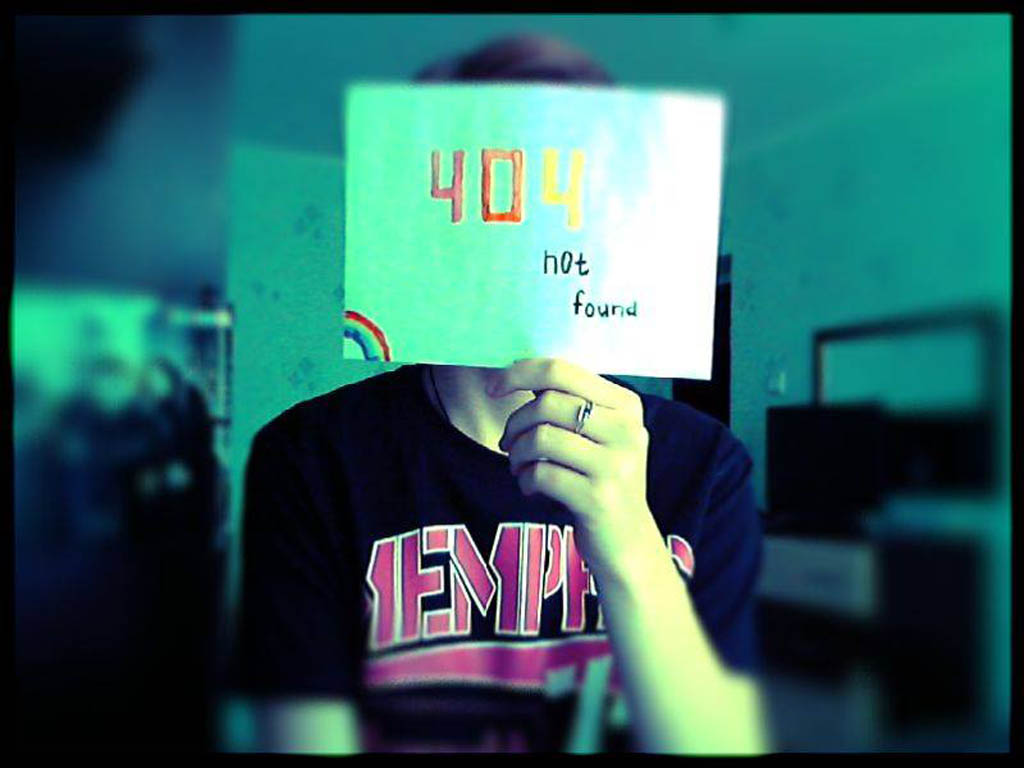
The name is inspired by “Error 404, page not found” a message that often comes up on the Internet. Klimova chose it because Russian society is seemingly telling gay teens that they don’t even exist. It gives then a chance to say “We are here!”

not found

More than 22,000 joined the group; 1,364 shared their stories.The film features excerpts from the messages posted on the site. Many are heart-rending, filled with sadness and despair. One mocks the idea that anyone would possibly “choose” to be gay. “Hey kids, be gays! Everyone hates us, humiliates us, beats us up – this is so cool!”

Few teens dare to tell their parents about their orientation, for fear of being thrown out of the house. The father who accepts his daughter and is proud that she is different is a rare exception.

A Guardian article about Error 404 quotes a “16-year-old from a small town ‘which isn’t even on the map’.” He says “Our school is considered progressive, but it is quite normal for teachers to say that homosexuals will burn in hell.”

Another Guardian article from 2013 says that “an MP in the Siberian region of Zabaikalsk called for a law allowing gays to be publicly flogged by Cossacks.”

Elena Klimova was 25 when the film was made. She doesn’t look much older than a teenager herself, which is remarkable considering the stress she must have been under for years. She reveals that she and her partner lost their jobs because of their orientation. They were both told to resign. Almost all the same-sex couples she knows want to leave Russia, but she does not want to go. She looks forward to a future when the present-day situation will be described as the “stone age,” and she hopes that it won’t take decades to arrive.

Klimova has been taken to court twice over the web site, in the most recent case, she was fined 50,000 rubles, approximately $740 U.S. An online notice from Amnesty International, dated March 18, 2015, says the the “Prosecutor’s Office in one of St Petersburg’s districts had submitted a request to have the Children 404 group. . .closed down.” Readers are urged to support Klimova by writing to Russian officials in protest.

Elena Klimova, founder of the Russian web site Children 404, which gives gay teens a place to express themselves and seek advice and support.

Forty-five members of Error 404 participated in the filmmaking, with some sharing footage shot on their cellphones. But an articulate young man named Pasha receives the most screen time. When he visits his former school, the presence of a cameraman doesn’t stop students from yelling insults and throwing things at him. What do they do when they aren’t being recorded?

Pasha says that one of his teachers had said that gay people “should be burned and banished,” and that the school social worker and psychologist told him he was the one with a problem, because he couldn’t accept homophobes. “If you find love for them, they will find love for you,” they said. As if.

Rather than follow their surreal advice, Pasha’s solution is to move to Canada, home of his idol, Justin Bieber(!) He says “I am convinced that after seven years I will have a family, small kids and a house.” He also says that he plans to study journalism and possibly enter politics. He’s obviously a strong, smart and very determined guy, though I wonder if he has checked the price of Toronto real estate lately, or the sorry employment prospects for journalists in North America. All the same, I wish him the very best in his life here.

I have a suggestion, too. There’s a scene at a memorial to Lenin where Pasha sings a slightly fractured version of O, Canada. It sounds like he’s singing “We stand on guard for free.” Once he learns all the words, why not invite him to sing the anthem at some public event?

Pasha Romanov visits a friend before leaving Russia for Canada, in a scene from the Russian documentary Children 404. (Romanov now calls himself Justin, in honour of Justin Bieber.)

The web site Queer Russia says that vigilantes and policemen with machine guns tried to disrupt the premiere of Children 404 in Moscow last year. Police “checked the IDs of the audience, looking for minors and writing down passport data of some people.”

I’ve been asked to include this information: “Cinema Politica is presenting the Quebec premiere screening of CHILDREN 404 on Monday, March 23, 2015. Directors Askold Kurov and Pavel Loparev will be in attendance all the way from Russia for a Q&A after the screening! The event is co-presented with Radical Queer Semaine, Concordia Documentary Centre, Simone de Beauvoir Institute, and Queer Concordia.
More information can be found about Children 404 here:

While I wasn’t asked to share this info, I am happy to tell you that Cinema Politica was instrumental in getting the film made. The CP web site says “Cinema Politica co-founders Svetla Turnin and Ezra Winton, along with CP Board Member and Concordia University Research Chair in Sexual Representation and in Documentary Thomas Waugh and his colleague Ryan Conrad, launched an Indiegogo campaign to raise essential funds for this project. We eventually surpassed our goal and were able to raise $11,575 U.S. towards the making of CHILDREN 404!” The film’s credits says that all the money usedto make it came from crowdfunding. You might notice that some names appear several times, too.
CHILDREN 404
Directed by Askold Kurov and Pavel Loparev / Russia / 2014 / 70 ‘ / Russian / English subtitles
Monday, March 23, 2015, 7 p.m.
Concordia University, 1455 de Maisonneuve Blvd., W., Room H-110
Montreal, Quebec
Canada

Directors Askold Kurov and Pavel Loparev will be there. (I predict that the first question they’re asked will be “What can we do to help?”)
Suggested admission is $5 to $10.