Movie review: Le dernier souffle is a love letter to Hôtel-Dieu Hospital

Common Room of Hotel Dieu Hospital in 1911. (Wm. Notman photo)

The documentary film Le dernier souffle, au coeur de l’Hôtel-Dieu de Montréal (The Last Breath, at the Heart of the Hôtel-Dieu) is a powerful love letter to Hôtel-Dieu. You might just want to run over to the hospital to give the staff a collective hug. And if you watch it at Cinéma du Parc, you won’t have to run far, either!

Don’t wait too long, though. Director Annabel Loyola was prompted to begin the film after reading a distressing newspaper headline “Hôtel-Dieu to be sold” in March 2013. She wanted to “recreate. . .the distinctive universe of the Hôtel-Dieu,” and she has done so magnificently.

She introduces us to the hospital’s patients, doctors, nurses, volunteers, painters, carpenters, electricians, gardeners and cleaners. And the musical therapist, with her beautiful white harp! The staff members all seem like lovely, friendly people who enjoy their work and appreciate their co-workers. One woman has been a volunteer there for more 40 years. Two heart surgeons worked together so often, that they were listed on the operating room schedule as one person, with a hyphenated name. And then there are the “two Sylvains” in building services, who also worked together for decades. Patients share their joys, pain and fears.
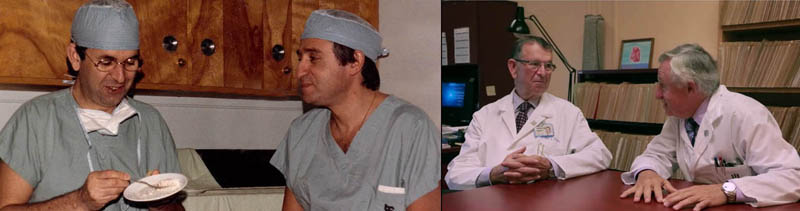
Then and now: Cardiac surgeons Ignacio Prieto and Fadi Basile have worked together at Hotel Dieu for 30 years. They would be listed on the operating room schedule under one hyphenated name – Dr. Basile-Prieto.

We even meet some non-human “employees” – the bees who pollinate the hospital’s apple orchard and garden. (I used to walk by the hospital almost every day and had no idea that there were beehives in there.)

Loyola returns to those bees many times. Maybe she just likes them and the surrounding garden, but I assume that she is telling us, in a subtle way, that the hospital and the beehive are both complex social organisms where individuals work hard for the good of the whole. Sometimes beehives and hospitals fall victim to things beyond their control, like pesticides, parasites, etc., in the case of the bees, and government decisions in the case of hospitals.

Loyola spent two years shooting the film, so we see the hospital in all seasons, from the lush greenery of summer to the depths of winter, when the beehives are buried under mounds of snow. She takes us to hospital areas, utilitarian or beautiful, calm and peaceful, that we might not otherwise notice or have access to. Images are carefully framed and the editing is impressive, too. Archival maps, engravings, paintings and photos complete the picture. (Like Jeanne Mance herself, Loyola was born in Langres, France. In 2010 she made La folle entreprise, sur les pas de Jeanne Mance / A Mad Venture, in the Footsteps of Jeanne Mance. Canal Savoir will show it five times in May. The station’s web site has more details.)

Fort Ville Marie, as it was in 1645.

As an organization, Hotel Dieu Hospital is as old as Montreal itself. On May 17, 1642, Paul Chomedey de Maisonneuve, and Jeanne Mance, accompanied by about 50 settlers from France, founded Fort Ville-Marie, where the St. Laurent and St. Pierre rivers meet. At first Jeanne Mance treated the sick from her own home; a separate building was built in 1645. It would be replaced many times in the years to come. In 1659 Jeanne Mance recruited three sisters from the Hospitalières de Saint-Joseph. These sisters ran the hospital after she died and members of their order continued to do so until the early 1960s. The hospital left St Paul St. in Old Montreal for its present location, on St. Urbain, in 1861. That area was then regarded as “the countryside” and blessed with fresher air to benefit the patients.

(BTW: Jeanne Mance lived until the age of 66 – that seems like a long life, considering the difficult conditions in the colony.)

Hôtel-Dieu was the city’s only hospital until the Montreal General Hospital opened, in 1821.

Religieuses de l Hotel-Dieu de Montreal, James Duncan, 1853.

The history of the hospital reflects that of Quebec in so many ways. The hospital was run by nuns until the early 1960s when the Quebec government took over. (Nursing sisters continued to work there, though.) In the 1960s, when female participation in the workforce was not as widespread as it is now, the stay-at-home wives of male doctors were encouraged to become hospital volunteers.

Le dernier souffle is interesting enough purely as a moving portrait of the hospital, as it was and as it is now, but it has extra poignancy because of the uncertain future of the buildings and grounds.

Since 1996, Hôtel-Dieu has been part of the Centre hospitalier de l’Université de Montréal (CHUM). By the end of 2017, the hospital’s staff and functions are supposed to move into the “superhospital” on St. Denis. Years ago, when this move was announced, there were fears (and anger) that the hospital grounds might be sold for luxury condos. Neighbours and fans of the hospital held rallies and created petitions advocating for community clinics and social housing instead. To this day, no concrete plans have been announced.

As a final indignity, the Hôtel-Dieu has been left out of all the brouhaha surrounding Montreal’s 375th anniversary.

In Brief: Le dernier souffle, au coeur de l’Hôtel-Dieu de Montréal (The Last Breath, at the Heart of the Hôtel-Dieu) is warm, loving, respectful, a marvel of editing and filmmaking.
Who is it for?: Anyone interested in other human beings, documentary film fans, history buffs, Montrealers, Québécois, Canadians.
I see what you did there: Right after a scene where a priest lights an incense censer, we see a beekeeper with his smoker, a device used to calm the bees so they won’t sting.

Filmmaker Annabel Loyola in the garden of Hotel Dieu Hospital. (Photo: Julie D’Amour)

Le dernier souffle, au coeur de l’Hôtel-Dieu de Montréal (The Last Breath, at the Heart of the Hôtel-Dieu)
72 minutes long; researched, written and directed by Annabel Loyola;
Camera: Tomi Grgicevic, Annabel Loyola; Editing: Emma Bertin; Original Music: Fabienne Lucet

Montreal screenings will take place Friday, April 7 to Thursday, April 13.

Cinémathèque québécoise
Everyday 6:15pm | Sunday April 9, 4:00pm

Screening and Q&A hosted by film crew, April 7 at 6:15pm
Screenings and Q&As hosted by filmmaker Annabel Loyola, April 7, 8, 9, 11 at 6:15pm
Debate with Christine Gosselin, conseillère d’arrondissement Jeanne-Mance district, Dinu Bumbaru, Héritage Montréal and Amir Khadir, Québec Solidaire, Sunday April 9, 4:00pm.

Cinéma du Parc (original French version with English subtitles)
Everyday 2:45pm, 7:10pm | Saturday April 8, 10:00am, 7:10pm | Sunday April 9, 10:50am, 2:45pm, 7:10pm

Screening and Q&A hosted by film crew, April 7, 7:10pm
Screenings and Q&As hosted by filmmaker Annabel Loyola, April 7, 8, 9, 11, 7:10pm
Debate with Dominique Daigneault, Coalition Sauvons l’Hôtel-Dieu, and Ron Rayside, architect, Hôtel-Dieu social and community project, April 11, 7:10pm

Visit the film’s web site for information about screenings in Coteau du Lac, Quebec City, Sherbrooke and Rimouski.

Film Review: A Man Called Ove

Rolf LassgŒrd plays the title character in A Man Called Ove.
Rolf LassgaŒrd plays the title character in A Man Called Ove.

The Swedish film A Man Called Ove is one of the five entries competing for an Academy Award as Best Foreign Language Film. It’s also nominated for a Best Makeup and Hairstyling Oscar.

Ove is only 59, but he looks much older. That’s what crankiness will do to you! Ove is a stickler for rules; his main purpose in life seems to be upholding them. Even the possibility that a rule might soon be broken raises his ire.

Every morning, Ove Lindahl (Rolf Lassgård) does the “rounds” in his suburban neighbourhood, even though he is no longer the head of the residents’ association. Cars parked (or driven) where they shouldn’t be, errant bicycles, cigarette butts, tiny dogs piddling where they should not, these are just a few of the things that get his goat. Ove even takes his suicide rope back, to a Home-Depot type place, to complain that it was not “suitable for all uses.” The man has chutzpah!

Why suicide? Grief, boredom, or feeling useless and rejected? I choose “all of the above.” Ove’s wife Sonja died within the past year and he misses her very much. Every day he visits her grave to promise her that he will join her soon. He recently lost his longtime job with the railroad, too. (The dialogue in that scene should make human resources people everywhere cringe.) Arguing with the neighbours and store clerks is just not enough to keep a man going. But when decent, friendly Patrick (Tobias Almborg), his wife Parvaneh (Bahar Pars), and their two little girls move in next door, they do provide many new distractions.

Bahar Pars plays Parvaneh, the friendly, lively neighbour of Ove (Rolf LassgaŒrd).

A Man Called Ove is a crowd-pleasing tear jerker, with some jokes and pokes at smug, smirking bureaucrats. Some of those bureaucrats are just clueless, while others are truly evil.

Ove himself is not evil, he’s a sad, somewhat clumsy man, who has constructed a hard shell over his gooey centre. He’s a politically-correct crank – he does not hate gays, immigrants, or women, so he doesn’t have too far to go to redeem himself, as we know he eventually will. This is not one of those stories where a neo-Nazi sees the light and becomes a human-right lawyer. Too bad he’s so mean to retail clerks, though. As for his run-in with a clown. . . who really likes clowns, anyway?

The young adult Ove (Filip Berg) while socially inept in the extreme, wins the heart of school-teacher-to-be Sonja (Ida Engvoll). He is astounded by how many books she has when they move in together, but gamely sets to building more yet shelves when he realizes he did not make enough the first time. At first, we only see Sonja in relation to Ove, later we learn more about her life-changing goodness toward others. It might have been nice to see more of her, but the story IS A Man Called Ove, not a Woman Called Sonja.

When that same young adult Ove meets his neighbour Rune, it’s like finding another sort of love, as they run after the local rule-breakers with the joy of small children, or frolicking puppies.

Most people might guess the general direction the film will take and some might feel manipulated. While A Man Called Ove has its clichéd elements, I enjoyed it anyway, I’m not sorry I watched it; I don’t feel like I wasted my time. Be warned though: Reviews I read before seeing the film led me to expect a comedy about a cranky man. I was surprised by the many tragedies and injustices that were revealed in the flashbacks. While Ove’s life was not quite as bleak as that of the Biblical Job, he did suffer a lot, much more than I had expected, based on summaries and reviews I’d read before seeing the film.

Random info and musings: The film is based on Fredrik Backman’s  popular novel; it’s been translated into many languages.

Makeup artist transforms actor Rolf LassgŒrd into the balding cranky Ove. (Gala magazine photo)
Makeup artist transforms actor Rolf LassgaŒrd into the balding, cranky Ove. (Gala magazine photo)

Rolf Lassgård has played the detective Wallander on TV. In real life, he doesn’t look much like the worn-out Ove at all. Hence the nomination for a Best Makeup and Hairstyling Oscar.

Ida Engvoll, who plays Sonja, is slightly toothy. If she were a Hollywood star, would someone have suggested that she “fix” those teeth?  I wouldn’t be surprised.

Ove was so lucky to meet his wife, who accepted him as he was. Would an awkward woman be so lucky? I wonder. Don’t think I have see a film like that yet.

Ove’s estranged friend Rune reminded me of one of the guys from TV show Trailer Park Boys.

The blue in Ove’s workplace made me think of the blue of Montreal’s metro system.

The film opens in the plant department of a store that looks like the Home Depot on Beaubien St.

Feline trivia: According to web site imdb.com, the large fluffy cat in the film is portrayed by two Ragdolls, both from Poland. In an interview after a screening in Seattle, director Hannes Holm said one cat was sleepy while the other was quite aggressive. More than once, crew members brought the wrong cat onto the set, with painful consequences. Holm also said that a Hollywood film would probably opt for CGI cats, but Swedish filmmakers don’t have that kind of money. When told that the film Inside Llewyn Davis used six cats, he said he couldn’t have afforded so many. The entire production budget for A Man Called Ove was a mere $350,000! Quite amazing!

In Montreal, A Man Called Ove is playing at Cineplex Odeon Forum, Cinéma du Parc, and Cinéma Beaubien. One hour, 56 minutes long, In Swedish with English subtitles at Forum and Cinéma du Parc, French subtitles at Cinéma Beaubien.

A Man Called Ove, written and directed by Hannes Holm, with Rolf Lassgård, Filip Berg, Ida Engvoll, Bahar Pars, Tobias Almborg, Poyan Kamiri, Borje Lundberg, Stefan Gödicke

Movie Review Gulistan: Land of Roses


Rojen Beritan in the documentary Gulistan Land of Roses. Much of the film was shot in the mountains of Iraq.


In the documentary Gulistan Land of Roses, Montreal filmmaker Zaynê Akyol puts puts names and faces on a struggle taking place far away from us – the fight against Islamic State, also known as IS, ISIS or Daesh. Specifically, she introduces us to some of the Kurdish women who are taking part in that fight.

We see them, among the trees of their mountain training camp, doing calesthenics, cleaning their weapons, attending open air political-education classes, sharing meals together in the grass. They look very serious, yet also elegant in their drapey shalwar. Some express their camaraderie in hair-braiding sessions.

They discuss the different attributes of U.S., Russian, and Iraqi bombs. They tell us about their weapons – where they’re from and the names they have given them. It doesn’t seem strange that such an important item be given a name.

We learn that equality for women is one of the tenets espoused in the writings and communiqués of their leader, Apo. Certainly, while they might miss their parents and siblings, none of these women are dreaming of wedded bliss or motherhood. In fact, one says that she has never met a happy housewife. “Every married woman leads a life of slavery.” “From what I’ve seen, married women are never happy.”

Rojen Beritan, centre, is one of many Kurdish women who are fighting against the Islamic State.

The foul-mouthed, sadistic drill sergeant is a staple of U.S. soldiers-in-training films, but the female drill sergeant in this film, who trains men, too, is a different kind of soldier. She doesn’t call anyone a maggot or make then do extra pushups. She does tell those who are impatient to start fighting right away that it would be unwise, and wasteful, to go into battle before one is fully prepared.

While the training area looks relatively bucolic, it is still a dangerous place. When that terrain was held by Saddam Hussein’s men they filled it with land mines, and many still remain. Furthermore, we learn that “if Iran attacks, this is their first target.” Same thing with Turkey. And then there’s Daesh, too. “We can be attacked from all sides.” On the other hand, even though we don’t see them, we’re told that every mountain and valley is guarded by “comrades” with heavy weapons.

Later, we also see the women on patrol and observation duty in a desert area near the town of Makhmur, 95 km southeast of Mosul. While plumes of smoke rise from the town, they watch the comings and goings of Daesh, through binoculars. Is Daesh watching them, too? Probably. Despite the relative quiet, there is a sense of constant danger. Akyol and her cameraperson are told they really ought to leave, but the film continues.

The philosophical Sozdar Cudi shares her thoughts in Gulistan Land of Roses.

A soldier named Sozdar Cudi gets much of the screen time Gulistan: Land of Roses, she is very thoughtful, philosophical even. If not for this war, what kind of life might she be leading? Would she be a politician, working for women’s rights? Maybe a poet?

The footage was shot in August 2014, but it remains 100% relevant because ISIS has not gone away.

After watching Gulistan: Land of Roses, I wanted to know more about these women and their fight.

My first question was: Are they still alive? I fear that some are not, but the PR people for the film could not say.

I wanted to know more about the Kurds, Kurdish woman, the Peshmerga, the towns of Makhmur and Sinjar. It seems that even as long ago as the early 1990s, 30 per-cent of the 17,000 armed Kurdish militants were women. Not surprisingly, Makhmur and Sinjar, like many others, have changed hands several times since 2014. You can read about the Kurdish women fighting ISIS in these articles from VICE, Reuters and the Independent.

And what of their often-quoted leader, Apo? He is Abdullah Öcalan, a Kurd from Turkey, and the co-founder of the PKK (Partiya Karkerên Kurdistanê‎, known as the Kurdistan Workers Party in English). He has been in prison since 1999. Many countries and organizations classify the PKK as a terrorist group, though the UN does not. Wikipedia has an entry on Öcalan. He has said “A country can’t be free unless the women are free.” Some of his writings about women in society can be read at the International Initiative website.

On a less serious note, I also bought some nettle tea. In the film, we see the women rinsing their hair with water containing nettle leaves. The Internet says that people of many cultures believe that it it is good for promoting hair growth, whether you drink it or apply it. Who knows? It can’t hurt, right?

Gulistan: Land of Roses was enjoyed by audiences at the HotDocs Festival in Toronto 2016, and at festivals in the U.S, France, Argentina and Switzerland. It won the Best Feature Film Award (International Competition) at the Milan Film Festival, the 2016 Doc Alliance Selection Award, which was presented at 2016 Locarno Film Festival, the Meilleur Espoir Québec / Canada Award 2016 at Montreal’s documentary film festival, RIDM.

Gulistan: Land of Roses (with English subtitles) is playing at Cinema du Parc until Feb 9.
Under the title Gulîstan, terre de roses it is playing at the Cinémathèque Québécoise, with French subtitles, until Feb. 16, 2017. The dialogue in the film is in Kurmanji and Turkish.

The film is a co-production of Mitosfilm, Peripheria Productions, and Canada’s National Film Board (NFB/ONF). If you can’t see it in a cinema, perhaps it will show up on TV or on the NFB web site some day. But I suggest you try to see it before then!

Movie Review: The Founder

the-founder-michael-keaton

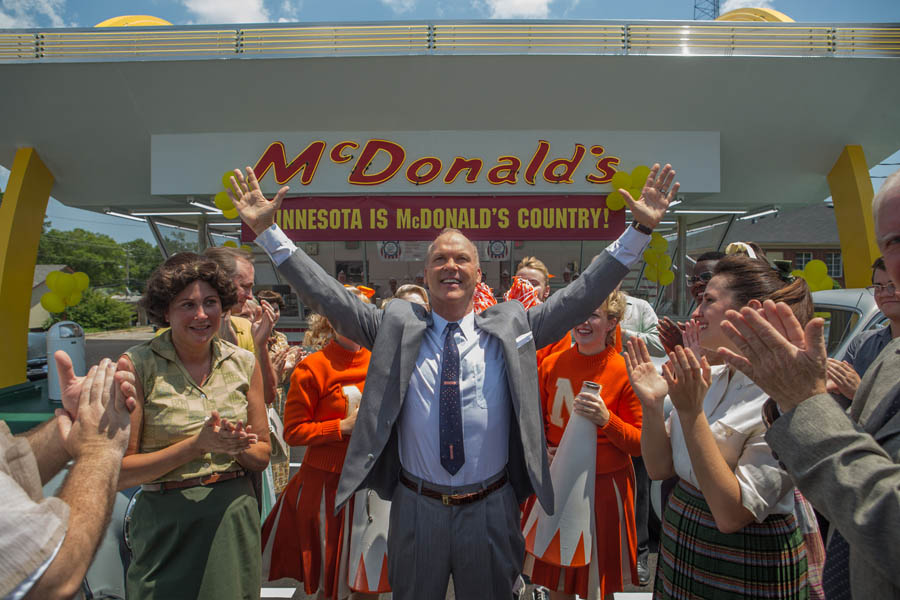
Ray Kroc, the main character in The Founder, did not found anything, despite his claims to the contrary made on his business card and elsewhere. He took a small, already existing chain founded by the McDonald brothers and took it national, then international, becoming filthy rich in the process.

Ray Kroc took advantage of Richard and Maurice McDonald and essentially ripped them off for billions of dollars.

While The Founder is not a thriller, I see it as a sort of slow-motion heist movie, albeit without any guns. It’s very well-made and Michael Keaton gives a compelling perfomance as Ray Kroc, but I was totally appalled at Kroc’s behaviour. Wouldn’t, couldn’t call him a hero. Not a nice man at all. And that old tradition of sealing a deal with a handshake, “my word is my bond,” etc., etc? Forget it. Not an honourable man, either. He also stole another man’s wife, though I guess she went willingly. He was often petty too, but I’ll leave those for viewers to discover for themselves.

At the beginning of the film, Kroc is selling mixers that make several milkshakes at a time. Selling one is hard enough, so when a place in California orders several, his curiosity leads him on a trip to San Bernadino (via the legendary Route 66) to see what kind of business is selling so many milkshakes. The McDonald brothers, called Dick (Nick Offerman) and Mac (John Carroll Lynch) in the film, are doing a roaring business at their hamburger-shakes-and fries stand.

Right after Kroc orders a burger, it is placed in front of him in a paper bag. Amazing! Where to eat it? Anywhere. In your car, on a bench, in the park. Plates, cutlery? None of that. . .Eat it with your hands, just as many people around him are doing, with ecstatic expressions on their faces.

John Carroll Lynch, left, as Mac McDonald, and Nick Offerman as Dick McDonald, in the film The Founder. (Photo: The Weinstein Company)

We’re meant to understand that this was a revolutionary thing at the time. The brothers are quite happy to show Kroc how their employees can work so quickly and efficiently, and reveal how much time they spent refining their methods and fine-tuning the layout of the kitchen. (All their employees were men, if I recall correctly.)

Kroc is very impressed and has visions of McDonald’s restaurants all over the U.S. He shouts “Franchise, franchise, franchise!” to the brothers. They say they’ve already tried that, but bad behaviour by franchisees makes them reluctant to continue expanding.

However, I did read on the Internet that expansion had just paused temporarily, because the person handling franchising for them had fallen ill. They just needed a new employee to continue the work. Kroc becomes that employee.

Dick, Mac and Kroc get along relatively well in person, but things start falling apart when they have to communicate via phone calls and letters. The brothers find Kroc too demanding and too impatient; Kroc is exasperated by their caution and slow decision making. The relationship becomes more and more strained. The brothers realize too late that they “let the fox into the henhouse.” Something has to give.

Michael Keaton as Ray Kroc, left, and Laura Dern as his first wife, Ethel. (Photo: The Weinstein Company)

Laura Dern has the thankless role of Kroc’s first wife, Ethel. She doesn’t get much screen time (just as Ethel probably didn’t get much alimony, either). Mostly she looks sad or worried, and why not? Her husband spends most of his time on the road and his previous schemes did not pan out. Kroc’s remarks to her indicate that he sees her as an unsupportive nag, but there’s no evidence of that at all.

The Founder does not even mention Wife No. 2 (Jane Dobbins Green,1963–1968), and the romancing of wife No. 3 (Joan Mansfield, from 1969 until 1984, when Kroc died) mostly takes place offscreen. Their future together is telegraphed by Kroc’s smitten look when he first sees her, seated at the piano in her husband’s fancy restaurant. To make things clearer still, they sing a duet together, while seated at that piano. They sound quite good, too. The song is “Pennies From Heaven.” Prophetic in another way. (Google tells me that lounge pianist was one of Kroc’s many former jobs.)

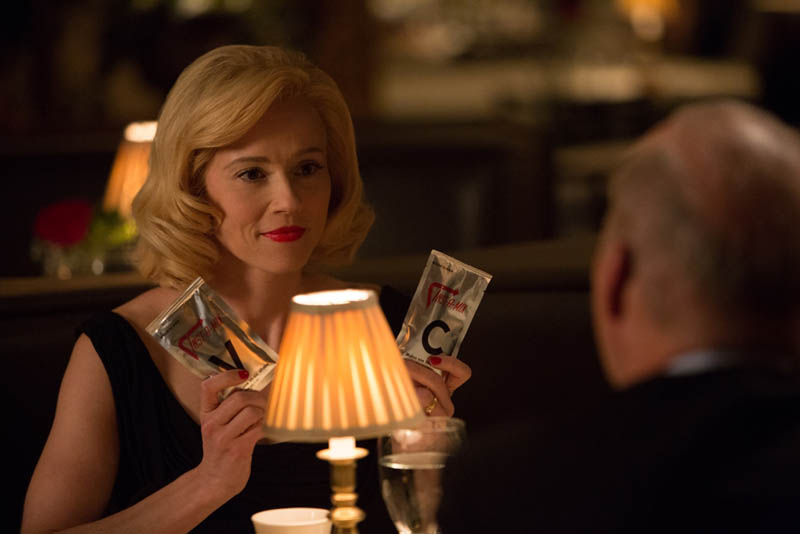
Linda Cardellini plays Joan, the woman who becomes Ray Kroc's third wife. Here, she's offering him a choice between vanilla or chocolate powdered milkshakes, with their stabilizers, emulsifiers. etc. "Delicious!" she says, claiming that they taste just the same as milkshakes made from ice cream and fresh milk.
Linda Cardellini plays Joan, the woman who becomes Ray Kroc’s third wife. Here, she’s offering him a choice between vanilla or chocolate powdered milkshakes, with their stabilizers, emulsifiers. etc. “Delicious!” she says, claiming that they taste just the same as milkshakes made from ice cream and fresh milk.

On more than one occasion, Kroc talks about McDonald’s as a special place for U.S. families to gather; he expresses a wish that every town have one, and compares McDonalds to worthy institutions like churches and courthouses. (“McDonald’s can be the new American church!”) I wasn’t sure if that was just hype for the McDonald brothers and his potential investors, if it reflected his true beliefs, or if the scriptwriter Robert D. Siegel was pulling our collective legs.

We alll bring our own view and prejudices to the cinema, so a closing scene, showing Kroc practicing a speech honouring Ronald Reagan, was just another nail in the coffin. Apparently, he also made illegal donations to Richard Nixon, presumably to influence legislation on wage and price controls. On a less serious note, when asked to choose between a chocolate or vanilla ersatz milkshake, he takes the vanilla! So boring.

Ray Kroc died a very rich man. Some viewers might admire him and think he was so clever to outfox the McDonald brothers. I wonder if he had a clear conscience? His third wife gave a lot of that money away, so perhaps she didn’t have one. Could have been a tax dodge, too, of course.

I have no idea why, but Norman Greenbaum’s 1969 hit Spirit in the Sky plays during the closing credits of The Founder. It sounded great coming through the cinema’s sound system, and I enjoyed hearing it, but how is it connected to Ray Kroc’s story? If there is such a place as heaven, I would not expect to find Kroc in it.

The Founder: directed by John Lee Hancock; written by Robert D. Siegel; with Michael Keaton; Laura Dern; Nick Offerman; John Carroll Lynch; Linda Cardellini; Patrick Wilson; B. J. Novak.

Sommets du cinéma d’animation 2016: Review of animated film Fox Fears

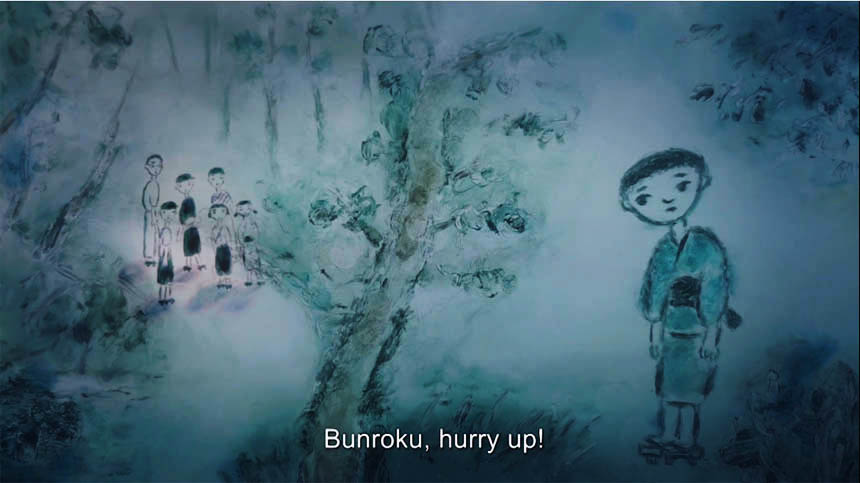
In this scene from the animated film Fox Fears, Bunroku can't keep up with his friends because he is wearing his mother's clogs.
In this scene from the animated film Fox Fears, Bunroku can’t keep up with his friends because he is wearing his mother’s clogs.

The mystery of the night, primordial fears, the power of a mother’s love – those are some of the ingredients in Fox Fears (Kitsune Tsuki)
a lovely short animated short from Japan. (Nothing to do with the nefarious U.S. TV network!) Director Miyo Sato made Fox Fears using sand and paint on glass.

The story begins the way a low-key horror film might. A young boy named Bunroku narrates the story. Under a bright moon, he was walking to a night festival with his friends, but he couldn’t keep up with them because he was wearing his mother’s clogs. (Not the right size, I guess. What happened to his own shoes? Too small? They broke?)

He and his friends stop at a clog shop so he can buy new ones. While they are in there, we hear distant music from the festival – flutes and drums. One flute sounded a bit like a wolf’s howl, to me. After the boy makes his purchase, a mysterious old woman appears and tells them that buying clogs after dark means you will turn into a fox. Don’t they know that? “Lies!” they shout, and head off to the festival, with its lanterns, banners, floats and music. (I would have liked to spend a few more seconds at this festival!)

Bunroku tells us that his friends would always see him safely home, and yet somehow this night, they do not. He imagines foxes and their shadows stalking him all the long, long way home. Once he gets there (guess that’s a spoiler, sorry!) he tells his mother what happened and she reassures him there’s nothing to worry about. She uses the word “lies,” as well. Maybe superstition is too big a word and too big a concept for a little kid. Not to mention folklore or mythology.

But Bunroku needs further reassurance. “But what if I DID turn into a fox?” His mother has an answer to that. He has more complicated questions and she has more detailed answers. I won’t spoil all that for you. One of the imagined scenarios is tragic and might bring the susceptible to tears.

Bunroku and his mother, from the Japanese animated film Fox Fears.

Even thought they are having a theoretical, late-night, drowsy chat about shapeshifting, it is very clear that Bunroku’s mother would do anything and everything to keep him safe. That’s what good mothers everywhere do. It’s quite an amazing thing!

References and my reactions: It is possible that I am seeing things in Fox Fears that director Miyo Sato did not intend. Who knows, really. But, one way or the other, those things added to my enjoyment of the film.

Fox Fears has a dreamy, timeless quality. I don’t remember seeing any cars, buses, trucks, cellphones. If not for a light bulb seen at Bunroku’s home, and the Western clothes on some characters, the story could have taken place hundreds of years ago.

I find it cute that he’s wearing his mother shoes. I used to wear my mother’s boots when I was quite young (I had big feet!) That made me feel closer to her, not to mention that her boots were prettier and more stylish than mine.

The clog shop looks isolated, on the edge of the forest. That reminded me of so many films, Japanese ones in particular, where magical (and/or evil) places only exist at night. In the light of day, there is nothing there at all. Or just some ruins. The people who seem to live in those places are really ghosts or demons. Eat or drink what they give you and you will be under their power forever. Does that clog shop even exist in the day time?

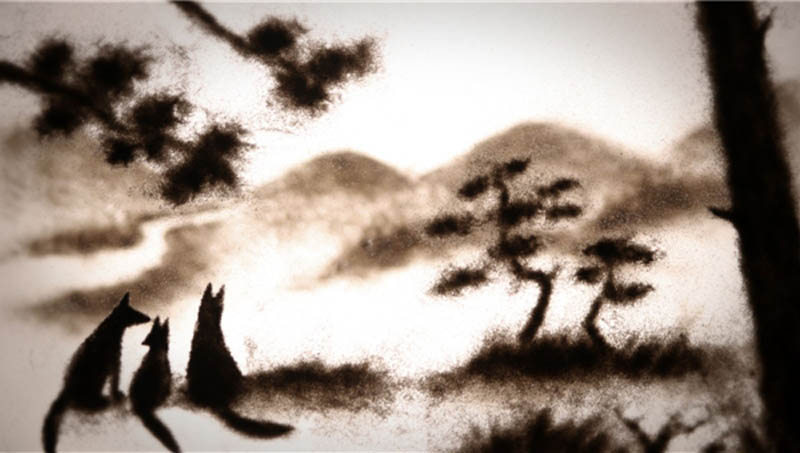
A fox family in sihouette in the animated film Japanese Fox Fears. Director Miya Sato created the images using sand and paint on glass.

Foxes and fox spirits figure in Japanese folklore and films; I’ve read some of those stories and seen some of those films. They appear in Chinese and Korean tales and films too, though the details vary.

I saw Fox Fears (Kitsune Tsuki) at Les Sommets du cinéma d’animation de Montréal 2016, at the Cinémathèque Québecoise.

Fox Fears (Kitsune Tsuki)
Animation (PG)
Director: Miyo Satori
Length: 7 min., 38 sec
Language: Japanese
Subtitles: English
Completed date: 2015


Sommets du cinéma d’animation 2016: Review of the documentary Oscar

A screen grab from Oscar, an NFB/ONF documentary about jazz pianist Oscar Peterson. The film was directed by Marie-JosŽe Saint-Pierre.

In the 12-minute NFB/ONF documentary Oscar, filmmaker Marie-Josée Saint-Pierre uses animated sequences, archival footage, photos, news clippings and other documents, radio and TV interviews with Montreal-born jazz pianist Oscar Peterson to chart his career and to depict the loneliness of life on the road and the toll it takes on a marriage, on the relationship between a father and his children and on musical performance, too. (Peterson was only 19 when he married for the first time. He tells an unseen interviewer that he should have waited until he was at least 40.)

A telegram reads: “I miss you Daddy. When are you coming home?” We also see a divorce document – genuine or recreated, I don’t know – that lists the respective parties as “Oscar Peterson” and “Mrs. Peterson.” That’s how it was in those days, married women didn’t even have a name of their own. More cringe inducing is a radio segment from 1944 in which announcer Jeff Davis calls 18-year-old Peterson a “coloured boy with amazing fingers.”

Oscar Peterson had a regular gig at Montreal's Alberta Lounge.
Oscar Peterson had a regular gig at Montreal’s Alberta Lounge.

In addition to talk about the hardships of touring, we see daytime and night-time photos of Montreal back in the 1940s, are reminded how popular our city was with U.S. tourists, and revisit the tale of how U.S. impresario Norman Granz was riding in a Montreal taxi when he heard Peterson on a live radio broadcast from the Alberta Lounge. Granz instructed the driver to take him there right away.

When he was still a young man, Oscar Peterson shared a bill at Carnegia Hall with his idols Ella Fitzgerald, Dizzy Gillespie and Ray Brown.

In the next sequence, Granz has taken Peterson to Carnegie Hall, where he plays on a bill that includes Ella Fitzgerald and Dizzy Gillespie. (Granz was Peterson’s manager for most of his life; a New York Times obituary for Granz says that Peterson named one of his sons after him. Google tells me that late in life Peterson had a daughter named Celine. Was she named for our national songbird? Anybody know?)

An animated depiction of CBC radio host Peter Gzowski is astounded when Peterson tells him that he thinks ahead while he’s playing, or more precisely, that he plays behind his thinking.

Needless to say, Oscar contains lots of Peterson’s music, too, a bonus for old fans and newly created ones.

Oscar is part of a three-film selection called Animating Reality 1: Familiar Faces, that will be shown on Sunday, Nov. 27, at 1:15 p.m., as part of the Sommets du cinéma d’animation film festival, at the Cinémathèque Québecoise, 335, de Maisonneuve Blvd. E.

NOTE: Casino, a 4-minute film by Montreal director Steven Woloshen, uses music by Oscar Peterson. Casino is among the films in the International Competition – Programme 3, that will be shown at 3 p.m. on Sunday, Nov. 27, at 1:15 p.m., at the Sommets du cinéma d’animation.


Review of Window Horses: The Poetic Persian Epiphany of Rosie Ming

Ann Marie Fleming's animated film Window Horses: The Poetic Persian Epiphany of Rosie Ming is incredibly colourful.
Ann Marie Fleming’s animated film Window Horses: The Poetic Persian Epiphany of Rosie Ming is incredibly colourful.

It is cold here in Montreal. We had the first snow of the season on Monday the same day that I saw Ann Marie Fleming’s animated film, Window Horses: The Poetic Persian Epiphany of Rosie Ming. It was like the proverbial breath of fresh air – warm, welcoming, colourful, joyful, musical, magical, mesmerising and marvelous! It’s about the love of family, love for words and music and other good things. It’s also about more complicated stuff like history, dissent, exile, reconciliation and finding your own voice. So many elements, but they all work together well, as in a symphony, or (corny reference, sorry) a beautiful carpet. Window Horses is a treat for the eyes and ears that will touch your heart. (Not exaggerating!)

The film’s French title is La vie en Rosie : L’épopée persane de Rosie Ming – a different cultural reference, while the alliteration remains.

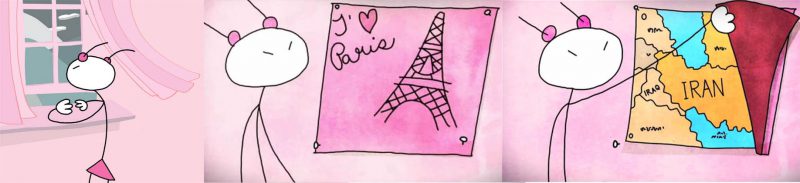
Rosie Ming is a young Vancouver woman of Chinese and Iranian parentage. She was raised by her loving Chinese grandparents and still lives with them. (Rosie has the voice of actress Sandra Oh and a stick-figure body. That body is the alter ego of director Ann Marie Fleming. The other characters look like more conventional human beings.)

Rosie loves Paris even though she has never been there. After self publishing a slender book of her poems (My Eye Full, Poems by a Person Who Has Never Been to France) Rosie is surprised to receive an invitation to a poetry festival in Iran.

Her best friend Kelly (voice of Ellen Page) tells Rosie that she MUST make the trip. (Kelly did not even know that Rosie wrote poetry, so she’s a bit hurt that Rosie kept that info to herself.)

Rosie Ming is drawn as a stick figure in the film Window Horses: The Poetic Persian Epiphany of Rosie Ming. Rosie loves Paris, but there's a map of Iran under her Paris poster.
Rosie Ming is drawn as a stick figure in the film Window Horses: The Poetic Persian Epiphany of Rosie Ming. Rosie loves Paris, but there’s a map of Iran under her Paris poster.

Rosie’s grandparents are happy that their little girl has been honoured; they are less enthusiastic when they learn that the event is in Iran. But once Rosie has decided to go, they can’t dissuade her. (Grandpa Stephen is played by Eddy Ko, Grandma Gloria is played by Nancy Kwan. THE Nancy Kwan, of The World of Susie Wong, Flower Drum Song, etc.)

As the airplane starts its descent to the airport, all the women cover their hair with scarves. Rosie outdoes them, going full chador. (Throughout her visit, she is told: “You don’t have to do that, you know.”)

When Rosie tells the customs officer that she is attending a poetry festival in Shiraz, he says that he is a poet, too. Everyone in Iran is a poet!

Even though she is quite young and has only written one book, Rosie is treated with warmth and respect by everyone at the festival, apart from snarky German guest Dietmar, who usually has his nose buried in his phone.

Don McKellar and Sandra Oh enjoy themselves recording the voices of Dietmar and Rosie, for the film Window Horses: The Poetic Persian Epiphany of Rosie Ming.

(Canadian actor and director Don McKellar provides the voice of Dietmar. “I have angst. I’m doomed,” he says.) Other guests include Chinese exile Di Di and U.S. poet Taylor Mali. (Mali is a real-life person.)

Rosie knows about Rimbaud, Baudelaire and other French poets; in Shiraz her hosts introduce her to the verses of Iranian poets Rumi, Hafiz (also spelled Hafez) and Saadi. The last two were both sons of Shiraz.

Window Horses is full of beautiful sequences; here are two. We hear the call to prayer coming from a minaret. The sounds are represented by colourful ribbons that fly through the air. Soon an enraptured Rosie is floating with them. (This sequence was made Kevin Langdale, who is the lead animator and designer of the entire film.) A sequence describing the life of Hafiz is exceptional, with complicated paper cut-outs, whirling calligraphy, etc. Bahram Javaheri, a Vancouver-based Iranian filmmaker, made the cutouts and Michael Mann assembled and animated them using Adobe’s After Effects software.

The Iranian poet Hafiz, right, listens to his father recite poetry in a scene from Ann Marie Fleming's animated film Window Horses: The Poetic Persian Epiphany of Rosie Ming. Bahram Javaheri, a Vancouver-based Iranian filmmaker, made the paper cutouts and Michael Mann assembled and animated them using After Effects software.
The Iranian poet Hafiz, right, listens to his father recite poetry in a scene from Ann Marie Fleming’s animated film Window Horses: The Poetic Persian Epiphany of Rosie Ming. Bahram Javaheri, a Vancouver-based Iranian filmmaker, made the paper cutouts and Michael Mann assembled and animated them using After Effects software.

(People come from all over Iran to visit the tomb of Hafiz; Rosie visits it, too. We learn that Iranians consult books of his poetry to answer questions about their lives – open any page, and his ancient words will have meaning in the present-day situation. This made me think of people consulting the I-Ching back in the 1960s.)

Rosie does not know much Mandarin beyond “ni hao,” yet she is moved to tears by Di Di’s untranslated poem. Even though she does not know the words, she feels their meaning and the emotions behind them. In a flashback scene, Rosie’s parents meet and bond immediately over their shared love for Rumi. When Rosie’s father recites a Rumi poem in Farsi, Rosie’s mother cries crystal tears.

When Rosie's parents meet, her future mother, Caroline, is reading a book by Rumi. Caroline cries when Rosie's future father recites a Rumi poem in Farsi.
When Rosie’s parents meet, her future mother, Caroline, is reading a book by Rumi. Caroline cries when Rosie’s future father recites a Rumi poem in Farsi.

Despite much warmth and happiness in Rosie’s life, and in her visit to Shiraz, there is an undercurrent of melancholy, with gusts to bitterness. Her mother is dead, and her father abandoned her when she was 7 years old. How could he do that? Many people in Shiraz knew her father, and they tell her he was a very good man. At first, Rosie does not want to hear anything about him, but then she, and we, make some surprising discoveries about him. To reveal more would be to spoil things.

Window Horses is among the two opening films of Les Sommets du cinéma d’animation, 15th edition, at the Cinémathèque Québécoise. It will be shown Wednesday, Nov. 23, 2016. at 7 p.m. (Oooops, the screening is now sold out.) Window Horses will get a general release in Canada in 2017.

Read more about Window Horses on the Cinémathèque’s web site.

RIDM 2016: Review of documentary film El Futuro Perfecto

In a scene from the hybrid documentary El Futuro Perfecto, Zhang Xiaobin, centre, and her fellow students in a Spanish language class prove that they understand the meaning of the word "ojos."
In a scene from the hybrid documentary El Futuro Perfecto, Zhang Xiaobin, centre, and her fellow students in a Spanish language class prove that they understand the meaning of the word “ojos.”

Xiaobin is a young woman of 17 who moves from China to Buenos Aires to join her parents.

Signing up for Spanish lessons allows her to make friends, expand her horizons and contemplate many possible futures.

Each student in the class is given a Spanish name (she gets Beatriz). They can play at new identities – a nurse from Barcelona, a business woman from Colombia, a lawyer from Montevideo.

They read questionable statements from their text book, “If I marry a rich man, I won’t have to work.” (Tsk, tsk!)

They practice mildly stilted dialogue exercises, inviting each other to meals or to the movies. Outside the classroom, Xiaobin uses those phrases when talking to Vijay, an immigrant programmer from India, and they really do go places together. They still act like they’re practicing, though. They order orange juice, and then decide to leave a few minutes later without even tasting it. “Should we go? “Let’s go.” The audience in the cinema laughs.

After the film, a friend said that the person who played Vijay was not a good actor. I’m not sure about that. I think he might have played his part exactly the way director Nele Wohlatz wanted him to.

The dialogues in their text books will sound familiar to anyone who’s ever taken a language class, but some of the overwrought things Vijay says sound like they’re from a melodramatic telenovela.

Kitty content: After a few dialogues about cats, kittens start to appear in the homes of some of the students.

El Futuro Perfecto is not a typical documentary at all. It’s some sort of hybrid thing – drama/documentary/improv, based on the real-life experience of star Zhang Xiaobin. Many parts are quite funny, too. I would have been happy to spend more time in the world of El Futuro Perfecto, but it’s only 65 minutes long. Maybe writer/director Wohlatz and her cast said every thing that they wanted to say within that time frame. If so, kudos to them for not dragging things out.

Learn more about El Futuro Perfecto or buy tickets on the web site of RIDM, Montreal’s documentary film festival.
El Futuro Perfecto, 65 minutes long, in Spanish and Mandarin with English subtitles.
Director: Nele Wohlatz
Cast: Zhang Xiaobin , Saroj Kumar Malik , Jiang Mian , Wang Dong Xi , Nahuel Pérez Biscayart
Producer: Cecilia Salim
Cinematography: Roman Kasseroller, Agustina San Martín
Sound: Nahuel Palenque
Editing: Ana Godoy
Production: Murillo Cine

El Futuro Perfecto
Sunday, Nov. 20 at 2:30 p.m., Cinémathèque Québécoise, Salle Principale, 335 de Maisonneuve Blvd E.

RIDM 2016: Review of documentary film NUTS!

The documentary NUTS! uses animation, photos, old film footage and newspaper clippings to tell the story of medical charlatan Dr. J.R. Brinkley.

The documentary film NUTS! tells the story of Dr. J.R. Brinkley (1885-1942). He became a very wealthy man by selling his alleged medical expertise, along with his dubious potions and questionable procedures.

J.R. Brinkley was a pioneer in three fields – medicine, business and radio. He became rich and famous as the “goat-gland doctor.” He claimed to cure impotence and infertility by implanting goat testicles, or pieces of them, into his male patients, who then went on to father “miracle babies.” A public relations man saw to it that articles about Brinkley appeared in newspapers across the U.S. It was suggested that one of these miracle babies might grow up to be another Lincoln, Edison or Shakespeare. Men flocked to Brinkley’s clinic in the tiny town of Milford, Kansas for the surgery and paid hundreds of dollars for it.

Brinkley gave health advice, sexual and otherwise, on his own radio station, KFKB, which was one of only four commercial stations in the U.S. at the time. He received thousands of letters from listeners and answered them on a show he called Medical Question Box, which ran several times per day. He recommended his own elixirs, which could be ordered from the station or bought from many pharmacists. KFKB grew from 500 watts in 1923 to 5,000 in 1927. In between his talks, the station ran lectures, French lessons, and played country music instead of the staid “potted palm music” of more conventional stations. This increased the popularity of country music.

NUTS! artfully combines animation with archival footage, photos, and newspaper articles about Brinkley. He’s often seen in a white suit, like Col. Sanders of Kentucky Fried Chicken fame. Like a wealthy entrepreneur of our own day, Brinkley also ventured into politics. He ran for governor of Kansas twice, and got lost of votes. When his broadcasting license and his license to practice medicine were revoked in Kansas, he moved to Texas where he built a palatial estate and set up a one-million-watt radio station over the border in Mexico. (Many years later, the DJ Wolfman Jack would broadcast his shows from that station.)

Brinkley bought fancy cars, airplanes, three yachts and even hired a filmmaker to document a family cruise to the Galapagos Islands. Brinkley, wife Minnie and son John are seen toting guns and looming over dead creatures. They caught five turtles, too. Green Turtle Soup!

Most of the film describes Brinkley’s life as just one roaring success after another, the same way his prolific biographer-for-hire Clement Wood did in the book The Life of a Man. The only thing that kept his life from being totally perfect were some little skirmishes with hidebound naysayers in the American Medical Association and elsewhere who were determined to halt the course of progress, etc., etc. They called him a quack.

The financial success was real, but unfortunately for many of his patients, Brinkley WAS a quack, much better at selling than he was at surgery, but somehow it took years for the general public to find that out. He had gone to medical school, but it was an unaccredited one, and he did not complete the course.

In 1939, in a very unwise move, Brinkley took his nemesis, the editor of the Journal of the American Medical Association, Morris Fishbein, to court, accusing him of libel. Brinkley lost the case and his reputation was shattered. Injured patients (or their survivors) sued him for damages. By 1941 he was bankrupt, and in 1942 he died of a heart attack.

NUTS! is quite fascinating just as it is, but I would have liked to know more about all the harm Brinkley did. The Internet helps with that, though. A review of the book The Fraudulent Life of John Brinkley, by Pope Brock says that hundreds of his patients died. That being the case, I find it amazing that he couldn’t be stopped sooner.

We might like to think that we live in a more sophisticated age these days, but there are all too many quacks out there, and the Internet is even more powerful tool than a one-million-watt radio station.

Minor Canadian connections that don’t appear in the film: When he was separated from his first wife, Brinkley kidnapped his young daughter and fled to an unspecified location in Canada, for an unspecified period of tiime. Later, after he achieved fame and fortune, Brinkley liked to fish in Nova Scotia. Oh, not particularly a Canadian thing, but Brinkley was also a bigamist.
NUTS!
Country : United States
Year : 2016
Duration : 79 min.
Director: Penny Lane
Editing : Penny Lane, Thom Stylinski
Production : Caitlin Mae Burke, Penny Lane, James Belfer, Daniel Shepard
Writer : Thom Stylinski
Sound Design : Tom Paul

You can see NUTS! Saturday, Nov. 19, 3:30 p.m. as part of RIDM, Montreal documentary film festival.
Cinémathèque Québécoise – Salle Principale
Director Penny Lane will attend the screening, which will be presented with French subtitles.

RIDM 2016: Review of documentary film The Great Wall

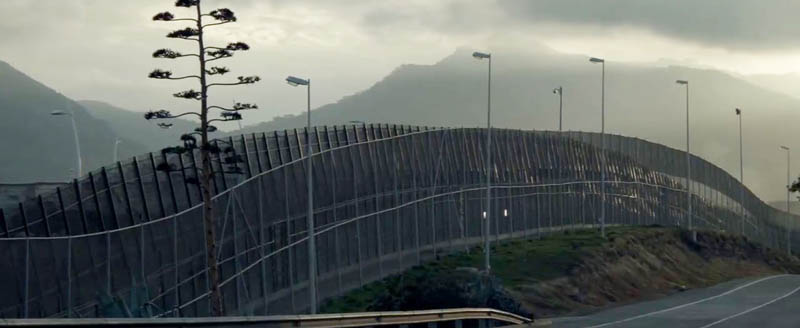
An image from the documentary The Great Wall, whch is being shown at the 2016 RIDM documentary film festival in Montreal. For me, the curves of this fence suggest the dragon-like undulations of The Great Wall of China.

The Great Wall is about walls and borders, old and new. The old one is the Great Wall of China, as described by Franz Kafka, in his short story Building The Great Wall of China, which was written in 1917, though not published until 1931. (Coincidentally, I happened to read it a few weeks before I heard of this film. Everyone seems to call it a short story, but it reads more like a philosophical essay to me. )

The short story’s nameless narrator is someone who worked on the wall himself, thouands of years ago; he muses about why it was built the way it was – in many unconnected pieces of 1,000 metres each, with great gaps in between. He declares that it was dysfunctional and the authorities must have known that, so they must have intended it to be dysfunctional. . .but again, why?

The film’s narrator, Nicola Creighton, reads excerpts from Kafka, in the original German, while we look at walls and very tall fences marking borders in Europe and North Africa. Those North African scenes were shot in Melilla, a small chunk of Morocco that Spain has held on to since 1497.

Because I had read the story recently, I caught a change that had been made to Kafka’s words. He wrote: “Against whom was the great wall to provide protection? Against the people of the north.” The film narration says “people of the south.” This north-south change occurs several times in the narration.

Walls and fences alone are not enough to keep the “others” out. There are watchers in the sky, in airplanes, surveillance cameras with night vision, and the kind of towers you see in films about prisons and concentration camps.

Often, it is not clear where we are in the world, though palm trees hint at a hot climate. Is that because one border often looks like another? Is it because some refugees/migrants don’t always know where they are, either? Should we think of it as a metaphor, more than anything?

Sometimes, the forces of law and order give us a clue: what does it say on the back of their uniforms? POLICE, POLIZEI or GUARDIA CIVIL? In Greece, their shields say POLICE, but there is another word writen in Greek alphabet.

Some scenes start in one country and end in another (far as I could tell). The Great Wall was shot in 11 countries; I did not recognize all of them. One city had a large, strange, ugly building. I want to learn the story of that. (As in, who are the guilty parties?)

There are scenes of huge skyscrapers in big cities, with pedestrians in suits walking around looking powerful and purposeful. My thought about that was, those buildings are another kind of wall or border, that will succeed in keeping strangers out. It’s likely that few migrants will be able to enter them, except perhaps as cleaners.

The music in the film gives an air of menace to many scenes. On the other hand, we often hear birds singing. My interpretation of that: birds are almost everywhere, they sing on good days and bad, they can go to any place that the wind and their wings will take them, unlike humans, they know no borders.

Coincidence: This was the second time this week that I have seen Maersk shipping lines onscreen. The other time was in a documentary about the “boat people” who fled Vietnam 40 years ago. Some of them were rescued by a Maersk ship.

At 72 minutes, The Great Wall felt a bit longer than it is. Some viewers might find their interest flagging toward the end. Or not. I’m not sorry that I went. There’s lots of food for thought in the film.
The Great Wall, 2015, from Ireland.
Director: Tadhg O’Sullivan
Camera: Feargal Ward
In German with English subtitles

The Great Wall is being shown as part of RIDM, Montreal’s Documentary film festival. See it at 8:30 pm, Friday, Nov. 18, at Cinéma du Parc, 3575 Ave du Parc. You can read more about it, and buy tickets on the RIDM web site. The trailer below looks very dark. Most of the scenes in the film are not like that.