RIDM Review: My Love, Don’t Cross That River

Kang Gye-yeol, left, is 89 and her husband, Jo Byeong-man is 98. They ust might be the cutest couple you have ever seen. You can see them in the Korean documentary film My Love, Don't Cross That River
Kang Gye-yeol, left, is 89 and her husband, Jo Byeong-man is 98. They just might be the cutest couple you have ever seen. You can see them in the Korean documentary film My Love, Don’t Cross That River

My Love, Don’t Cross That River is a portrait of a marriage. Jo Byeong-man is 98 and Kang Gye-yeol and is 89. They have been together for 75 years. Pretty amazing, right?

Director Jin Mo-young records their lives for 15 months, as they discuss their past, clean up around their rural home, prepare meals and take walks. They are slow walks, to be sure, but they can still move, and in one scene Jo Byeong-man carries an impressively large load of firewood on his back.

Many of their walks are taken hand in hand and that’s how they fall asleep each night, too. They are always seen in traditional Korean clothes, usually in matching colours – bright, beautiful colours. Were they on their best sartorial behaviour for the full 15 months, or is that just the way they like to dress? I’m going to assume the latter.

While you’ll hear the occasional comment like “people get old, you can’t do anything about it,” they are remarkably upbeat. They’re playful, too, like children, newlyweds, or the cute little puppies that arrive in the fullness of time (after the pastor’s dog pay a visit to their own pooch.)

Jo presents his wife with a little bouquet of flowers and she accepts them happily, rubbing them on her face and his. They throw autumn leave at each other, sample the seasons first snowfall (then play with that, too).

After all these years, he still appreciates her cooking: “He’s never said it isn’t good. . .he eats a lot and then says ‘what a great meal.’ ” Actually, Kang Gye-yeol seems to have more energy (or patience) for food preparation than I do!

Children and grandchildren come to visit, bring gifts and pay their respects on New Year’s Day and Kang Gye-yeol’s birthday. Presumably they live far away, because we don’t see them much, apart from those days. I was uncomfortable watching a nasty fight between two siblings; it’s a harsh contrast to the warm affection that the two love birds share and it leaves them in tears.

Even at the beginning of the film, Jo Byeong-man coughs frequently and things just get worse as time goes on. Sometimes his cough keeps him awake at night. When they take their walks he has to stop more often to rest. Do you see where this is going? Kang Gye-yeol asks her husband to hang on a little longer, but at the same time, she starts burning some of his beautiful, colourful clothes so that he will have things to wear in the afterlife.

My Love, Don’t Cross That River was a big hit at the Korean box office, outselling many U.S. hits in the first weeks it was in cinemas. So far it is Korea’s most popular homegrown documentary. (Old Partner, about a man his ox and his wife, pretty much in that order, holds the No. 2 spot. The AmerAsia Film Festival showed Old Partner in Montreal in 2011. Read my review Old Partner for the Montreal Gazette here. )

My Love, Don’t Cross That River
Directed by Jin Mo-young
Country : South Korea
Year : 2014
Language : Korean
Subtitles : French, English
Runtime : 86 min
Production : Kyungsoo Han
Cinematography : Moyoung Jin
Editing : Zinsik Hyun
Sound : Minu Jung
Contact: Maëlle Guenegues
Cat & Docs
Maelle@Catndocs.Com

Sunday, Nov. 15, 2015, 4:15
Cinéma Du Parc 1, 3575 Park

RIDM 2015 Review: The Woods Dreams Are Made Of (Le Bois Dont Les Rêves Sont Faits)

RIDM Bois Woods

Spending more than two hours watching the goings on in Bois de Vincennes of Paris? Wouldn’t that be a bit much? The time passed relatively quickly, actually. The film opens with shots of a park that’s so expansive it looks like part of the countryside. Once upon a time it was, but then Paris grew around it. Other scenes will show that there are apartment buildings close to the edge of the park and that sometimes you can hear the rumble of traffic even if you can’t see it.

There are many reasons to visit the park: to exercise, to relax, to commune with nature, to work, officially or unofficially. Some people set up tents and live in the park in the warmer months.

Director Claire Simon shows us people who do those things; sometimes she talks with them, other times she observes from a distance. I was curious about the man who filled dozens of plastic water bottles from a fountain while thirsty joggers waited for their turn to drink. What was he going to do with them? Sell them to unsuspecting people? Who knows?

A man paints in nature, though not from nature, in a scene from the French documentary film The Woods Dreams Are Made Of (Le Bois Dont Les Rves Sont Faits).

Some guys who catch a large carp spend a long time examining it; distraught spectators tell them they’re being cruel and urge them to put it back in the water. A man paints outdoors, though he does not paint what he sees. A gay man explains cruising etiquette and laments the advent of smartphone apps; he doesn’t meet as many men in the woods as he used to do.

Workers who clean up the fallen leaves of autumn use horse-drawn wagons to reach places to narrow for trucks. Other employees look more bureaucratic, taking notes on their clipboards, discussing the possibility of redirecting some of the decorative waterways. Yet others, wearing hazmat suits, clear away abandoned tents and other possessions.

In the late 1960s, philosopher Gilles Deleuze was one the professors at an experimental university in the woods; as if in a dream, his daughter shows where the classes took place. It feels like being inside a ghost story.

Claire Simon spent one year shooting the film; if that year was typical, Paris does not get much snow at all – it barely made an appearance.

The Woods Dreams Are Made Of (Le Bois Dont Les Rêves Sont Faits)
Country : France, Switzerland
Year : 2015
Language : French
Subtitles : English
Runtime : 144 min
Production : Jean-Luc Ormières
Cinematography : Claire Simon
Editing : Luc Forveille
Sound : Olivier Hespel, François Musy, Gabriel Hafner

Sunday, Nov. 15, 2015, 2:30 p.m., Salle Claude-Jutra, Cinémathèque Québécoise, 335 de Maisonneuve Blvd E.
RIDM (Rencontres internationales du documentaire de Montréal) runs from Nov. 12-22, 2015. Visit the web site ridm.qc.ca for more information.


RIDM Review: Guantanamo’s Child: Omar Khadr

Omar Khadr, centre, talks to members of the media outside the Edmonton home of his lawyer Dennis Edney.

The fine Canadian documentary Guantanamo’s Child Omar Khadr is many things at once – chilling, heartbreaking and heartwarming; a record of shameful behaviour but also one of kindness and dedication; and a testimony to the resilience of the human body and spirit.

Omar Khadr was only 15 years old when he was gravely injured in a firefight in Afghanistan in 2002. That made him a child soldier by definition, though it did not save him from being accused of murder and being imprisoned for 12 years. (A photograph taken after the battle shows gaping holes in his chest; I was amazed that he survived at all.)

In the film, Khadr himself describes the torture and ill treatment he suffered at Bagram Airfield in Afghanistan and later at the U.S. prison at Guantanamo Bay, Cuba. His account is backed by former prisoners and the former military men who witnessed or delivered this torture themselves. Treatment and medication were withheld when Khadr would not or could not say what his interrogators wanted to hear, in contravention of the Geneva Convention.

We see videotape of a visit that CSIS investigators made to Guantanamo. Khadr is happy to learn that they are Canadians, you can hear it in his voice – he mistakenly thinks they have come to help him, but then he realizes that’s not the case at all. When he tells them about his wounded arms, one man says “you look fine to me.” This interview was not new to me, it’s part of the film You Don’t like the Truth: Four Days Inside Guantanamo, but watching it still makes me sad and angry. It’s one more lesson to all of us that we can’t necessarily depend on our own government to look out for our interests, even though it is legally and morally obliged to do so.

Omar Khadr as a teenager.

Those are some of the shameful things in Guantanamo’s Child: Omar Khadr. Now for the positive side.

Edmonton lawyer Dennis Edney spent years representing Khadr and fighting for his release. It took four years of effort before he was even allowed to meet with Khadr. Others might have given up long before then. Edney has won many awards for his work, and probably deserves many more. Khadr was returned to Canada in September, 2012, and sent to prison. In May, 2015, he was released on parole into Edney’s custody. He lives with Edney and Edney’s wife Patricia, in their Edmonton home. Khadr says that over time, their relationship has changed from a lawyer-client one to a father-son one. It’s lovely to see the way they interact with each other. Edney says he looks forward to seeing Khadr graduate from university. He wipes away tears describing prison visits with Khadr at Guantanamo, when he tried to reassure him that eventually he would be released and that they would go camping and fishing together in Alberta. Edney wanted to show Khadr photos or maps of the places they would go, but even that was not allowed.

Despite the treatment he received, Khadr is amazingly, remarkably calm. (he could probably write a self-help book about surviving under intense pressure.) He takes obvious joy in just breathing fresh air, and being able to look up at the sky. He talks of his decision, while still in Guantánamo, not to allow the people who were mistreating him to take up too much space in his head. I wonder how many of us could do the same? Khadr wants the chance to prove to former prime minister Stephen Harper, and other Canadians, that he is not the man they think he is.

Guantanamo’s Child: Omar Khadr is co-directed by Toronto Star journalist Michelle Shepherd and Patrick Reed. Shepherd followed the case for years and also wrote a book, Guantanamo’s Child: The Untold Story of Omar Khadr, which was published in 2010. Reed’s previous films include Fight Like Soldiers, Die Like Children (2012), which is about former General Roméo Dallaire and his campaign to end the use of child soldiers.

Guantanamo’s Child: Omar Khadr (click on the film’s name to be taken to the RIDM synopsis)
Directed by Patrick Reed Michelle Shephard

Country : Canada
Year : 2015
Language : English, Arabic
Subtitles : English
Runtime : 80 min.
Production : Peter Raymont
Cinematography : John Westheuser
Editing : Cathy Gulkin
Sound : Downy Karvonen, Sanjay Mehta, Peter Sawade

Saturday, Nov. 14, 2015, 6 p.m.
Theatre J.A. De Sève, Concordia University, 1400 de Maisonneuve Blvd. W.
RIDM (Rencontres internationales du documentaire de Montréal) runs from Nov. 12-22, 2015. Visit the web site ridm.qc.ca for more information.

RIDM 2015 Review: They Will Have To Kill Us First: Malian Music in Exile

Members of the band Songhoy Blues are among the musicians who appear in the documentary film They Will Have To Kill Us First: Malian Music in Exile.

They Will Have To Kill Us First: Malian Music in Exile is a documentary about the difficulties faced by residents of northern Mali, especially the musicians, after a Tuareg rebellion in 2012 was hijacked by Islamist forces. Mosques, tombs, libraries, and ancient manuscripts were destroyed. The imposition of sharia law meant veils for women, amputated limbs for convicted thieves and a ban on all music – even ringtones on cellphones. Musicians fled cities like Gao and Timbuktu in fear for their lives. Among those who appear in the film, some went to Bamako, in Mali’s south, while others went to refugee camps in Burkina Faso.

Malian musician Fadimata Walett Oumar, who is nicknamed Disco, right, and her husband Hassan (Jimmy) Mehdi, in a scene from the documentary film They Will Have To Kill Us First: Malian Music in Exile. The film is being shown at RIDM, Montreal's documentary film festival.
Malian musician Fadimata Walett Oumar, who is nicknamed Disco, right, and her husband Hassan (Jimmy) Mehdi, in a scene from the documentary film They Will Have To Kill Us First: Malian Music in Exile. The film is being shown at RIDM, Montreal’s documentary film festival.

The people we meet include established stars Khaira Arby and Fadimata Walett Oumar (nicknamed Disco, because she was a big Madonna fan in her younger days). Disco is a longstanding member of the group Tartit, though it is not named until near the end of the film. She is also married to a high-ranking Malian soldier who changes allegiance more than once, which makes their lives somewhat complicated. The film also serves as a promotional vehicle for a younger band called Songhoy Blues, and includes footage from their U.K. tour. (Earlier this year, they toured North America, making stops at SXSW and in Toronto, too.) You can find music by Khaira Arby, Tartit and Songhoy Blues on iTunes; click on their names to go there. The film’s soundtrack will be released, but sadly, it isn’t ready yet. If you like what you heard in the film, check out Tinariwen, as well.

Khaira Arby is among the Malian musicians who appear in the documentary film They Will Have To Kill Us First: Malian Music in Exile.

Most of us will never see the wonders of Timbuktu in person, so I appreciated glimpses of them in the film. I suspect that some scenes were shot before the widespread destruction and that many of those intriguing structures no longer exist.

At 100 minutes, the film seems stretched out. I expected lots of music, since it is about musicians, after all, but got tantalizing snippets instead. There is lots of talking, and some of it is repetitive. Perhaps I am just a victim of my own expectations – the film has many positive reviews on the Internet. Sample quote from a review in the Austin Chronicle:
“Social journalism of the highest order, They Will Have to Kill Us First is by turns horrific and front-loaded with sonic heroism. It’s also one of the most vibrantly shot and masterfully edited documentaries of this or any other SXSW year.”

Full disclosure, I did watch They Will Have To Kill Us First at home via an online screener, which must have reduced its power considerably.

(Justified) spoiler: The film ends with a joyous outdoor concert in Timbuktu, with lots of happy women and children among the audience.
They Will Have To Kill Us First: Malian Music in Exile (Click on the film’s name to read more about it on the RIDM web site.)

Friday, Nov. 13, 2:30 p.m.
Cinéma Du Parc 1 (Buy tickets here)

Saturday, Nov. 14, 215 p.m.
Cinéma Du Parc 2 (Buy tickets here)

They Will Have To Kill Us First: Malian Music in Exile
Country : Mali, United Kingdom
Year : 2015
Language : English, Bambara, French, Songhay
Subtitles : English
Runtime : 100 min
Production : Kat Amara Korba, Sarah Mosses, Johanna Schwartz, John Schwartz
Cinematography : Karelle Walker
Editing : Andrea Carnevali, Guy Creasey
Sound : Phitz Hearne
RIDM (Rencontres internationales du documentaire de Montréal) runs from Nov. 12-22, 2015. Visit the web site ridm.qc.ca for more information about the festival.

Fascinating slime mould documentary The Creeping Garden returns to Montreal


Poster for the documentary film The Creeping Garden. Note the reference to Montreal's Fantasia Film Festival in the upper left hand corner.
Poster for the documentary film The Creeping Garden. Note the reference to Montreal’s Fantasia Film Festival in the upper left hand corner.

The documentary film The Creeping Garden was one of the sold-out hits of the 2014 Fantasia Film Festival. Now the film is in limited release in Europe and North America, and Montrealers can watch it again, or for the first time, at the Dollar Cinema.

I saw and enjoyed The Creeping Garden at Fantasia, and reviewed it for the Montreal Gazette. Here are the first few paragraphs of my review:
“Slime mould – each word is bad enough by itself, but the effect is much worse in combination – eww, ick, gross! Slime mould sounds dangerous AND disgusting. Parents might panic if slime mould were found in their child’s school; potential buyers would refuse a home with slime mould in it, and on top of that, it sounds as slippery as the proverbial banana peel.

“And yet, after watching the documentary film The Creeping Garden (which had its world premiere at Fantasia) I know that it is not dangerous, and I do believe that an enterprising person could turn slime mould into the next chia pet, or a modern-day version of “sea monkeys.” Somewhere, an MBA class might be working on such a project right now. If so, the first order of the day would have to be – a name change.

Transforming plasmodium., looking pretty and colourful. Credit: Steven L. Stephenson
Transforming plasmodium., looking pretty and colourful. Credit: Steven L. Stephenson (Part of a New York Times slide show “Beauty and the Blob.”)

“Using beautiful, often hypnotic images, and the words of artists and scientists (amateur and professional), The Creeping Garden introduces us to this fascinating . . . entity. Slime mould was once thought to be a plant at one stage of its existence and an animal at another, because of its ability to move, albeit slowly. (It moves slower than the slowest snail; you need time-lapse photography to see it.) For some time, slime mould was classified as a fungus, but that designation was later changed, too.

“Scientists estimate that slime mould could be as much as 600-million years old.There are more than 1,000 varieties of slime mould out there. It can look like a delicate fern, little yellow balls, grains of translucent rice, chopped up spaghetti, or a meandering river, seen from above. On the other hand, one kind goes by the common name of Dog Vomit, for reasons that are quite obvious when you look at it.

“Sometimes the film shows us slime mould as the naked eye would see it, other times we see it magnified through a high-powered microscope.

“Slime mould has attracted many fans, and they come in many varieties,too. There are those who study it in their spare time just for the joy of discovery, others who make art with it (images or music) yet others who are using it to solve real-world problems, such as the quickest way to get to a fire exit in a building with a complicated layout.”

Metatrichia vesparia, looking quite weird! Credit: Steven L. Stephenson
Metatrichia vesparia, looking quite weird! Credit: Steven L. Stephenson (Part of a New York Times slide show “Beauty and the Blob.”)

You can read my full review Creeping Garden review on the Gazette web site. (When the paper revamped its “platforms” my name got scrubbed off, but it IS my review, I assure you!)

That review includes several links, so you can learn quite a bit more about slime mould, if you want to.

This slide show from the New York Times might get you in the mood for the film.

If you want a very quiet pet, you can order your own slime mould kit from the Carolina Biological Supply Company.
The Creeping Garden is co-directed by Tim Grabham and Jasper Sharp. It’s 81 minutes long and can be seen at the Dollar Cinema, 6900 Décarie Square, in Montreal, until Nov. 12, 2015. It’s one of the cinema’s “Marquee” presentations, which means that tickets actually cost $5. Quite a good deal, really!

Public transit users can get to the Dollar Cinema via the Namur metro, via bus lines 17, 160, 161, and 166.

Visit The Creeping Garden’s web site and Facebook page for more info about the film. You non-Montrealers can see if the film is coming to your town.

FNC 2015 Review: Chinese punk musicians have their say in Never Release My Fist

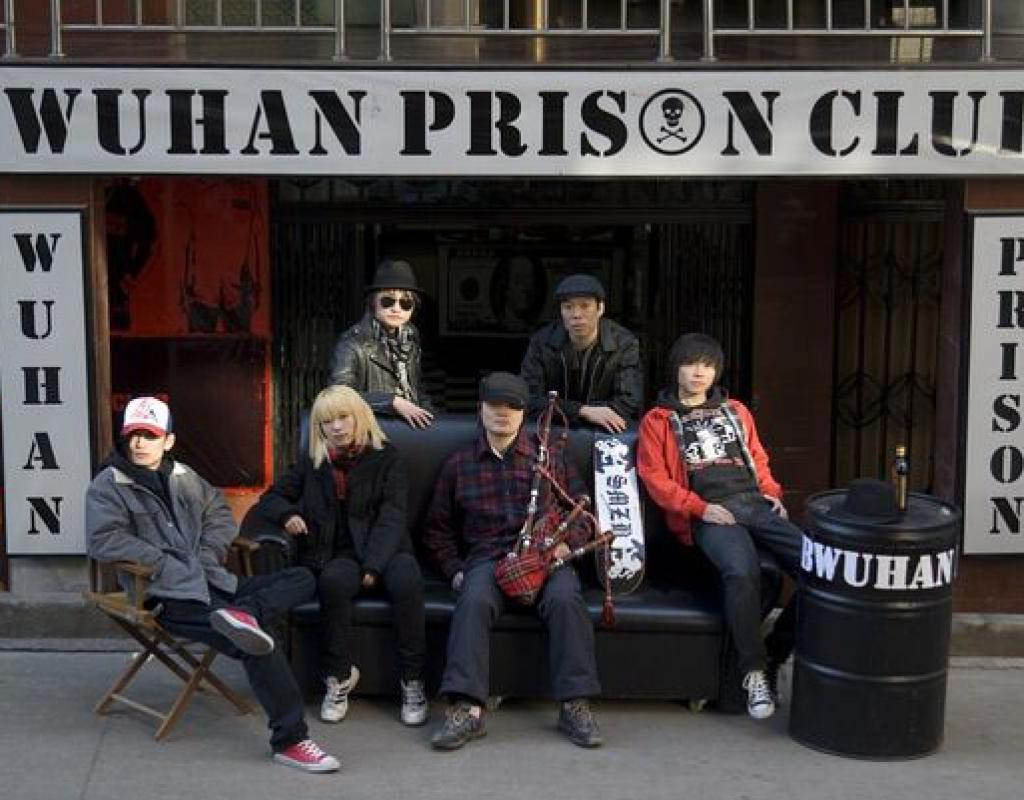
Wu Wei, standing, centre rear, with his fellow punk musicians outside his bar in Wuhan, China. Note the bagpipes! The history of Chinese punk music is explored in the documentary Never Release My Fist, by Shuibo Wang.

If you like punk music, China, or documentary films, then Never Release My Fist is especially for you. But really, I think this film would appeal to any living, breathing person with an interest in his or her fellow human beings, and how they live their lives, struggle to survive, and try to express themselves. I liked it a lot; if I didn’t have another musical commitment today, I would watch it again!

Montreal documentary filmmaker Shuibo Wang received an Oscar nomination for his NFB short, Sunrise Over Tiananmen Square. In Never Release My Fist he explores the world of Chinese punk, with particular attention paid to Wu Wei, who is often described as the father of Chinese punk. He formed his band SMZB in 1996.

Wu Wei describes himself as unemployed and aimless in the first few years after he finished high school, but he now comes across as very thoughtful and articulate man, distressed by the politics and rampant consumer culture in China. All the same, his lyrics sound quite poetic.

Wu Wei is from the city of Wuhan, the capital of Hubei province in central China. It’s a city of 10 million people known for heavy industry but it also has several universities, with as many as one million students (potential fans! Though director Wang says that most young Chinese prefer pop music).
While he benefited from some time in Beijing, Wuhan is where Wu Wei played most of his music, and it became the punk hotspot of China.

Musicians everywhere have tough lives, but the punks of Wuhan had little money to buy instruments, few places to play, and they faced government censorship as well. Text messages and email were intercepted.

An image from Never Release My Fist, a documentary film about punk rock in China. It's part of the lineup at the Festival du nouveau cinema in Montreal.
An image from Never Release My Fist, a documentary film about punk rock in China. It’s part of the lineup at the Festival du nouveau cinema in Montreal.

Wu Wei might be the main star of the film but his bandmates, former bandmates and fellow punk musicians get their share of screen time. Punk in Wuhan was not just a guy thing, either. Women played a big part, too. We see their performances and they share their sometimes harrowing stories and as well.

At some point SMZB included bagpipes and a violin to some songs, a very interesting touch! And Hou Hsiao Hsien uses bagpipes in the closing credits of The Assassin. Are bagpipes a thing in China now?

Filmmaker Shuibo Wang was able to use lots of great vintage footage that was shot before he ever met the musicians. He will attend the screening and answer questions after the film.

Festival du nouveau cinema programmer Julien Fonfrede, left, and Montreal director Shuibo Wang. (Photo copyright Maryse Boyce)

Never Release My Fist is being shown as part of the Festival du nouveau cinéma, which runs from Oct. 7 – Oct. 18, 2015. Visit the FNC web site for more information about Never Release My Fist.

Never Release My Fist
Directed by Shuibo Wang
China, Canada | 87 minutes | 2015, in Cantonese with English subtitles
Saturday, Oct.17, 2015, 17:00
Program #283
Cinéma du Parc 2, 3575 Ave. du Parc

FNC 2015 Review: Eco thriller La Tierra Roja looks at the evils of big business in Argentina

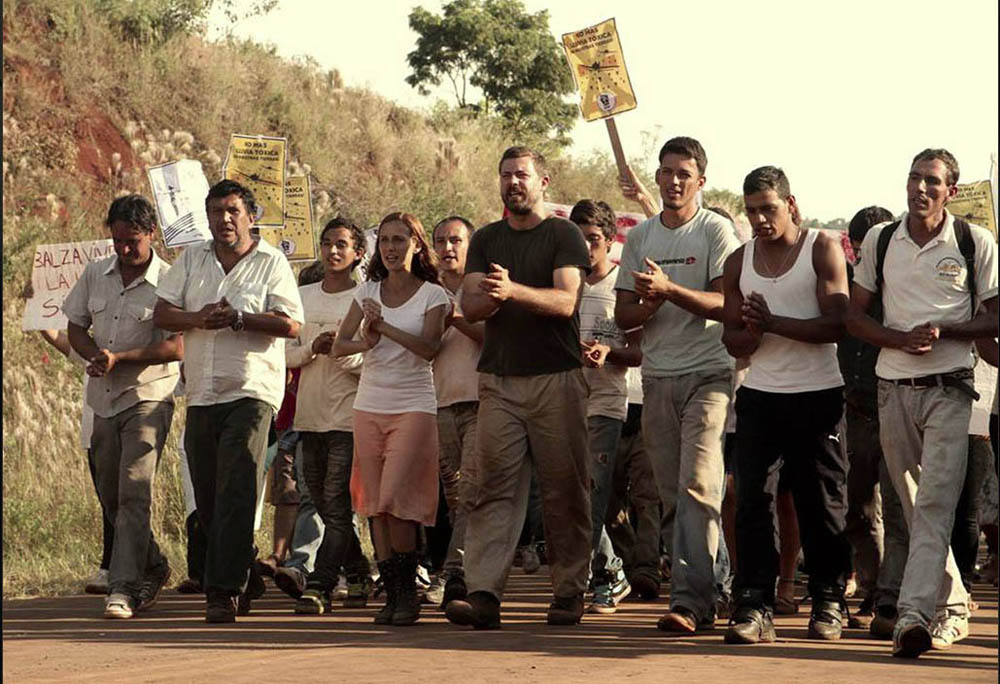
Ana (Eugenia Ram’rez Miori, in the orange skirt) and Pierre (Geert Van Rampelberg, in the black T-shirt) take part in a march against the use of toxic chemicals and the oppression of workers, in the film La Tierra Roja. It's a co-production between Belgium and Argentina that's being shown as part of the Festival du nouveau cinema.
Ana (Eugenia Ram’rez Miori, in the orange skirt) and Pierre (Geert Van Rampelberg, in the black T-shirt) take part in a march against the use of toxic chemicals and the oppression of workers, in the film La Tierra Roja. It’s a co-production between Belgium and Argentina that’s being shown as part of the Festival du nouveau cinema.

La Tierra Roja is a Belgium-Argentina co-production, shot in Argentina’s Misiones province. It’s fiction, but based on fact. Viewers in Argentina probably see it as a “ripped from the headlines” type of film.

Pierre works for a multinational company that cuts down trees and runs a sawmill and paper plant in northeast Argentina. In his spare time, he coaches a rugby team, and carries on an affair with Ana, a school teacher, who also works a small local medical centre. Pierre finds himself in an awkward position after Ana alerts him to the fact that his company’s use of herbicides is causing cancer, miscarriages, birth defects, learning disabilities and other problems among the workers and their families. The fish hauled from the river have strange bumps on their heads.

The government supports the company with subsidies; the governor will not even meet with Dr. Balza, who has been documenting all the health problems in the area.

When Dr. Balza presents the results of his research at an information meeting for the locals, Pierre’s superiors do what such people usually do – they claim that the man is lying, the chemicals are safe, and hey, what about all these wonderful jobs they are providing? (Even if they are dangerous and dirty.) Where have we heard this before? One worker points out that the company is employing 1,000 but poisoning one million. (Is that the price of progress?) After the doctor is murdered, Pierre realizes that he must take a stand.

While the good-guy/bad-guy situation is presented in a black-and-white manner (and quite justifiably so) the environemnt is quite colourful. The earth is indeed red in La Tierra Roja, in sharp contrast to the lush green forest. Ana’s house is a bright pink, and a local bar is purple. She wears an orange dress when she rides her horse to school.

La Tierra Roja is fiction, but I have seen my share of documentaries exploring similar situations in many countries of the world. We used to have a Human Rights Film Festival here in Montreal; we don’t have one any longer, but the Cinema Politica film series at Concordia University exposes problems like this on a regular basis.

La Tierra Roja has a Facebook page at   www.facebook.com/LaTierraRojaFilm/  It seems that the film was shown to residents of El Soberbio in Misiones just a few days ago. Read more about the film and other ecological problems in Argentina on that page.

La Tierra Roja
Argentina, Belgium | 104 minutes | 2015
Original version in Spanish, with English subtitles
Directed by Diego Martínez Vignatti, with Geert Van Rampelberg, Eugenia Ramírez Miori, Jorge Aranda, Alexandros Potamianos

Friday, Oct. 16, 2015, 17:00
Program #237
Cineplex Odeon Quartier Latin, Salle 10, 350 Emery St. (Berri-UQAM metro)
Visit the FNC web site for more info about La Tierra Roja

The Festival du nouveau cinéma runs from Oct. 7- Oct. 18, 2015.

FNC 2015 Review: Coin Locker Girl

Mom (Kim Hye-soo, with cigarette) and Il-young (Kim Go-Eun, centre in khaki T-shirt) in Coin Locker Girl.

The South Korean film Coin Locker Girl plunges us into a cruel and deadly world. It might not stand up to scrutiny, so don’t think about it too much, just go along for the ride.

The coin locker girl of the title was abandoned in an Incheon coin locker shortly after her birth. She is not taken to the police, or a hospital, as you might expect, she is informally adopted by some homeless people. Is this an act of kindness or does her presence make begging a little easier? We never find out. Her story only really begins for us when a crooked cop scoops her up, stuffs her in a suitcase and delivers her to “Mom,” the tough boss of Ma Enterprises, in Chinatown. Someone remarks prophetically that no good will come of this.

The little girl had been named Il-young after the number of the locker she was found in; in Sino-Korean il is one and yeong (or young) is zero. Talk about not having an identity of your own.

As a child, Il-young begs on the subway with other young children who live with Mom. (We don’t learn their back story.) By the time she reaches her teens, she is a very tough, somewhat androgynous young woman (played by Kim Go-Eun), who collects debts for Mom. Woe betide the self-styled tough guy who does not take Il-young seriously and treat her with respect. She is quite handy with fists, feet, knives or ashtrays.

Continue reading “FNC 2015 Review: Coin Locker Girl”

FNC 2015: Yakuza Apocalypse has tattoos, swords, knives, fists and fangs, a stinky kappa, a fighting frog and vampires!

This frog packs a mean punch, and mean kicks. too, in Takashi Miike's film Yakuza Apocalypse. It's part of the lineup at Montreal's Festival du nouveau cinema.
This frog packs a mean punch, and mean kicks. too, in Takashi Miike’s film Yakuza Apocalypse. It’s part of the lineup at Montreal’s Festival du nouveau cinema.

Takashi Miike – that should be enough information for many of you. For others, how about yakuza vampires and Yahan Ruhian, one of the baddest bad guys from Indonesian film The Raid?

What about a fuzzy frog, adept at martial arts? That creature up there at the top of the page?

There’s a female mob boss, too, for some gender equality.

Plot, you want a plot? OK. Lily Franky plays Kamiura, one of those mythical gangsters who protects the townsfolk from harm, and only goes after other gangsters.

Recent recruit Kageyama (Hayato Ichihara) admires him immensely, and hopes to be like him one day. Little does he know how soon that day will arrive.

In Yakuza Apocalypse, Yayan Ruhian's character looks like a geeky tourist at first glance, but he soon unleashes his lethal fists and feet.
In Yakuza Apocalypse, Yayan Ruhian’s character looks like a geeky tourist at first glance, but he soon unleashes his lethal fists and feet.

Kageyama doesn’t know it yet, but Kamiura is a vampire gangster. He seems indestructible until the arrival of two mysterious strangers, who demand that he rejoin some syndicate that he previously abandoned. After his death (!) Kamiura still manages to bite Kageyama, and thereby anoint him as his successor. Mayhem ensues. It doesn’t make much sense, but it’s fun. Nothing like Audition, though!

Yakuza Apocalypse, in Japanese with English subtitles, 115 minutes long. Directed by Takashi Miike, with Hayato Ichihara, Lily Franky, Yayan Ruhian.
Wednesday, Oct. 14, 2015, 21:00
Program #178
Cineplex Odeon Quartier SALLE 10, 350 Emery St. (metro Berri-UQAM)


FNC 2015 Review: High-Rise is like Lord of the Flies with the addition of adults and Tom Hiddleston

Tom Hiddleston plays a drunken Dr. Robert Laing in this scene from the film High-Rise. It's based on a novel by J.G. Ballard and directed by Ben Wheatley. The film is being shown at the Festival du nouveau cinema in Montreal.
Tom Hiddleston plays a drunken Dr. Robert Laing in this scene from the film High-Rise. It’s based on a novel by J.G. Ballard and directed by Ben Wheatley. The film is being shown at the Festival du nouveau cinema in Montreal.

The film High-Rise is being shown twice as part of Montreal’s Festival du nouveau cinéma. The first screening was very close to being sold out – I could only see a few empty seats in the large theatre.

What was the attraction? The direction by Ben Wheatley, a story based on a 1975 novel by J.G. Ballard, or British actor Tom Hiddleston? All of the above?

I’d bet on Hiddleston. During a scene that showed Hiddleston sunbathing, naked apart from a strategically placed newspaper, at least one person in the audience let out a loud whoop. (I assumed it came from a friend who had told me she’d be there, but when I wrote her an email later she said no, she had not been able to attend, after all.)

OK, then, what about the plot? The film opens with a very dishevelled Hiddleston. His white shirt is dirty and covered in blood, but he’s still wearing a tie. A dog’s leg is turning on a spit. In voice over, he recites the novel’s opening sentence: “Later, as he sat on his balcony eating the dog, Dr. Robert Laing reflected on the usual events that had taken place within this huge apartment building during the previous three months.” Then the words “three months earlier” appear onscreen.

Almost everything happens inside the high rise of the title. The building is a concrete monster looming over the landscape. It’s an apartment block, the first of many; others are under construction nearby. There’s lots of exposed concrete inside, too, which gives the place a cold, brutal and primitive look.

With a gym, a swimming pool and a well stocked supermarket, there’s no need for tenants to go out if they don’t want to. Of course, some people do have jobs to go to, and in the morning they stride purposefully through the expansive lobby to the equally expansive parking lot, where they climb into their cars.

The rich people have the upper floors, while the less well off, the families with their noisy, messy children, live on the lower floors. It’s like a vertical Snowpiercer. (Wish I could be the first to put that in writing.) Unlike the train passengers, the lower classes are not being held prisoner in the building, though. On the other hand, when everything start going to hell in a handbasket, no one considers leaving.

The building was designed by Anthony Royal (Jeremy Irons). A symbolic name, I assume. Royal lives on the top floor (the 50th) and has a huge rooftop terrace with grass, trees, a goat, a horse, and who knows what else. Sometimes Royal’s wife wanders around up there dressed like Little Bo-Peep. Royal wears a white, high-collared, shirt-jacket thingy which looks like a cross between white-hunter explorer gear and a retro space-captain uniform.

This photo, originally from the Screen Daily web site shows director Ben Wheatley, centre, and actor Jeremy Irons, right.

Tom Hiddleston’s Robert Laing, a man who is looking to “start over, begin afresh.” We never find out exactly what he means by that. As a doctor who lectures at a nearby hospital, Laing falls somewhere in the middle on the social scale, though his suits look quite nice and he obviously has aspirations to move up. He is mocked and insulted by some, for that very ambition.

Far from being a well-oiled machine, the building is plagued by power failures and elevator breakdowns, because “the building is still settling in.” That’s the official explanation and people repeat if often, in an effort to reassure themselves that the problems are only temporary.

But things just get worse instead of better and the social hierarchy starts to fall apart as well, with the lower orders objecting to the lordly behaviour of their “betters.” There are raiding parties, kidnappings and murder. (The Lord of the Flies vibe was strengthened for me by Hiddleston’s trousers – they were rolled up to the knee, approximating the shorts of British schoolboys.)

Luke Evans plays glowering Richard Wilder in the fim High-Rise.

Philandering TV cameraman Richard Wilder (Luke Evans) wants to capture all the goings on in a documentary. He’s far from an impartial observer, though, he instigates much of the mayhem himself.

Elisabeth Moss, of Mad Men fame, plays Wilder’s very patient, very pregnant wife. (They already have several children.)

Sienna Miller plays multitasking Charlotte Melville. She’s the mother of a geeky son, Toby; she’s Wilder’s lover, and Royal’s assistant, (though that isn’t very clear in the film) but she still manages to find time in her busy days and nights to get to know Hiddleston’s Dr. Laing a little better.

Many of Hiddleston’s fans read the book while they waited for the film to come out. Viewers who have done that will be at a distinct advantage, because the chaos seems to arrive too quickly in the film.

Extra details for the Tom Hiddleston fan-girls: You will see: Steely Tom, Sarcastic Tom, Shirtless Tom, Tom in a suit, Tom in the shower, Tom in nothing and “beardy Tom.” In scenes set in a mirrored elevator, you can see multiple Toms (just as there were multiple Lokis in a scene in the film Thor).

Together again: The film is a reunion for Jeremy Irons and Tom Hiddleston who played father and son in the Shakespeare play Henry IV, Part 1, which was shown on the BBC and PBS.
Read more about High-Rise on the FNC web site. You can buy tickets there, too.

High-Rise, in English, 112 minutes.
Directed by Ben Wheatley, written by Amy Jump, J.G. Ballard, with Tom Hiddleston, Jeremy Irons, Sienna Miller, Elisabeth Moss, Luke Evans.

Wednesday, Oct. 14, 2015, 18:15
Program #186
Cinéma du Parc 1, 3575 Ave. du Parc