FNC 2015 Review: The Sandwich Nazi

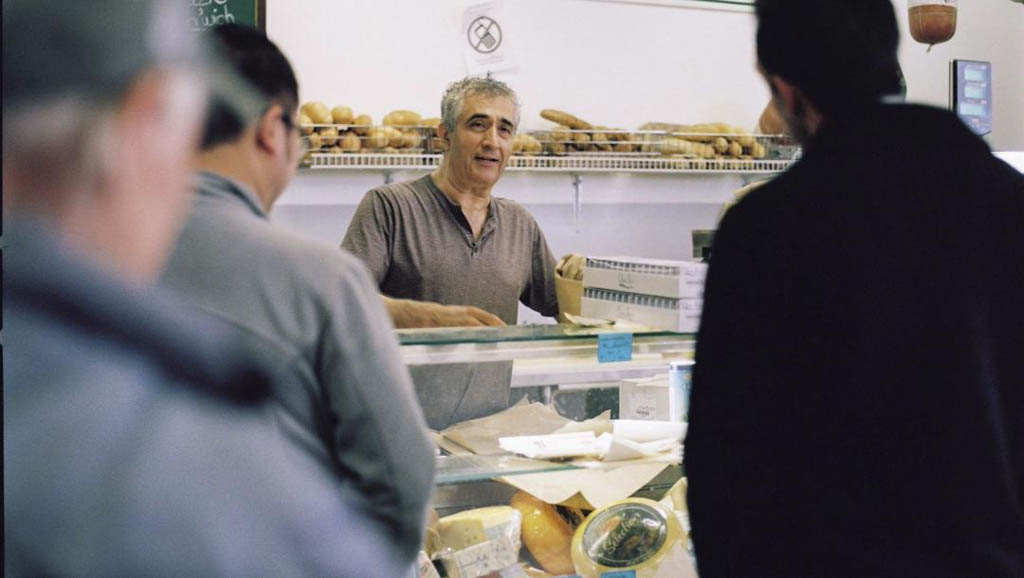
Vancouver deli owner Salam Kahil is the star of the documentary film The Sandwich Nazi. The film was directed and edited by Lewis Bennett. It's one of many films being shown at Montreal's Festival du nouveau cinŽema. (Photo by Rommy Ghaly)
Vancouver deli owner Salam Kahil is the star of the documentary film The Sandwich Nazi. The film was directed and edited by Lewis Bennett. It’s one of many films being shown at Montreal’s Festival du nouveau cinŽema. (Photo by Rommy Ghaly)

The Sandwich Nazi is a documentary portrait of Vancouver deli owner Salam Kahil. His customers call him Sal. Anyone who thinks Canadians are dull and boring has not met this guy.

Sal has a dirty mouth and a big heart. Viewers can assess some of his other parts in the last moments of the film.

Sal was born into a large family in Lebanon. He left home at an early age for assorted reasons. He lived in 18 countries before coming to Canada in 1979 and he has the photos to prove it. I didn’t hear him name our city, but it looks like he lived here in Montreal for a while.

When he was no longer “young and pretty” he went into the deli buiness, with La Charcuterie Delicatessen, a “Scandinavian place with a French name” being the most recent one. In addition to sandwiches, he sells imports you probably won’t find at your local supermarket. Customers are fond of the pickled asparagus from Denmark. When someone calls to ask if he has “Norwegian cooking chocolate” he says there’s probably some in the back. (You can see that chocolate on the La Charcuterie’s web site and lots more – Viking Bread, Norwegian fishballs, many cheeses, condiments, cookies, candy and sweets, including the very yummy Anthon Berg Marzipan Plum in Madeira. The site includes a recipe for Danish meatballs! )

(Looking at that website made me want to visit Montreal’s La Vieille Europe on St. Laurent, since it might have some of those things.)

Sal has many stories to tell, most of them crude. He says he used to be a male escort who could be hired by men or women. He says he has also been a very successful sperm donor (twins!) for women who did not have (or want) a male partner.

He tells these stories to his customers as he prepares their sandwiches. They’re an extra garnish, you might say. Are they all true? Are some exaggerated? Who knows? Who cares?

The sandwiches themselves are HUGE. Sal says they’re the best in the world and his customers seem to agree. Don’t go the film on an empty stomach.

The film’s title is a reference to the “soup Nazi” from the Seinfeld TV show. That guy made great soup but customers could be banished forever if they did not obey his many rules. Sal has rules, too; payment is cash only and he demands politeness and respect from his clients. For the most part, he seems to get it. We only hear one or two banishment stories.

As far as I can recall, the “soup Nazi” did not have any redeeming qualities beyond his culinary talents. In contrast, Sal and his army of volunteers prepare meals and distribute them to the poor and the homeless of Vancouver’s Downtown Eastside on a regular basis. He treats those people with warmth and respect and they are obviously happy to see him and his food. He feeds the volunteers, as well. We learn about many other good deeds in the film.

The documentary was made over several years. On more than one occasion, Sal says he will return to Lebanon to visit his family, even naming a departure date. But he doesn’t go. When he’s finally ready to make the trip, the film crew wants to accompany him, but his family says no. Sal documents things himself, and shares his footage with the filmmaker and viewers upon his return. This includes a hair-raising, high-speed drive through a sniper-infested area – not something that happens on your average vacation.

The Sandwich Nazi is one of the hundreds of films being shown at the Festival du nouveau cinéma. Read more about The Sandwich Nazi on the FNC web site.


The Sandwich Nazi
, directed and edited by Lewis Bennett
Original Version In English, 72 minutes long

Tuesday Oct. 13, 2015, 21:30
Program #163
Cinéma du Parc 1, 3575 Ave, du Parc


Cinema Politica presents This Changes Everything on Monday, Oct. 5, and Naomi Klein and Avi Lewis will be there

THIS CHANGES EVERYTHING1

Montrealers can see the important documentary film about climate change, This Changes Everything, at 7 p.m., on Monday, Oct. 5, 2015, at Concordia University (1455 de Maisonneuve Blvd. W., Room H-110) thanks to the organization Cinema Politica. Writer Naomi Klein and director Avi Lewis will be there. Suggested donation is $10 – $20. That’s probably all the information many of you will need. For others, I hope the review below will make you want to see it.

It’s all about the story – the story that we’ve been told, the story that we tell ourselves, the story that we believe. That story might be so firmly engrained in us that we never even think about it, or question it.

And that story is, that the Earth is a machine, and that mankind can and should manipulate its levers. The unfortunate results of that thinking can be seen all around us.

Changing the story is the first step toward changing our lives, our future and the life of this planet that we all depend upon.

After some opening shots of hurricanes, parched earth, polar bears and crumbling, tumbling ice bergs, This Changes Everything takes us to the ugly and monstrous tars sands of Fort McMurray, “the largest industrial project on Earth.” Would the citizens of any large city like Calgary, Edmonton, Vancouver, Toronto or Montreal accept such a huge and destructive project if it were in their own backyard? Somehow I doubt it. But the tar sands are far away and the local population is small. Later in the film, such a place is called a “sacrifice zone.”

One worker claims: “If not for the oil sands, there’d be nothing to come here for.” Then the camera shows us some stunning scenery – a majestic river flowing through a pine forest.It might be difficult for the average person to get up there, but many people would enjoy seeing it, or just knowing that such a place exists.

When we’re told that $150 to $200 billion would be invested there over the next decade, I couldn’t help but wonder what could be accomplished if that kind of money was spent on sustainable development instead.

The abuse of the English language and the twisted metaphors used by some of the people in this film – you have to hear them to believe them. I predict gasps, laughter, boos and hisses at various points during the screening of This Changes Everything.

One guy has the nerve to frame the tar sands project this way: “We’re cleaning up one of the largest oil spills on earth.” There are claims that the area will be brought back to its original state 20 years from now. Tailing ponds will be cleaned and, “you’ll be able to drink the water.” I’d really like to believe that, but I just can’t.

Meanwhile, the Beaver Lake Cree Nation has filed a court case to stop any further exploration, since the oil sands are under their traditional land and the present project has already done so much damage to their lives.

I won’t describe the whole film in detail, but I will say that it visits activists in Montana, New York state, India, Greece, China and Germany. People are standing up, complaining, saying “No!” to rampant development, demanding their rights and a new way of doing things.

While Klein does not present Germany as a perfect place, she produces some impressive statistics (30 per cent of Germany’s electricity comes from renewables, emissions are down, employment is up, etc.) Could Canada do the same? Especially if we can elect a new government in a few weeks?

Speaking of our country, as a Canadian, I’m embarrassed and distressed to see a Canadian mining company throwing its weight around in Greece, eager to get its corporate mitts on the gold there. My apologies to you, people of Halkidiki. And shame on you, mayor of Halkidiki, who dismissed the intimidation and arrests of protestors when he said: “the police don’t knock on doors without a reason; they don’t knock on yours or mine.”

This woman in Halkidiki, Greece, opposes a Canadian gold mine in her area.

This Changes Everything, the film, is a companion piece to Naomi Klein’s book This Changes Everything: Capitalism vs. the Climate. They were created at the same time, the film is not based on the book.

I think it’s quite wise that the subhead, “Capitalism vs. the Climate” is not attached to the film – why alienate some of your potential audience right off the bat? As far as I can recall, the word “market,” as a synonym for capitalism, is not heard until 27 minutes into the film, and capitalism itself is not mentioned until 45 minutes in, when Greek activist Mary Christianou identifies it as the core problem. She’s initially reluctant to even say so on camera, because: “I don’t know if it helps the struggle.”

In reviewing the book, some writers suggest that “neo-liberalism” is more to blame for many of our present ills than capitalism alone. Abandoning the belief that all the resources of the Earth, the metals, the coal, the gas and the oil must be extracted, and that the Earth itself is just a machine that we can be trusted to run, seem like easier first steps on the path to change.

This screen grab from the documentary film This Changes Everything shows India buried under "Proposed Coal-Fired Power Plants."
This screen grab from the documentary film This Changes Everything shows India buried under “Proposed Coal-Fired Power Plants.”

This Changes Everything will be shown on Monday, Oct. 5, 2015, 7 p.m., at
1455 de Maisonneuve West, Room H110, Concordia University, Montreal, QC.
Naomi Klein and Avi Lewis will be there for a Q&A session after the film.

There’s a Facebook page for the screening of This Changes Everything.

Visit thischangeseverything.org to learn more about the book, the film, and what you can do.

Montreal International Black Film Festival: Low-level Colombian smugglers are just trying to stay alive in Manos Sucias

manos sucias boat
Manos Sucias (Dirty Hands) is a taut tale set in Buenaventura, on the Pacific coast of Colombia. Within the first few minutes we see several tough-looking guys and many serious weapons. (There’s even a little kid nonchalantly cleaning a revolver.) Buenaventura is obviously a dangerous place, and a quick Google search will confirm that, with headlines like: Colombian City’s New Face and Violent Underbelly Collide; Colombian port city terrorised by criminal gangs – BBC News; Welcome to Buenaventura, Colombia’s most violent city.

There are 400,000 people Buenaventura, though we only see a handful of them, in the roughest, poorest parts of town.

Our main characters are Jacobo (Jarlin Martinez) and his younger brother Delio (Cristian Advincula). They’ve been estranged for years but end up working on the same drug run for Don Valentin. It’s the first time that Delio has done this kind of thing; Jacobo is an old hand who plans to move to Bogota once the job is done. That made me suspect that things might not go well for these guys. Just think of all the films have been made about that one last heist, or the cop who is one week, or even one day away from his retirement.

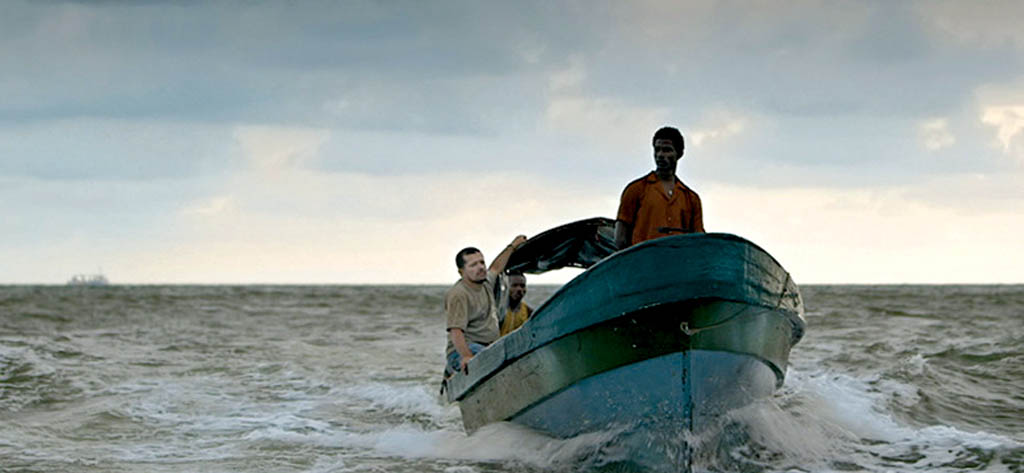
Jacobo and Delio will help a man named Miguel (Hadder Blandon) to pilot a small, battered fishing boat north towards Panama. This will take several days. Attached to the boat is a “torpedo” filled with 100 kg of cocaine in small packets. All of the packets will be weighed at the checkpoint, the guys are told. Point taken, no need to elaborate further.

The torpedo is fitted with a tracking device just in case it comes loose from the boat. (Cough.) Miguel has a cellphone, a GPS locator, and a gun. Delio has a machete that he uses to open coconuts, among other things. Seeing these items, one wonders if, or more likely when, they will be used, and in what circumstances.

Jarlin Martinez plays Jacobo in Manos Sucias, a film from Colombia that's being shown at the 2015 Montreal International Black Film Festival.
Jarlin Martinez plays Jacobo in Manos Sucias, a film from Colombia that’s being shown at the 2015 Montreal International Black Film Festival.

During their trip they will have to worry about running into guerrillas, the military, the paramilitaries, and anyone else who might have designs on their cargo. These people will feel entitled to take anything they might have, including their lives. There’s nothing dashing or glamourous here. Just danger and dread.

Soccer and racism are recurring themes in Manos Sucias. Before the trip, Jacobo watches an informal game with an old friend. When told about the plan to move to Bogota, the friend says there are no blacks there, or hardly any. They’re only able to get the most horrible jobs, and it’s freezing there, too. Later, Jacobo, Delio and Miguel sit around a campfire, talking about the great soccer stars of the past. Seems like your typical male bonding stuff, until the white Miguel spoils the mood and makes some racist remarks to the Afro-Colombian brothers.

When some unexpected events take Miguel out of the picture, Jacobo and Delio continue with the mission. What else can they do? But what will happen afterwards? (They HAD been told that this would be the “easiest job you ever had.” “Like a paid vacation.” Ha!)

The music Manos Sucias is worth mentioning. Haunting tunes from Grupo Gualajo make use of soaring women’s voices and a marimba.

Fans of Colombian salsa might nod their heads (I did, anyway) when Jacobo has one of those “kids, these days!” chats with his brother, disparaging the rap music that Delio admires and suggesting that he listen to “something good,” like Grupo Niche, Nemus del Pacifico, or Orquesta Guayacan.

Manos Sucias (Dirty Hands) U.S.A./Colombia, 2014, 82 minutes, in Spanish with English subtitles
Directed by Josef Kubota Wladyka, with Cristian Advincula, Jarlin Martinez, Manuel David Riascos, Hadder Blandon. Spike Lee was an executive producer

Sunday, Oct. 4, 2015, at 5 p.m.
At the Former NFB Cinema, 1564 St. Denis
Admission is $10

Check the Montreal International Black Film Festival web site, www.montrealblackfilm.com/ for further pricing details, the film schedule, film synopses and trailers.
The Montreal International Black Film Festival has a Facebook page, too.

License to Operate: Former Los Angeles gang members come together to save lives

License to Operate map

The documentary License to Operate introduces us to former Los Angeles gang members who were deadly enemies in their younger days but are now co-operating, through an organization called A Better LA,  to break a cycle of murder and retaliation that had lasted for decades.

One man gets out his high school yearbook and tells us that most of his former classmates are dead now. He has photos from their funerals. it’s obvious that he’s lucky to still be alive himself. Another man tells of seeing five candlelight memorials for murder victims in just one evening. That was the night that he knew he had to do something to save the next generation of children.

After receiving instruction from the Professional Community Intervention Training Institute, the men do liaison work between neighbourhoods and the police and fire departments, encouraging young people to stay out of gangs and calming tensions after murders. If something happens, even in the middle of the night, they’re out there on the street, trying to keep the situation from escalating, eliminating rumours, etc.
They certainly have their work cut out for them. A Better LA says that there are more than 450 gangs in Los Angeles, and that: “ ‘Invisible lines’ drawn by gangs to designate their turf cause children to live in a constant state of fear, wondering if walking to school or crossing the street puts them in harm’s way.”

A lawyer explains that many of the children in these neighbourhoods have the same levels of post traumatic stress disorder as children living in war zones. Before the age of 16, they have lost as many as 10 friends to murder. We see doors and walls that have been riddled with bullets. It’s truly appalling.

License To Operate, directed by James Lipetzky, 101 minutes, in English
Saturday, Oct, 3, 2015 – 7 pm
Cinéplex Odéon du Quartier Latin
350, Rue Émery, Montréal (Métro Berri UQAM)
Admission is $10.
Check the Montreal International Black Film Festival web site, www.montrealblackfilm.com/ for details, the film schedule, film synopses and trailers.
The Montreal International Black Film Festival has a Facebook page, too.

Montreal International Black Film Festival: Thursday night choices include music and memory loss in New Orleans, struggling siblings in a South African township

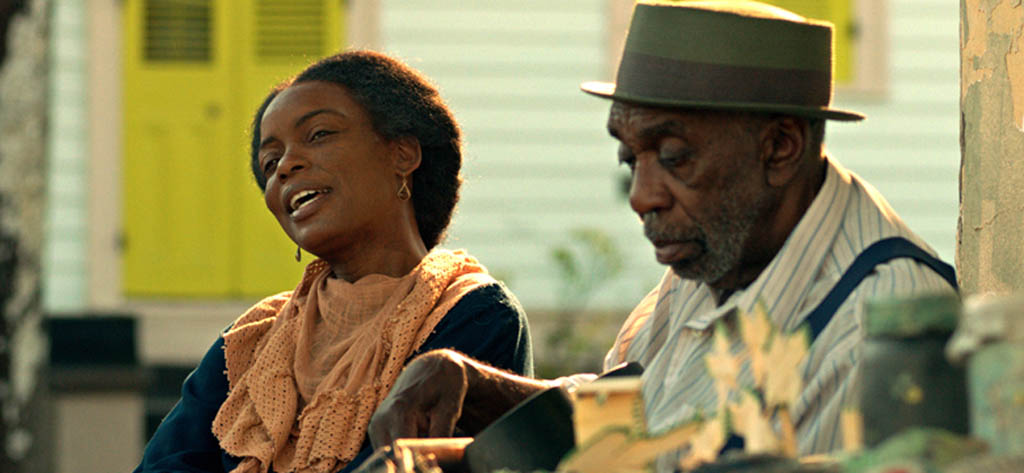
Aunjanue Ellis, left, and Bill Cobbs in Una Vida: Of Mind and Music, one of the films being shown at the 2015 Montreal International Black Film Festival.

Many Montreal film festivals show several films at the same time, which can make life difficult for fans. How to choose?

Here are brief reviews of the two films that will be shown at 7 p.m. on Thursday, Oct. 1, 2015 at part of the Montreal International Black Film Festival; I hope that they are helpful!

Una Vida: Of Mind and Music is a gentle tale that unfolds in an unhurried way. Dr. Alvaro Cruz (Joaquim de Almeida) is a neuroscientist who lives in New Orleans. Appropriately enough for someone who lives there, he likes jazz and blues. His mother has Alzheimer’s disease.

Soon after the film begins he is overcome by guilt because his mother died when he was away at a medical conference. He keeps dreaming of a time in his childhood when he got lost while chasing an elusive butterfly.

He takes time off from work to just kinda hang around. He meets an elderly musical couple – singer Una Vida, and guitarist Stompleg. They play on the street and in a small bar. He can see that the woman’s memory is failing, though her songs seem more firmly rooted in her brain than other things are. As a scientist, he is intrigued by this situation; as a human being he wants to help if he can.

Everyone seems to like Dr Cruz, except for a young woman named Jessica, who does a lousy job of helping Stompleg to look after Una Vida. She is hostile and suspicious and tells him to stay away. of course, we know that he won’t, don’t we?

Oh, for what it’s worth – Una Vida is also known as Queenie, though her real name is Maizie.
There are some nice tunes in Una Vida: Of Mind and Music, but there isn’t really much of a plot. The fortysomething actress Aunjanue Ellis, who plays Una Visa, is made up to look much older, yet her voice still sounds quite youthful most of the time. The film is based on a novel written by a real life neuroscientist Nicolas Bazan. It has many rave reviews on Amazon.com.

Una Vida: Of Mind and Music, 2014, U.S.A., 97 minutes, In English, with some Spanish dialogue when Dr Cruz talks to his mother.
Director: Richie Adams
Cast: Joaquim De Almeida, Bill Cobbs, Ruth Negga, Sharon Lawrence and Aunjanue Ellis
Screenwriter: Richie Adams, Nicholas Bazan
Producers: Richie Adams, Brent Caballero, Nicolas Bazan, Nancy Green-Keyes

Busisiwe Mtshali plays Zanele in the South African film Thina Sobabili (The Two of Us), which is one of the selections at the 2015 Montreal International Black Film Festival.

Thina Sobabili (The Two of Us) is about high-school student Zanele, and her older brother Thulas, who is raising her in the Johannesburg township of Alexandra. He is very strict and stern with Zanele, though he makes his living from robbing the homes of rich people. (We don’t actually see them do it, we just hear Thulas and his friends talk about it, and we see a bit of the loot.)

Zanele and her friend Tumi look very young in their school uniforms and white ankle socks, but Tumi is already flirting and accepting rides, meals, drinks and money from smarmy older men who own cars. She calls one of them the Minister of Finance. There are always lots of people in the street, so her behaviour does not pass unnoticed.

Thulas orders his sister to stay away from Tumi, but rebellious Zanele remains loyal to her friend. We know that this is bound to lead to trouble.

There are some very uncomfortable scenes in Thina Sobabili, and certain connections and coincidences seem too a bit of a stretch. Nonetheless, it is quite impressive, especially considering the fact that it was made on a tiny budget and shot in a mere seven days. Thina Sobabili is South Africa’s submission for the foreign-language Oscar.

Thina Sobabili (The Two of Us) 2015, 90 minutes, South Africa, in Zulu with English subtitles,
Director: Ernest Nkosi
Cast: Richard Lukunku, Emmanuel Nkosinathi Gweva, Zikhona Sodlaka, Thato Dhladla, Busisiwe Mtshali and Mpho (Popps) Modikoane
Screenplay: Ernest Nkosi, Mosibudi Pheeha
Producers: Ernest Nkosi, Enos Manthata, Mosibudi Pheeha
Una Vida: Of Mind and Music
Thursday, Oct. 1, 2015, 7 p.m.
Cineplex Quartier Latin, 350 Emery St.

Thina Sobabili (The Two of Us)
Thursday, Oct. 1, 2015, 7 p.m.
Former NFB Cinema
(Judith Jasmin Annexe)
1564 St. Denis

Tickets are $10. Check the Montreal International Black Film Festival web site, www.montrealblackfilm.com/ for further pricing details, the film schedule, film synopses and trailers.
The Montreal International Black Film Festival has a Facebook page, too.

Cinema Politica: After the Last River explores Attawapiskat’s troubles

AFTER THE LAST RIVER kids protest

The northern Ontario town of Attawapiskat has been in the public eye a lot over the last few years, because of its housing crisis. Victoria Lean’s documentary film, After the Last River, provides a much deeper look at the situation than you’re likely to get on a nightly newscast. The stories that she tells would be interesting (and distressing) at any time, but they are particularly relevant now, as the federal election gets nearer.

Lean visited Attawapiskat for the first time in 2008. She tagged along with her father, ecotoxicologist David Lean, who had been invited there by the Cree community to share his expertise. De Beers had just opened a diamond mine in the area and residents were worried that this would lead to an increase the already high mercury levels in the local fish that were part of their traditional diet. That’s exactly what did happen.

Canadian diamonds are marketed as ethical, in contrast to “conflict diamonds” or “blood diamonds” from Africa, but an article on the Mining Watch Canada web site says “There are no clean diamonds. Exploring for them, digging them out of the ground and selling them requires sacrifices from the natural environment, from the wildlife and fish that live on it, and from the Aboriginal people who depend on it. . .The federal, provincial and territorial regulatory frameworks in Canada are inadequate to protect the environment from long term and cumulative environmental effects.” (The film informs us that the federal government weakened environmental protection legislation when it passed Bill C-38 and C-45.)

An aerial view of the Attawapiskat River community.

Victoria Lean returned to Attawapiskat several times over the next five years. She began making a film with an ecological focus, but as she explains in her director’s notes, “it expanded to the community’s rights to education, healthcare, housing and a clean and safe environment. One of the goals of the film is to draw attention to a number of intersecting challenges.”

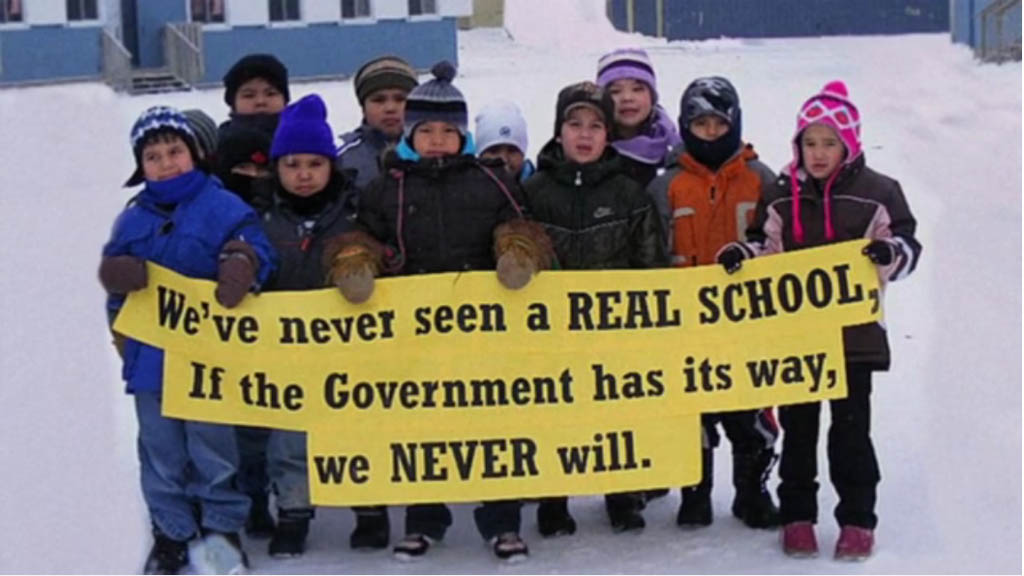
Among the things we learn in After the Last River: In the 1970s and 1980s, the federal government built homes with substandard materials, and that housing has deteriorated further since then. Many homes do not have running water; residents use buckets for toilets. Some homes are plagued with black mould. In 1979, 30,000 gallons of diesel leaked under the elementary school, which remained in use, despite bad smells and students complaining of headaches. The school finally closed in 2001, and the students were moved into portables, right next to the toxic site. They had to wait until 2014 for a new school.

Relatively recent news clips from Parliament and the Ontario legislature show that both levels of government are adept at playing the old “it’s-not-my-department” game. It’s truly maddening to watch those clips, after seeing the terrible conditions that people are living in. Old news clips shot in the north show that little has changed in decades.

Residents discussing their situation with Lean say that “People in the south think that we own diamonds and we’re rich. They don’t know what’s happening here.” “We’re not rich; it’s just the land that rich.”
The mine has not improved the lives of the people of Attawapiskat. In fact, it looks like the mine has only brought benefits to DeBeers and its immediate employees.

Amazingly enough, the amount of royalties paid by DeBeers to the Ontario government is confidential. However, through diligent digging, the CBC discovered that: “the provincial government made more money on salt royalties in 2013-14 than diamonds. De Beers Canada, which owns the only diamond mine in the province, paid $226 in royalties while salt netted the province $3.89 million in royalties.” “. . .De Beers paid little or nothing for most of the seven years its Victor mine has been in production in Northern Ontario, about 90 kilometres west of Attawapiskat.”

De Beers is said to have its eyes on 15 more diamond deposits in the area.

After The Last River
Victoria Lean / Canada / 2015 / 86 ‘ / English
Monday, Sept. 28, 2015, 7 p.m.

Concordia University
1455 de Maisonneuve West, Room H-110
Montreal, QC
Canada

Director Victoria Lean, producer Jade Blair and special guests will be in attendance. The screening is co-presented with the Sustainability Action Fund and Mining Watch Canada. The venue is wheelchair accessible.
For more information visit Cinema Politica’s Facebook page for this event.

Festival des film du monde review: Naoto Hirtoriki (Alone in Fukushima)

Naoto Matsumura has a chat with one of the ostriches under his care in a scene from the Japanese documentary film Naoto Hirtoriki (Alone in Fukushima), which is being shown at the Festival des films du monde in Montreal. Naoto Matsumura looks after many of the animals that were abandoned after the 2011 meltdown of the nuclear power plant in Fukushima, Japan.

Naoto Hirtoriki (Alone in Fukushima) is a documentary portrait of Naoto Matsumura, a man who voluntarily looks after the (mostly) four-legged victims of the disaster at the Fukushima No. 1 nuclear power plant in March of 2011. These include dogs, cats, cows, and a pony. There are some wild boars prowling around, too, though they look like scroungers, not officially under his care. And then there are the two otherwordly ostriches, with their quizzical expression and powerful legs that can break ribs.

The nuclear plant went into meltdown after an earthquake and the resulting tsunami. Humans were quickly evacuated because the radiation leak made the area too dangerous for them to remain. Many people had no idea that they would be gone so long. They tied their dogs up and planned to come back for them within a day or so. But they were not allowed to come back, and shelters did not accept dogs and cats, in any case.

Some cattle were destroyed on orders of the government, others starved to death, but some were entrusted to Naoto Matsumura, and he continues to look after them to this day. In the beginning, he bought food for them with money from his small pension, now he also gets donations from supporters. He says he wishes the government would look after the animals, that would be the moral thing to do, and it would also increase knowledge about the effects of radiation. The animals are mammals, just like us, whatever happens to them might happen to humans, too.

On a technical level, Naoto Hirtoriki (Alone in Fukushima) is not perfect. Especially in the opening footage, some bright areas are bleached out, and throughout the film, the microphone picks up many distracting sounds – truck engines, and fierce winds among them. But heart is more important than technique – watch the film to see Naoto feeding and interacting with the animals and describing his feelings of obligation toward them. He tells us how the nuclear plant changed his town of Tomioka – at first it brought prosperity, and conspicuous consumption – a car for every family member! Then came the disaster. It could take 30 years to decontaminate the town; maybe it will never be safe again. He wonders if the decontamination work is really just for show.
Naoto Hirtoriki (Alone in Fukushima)
Director : Mayu Nakamura
Cinematographer : Mayu Nakamura
Editor : Mayu Nakamura
Music : Saho Terao
Film production and Sales : Prod.: Mayu Nakamura, Omphalos Pictures,Tokyo 180-0002 (Japon), tél.: +80 (80) 3408 85 30 missyn510@aol.com.

Naoto Hirtoriki (Alone in Fukushima)
Saturday, Sept. 5, 2015 – 4 p.m. – Cinéma Quartier Latin 2, 350 Emery St., in Montreal. (Metro Berri-UQAM)

Festival des films du monde: It’s Really Kind of You Review

This mysterious woman is one of the two main charcaters in the South Korean film It's Really Kind of You.
This mysterious woman is one of the two main charcaters in the South Korean film It’s Really Kind of You.

It’s Really Kind of You is a Korean drama-thriller-mystery, which I saw at the Festival des films du monde / Montreal World Film Festival.

It’s hard for me to review it because I didn’t like it. On the other hand, I don’t like to be negative, I do enjoy Korean films in general, and I’m well aware that different people have different tastes. So, here goes!

First of all, I was confused because the film did not begin as I expected it to; a murder described in the film’s synopsis only took place once the film was well underway. Presumably, that was a flashback, though it COULD have been a dream, or a figment of one character’s imagination.

The plot is ingenious, but most of the characters range from unpleasant to despicable.

In the opening moments, the main character (played by Ok Ja-yeon, I think) is hitchhiking, in the dark, beside a country road. When a driver does stop for him, he seems so creepy and his manner is so odd, it’s hard to believe that anyone would want to give him a ride. He just stares for what seems like a very long time, then makes his request in a flat, robotic tone. He says that he was fishing and that he missed the last train; could the driver take him downtown? Well, I certainly wouldn’t! The actor conveys creepiness extremely well, but the story would be more believable if he could pretend to be charming, or at the very least relatively normal, now and then.

Nonetheless, Creepy Hitchhiking Man gets a ride from a guy who turns out to be a dog-breeder. They chat awkwardly for a while, then they fight and there’s an accident. A dishevelled woman who’s wearing just a slip shows up; she has a bruised face and haunted eyes; she does not speak. She seems traumatized and more than a little strange herself. She might, or might not, be mentally handicapped.

This woman will later be involved in some graphic sex scenes that are disturbing, go on for a long time, often take place at inappropriate times in inappropriate places, and are definitely not “artistic” in any way.

It’s difficult to say more without going into spoiler territory. The film could have ended much earlier than it did and still have been quite creepily effective. I’m sorry not to be more specific about the actors the credits went by very quickly and I incorrectly assumed that I could find out later who played which role. The Montreal screening is a world premiere, so there isn’t much info about the film out there.

When the film was over, an audience member asked me: “Did that make any sense to you?” I told him that it did (more or less) make sense to me, but I did not like it.

BTW: An Internet search tells me that hitchhiking is not too common in South Korea. This film won’t do anything to make it more popular, that’s for sure!

It’s Really Kind of You, from South Korea, in Korean with English subtitles, 90 minutes

Director : So Jae-ick
Screenwriter : Pak Me-hyun
Cinematographer : Cho Choul-ho
Editor : Chol Hyun-sook
Cast : Ok Ja-yeon, Bae Tae-won, Choi Dae-hoon, Do Young-cha, Kim Young- hwan, Baeg Ae-gyeong, Kang In-chul
Music : Lee Jae-sin
Film production and Sales : Prod.: So Jae-ick, So-Film, #310-402, Shindo braenew 11, Yonghyun-dong, Uijeongby-si, Kyungki-do (Corée du Sud). tél.: +82 (10) 6221 07 53, jaeick10,hanmail.net.

It’s Really Kind of You will be shown on Wednesday, Sept, 2, 2015, at 6:30, in Theatre 12 of the Cinéma Quartier Latin, 350 Emery St., in Montreal. (Metro Berri-UQAM)

Go Away Mr. Tumor Review: Hilarity and heartbreak mix amazingly well in this popular film from China

Bai Baihe, left, and Daniel Wu promote their film Go Away, Mr. Tumor. (Xinhua photo)

Go Away Mr. Tumor is a film full of laughs about a woman who is very ill. This might sound questionable, but the people in the cinema where I saw it (Cineplex Odeom Forum) seemed to like it a lot. It worked for me, too! On top of that, Go Away Mr. Tumor, is drawing huge audiences in China. (Variety says it earned “$29.7 million in four days.”

The main character in Go Away Mr. Tumor is Xiong Dun, aka Bearton – “Xiong like bear, Dun like Newton,” she says – a graphic artist who is 29 but fast approaching 30, and comparing herself to others who did great things at that age, or at least started to do them. (The long list includes computer guys Steve Jobs and Bill Gates, and writer Haruki Murakami.)

In the first few scenes, she is so very perky and quirky that I felt annoyed, and feared that I’d made a mistake by going to see the film. False alarm, though; things picked up quite quickly.

While entertaining her friends, in her very nice apartment, Xiong Dun (Bai Baihe, who also uses the name Fay Bai) collapses and ends up in a hospital. The first sight she sees upon waking are the eyes and long eyelashes of Dr. Liang (U.S. actor Daniel Wu.) All right then! Things are not so bad after all. They seem better still after he takes off his surgical mask.

Xiong spends more time dreaming and daydreaming about Dr. Liang, and figuring out how to get more of his attention, than she does thinking about her health problem, which turns out to be quite grave when her test results come back. She obviously thinks that being a patient is a pretty good thing; it allowed her to meet him, after all. There’s a delicate balance here; her craving for attention is almost puppyish, but she’s not pathetic in any way. And she’s quite cute, with her big eyes and gamine haircut. If not for those pesky doctor-patient taboos, who knows what might happen?

Daniel Wu plays Dr. Liang as a guy who’s very serious and very professional, but also very caring. He lives in a bit of a bubble though – he’s astonished to learn that his subordinates are afraid of him. He’s also very busy and mindful of all the proprieties. He gently explains to Xiong that it’s his job to look after her and her job to have faith in him. There doesn’t seem to be any possibilty of more than that. And yet. . .

The two characters do have a lovely rapport. Dr. Liang enjoys listening to Xiong’s stories about her childhood, and her rationale for her sunny outlook on life, even in the face of adversity. (Now and then, I did think that her optimism was a bit farfetched, but hey, some people really are like that. Also, yeah, that “trust me, have faith” thing is more than a little retro and patriarchal, but. . . )

Dream and fantasy sequences add much appeal to Go Away Mr. Tumor. Many are laugh-out loud hilarious, though with hindsight others don’t seem quite as funny as they had been.

In Xiong’s dreams, zombies are a metaphor for her illness. At first, she fights them alone, like a superhero in a video game, or a Marvel movie, wearing a cape, flying around via wirework and firing two guns at once like Chow Yun Fat in an old John Woo movie. Later, when a zombie has her in a chokehold, Dr. Liang appears, dressed all in black, armed with a crossbow, to save her with one well-timed, well-placed arrow. Pow! Peng! Cheers from the audience! (Spoiler, sorry!)

You want this guy on your side, right? Dr. Liang, (Daniel Wu) is prepared to go all out to protect the life of his patient.

Another scene mocks the international popularity of romantic Korean TV dramas. Xiong, wearing adorable furry earmuffs, stands in a park amidst falling snowflakes. As she starts to fall over backwards, in a slow motion swoon, Dr. Liang appears, clad in a quietly elegant camel-hair coat. He catches her gracefully with one arm while stopping the snowfall with a masterful, magical snap of his fingers. “Oppa!” Xiong exclaims. (It means “big brother,” but it’s also what Korean girls call their boyfriends, and what fans write on messageboards devoted to their crush. Don’t ask me how I know.) As a further nod to Korea’s powerful influence, Xiong gives Dr. Liang some Korean hand lotion, to repair the damage done by his frequent hand washing. (He keeps it in an office drawer with his British tea.) Korea has its share of medical dramas, the “trust me, have faith” likely appears there, too.

Dr. Liang (Daniel Wu) and his patient Xiong Dun (Bai Baihe) in the Chinese film, Go Away Mr Tumor. Xiong has watched lots of Korean TV dramas and she has a crush on Dr. Liang, so she imagines many scenes like this one.

Xiong’s friends are a loyal, supportive and entertaining bunch, with some quirks of their own. They visit her often in the hospital, and gleefully help her with an elaborate, spur-of-the-moment prank against her obnoxious ex-boyfriend.

The film is based on the real-life experiences of cartoonist Xiang Yao. (Xiong Dun/Bearton was her pen name, which she chose because bears were her favourite animal.) She had already written several comic books before she became ill; an article on the web site China.org.cn says that her other books were about “teenage love, weight-loss, living the single life and her lifelong idol Michael Jackson.”

Bears were Xiong Dun's favourite animal. Could you tell?
Bears were Xiong Dun’s favourite animal. Could you tell?

Once she became sick she wrote an online comic to raise money for her treatment and share her ordeal with her fans. (While she is often seen sketching in the film, the book is not actually mentioned.) In addition to Go Away Mr Tumor, various articles have rendered the English translation of the book’s title as Go To the Devil, Mr. Tumor, Be Gone, Mr. Tumor, Get out, Mr. Tumor, even F*** Off, Mr. Tumor! The article goes on to say that “More than one million books of the cartoons were sold, and the series inspired millions of people with its optimism and courage.” It includes this quote from Xiang: “I hope my drawings can entertain people and bring positive energy to me and to others. I am happy and delighted that they can enjoy it.”

Go away Mr Tumor Xiong Dun cartoon


BTW: The actors chosen to play her loving parents look quite a bit like their real-life counterparts.

Go Away Mr. Tumor (Gun dan ba! Zhong liu jun)
125 min., in Mandarin with English subtitles.
Director: Han Yan
Cast: Bai Baihe, Daniel Wu, Zhang Zixuan, Li Yuan, Liu Ruilin, Cheng Yi, Liu Lili, Li Jianyi, Temur Mamisashvili, Joel Adrian

In Montreal, Go Away Mr. Tumor is being shown at Cineplex Odeon Forum Cinemas. It’s also being shown in Vancouver, Edmonton, Toronto, in several U.S. cities, and in New Zealand and Australia.


NYAFF and Fantasia 2015 Review: Battles Without Honor and Humanity

Bunta Sugawara as a gangster in the 1973 Japanese film Battles Without Honor and Humanity, which is being shown at the 2015 Fantasia Film Festival.

Battles Without Honor and Humanity! What an appropriate title! Many yakuza films would have us believe that there are rules to be obeyed, a code of conduct to be followed, that there is, in fact, honour among thieves. This film just laughs at such silly notions . . . beats them to a pulp, and throws them right out the window.

And the various rituals and ceremonies? When it’s time for someone to give up a finger, no one is quite sure how it’s supposed to be done. A woman says “I saw it in Osaka, once.”

Battles Without Honor and Humanity was made in 1973, though the story it tells begins just after World War II, in Hiroshima. Japan is under U.S. occupation, and U.S. soldiers are running wild and acting like animals. The local crooks almost look civilized in comparison, which is quite the feat.

The film mixes conventional scenes with parts that are like a vintage version of 60 Minutes, with a narrator describing feuds and alliances, and onscreen text telling us how and when certain people were killed.

Gangs struggle for supremacy within the city, and gangsters struggle for power within their gangs. A boss cries poor so he can get away with underpaying his underlings. There’s lots of yelling and arguing; fights are not elegantly choreographed. Not one of these guys seems like a criminal mastermind.

Frankly, I couldn’t keep track of all the lying, plotting and double crossing that was going on. I could have used a family tree and a score card. Maybe that’s because the film is based on the memoirs of a gangster and real life can be more complicated than fiction? Battles Without Honor and Humanity was also part of the lineup at the recent New York Asian Film Festival.

Battles Without Honor and Humanity

Crime / Thriller / Classic / Retro Japan 1973, 99 min., DCP, Japanese (with English subtitles)
Director: Kinji Fukasaku
Screenplay: Kazuo Kasahara, Koji Shundo, Koichi Iiboshi
Cast:Bunta Sugawara, Hiroki Matsukata, Nobuo Kaneko, Kunie Tanaka, Goro Ibuki, Tatsuo Umemiya, Tsunehiko Watase, Seizo Fukumuto

Saturday, Aug 1, 2015, 2:50 p.m., Concordia Hall Theatre, 1455 de Maisonneuve Blvd. W.


The Fantasia International Film Festival runs from July 14-Aug. 5, 2015. Read more about the festival at fantasiafestival.com