RIDM 2015 Review: The Other Side

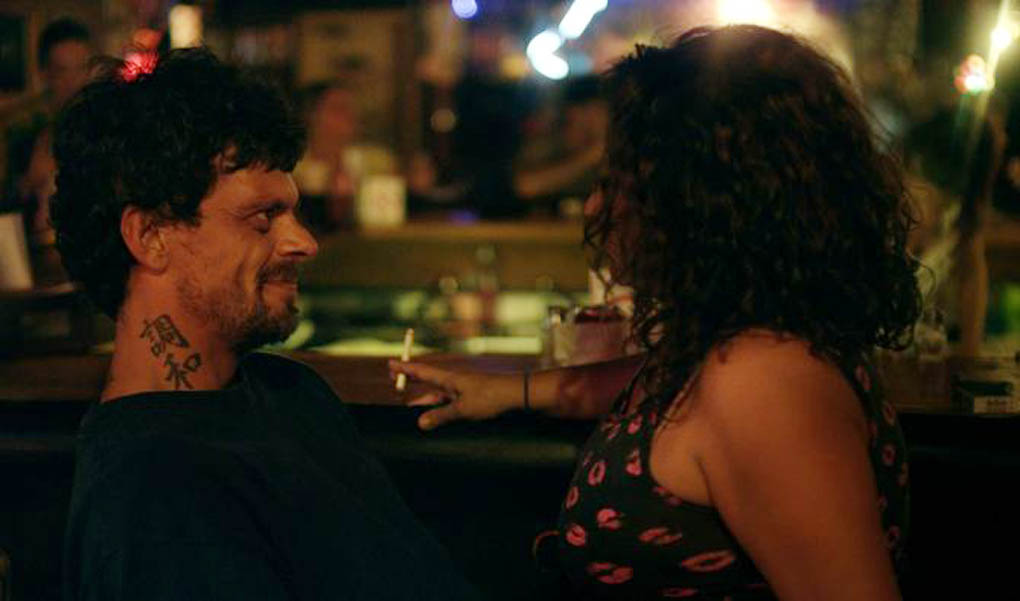
Mark and Lisa in the documentary film The Other Side.

Do you ever watch a film and find yourself wondering “WHAT were they thinking?” Or, “What WERE they thinking?” “They” could be the film studio, the writer, the director, the actors, or, in the case of a documentary, the participants.

I had that thought often while watching The Other Side, a documentary filmed in rural Louisiana by Italian filmmaker Roberto Minervini. The film is divided into two parts of unequal length. The first, and longest part, is about Mark and Lisa, down-on-their luck lovers and drug addicts who aren’t shy about getting naked. In fact, they spend most of their at-home time that way. There’s also a scene where Mark wakes up at the side of the road, starkers, and ambles home, his bare feet making a flappin noise on the highway.

They use drugs frequently while on camera, and Mark is seen injecting Lisa and others with them. Could that drug-use footage be used as evidence, if they are arrested? Or do the authorities alreasdy have plenty on him already? He has spent time in jail.

In another scene, Mark and a (male) friend break into a school and make fun of a wall chart that explains economics and capitalism. (I’m not suggesting that those things are above mockery, far from it!) While they’re having their laughs, they describe themselves as pimps, which I found disturbing. If they really are pimps, it was not demonstrated explicitly. Mark injects a pregnant, nude dancer before she does her act. Does he gets part of her earnings?

Whatever you might think of drug dealing, it seems that “good, honest work” is not readily available in Mark’s neck of the woods.

The other part of the film deals with some heavily-armed guys who are expecting bad things, and pretty soon, too. An insurrection, a revolution, the big bad government coming to take their weapons, something like that. While their world-view seems more than a little twisted, they seem dead serious. These guys are scary. I’m glad they are far away, thugh heaven knows, maybe there are others who think the same way, closer to home than I realize.

People throughout the film badmouth U.S. president Barack Obama with racist language, which I found uncomfortable to listen to. The support one guy expressed for Hillary Clinton was surprising, because I had assumed that racists would be sexists, too. Apparently not always.

Quite apart from the too-much-information aspect and the racism, The Other Side won’t be for everyone. It would be depressing as fiction, as reality it’s much worse.
The Other Side (click for more info)
directed by Roberto Minervini
Country : France, Italy
Year : 2015
Language : English
Subtitles : French
Runtime : 92 Min
Production : Muriel Meynard, Paolo Benzi, Dario Zonta
Cinematography : Diego Romero Suarez-Llanos
Editing : Marie-Hélène Dozo
Sound : Chico Bernat Fortiana, Ingrid Simon, Thomas Gauder
Contact
(Distribution)
Maxwell Wolkin
Film Movement
maxwell@filmmovement.com

Saturday, Nov. 21, 2015, 9:30 p.m.
Cinéma Excentris – Cassavetes, 3536 St. Laurent Blvd.

RIDM 2015 Review: Polar Sea 360° is a virtual-reality voyage to the Arctic with a rich, detailed, online component, too

Screen grab from Polar Sea 360 web site. Clicking on it won't do anything!
Screen grab from Polar Sea 360 web site. Clicking on it won’t do anything!

Go to RIDM’s UXdoc Space at Cinémathèque Québécoise, put on the virtual reality headset, and you’ll find yourself immersed in the Arctic – except you won’t need big mitts and an extra warm coat.

You can look right, left, up, down or behind you; there’s always something to see. You might be in a helicopter, on a blue-sky, sunny day, hovering above ice, snow, glaciers and icebergs or somehow outside the ‘copter, looking into it at the pilots. You might be on the deck of a small boat, in the dining room of cruise ship, or riding through a small village on an all-terrain vehicle. On top of all that, you can see the aurora borealis shimmering in the night sky in its mysterious way.

For me, it was a fascinating experience and well worth the trip to the Cinémathèque, which is conveniently located mere steps from the Berri-UQAM metro. But that’s not all, there so much more!

Before and/or after experiencing the Arctic in this way, you can find a wealth of information, from many points of view, at the web site polarsea360.arte.tv  There is a video with several chapters, and a “magazine” with 10 episodes; some of these episodes also have short videos embedded in them, as well. During the main video, and many of the video segments, viewers can use the arrow keys on their computer to get a 360-degree view. (The project can be enjoyed on smartphones and tablets, too, but I used a desktop computer. If you have a virtual reality headset at home, you cam use that. too. The web site has links to three companies that sell them.)

Screen grab for the Polar Sea 360¡ web site shows Arctic ice bergs.
Screen grab for the Polar Sea 360 web site shows Arctic ice bergs.

Polar Sea 360° is an international project with participants from Canada, Argentina, Denmark, France, Germany, Greenland, Ireland, Norway, and Switzerland. They include Arctic residents, authors, amateur explorers, biologists, a Canadian Coast Guard officer, filmmakers, geographers, geologists, historians, photographers, a prof in international politics, sailors, sea captains, scientists, singers, and veterinarians.

Climate change, and the way it affects people, wildlife and the landscape, is a major topic of the videos and the texts. The trip offered by the French cruise ship Boréal would not have been possible in past decades, because the ice was thicker then. Increased access to the Arctic means more shipping, exploration for oil and minerals and the habitat destruction and pollution that can come with that.

We also learn about the DEW Line, the Franklin expedition, explorer Roald Amundsen, and Inuit history and culture, including the forced relocation of some Inuit to Resolute Bay to shore up Canada’s arctic sovereignty claims, the abuse at residential schools, the importance of narwhal and seal in the traditional Inuit diet, their hospitality customs, hunting methods, throat singing, traditional place names, historical routes, and the problems of the present day; Nunavut has highest suicide rate in Canada.

A graphic about Arctic sovereignty from Polar Sea 360. The international, interactive project combines information about ecology, geology, history, politics and more.

The waters being navigated in Polar Sea 360° are part of the famous, near mythical, Northwest Passage. Mention of it takes me back to Grade 6 history class. (You, too?) In those days, we didn’t learn much about the negative aspects of exploration and the imperialism that came with it. But we did learn about the Northwest Passage – for centuries, explorers dreamed of it and searched for it – a quicker way from Europe to the riches of Asia. The man (of course, it would be a man!) who found it would be rich, famous, admired, bring glory to his country, etc. It was a big deal then and it has become a big deal once again. Read more about the RIDM presentation of Polar Sea 360° here.


Polar Sea 360°

Country : Canada, Germany
Year : 2014
Language : English, French, German
Runtime : (up to you!)
Platform : Réalité Virtuelle / Virtual Reality (Samsung Gear Vr)
Website : http://polarsea360.arte.tv
Production : Irene Vandertop, Thomas Wallner, Stephanie Weimar
Artistic Direction : Thomas Wallner
Technical Direction : Scott Herman
Sound : Janine White
Contact
(Production)
Thomas Wallner, Deep Inc., thomas@deep-inc.com

Visit the UXdoc Space at Cinémathèque Québécoise, 335 de Maisonneuve Blvd E., from Nov. 12-22, 2015, from 11a.m. to 8p.m., to see Polar Sea 360° and other interactive presentations.
RIDM (Rencontres internationales du documentaire de Montréal) runs from Nov. 12-22, 2015. Visit the web site ridm.qc.ca for more information.

RIDM 2015: Watch interactive documentary at home, or take part in an ‘assisted navigation’ with director Brett Gaylor

Director Brett Gaylor explains the Do Not Track interactive web documentary at RIDM, Montreal's documentary film festival.
Director Brett Gaylor explains the Do Not Track interactive web documentary at RIDM, Montreal’s documentary film festival.

Director Brett Gaylor explains the  interactive web series Do Not Track at RIDM, Montreal’s documentary film festival.

Do you know about Brett Gaylor? He directed Rip! A Remix Manifesto, a documentary about fair use, the concepts of “CopyRight and CopyLeft” and DJ Girl Talk. Maybe I’ll post some links about that later.

These days, Gaylor is the mastermind behind Do Not Track, an educational and international interactive web series about our privacy, or the lack thereof, on the Internet.
The project is a co-production between Canada’s own National Film Board, UPIAN, ARTE, Bayerischer Rundfunk (Bavarian Public Broadcasting), with the participation of Radio-Canada, AJ+ (“the digital-only video news network and community from the Al Jazeera innovation department”), RTS (Radio Télévision Suisse). It has seven supporters, too, including Montreal’s EyeSteel Film. You can see them all here.

There are seven episodes, with most being about 7 minutes long. Some could be longer, depending on the options viewers choose. The subjects are Tracking, Cookies, Social Networks, Mobile, Big Data, Future Bubble and Future of Tracking.

Each episode also has some articles related to the video – what we’d call “sidebars” in the newspaper biz. “How to protect your smartphone” part of Episode 4 of Do Not Track, would probably be of interest to anyone who has one. That same episode includes links to articles in the New York Times, The Intercept, and the Electronic Frontier Foundation. (The EFF has rated so-called “secure messaging” products.

You can watch these videos at home, but if you come to the director’s navigation you can hear the inside scoop on the project, ask Gaylor some questions and possibly volunteer as a guinea pig to discover your Big 5 Personality Traits, according to an algorithm that analyzes your online activity.

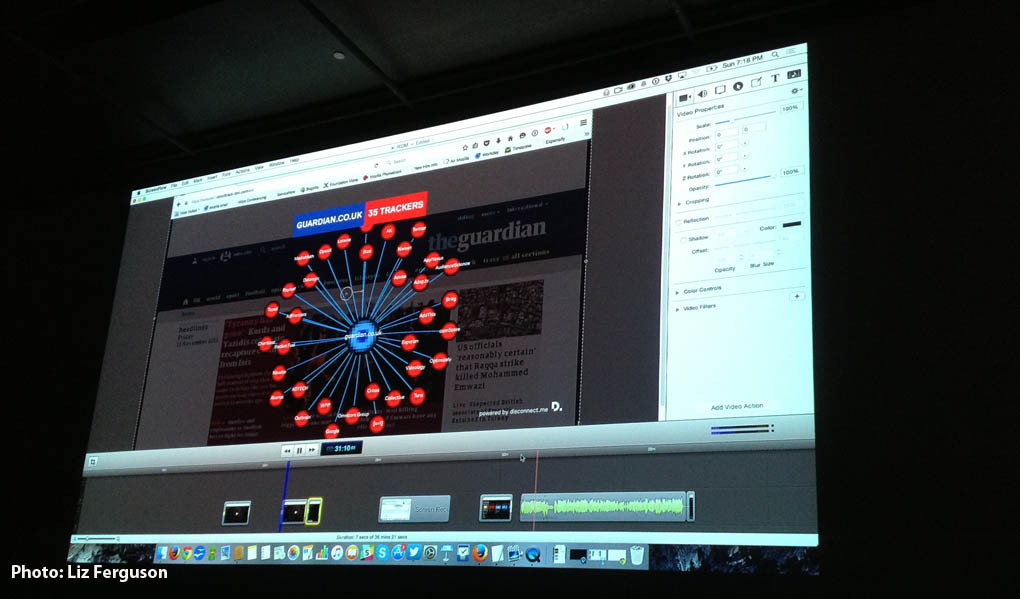
At an assisted navigation of the documentary web series, Do Not Track, director Brett Gaylor showed particpants that the the web site of The Guardian has 35 trackers.
At an assisted navigation of the documentary web series, Do Not Track, director Brett Gaylor showed participants that the web site of The Guardian has 35 trackers.

Gaylor remined us that the Internet isn’t really free, we pay for it with information about ourselves instead of with money. (Gaylor went on the Guardian web page and showed us that it had 35 trackers.) Trackers collect information about our needs and interests to create a profile which they then sell to the highest bidder, who then places ads on our Facebook feed and elsewhere. He said Europe has better legislation about online privacy than the U.S. does, but that technology is moving so fast that legislation can’t keep up.

He raised the possibility that people would be denied loans, mortgages, or insurance coverage based on information gleaned from their online profiles and from the profiles of their friends and families.

Gaylor pointed out that we do get notices about cookies, but our only option is to click “OK,” there isn’t a “NO” button for opting out.

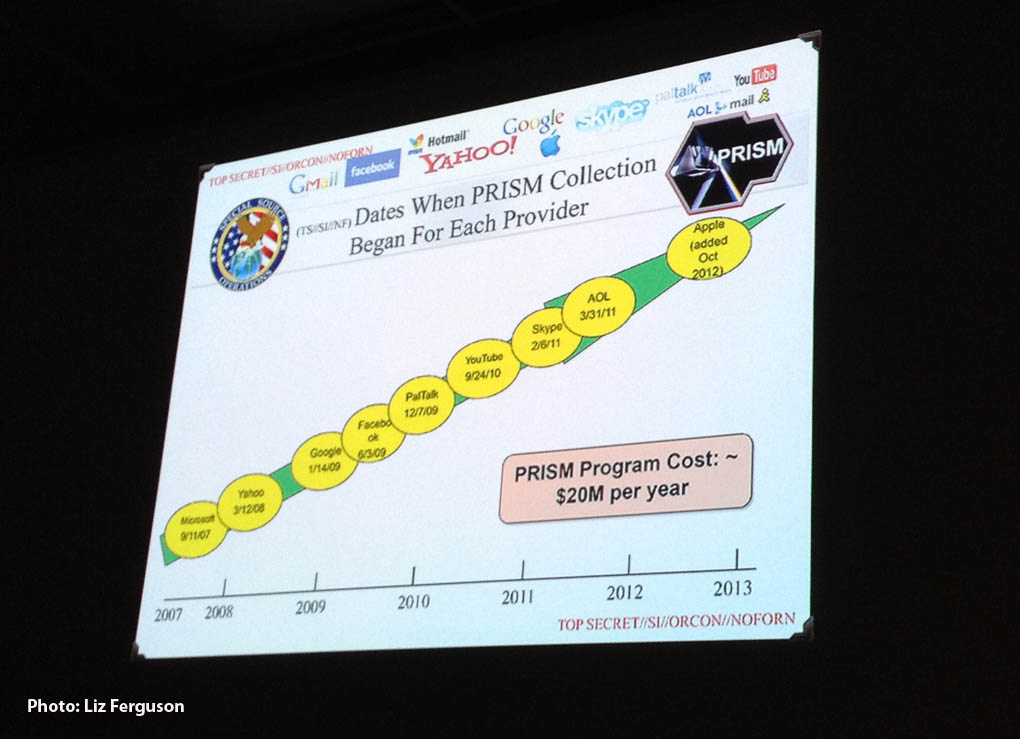
Has the NSA's surveillance program PRISM been reading your emails? This graphic was part of a presentation abut the interactive web documentary Do Not Track. (Photo: Liz Ferguson)
Has the NSA’s surveillance program PRISM been reading your emails? This graphic was part of a presentation about the interactive web documentary Do Not Track. (Photo: Liz Ferguson)

Spying on us isn’t just about selling stuff either, Gaylor presented a graphic about the NSA’s PRISM program, which has been reading email provided by Microsoft since 2007.

He asked people in the audience how much they’d be willing to pay for Facebook and Google if they would be free of ads and cookies. (What about you?)

Some people were willing to pay $10 per year for Facebook and as much as $50 for Google. Gaylor revealed that Facebook earns $9 per year on each Facebook account and Google earns $45 from selling information about each user.

Do Not Track
By Brett Gaylor, with the collaboration of Sandra Rodriguez and Akufen (Big Data episode)
Country : Quebec, Germany, France
Year : 2015
Language : German, English, French
Runtime :120 min
Platform : Webdocumentaire
Website : Http://donottrack-doc.dom
Production : Alexandre Brachet, Margaux Missika, Louis-Richard Tremblay, Gregory Trowbridge
Technical Direction : Nicolas Menet, Maxime Quintard, Avec La Collaboration D’akufen (Épisode Big Data)
Sound : Jason Staczeck
Distribution: Élise Labbé
Office National Du Film Du Canada
e.labbe@onf.ca

Do Not Track Screening – Navigation Assistée / Director’s Navigation
Tuesday, Nov. 17, 2015, 7 p.m.
Cinémathèque Québécoise – Salle Norman Mclaren (Salle Uxdoc)
335 de Maisonneuve Blvd E.

RIDM 2015 Review: Maman? Non, merci!

Why do strangers feel free to question women about their reproductive choices? That's one of the many things explored in the documentary film Maman? No merci! (No Kids For Me, Thanks!) It's being shown at RIDM, Montreal's documentary film festival.
Why do strangers feel free to question women about their reproductive choices? That’s one of the many things explored in the documentary film Maman? No merci! (No Kids For Me, Thanks!) It’s being shown at RIDM, Montreal’s documentary film festival.


“Baby hunger.” That’s what one of my friends used to call it. An overwhelming, seemingly impossible-to- ignore desire to have children. Some women have it, some don’t. All the same, women are expected to produce children, because. . .because we can? Contraception and abortion, if available, make it easier to plan the arrival of those children, but opting out of the idea of motherhood entirely is regarded as odd, possibly abnormal, inhuman, even. Where’s that famous maternal instinct?

Women who say they don’t want children are not taken seriously; they’re told that they’ll change their minds; they just haven’t met the right guy yet; they’re missing out on the most wonderful experience they could possibly have; they’re being selfish; they will have a lonely old age, and “you’ll be sorry!”

Consider for a moment the semantic differences between “childless” and “child free.” The first sounds rather forlorn, and might remind one of other words that end in “less” – words like homeless, penniless, hopeless. But “child free” – is it too celebratory? Could those who do have children see it as a criticism of motherhood and parenthood?

Perfect strangers feel entitled to quiz the childless-by-choice, berate them and analyze them. Seriously, is it anyone else’s business? Is there any other area of our lives that’s so open to scrutiny by others?

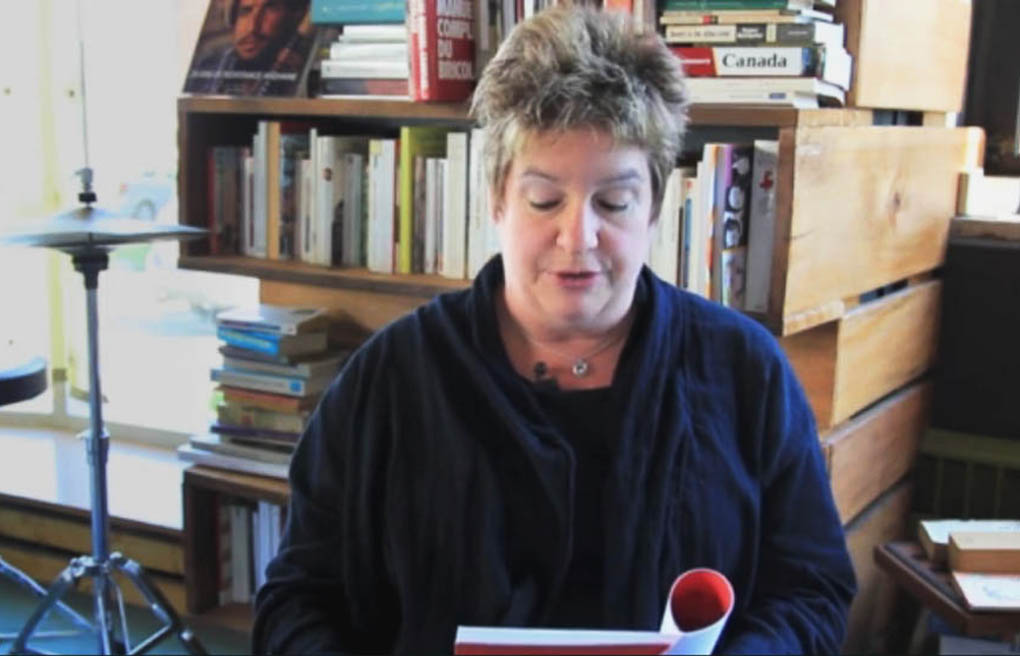
Author Lucie Joubert decries "frenetic maternalism" in her book L'Envers du landau.
Author Lucie Joubert decries “frenetic maternalism” in her book L’Envers du landau.

Maman? No merci! (No Kids For Me, Thanks!) is a documentary about women in Quebec, France and Belgium who are childless by choice, and quite clear and eloquent about it, too. Some men share their views, as well.

In the opening minutes of Maman? Non, merci!, director Magenta Baribeau says that she was surprised that strangers were so curious about her personal reproductive decisions; she decided to find other women like herself, and to discover why deliberate childlessness was so shocking for some in this day and age.

Right after the screening, there will be a French-language debate in the theatre on the topic La maternité, un idéal à repenser? (Rethinking Motherhood).

The participants will be: Magenta Baribeau, director of Maman? Non merci!; Stéphanie Benoit-Huneault, Special Projects Assistant, Réseau québécois en études féministes (RéQEF); Chiara Piazzesi, Professor, PhD (Département de Sociologie, UQAM); Judith Rouan, President of Fédération du Québec pour le planning des naissances (FQPN). Mélanie Sarazin, President of Fédération des femmes du Québec (FFQ) will be the moderator.
Maman? No merci! (No Kids For Me, Thanks!)
Directed by Magenta Baribeau
Country : Quebec
Year : 2015
Language : French
Subtitles : English
Runtime : 74 min
Production : Magenta Baribeau
Cinematography : Magenta Baribeau
Editing : Étienne Langlois
Sound : Gordon Neil Allen

Tuesday, Nov. 17, 2015, 5:30 p.m.
Cinéma Excentris – Cassavetes, 3536 St. Laurent Blvd.

RIDM 2015 Review: Star*Men


Director Alison Rose, second from right, and her astronomer friends take a break at the Rainbow Bridge National Monument in Utah.

Majestic music, monumental landscapes, mighty telescopes, and millions and millions of stars and galaxies! Billions, actually, but I was enjoying the alliteration.

You will find those things and more in the documentary film Star*Men. It’s a real treat. In addition to the sound and images mentioned above, you get human interest stories with historical significance.

The 1957 launch of the Soviet space satellite Sputnik in 1957 caused serious alarm in the West. The other side in the Cold War had better technology – what might they do with it? There must have been some wounded pride, too, because Sputnik was right up there in the night sky for anyone to see.

The U.S. did not have enough experts of its own and recruited scientists from all over the world to help it compete in this “Space Race.” The “star men” of the film’s title are Roger Griffin, Donald Lynden-Bell, Wal Sargent and Nick Woolf, British astronomers who were hired to work at the California Institute of Technology in Pasadena. As they explain, this was wonderful in so many ways. At that time there was little work in the U.K. for people with degrees in astronomy. They could leave the class system and the U.K. weather behind for sunny skies and open roads.

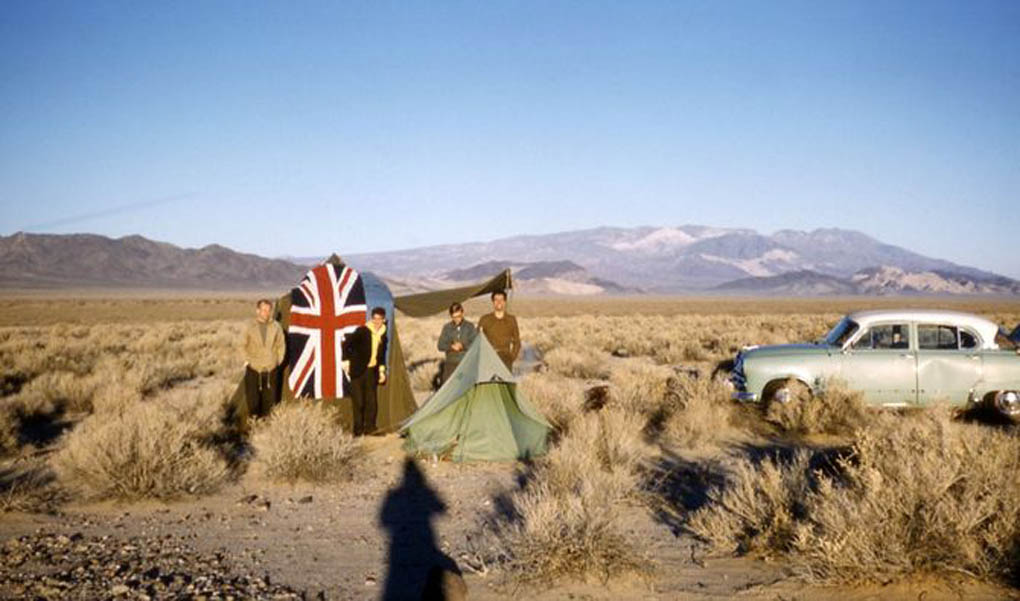
Photo taken by Roger Griffin in 1960 show his fellow astronomers at a their U.S. campsite with a large English flag. After they noticed the American fondness for their flag, they decided to take lots of photos with their own.

All four made important discoveries in astronomy during their working lives. In time two returned to the U.K. and two found other jobs in the U.S. Beside explaining their accomplishments, director Alison Rose takes us along when the four have a reunion, 50 years after their arrival in California, that includes much fascinating talk and some very strenuous hiking, including a visit to the Rainbow Bridge National Monument in Utah. And they wear huge backpacks while doing it, too! The cinematography of Star*Men is exceptional – natural landscapes and the views of star galaxies and nebulae are stunning. The music is great, too. Director Alison Rose will attend the screening and answer questions afterwards.

The Very Large Array, an astronomicla radio observatory in New Mexico. Do they look like giant ears to you? (Malcolm Park photo from Star*Men web site.
The Very Large Array, an astronomical radio observatory in New Mexico. Do they look like giant ears to you? (Malcolm Park photo from Star*Men web site.

Star*Men
Directed by Alison Rose
Country: Canada
Year: 2015
Language : English
Runtime: 88 min
Production : Alison Rose
Cinematography : Daniel Grant
Editing: Dave Kazala
Sound: Ken Myhr, Daniel Pellerin, Peter Sawade
Contact: Alison Rose
aer@inigofilms.com
Star*Men, Monday, Nov. 16, 2015, 6 p.m.
Cinémathèque Québécoise – Salle Claude-Jutra, 335 de Maisonneuve Blvd E.
RIDM (Rencontres internationales du documentaire de Montréal) runs from Nov. 12-22, 2015. Visit the web site ridm.qc.ca for more information.


RIDM Review: My Love, Don’t Cross That River

Kang Gye-yeol, left, is 89 and her husband, Jo Byeong-man is 98. They ust might be the cutest couple you have ever seen. You can see them in the Korean documentary film My Love, Don't Cross That River
Kang Gye-yeol, left, is 89 and her husband, Jo Byeong-man is 98. They just might be the cutest couple you have ever seen. You can see them in the Korean documentary film My Love, Don’t Cross That River

My Love, Don’t Cross That River is a portrait of a marriage. Jo Byeong-man is 98 and Kang Gye-yeol and is 89. They have been together for 75 years. Pretty amazing, right?

Director Jin Mo-young records their lives for 15 months, as they discuss their past, clean up around their rural home, prepare meals and take walks. They are slow walks, to be sure, but they can still move, and in one scene Jo Byeong-man carries an impressively large load of firewood on his back.

Many of their walks are taken hand in hand and that’s how they fall asleep each night, too. They are always seen in traditional Korean clothes, usually in matching colours – bright, beautiful colours. Were they on their best sartorial behaviour for the full 15 months, or is that just the way they like to dress? I’m going to assume the latter.

While you’ll hear the occasional comment like “people get old, you can’t do anything about it,” they are remarkably upbeat. They’re playful, too, like children, newlyweds, or the cute little puppies that arrive in the fullness of time (after the pastor’s dog pay a visit to their own pooch.)

Jo presents his wife with a little bouquet of flowers and she accepts them happily, rubbing them on her face and his. They throw autumn leave at each other, sample the seasons first snowfall (then play with that, too).

After all these years, he still appreciates her cooking: “He’s never said it isn’t good. . .he eats a lot and then says ‘what a great meal.’ ” Actually, Kang Gye-yeol seems to have more energy (or patience) for food preparation than I do!

Children and grandchildren come to visit, bring gifts and pay their respects on New Year’s Day and Kang Gye-yeol’s birthday. Presumably they live far away, because we don’t see them much, apart from those days. I was uncomfortable watching a nasty fight between two siblings; it’s a harsh contrast to the warm affection that the two love birds share and it leaves them in tears.

Even at the beginning of the film, Jo Byeong-man coughs frequently and things just get worse as time goes on. Sometimes his cough keeps him awake at night. When they take their walks he has to stop more often to rest. Do you see where this is going? Kang Gye-yeol asks her husband to hang on a little longer, but at the same time, she starts burning some of his beautiful, colourful clothes so that he will have things to wear in the afterlife.

My Love, Don’t Cross That River was a big hit at the Korean box office, outselling many U.S. hits in the first weeks it was in cinemas. So far it is Korea’s most popular homegrown documentary. (Old Partner, about a man his ox and his wife, pretty much in that order, holds the No. 2 spot. The AmerAsia Film Festival showed Old Partner in Montreal in 2011. Read my review Old Partner for the Montreal Gazette here. )

My Love, Don’t Cross That River
Directed by Jin Mo-young
Country : South Korea
Year : 2014
Language : Korean
Subtitles : French, English
Runtime : 86 min
Production : Kyungsoo Han
Cinematography : Moyoung Jin
Editing : Zinsik Hyun
Sound : Minu Jung
Contact: Maëlle Guenegues
Cat & Docs
Maelle@Catndocs.Com

Sunday, Nov. 15, 2015, 4:15
Cinéma Du Parc 1, 3575 Park

RIDM 2015 Review: The Woods Dreams Are Made Of (Le Bois Dont Les Rêves Sont Faits)

RIDM Bois Woods

Spending more than two hours watching the goings on in Bois de Vincennes of Paris? Wouldn’t that be a bit much? The time passed relatively quickly, actually. The film opens with shots of a park that’s so expansive it looks like part of the countryside. Once upon a time it was, but then Paris grew around it. Other scenes will show that there are apartment buildings close to the edge of the park and that sometimes you can hear the rumble of traffic even if you can’t see it.

There are many reasons to visit the park: to exercise, to relax, to commune with nature, to work, officially or unofficially. Some people set up tents and live in the park in the warmer months.

Director Claire Simon shows us people who do those things; sometimes she talks with them, other times she observes from a distance. I was curious about the man who filled dozens of plastic water bottles from a fountain while thirsty joggers waited for their turn to drink. What was he going to do with them? Sell them to unsuspecting people? Who knows?

A man paints in nature, though not from nature, in a scene from the French documentary film The Woods Dreams Are Made Of (Le Bois Dont Les Rves Sont Faits).

Some guys who catch a large carp spend a long time examining it; distraught spectators tell them they’re being cruel and urge them to put it back in the water. A man paints outdoors, though he does not paint what he sees. A gay man explains cruising etiquette and laments the advent of smartphone apps; he doesn’t meet as many men in the woods as he used to do.

Workers who clean up the fallen leaves of autumn use horse-drawn wagons to reach places to narrow for trucks. Other employees look more bureaucratic, taking notes on their clipboards, discussing the possibility of redirecting some of the decorative waterways. Yet others, wearing hazmat suits, clear away abandoned tents and other possessions.

In the late 1960s, philosopher Gilles Deleuze was one the professors at an experimental university in the woods; as if in a dream, his daughter shows where the classes took place. It feels like being inside a ghost story.

Claire Simon spent one year shooting the film; if that year was typical, Paris does not get much snow at all – it barely made an appearance.

The Woods Dreams Are Made Of (Le Bois Dont Les Rêves Sont Faits)
Country : France, Switzerland
Year : 2015
Language : French
Subtitles : English
Runtime : 144 min
Production : Jean-Luc Ormières
Cinematography : Claire Simon
Editing : Luc Forveille
Sound : Olivier Hespel, François Musy, Gabriel Hafner

Sunday, Nov. 15, 2015, 2:30 p.m., Salle Claude-Jutra, Cinémathèque Québécoise, 335 de Maisonneuve Blvd E.
RIDM (Rencontres internationales du documentaire de Montréal) runs from Nov. 12-22, 2015. Visit the web site ridm.qc.ca for more information.


RIDM Review: Guantanamo’s Child: Omar Khadr

Omar Khadr, centre, talks to members of the media outside the Edmonton home of his lawyer Dennis Edney.

The fine Canadian documentary Guantanamo’s Child Omar Khadr is many things at once – chilling, heartbreaking and heartwarming; a record of shameful behaviour but also one of kindness and dedication; and a testimony to the resilience of the human body and spirit.

Omar Khadr was only 15 years old when he was gravely injured in a firefight in Afghanistan in 2002. That made him a child soldier by definition, though it did not save him from being accused of murder and being imprisoned for 12 years. (A photograph taken after the battle shows gaping holes in his chest; I was amazed that he survived at all.)

In the film, Khadr himself describes the torture and ill treatment he suffered at Bagram Airfield in Afghanistan and later at the U.S. prison at Guantanamo Bay, Cuba. His account is backed by former prisoners and the former military men who witnessed or delivered this torture themselves. Treatment and medication were withheld when Khadr would not or could not say what his interrogators wanted to hear, in contravention of the Geneva Convention.

We see videotape of a visit that CSIS investigators made to Guantanamo. Khadr is happy to learn that they are Canadians, you can hear it in his voice – he mistakenly thinks they have come to help him, but then he realizes that’s not the case at all. When he tells them about his wounded arms, one man says “you look fine to me.” This interview was not new to me, it’s part of the film You Don’t like the Truth: Four Days Inside Guantanamo, but watching it still makes me sad and angry. It’s one more lesson to all of us that we can’t necessarily depend on our own government to look out for our interests, even though it is legally and morally obliged to do so.

Omar Khadr as a teenager.

Those are some of the shameful things in Guantanamo’s Child: Omar Khadr. Now for the positive side.

Edmonton lawyer Dennis Edney spent years representing Khadr and fighting for his release. It took four years of effort before he was even allowed to meet with Khadr. Others might have given up long before then. Edney has won many awards for his work, and probably deserves many more. Khadr was returned to Canada in September, 2012, and sent to prison. In May, 2015, he was released on parole into Edney’s custody. He lives with Edney and Edney’s wife Patricia, in their Edmonton home. Khadr says that over time, their relationship has changed from a lawyer-client one to a father-son one. It’s lovely to see the way they interact with each other. Edney says he looks forward to seeing Khadr graduate from university. He wipes away tears describing prison visits with Khadr at Guantanamo, when he tried to reassure him that eventually he would be released and that they would go camping and fishing together in Alberta. Edney wanted to show Khadr photos or maps of the places they would go, but even that was not allowed.

Despite the treatment he received, Khadr is amazingly, remarkably calm. (he could probably write a self-help book about surviving under intense pressure.) He takes obvious joy in just breathing fresh air, and being able to look up at the sky. He talks of his decision, while still in Guantánamo, not to allow the people who were mistreating him to take up too much space in his head. I wonder how many of us could do the same? Khadr wants the chance to prove to former prime minister Stephen Harper, and other Canadians, that he is not the man they think he is.

Guantanamo’s Child: Omar Khadr is co-directed by Toronto Star journalist Michelle Shepherd and Patrick Reed. Shepherd followed the case for years and also wrote a book, Guantanamo’s Child: The Untold Story of Omar Khadr, which was published in 2010. Reed’s previous films include Fight Like Soldiers, Die Like Children (2012), which is about former General Roméo Dallaire and his campaign to end the use of child soldiers.

Guantanamo’s Child: Omar Khadr (click on the film’s name to be taken to the RIDM synopsis)
Directed by Patrick Reed Michelle Shephard

Country : Canada
Year : 2015
Language : English, Arabic
Subtitles : English
Runtime : 80 min.
Production : Peter Raymont
Cinematography : John Westheuser
Editing : Cathy Gulkin
Sound : Downy Karvonen, Sanjay Mehta, Peter Sawade

Saturday, Nov. 14, 2015, 6 p.m.
Theatre J.A. De Sève, Concordia University, 1400 de Maisonneuve Blvd. W.
RIDM (Rencontres internationales du documentaire de Montréal) runs from Nov. 12-22, 2015. Visit the web site ridm.qc.ca for more information.

RIDM 2015 Review: They Will Have To Kill Us First: Malian Music in Exile

Members of the band Songhoy Blues are among the musicians who appear in the documentary film They Will Have To Kill Us First: Malian Music in Exile.

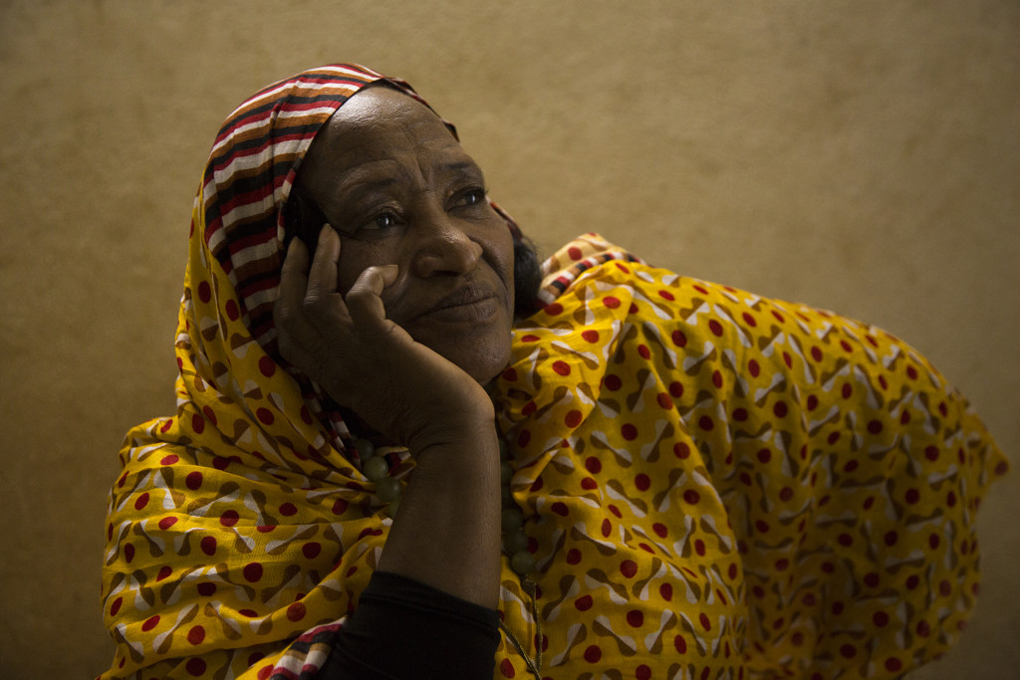
They Will Have To Kill Us First: Malian Music in Exile is a documentary about the difficulties faced by residents of northern Mali, especially the musicians, after a Tuareg rebellion in 2012 was hijacked by Islamist forces. Mosques, tombs, libraries, and ancient manuscripts were destroyed. The imposition of sharia law meant veils for women, amputated limbs for convicted thieves and a ban on all music – even ringtones on cellphones. Musicians fled cities like Gao and Timbuktu in fear for their lives. Among those who appear in the film, some went to Bamako, in Mali’s south, while others went to refugee camps in Burkina Faso.

Malian musician Fadimata Walett Oumar, who is nicknamed Disco, right, and her husband Hassan (Jimmy) Mehdi, in a scene from the documentary film They Will Have To Kill Us First: Malian Music in Exile. The film is being shown at RIDM, Montreal's documentary film festival.
Malian musician Fadimata Walett Oumar, who is nicknamed Disco, right, and her husband Hassan (Jimmy) Mehdi, in a scene from the documentary film They Will Have To Kill Us First: Malian Music in Exile. The film is being shown at RIDM, Montreal’s documentary film festival.

The people we meet include established stars Khaira Arby and Fadimata Walett Oumar (nicknamed Disco, because she was a big Madonna fan in her younger days). Disco is a longstanding member of the group Tartit, though it is not named until near the end of the film. She is also married to a high-ranking Malian soldier who changes allegiance more than once, which makes their lives somewhat complicated. The film also serves as a promotional vehicle for a younger band called Songhoy Blues, and includes footage from their U.K. tour. (Earlier this year, they toured North America, making stops at SXSW and in Toronto, too.) You can find music by Khaira Arby, Tartit and Songhoy Blues on iTunes; click on their names to go there. The film’s soundtrack will be released, but sadly, it isn’t ready yet. If you like what you heard in the film, check out Tinariwen, as well.

Khaira Arby is among the Malian musicians who appear in the documentary film They Will Have To Kill Us First: Malian Music in Exile.

Most of us will never see the wonders of Timbuktu in person, so I appreciated glimpses of them in the film. I suspect that some scenes were shot before the widespread destruction and that many of those intriguing structures no longer exist.

At 100 minutes, the film seems stretched out. I expected lots of music, since it is about musicians, after all, but got tantalizing snippets instead. There is lots of talking, and some of it is repetitive. Perhaps I am just a victim of my own expectations – the film has many positive reviews on the Internet. Sample quote from a review in the Austin Chronicle:
“Social journalism of the highest order, They Will Have to Kill Us First is by turns horrific and front-loaded with sonic heroism. It’s also one of the most vibrantly shot and masterfully edited documentaries of this or any other SXSW year.”

Full disclosure, I did watch They Will Have To Kill Us First at home via an online screener, which must have reduced its power considerably.

(Justified) spoiler: The film ends with a joyous outdoor concert in Timbuktu, with lots of happy women and children among the audience.
They Will Have To Kill Us First: Malian Music in Exile (Click on the film’s name to read more about it on the RIDM web site.)

Friday, Nov. 13, 2:30 p.m.
Cinéma Du Parc 1 (Buy tickets here)

Saturday, Nov. 14, 215 p.m.
Cinéma Du Parc 2 (Buy tickets here)

They Will Have To Kill Us First: Malian Music in Exile
Country : Mali, United Kingdom
Year : 2015
Language : English, Bambara, French, Songhay
Subtitles : English
Runtime : 100 min
Production : Kat Amara Korba, Sarah Mosses, Johanna Schwartz, John Schwartz
Cinematography : Karelle Walker
Editing : Andrea Carnevali, Guy Creasey
Sound : Phitz Hearne
RIDM (Rencontres internationales du documentaire de Montréal) runs from Nov. 12-22, 2015. Visit the web site ridm.qc.ca for more information about the festival.

Fascinating slime mould documentary The Creeping Garden returns to Montreal


Poster for the documentary film The Creeping Garden. Note the reference to Montreal's Fantasia Film Festival in the upper left hand corner.
Poster for the documentary film The Creeping Garden. Note the reference to Montreal’s Fantasia Film Festival in the upper left hand corner.

The documentary film The Creeping Garden was one of the sold-out hits of the 2014 Fantasia Film Festival. Now the film is in limited release in Europe and North America, and Montrealers can watch it again, or for the first time, at the Dollar Cinema.

I saw and enjoyed The Creeping Garden at Fantasia, and reviewed it for the Montreal Gazette. Here are the first few paragraphs of my review:
“Slime mould – each word is bad enough by itself, but the effect is much worse in combination – eww, ick, gross! Slime mould sounds dangerous AND disgusting. Parents might panic if slime mould were found in their child’s school; potential buyers would refuse a home with slime mould in it, and on top of that, it sounds as slippery as the proverbial banana peel.

“And yet, after watching the documentary film The Creeping Garden (which had its world premiere at Fantasia) I know that it is not dangerous, and I do believe that an enterprising person could turn slime mould into the next chia pet, or a modern-day version of “sea monkeys.” Somewhere, an MBA class might be working on such a project right now. If so, the first order of the day would have to be – a name change.

Transforming plasmodium., looking pretty and colourful. Credit: Steven L. Stephenson
Transforming plasmodium., looking pretty and colourful. Credit: Steven L. Stephenson (Part of a New York Times slide show “Beauty and the Blob.”)

“Using beautiful, often hypnotic images, and the words of artists and scientists (amateur and professional), The Creeping Garden introduces us to this fascinating . . . entity. Slime mould was once thought to be a plant at one stage of its existence and an animal at another, because of its ability to move, albeit slowly. (It moves slower than the slowest snail; you need time-lapse photography to see it.) For some time, slime mould was classified as a fungus, but that designation was later changed, too.

“Scientists estimate that slime mould could be as much as 600-million years old.There are more than 1,000 varieties of slime mould out there. It can look like a delicate fern, little yellow balls, grains of translucent rice, chopped up spaghetti, or a meandering river, seen from above. On the other hand, one kind goes by the common name of Dog Vomit, for reasons that are quite obvious when you look at it.

“Sometimes the film shows us slime mould as the naked eye would see it, other times we see it magnified through a high-powered microscope.

“Slime mould has attracted many fans, and they come in many varieties,too. There are those who study it in their spare time just for the joy of discovery, others who make art with it (images or music) yet others who are using it to solve real-world problems, such as the quickest way to get to a fire exit in a building with a complicated layout.”

Metatrichia vesparia, looking quite weird! Credit: Steven L. Stephenson
Metatrichia vesparia, looking quite weird! Credit: Steven L. Stephenson (Part of a New York Times slide show “Beauty and the Blob.”)

You can read my full review Creeping Garden review on the Gazette web site. (When the paper revamped its “platforms” my name got scrubbed off, but it IS my review, I assure you!)

That review includes several links, so you can learn quite a bit more about slime mould, if you want to.

This slide show from the New York Times might get you in the mood for the film.

If you want a very quiet pet, you can order your own slime mould kit from the Carolina Biological Supply Company.
The Creeping Garden is co-directed by Tim Grabham and Jasper Sharp. It’s 81 minutes long and can be seen at the Dollar Cinema, 6900 Décarie Square, in Montreal, until Nov. 12, 2015. It’s one of the cinema’s “Marquee” presentations, which means that tickets actually cost $5. Quite a good deal, really!

Public transit users can get to the Dollar Cinema via the Namur metro, via bus lines 17, 160, 161, and 166.

Visit The Creeping Garden’s web site and Facebook page for more info about the film. You non-Montrealers can see if the film is coming to your town.