Wu Wei, standing, centre rear, with his fellow punk musicians outside his bar in Wuhan, China. Note the bagpipes! The history of Chinese punk music is explored in the documentary Never Release My Fist, by Shuibo Wang.
If you like punk music, China, or documentary films, then Never Release My Fist is especially for you. But really, I think this film would appeal to any living, breathing person with an interest in his or her fellow human beings, and how they live their lives, struggle to survive, and try to express themselves. I liked it a lot; if I didn’t have another musical commitment today, I would watch it again!
Montreal documentary filmmaker Shuibo Wang received an Oscar nomination for his NFB short, Sunrise Over Tiananmen Square. In Never Release My Fist he explores the world of Chinese punk, with particular attention paid to Wu Wei, who is often described as the father of Chinese punk. He formed his band SMZB in 1996.
Wu Wei describes himself as unemployed and aimless in the first few years after he finished high school, but he now comes across as very thoughtful and articulate man, distressed by the politics and rampant consumer culture in China. All the same, his lyrics sound quite poetic.
Wu Wei is from the city of Wuhan, the capital of Hubei province in central China. It’s a city of 10 million people known for heavy industry but it also has several universities, with as many as one million students (potential fans! Though director Wang says that most young Chinese prefer pop music).
While he benefited from some time in Beijing, Wuhan is where Wu Wei played most of his music, and it became the punk hotspot of China.
Musicians everywhere have tough lives, but the punks of Wuhan had little money to buy instruments, few places to play, and they faced government censorship as well. Text messages and email were intercepted.
An image from Never Release My Fist, a documentary film about punk rock in China. It’s part of the lineup at the Festival du nouveau cinema in Montreal.
Wu Wei might be the main star of the film but his bandmates, former bandmates and fellow punk musicians get their share of screen time. Punk in Wuhan was not just a guy thing, either. Women played a big part, too. We see their performances and they share their sometimes harrowing stories and as well.
At some point SMZB included bagpipes and a violin to some songs, a very interesting touch! And Hou Hsiao Hsien uses bagpipes in the closing credits of The Assassin. Are bagpipes a thing in China now?
Filmmaker Shuibo Wang was able to use lots of great vintage footage that was shot before he ever met the musicians. He will attend the screening and answer questions after the film.
Festival du nouveau cinema programmer Julien Fonfrede, left, and Montreal director Shuibo Wang. (Photo copyright Maryse Boyce)
Never Release My Fist
Directed by Shuibo Wang
China, Canada | 87 minutes | 2015, in Cantonese with English subtitles
Saturday, Oct.17, 2015, 17:00
Program #283
Cinéma du Parc 2, 3575 Ave. du Parc
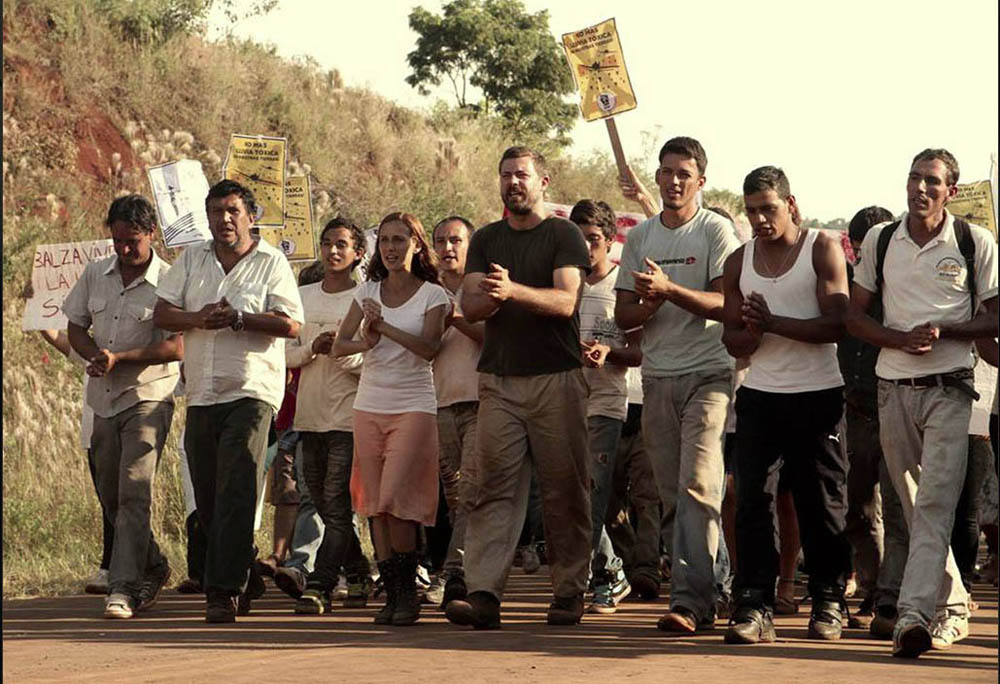
Ana (Eugenia Ramrez Miori, in the orange skirt) and Pierre (Geert Van Rampelberg, in the black T-shirt) take part in a march against the use of toxic chemicals and the oppression of workers, in the film La Tierra Roja. It’s a co-production between Belgium and Argentina that’s being shown as part of the Festival du nouveau cinema.
La Tierra Roja is a Belgium-Argentina co-production, shot in Argentina’s Misiones province. It’s fiction, but based on fact. Viewers in Argentina probably see it as a “ripped from the headlines” type of film.
Pierre works for a multinational company that cuts down trees and runs a sawmill and paper plant in northeast Argentina. In his spare time, he coaches a rugby team, and carries on an affair with Ana, a school teacher, who also works a small local medical centre. Pierre finds himself in an awkward position after Ana alerts him to the fact that his company’s use of herbicides is causing cancer, miscarriages, birth defects, learning disabilities and other problems among the workers and their families. The fish hauled from the river have strange bumps on their heads.
The government supports the company with subsidies; the governor will not even meet with Dr. Balza, who has been documenting all the health problems in the area.
When Dr. Balza presents the results of his research at an information meeting for the locals, Pierre’s superiors do what such people usually do – they claim that the man is lying, the chemicals are safe, and hey, what about all these wonderful jobs they are providing? (Even if they are dangerous and dirty.) Where have we heard this before? One worker points out that the company is employing 1,000 but poisoning one million. (Is that the price of progress?) After the doctor is murdered, Pierre realizes that he must take a stand.
While the good-guy/bad-guy situation is presented in a black-and-white manner (and quite justifiably so) the environemnt is quite colourful. The earth is indeed red in La Tierra Roja, in sharp contrast to the lush green forest. Ana’s house is a bright pink, and a local bar is purple. She wears an orange dress when she rides her horse to school.
La Tierra Roja is fiction, but I have seen my share of documentaries exploring similar situations in many countries of the world. We used to have a Human Rights Film Festival here in Montreal; we don’t have one any longer, but the Cinema Politica film series at Concordia University exposes problems like this on a regular basis.
La Tierra Roja has a Facebook page at www.facebook.com/LaTierraRojaFilm/ It seems that the film was shown to residents of El Soberbio in Misiones just a few days ago. Read more about the film and other ecological problems in Argentina on that page.
La Tierra Roja
Argentina, Belgium | 104 minutes | 2015
Original version in Spanish, with English subtitles
Directed by Diego Martínez Vignatti, with Geert Van Rampelberg, Eugenia Ramírez Miori, Jorge Aranda, Alexandros Potamianos
Mom (Kim Hye-soo, with cigarette) and Il-young (Kim Go-Eun, centre in khaki T-shirt) in Coin Locker Girl.
The South Korean film Coin Locker Girl plunges us into a cruel and deadly world. It might not stand up to scrutiny, so don’t think about it too much, just go along for the ride.
The coin locker girl of the title was abandoned in an Incheon coin locker shortly after her birth. She is not taken to the police, or a hospital, as you might expect, she is informally adopted by some homeless people. Is this an act of kindness or does her presence make begging a little easier? We never find out. Her story only really begins for us when a crooked cop scoops her up, stuffs her in a suitcase and delivers her to “Mom,” the tough boss of Ma Enterprises, in Chinatown. Someone remarks prophetically that no good will come of this.
The little girl had been named Il-young after the number of the locker she was found in; in Sino-Korean il is one and yeong (or young) is zero. Talk about not having an identity of your own.
As a child, Il-young begs on the subway with other young children who live with Mom. (We don’t learn their back story.) By the time she reaches her teens, she is a very tough, somewhat androgynous young woman (played by Kim Go-Eun), who collects debts for Mom. Woe betide the self-styled tough guy who does not take Il-young seriously and treat her with respect. She is quite handy with fists, feet, knives or ashtrays.
This frog packs a mean punch, and mean kicks. too, in Takashi Miike’s film Yakuza Apocalypse. It’s part of the lineup at Montreal’s Festival du nouveau cinema.
Takashi Miike – that should be enough information for many of you. For others, how about yakuza vampires and Yahan Ruhian, one of the baddest bad guys from Indonesian film The Raid?
What about a fuzzy frog, adept at martial arts? That creature up there at the top of the page?
There’s a female mob boss, too, for some gender equality.
Plot, you want a plot? OK. Lily Franky plays Kamiura, one of those mythical gangsters who protects the townsfolk from harm, and only goes after other gangsters.
Recent recruit Kageyama (Hayato Ichihara) admires him immensely, and hopes to be like him one day. Little does he know how soon that day will arrive.
In Yakuza Apocalypse, Yayan Ruhian’s character looks like a geeky tourist at first glance, but he soon unleashes his lethal fists and feet.
Kageyama doesn’t know it yet, but Kamiura is a vampire gangster. He seems indestructible until the arrival of two mysterious strangers, who demand that he rejoin some syndicate that he previously abandoned. After his death (!) Kamiura still manages to bite Kageyama, and thereby anoint him as his successor. Mayhem ensues. It doesn’t make much sense, but it’s fun. Nothing like Audition, though!
Yakuza Apocalypse, in Japanese with English subtitles, 115 minutes long. Directed by Takashi Miike, with Hayato Ichihara, Lily Franky, Yayan Ruhian.
Wednesday, Oct. 14, 2015, 21:00
Program #178
Cineplex Odeon Quartier SALLE 10, 350 Emery St. (metro Berri-UQAM)
Tom Hiddleston plays a drunken Dr. Robert Laing in this scene from the film High-Rise. It’s based on a novel by J.G. Ballard and directed by Ben Wheatley. The film is being shown at the Festival du nouveau cinema in Montreal.
The film High-Rise is being shown twice as part of Montreal’s Festival du nouveau cinéma. The first screening was very close to being sold out – I could only see a few empty seats in the large theatre.
What was the attraction? The direction by Ben Wheatley, a story based on a 1975 novel by J.G. Ballard, or British actor Tom Hiddleston? All of the above?
I’d bet on Hiddleston. During a scene that showed Hiddleston sunbathing, naked apart from a strategically placed newspaper, at least one person in the audience let out a loud whoop. (I assumed it came from a friend who had told me she’d be there, but when I wrote her an email later she said no, she had not been able to attend, after all.)
OK, then, what about the plot? The film opens with a very dishevelled Hiddleston. His white shirt is dirty and covered in blood, but he’s still wearing a tie. A dog’s leg is turning on a spit. In voice over, he recites the novel’s opening sentence: “Later, as he sat on his balcony eating the dog, Dr. Robert Laing reflected on the usual events that had taken place within this huge apartment building during the previous three months.” Then the words “three months earlier” appear onscreen.
Almost everything happens inside the high rise of the title. The building is a concrete monster looming over the landscape. It’s an apartment block, the first of many; others are under construction nearby. There’s lots of exposed concrete inside, too, which gives the place a cold, brutal and primitive look.
With a gym, a swimming pool and a well stocked supermarket, there’s no need for tenants to go out if they don’t want to. Of course, some people do have jobs to go to, and in the morning they stride purposefully through the expansive lobby to the equally expansive parking lot, where they climb into their cars.
The rich people have the upper floors, while the less well off, the families with their noisy, messy children, live on the lower floors. It’s like a vertical Snowpiercer. (Wish I could be the first to put that in writing.) Unlike the train passengers, the lower classes are not being held prisoner in the building, though. On the other hand, when everything start going to hell in a handbasket, no one considers leaving.
The building was designed by Anthony Royal (Jeremy Irons). A symbolic name, I assume. Royal lives on the top floor (the 50th) and has a huge rooftop terrace with grass, trees, a goat, a horse, and who knows what else. Sometimes Royal’s wife wanders around up there dressed like Little Bo-Peep. Royal wears a white, high-collared, shirt-jacket thingy which looks like a cross between white-hunter explorer gear and a retro space-captain uniform.
This photo, originally from the Screen Daily web site shows director Ben Wheatley, centre, and actor Jeremy Irons, right.
Tom Hiddleston’s Robert Laing, a man who is looking to “start over, begin afresh.” We never find out exactly what he means by that. As a doctor who lectures at a nearby hospital, Laing falls somewhere in the middle on the social scale, though his suits look quite nice and he obviously has aspirations to move up. He is mocked and insulted by some, for that very ambition.
Far from being a well-oiled machine, the building is plagued by power failures and elevator breakdowns, because “the building is still settling in.” That’s the official explanation and people repeat if often, in an effort to reassure themselves that the problems are only temporary.
But things just get worse instead of better and the social hierarchy starts to fall apart as well, with the lower orders objecting to the lordly behaviour of their “betters.” There are raiding parties, kidnappings and murder. (The Lord of the Flies vibe was strengthened for me by Hiddleston’s trousers – they were rolled up to the knee, approximating the shorts of British schoolboys.)
Luke Evans plays glowering Richard Wilder in the fim High-Rise.
Philandering TV cameraman Richard Wilder (Luke Evans) wants to capture all the goings on in a documentary. He’s far from an impartial observer, though, he instigates much of the mayhem himself.
Elisabeth Moss, of Mad Men fame, plays Wilder’s very patient, very pregnant wife. (They already have several children.)
Sienna Miller plays multitasking Charlotte Melville. She’s the mother of a geeky son, Toby; she’s Wilder’s lover, and Royal’s assistant, (though that isn’t very clear in the film) but she still manages to find time in her busy days and nights to get to know Hiddleston’s Dr. Laing a little better.
Many of Hiddleston’s fans read the book while they waited for the film to come out. Viewers who have done that will be at a distinct advantage, because the chaos seems to arrive too quickly in the film.
Extra details for the Tom Hiddleston fan-girls: You will see: Steely Tom, Sarcastic Tom, Shirtless Tom, Tom in a suit, Tom in the shower, Tom in nothing and “beardy Tom.” In scenes set in a mirrored elevator, you can see multiple Toms (just as there were multiple Lokis in a scene in the film Thor).
Together again: The film is a reunion for Jeremy Irons and Tom Hiddleston who played father and son in the Shakespeare play Henry IV, Part 1, which was shown on the BBC and PBS. Read more about High-Rise on the FNC web site. You can buy tickets there, too.
High-Rise, in English, 112 minutes.
Directed by Ben Wheatley, written by Amy Jump, J.G. Ballard, with Tom Hiddleston, Jeremy Irons, Sienna Miller, Elisabeth Moss, Luke Evans.
Wednesday, Oct. 14, 2015, 18:15
Program #186
Cinéma du Parc 1, 3575 Ave. du Parc
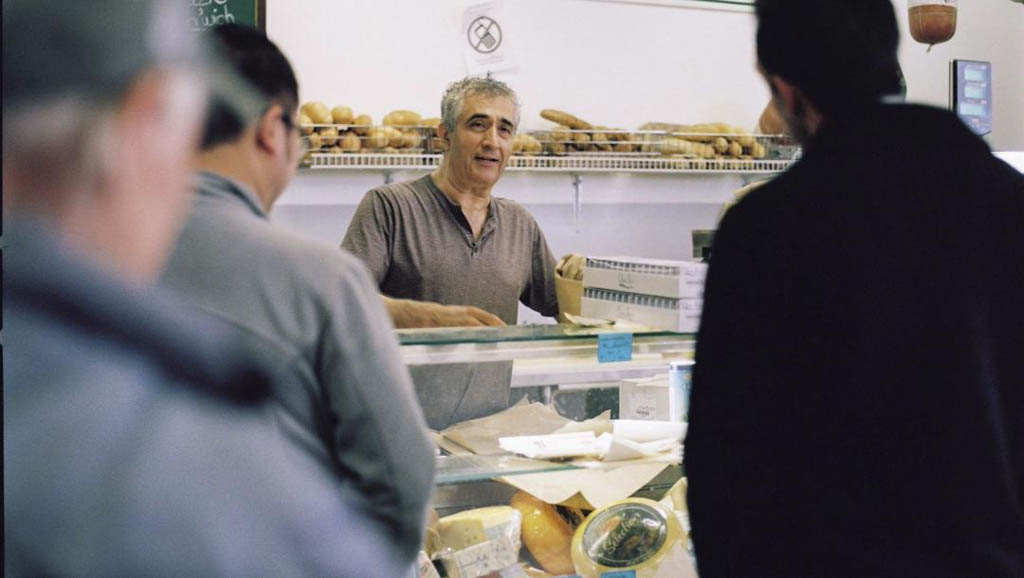
Vancouver deli owner Salam Kahil is the star of the documentary film The Sandwich Nazi. The film was directed and edited by Lewis Bennett. It’s one of many films being shown at Montreal’s Festival du nouveau cinema. (Photo by Rommy Ghaly)
The Sandwich Nazi is a documentary portrait of Vancouver deli owner Salam Kahil. His customers call him Sal. Anyone who thinks Canadians are dull and boring has not met this guy.
Sal has a dirty mouth and a big heart. Viewers can assess some of his other parts in the last moments of the film.
Sal was born into a large family in Lebanon. He left home at an early age for assorted reasons. He lived in 18 countries before coming to Canada in 1979 and he has the photos to prove it. I didn’t hear him name our city, but it looks like he lived here in Montreal for a while.
When he was no longer “young and pretty” he went into the deli buiness, with La Charcuterie Delicatessen, a “Scandinavian place with a French name” being the most recent one. In addition to sandwiches, he sells imports you probably won’t find at your local supermarket. Customers are fond of the pickled asparagus from Denmark. When someone calls to ask if he has “Norwegian cooking chocolate” he says there’s probably some in the back. (You can see that chocolate on the La Charcuterie’s web site and lots more – Viking Bread, Norwegian fishballs, many cheeses, condiments, cookies, candy and sweets, including the very yummy Anthon Berg Marzipan Plum in Madeira. The site includes a recipe for Danish meatballs! )
(Looking at that website made me want to visit Montreal’s La Vieille Europe on St. Laurent, since it might have some of those things.)
Sal has many stories to tell, most of them crude. He says he used to be a male escort who could be hired by men or women. He says he has also been a very successful sperm donor (twins!) for women who did not have (or want) a male partner.
He tells these stories to his customers as he prepares their sandwiches. They’re an extra garnish, you might say. Are they all true? Are some exaggerated? Who knows? Who cares?
The sandwiches themselves are HUGE. Sal says they’re the best in the world and his customers seem to agree. Don’t go the film on an empty stomach.
The film’s title is a reference to the “soup Nazi” from the Seinfeld TV show. That guy made great soup but customers could be banished forever if they did not obey his many rules. Sal has rules, too; payment is cash only and he demands politeness and respect from his clients. For the most part, he seems to get it. We only hear one or two banishment stories.
As far as I can recall, the “soup Nazi” did not have any redeeming qualities beyond his culinary talents. In contrast, Sal and his army of volunteers prepare meals and distribute them to the poor and the homeless of Vancouver’s Downtown Eastside on a regular basis. He treats those people with warmth and respect and they are obviously happy to see him and his food. He feeds the volunteers, as well. We learn about many other good deeds in the film.
The documentary was made over several years. On more than one occasion, Sal says he will return to Lebanon to visit his family, even naming a departure date. But he doesn’t go. When he’s finally ready to make the trip, the film crew wants to accompany him, but his family says no. Sal documents things himself, and shares his footage with the filmmaker and viewers upon his return. This includes a hair-raising, high-speed drive through a sniper-infested area – not something that happens on your average vacation.
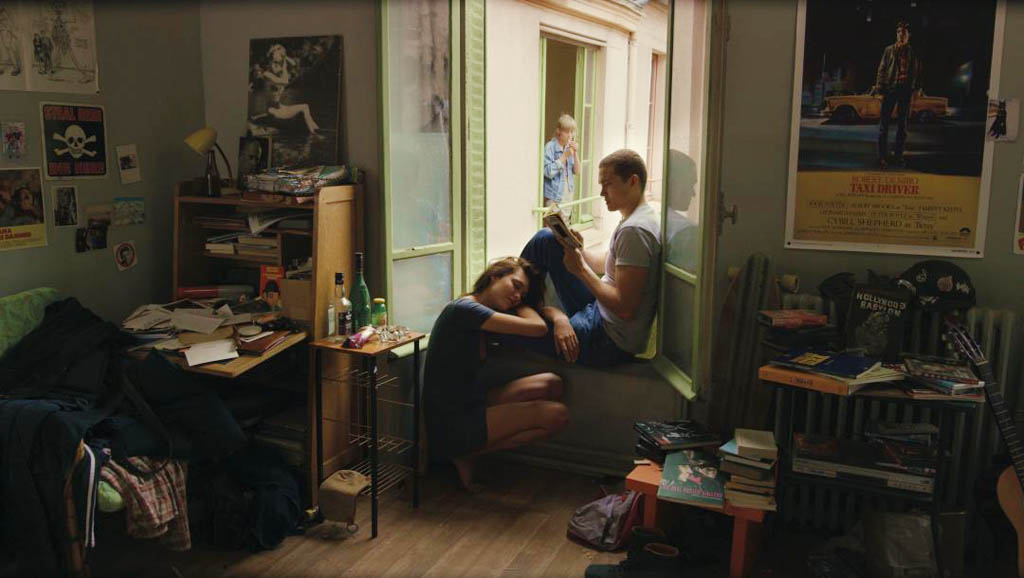
In this scene from Gaspar Noe’s film Love, Electra (Aomi Muyock) and her boyfriend Murphy (Karl Glusman) relax in their Paris apartment. New neighbour Omi (Klara Kristin) can be seen through the window.
“Well, that’s two hours of my life I’ll never get back.” It’s not a very original complaint (sorry!) but that’s what I was thinking, long before Love, the latest film from Gaspar Noé, was over. I wasn’t able to appreciate it. And it’s actually two hours and 14 minutes long, strictly speaking.
The film is called Love, but “Clueless Jerk,” might be a more apt title.
The main male character is an American in Paris named Murphy (Karl Glusman). His girlfriend, dark-haired Electra (Aomi Muyock), left him because he got another woman pregnant.
The film opens with Murphy and Electra having sex. Is that Murphy’s dream in the present day, or is that Noé telling us that they used to be a couple? Could be either, I guess. His phone rings and Murphy wakes up. He is in the same room (though it has different decor now) and the woman in the bed beside him is blonde. It’s New Year’s Day and the call is from Electra’s mother. She has not heard from her daughter for two or three months and she’s worried. Does Murphy know where she is?
There’s lots of voice over as we hear Murphy’s thoughts, which are not very interesting and (when it comes to the blonde, the mother of his child), quite rude and crude.
As the story unfolds we see that Murphy behaved very badly on many, many occasions. He wishes he could turn back time, though there’s no indication he would have behaved differently. In his mind, he declares his love for Electra, over and over. I was not convinced. Is he even serious about that, or is it just a story he’s telling himself, now that something bad might have happened to Electra, and she might be permantently out of his reach?
There are so many sex scenes in Love. I hear that you can see that kind of thing on the Internet, at home, for free. No need to go to the cinema! There isnt much laughter between this couple, though. What kind of relationship is that?
Love is in 3D, which added nothing to the experience for me, except for a scene where Murphy blows smoke rings, which was cool for a few seconds.
If you are already a Gaspar Noe fan, Love might be for you, especially since he will be in town to present the film.
LOVE, 134 Min, VOSTF
Written and directed by Gaspar Noé
Cast: Aomi Muyock, Karl Glusman, Klara Kristin, Juan Saavedra
Thursday, Oct. 8, 2015 at 8 p.m.
Concordia University, Alumni Auditorium (H-110), Hall Building, 1455 de Maisonneuve Blvd. W., Montréal, QC
Manos Sucias (Dirty Hands) is a taut tale set in Buenaventura, on the Pacific coast of Colombia. Within the first few minutes we see several tough-looking guys and many serious weapons. (There’s even a little kid nonchalantly cleaning a revolver.) Buenaventura is obviously a dangerous place, and a quick Google search will confirm that, with headlines like: Colombian City’s New Face and Violent Underbelly Collide; Colombian port city terrorised by criminal gangs – BBC News; Welcome to Buenaventura, Colombia’s most violent city.
There are 400,000 people Buenaventura, though we only see a handful of them, in the roughest, poorest parts of town.
Our main characters are Jacobo (Jarlin Martinez) and his younger brother Delio (Cristian Advincula). They’ve been estranged for years but end up working on the same drug run for Don Valentin. It’s the first time that Delio has done this kind of thing; Jacobo is an old hand who plans to move to Bogota once the job is done. That made me suspect that things might not go well for these guys. Just think of all the films have been made about that one last heist, or the cop who is one week, or even one day away from his retirement.
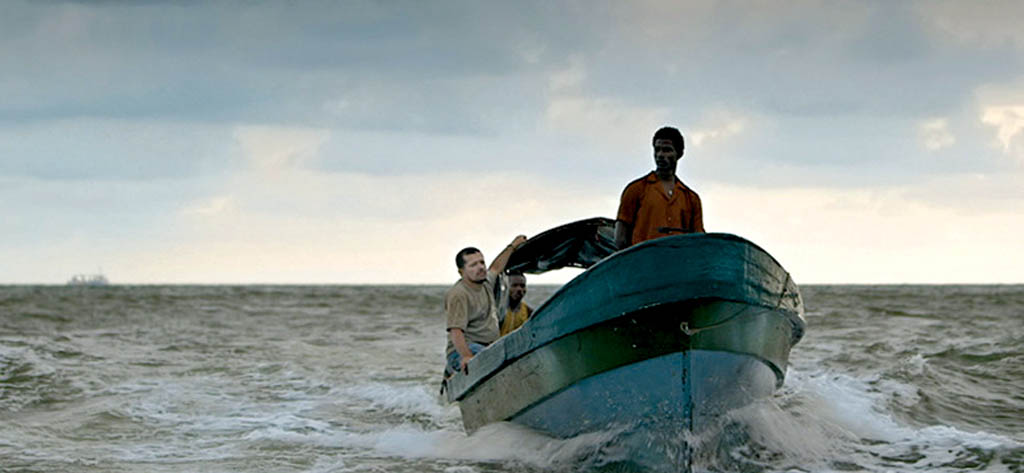
Jacobo and Delio will help a man named Miguel (Hadder Blandon) to pilot a small, battered fishing boat north towards Panama. This will take several days. Attached to the boat is a “torpedo” filled with 100 kg of cocaine in small packets. All of the packets will be weighed at the checkpoint, the guys are told. Point taken, no need to elaborate further.
The torpedo is fitted with a tracking device just in case it comes loose from the boat. (Cough.) Miguel has a cellphone, a GPS locator, and a gun. Delio has a machete that he uses to open coconuts, among other things. Seeing these items, one wonders if, or more likely when, they will be used, and in what circumstances.
Jarlin Martinez plays Jacobo in Manos Sucias, a film from Colombia that’s being shown at the 2015 Montreal International Black Film Festival.
During their trip they will have to worry about running into guerrillas, the military, the paramilitaries, and anyone else who might have designs on their cargo. These people will feel entitled to take anything they might have, including their lives. There’s nothing dashing or glamourous here. Just danger and dread.
Soccer and racism are recurring themes in Manos Sucias. Before the trip, Jacobo watches an informal game with an old friend. When told about the plan to move to Bogota, the friend says there are no blacks there, or hardly any. They’re only able to get the most horrible jobs, and it’s freezing there, too. Later, Jacobo, Delio and Miguel sit around a campfire, talking about the great soccer stars of the past. Seems like your typical male bonding stuff, until the white Miguel spoils the mood and makes some racist remarks to the Afro-Colombian brothers.
When some unexpected events take Miguel out of the picture, Jacobo and Delio continue with the mission. What else can they do? But what will happen afterwards? (They HAD been told that this would be the “easiest job you ever had.” “Like a paid vacation.” Ha!)
The music Manos Sucias is worth mentioning. Haunting tunes from Grupo Gualajo make use of soaring women’s voices and a marimba.
Fans of Colombian salsa might nod their heads (I did, anyway) when Jacobo has one of those “kids, these days!” chats with his brother, disparaging the rap music that Delio admires and suggesting that he listen to “something good,” like Grupo Niche, Nemus del Pacifico, or Orquesta Guayacan.
Manos Sucias (Dirty Hands) U.S.A./Colombia, 2014, 82 minutes, in Spanish with English subtitles
Directed by Josef Kubota Wladyka, with Cristian Advincula, Jarlin Martinez, Manuel David Riascos, Hadder Blandon. Spike Lee was an executive producer
Sunday, Oct. 4, 2015, at 5 p.m.
At the Former NFB Cinema, 1564 St. Denis
Admission is $10
The documentary License to Operate introduces us to former Los Angeles gang members who were deadly enemies in their younger days but are now co-operating, through an organization called A Better LA, to break a cycle of murder and retaliation that had lasted for decades.
One man gets out his high school yearbook and tells us that most of his former classmates are dead now. He has photos from their funerals. it’s obvious that he’s lucky to still be alive himself. Another man tells of seeing five candlelight memorials for murder victims in just one evening. That was the night that he knew he had to do something to save the next generation of children.
After receiving instruction from the Professional Community Intervention Training Institute, the men do liaison work between neighbourhoods and the police and fire departments, encouraging young people to stay out of gangs and calming tensions after murders. If something happens, even in the middle of the night, they’re out there on the street, trying to keep the situation from escalating, eliminating rumours, etc.
They certainly have their work cut out for them. A Better LA says that there are more than 450 gangs in Los Angeles, and that: “ ‘Invisible lines’ drawn by gangs to designate their turf cause children to live in a constant state of fear, wondering if walking to school or crossing the street puts them in harm’s way.”
A lawyer explains that many of the children in these neighbourhoods have the same levels of post traumatic stress disorder as children living in war zones. Before the age of 16, they have lost as many as 10 friends to murder. We see doors and walls that have been riddled with bullets. It’s truly appalling.
License To Operate, directed by James Lipetzky, 101 minutes, in English
Saturday, Oct, 3, 2015 – 7 pm
Cinéplex Odéon du Quartier Latin
350, Rue Émery, Montréal (Métro Berri UQAM)
Admission is $10.
Check the Montreal International Black Film Festival web site, www.montrealblackfilm.com/ for details, the film schedule, film synopses and trailers.
The Montreal International Black Film Festival has a Facebook page, too.
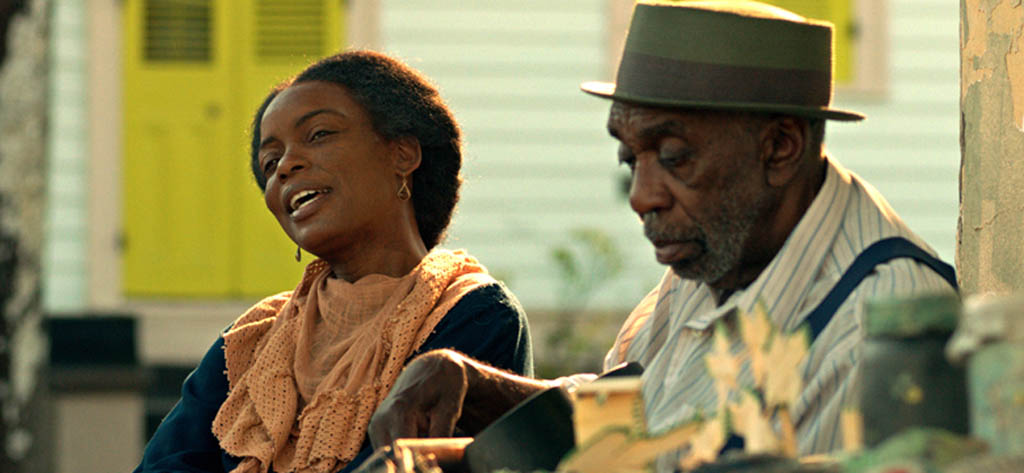
Aunjanue Ellis, left, and Bill Cobbs in Una Vida: Of Mind and Music, one of the films being shown at the 2015 Montreal International Black Film Festival.
Many Montreal film festivals show several films at the same time, which can make life difficult for fans. How to choose?
Here are brief reviews of the two films that will be shown at 7 p.m. on Thursday, Oct. 1, 2015 at part of the Montreal International Black Film Festival; I hope that they are helpful!
Una Vida: Of Mind and Music is a gentle tale that unfolds in an unhurried way. Dr. Alvaro Cruz (Joaquim de Almeida) is a neuroscientist who lives in New Orleans. Appropriately enough for someone who lives there, he likes jazz and blues. His mother has Alzheimer’s disease.
Soon after the film begins he is overcome by guilt because his mother died when he was away at a medical conference. He keeps dreaming of a time in his childhood when he got lost while chasing an elusive butterfly.
He takes time off from work to just kinda hang around. He meets an elderly musical couple – singer Una Vida, and guitarist Stompleg. They play on the street and in a small bar. He can see that the woman’s memory is failing, though her songs seem more firmly rooted in her brain than other things are. As a scientist, he is intrigued by this situation; as a human being he wants to help if he can.
Everyone seems to like Dr Cruz, except for a young woman named Jessica, who does a lousy job of helping Stompleg to look after Una Vida. She is hostile and suspicious and tells him to stay away. of course, we know that he won’t, don’t we?
Oh, for what it’s worth – Una Vida is also known as Queenie, though her real name is Maizie.
There are some nice tunes in Una Vida: Of Mind and Music, but there isn’t really much of a plot. The fortysomething actress Aunjanue Ellis, who plays Una Visa, is made up to look much older, yet her voice still sounds quite youthful most of the time. The film is based on a novel written by a real life neuroscientist Nicolas Bazan. It has many rave reviews on Amazon.com.
Una Vida: Of Mind and Music, 2014, U.S.A., 97 minutes, In English, with some Spanish dialogue when Dr Cruz talks to his mother.
Director: Richie Adams
Cast: Joaquim De Almeida, Bill Cobbs, Ruth Negga, Sharon Lawrence and Aunjanue Ellis
Screenwriter: Richie Adams, Nicholas Bazan
Producers: Richie Adams, Brent Caballero, Nicolas Bazan, Nancy Green-Keyes
Busisiwe Mtshali plays Zanele in the South African film Thina Sobabili (The Two of Us), which is one of the selections at the 2015 Montreal International Black Film Festival.
Thina Sobabili (The Two of Us) is about high-school student Zanele, and her older brother Thulas, who is raising her in the Johannesburg township of Alexandra. He is very strict and stern with Zanele, though he makes his living from robbing the homes of rich people. (We don’t actually see them do it, we just hear Thulas and his friends talk about it, and we see a bit of the loot.)
Zanele and her friend Tumi look very young in their school uniforms and white ankle socks, but Tumi is already flirting and accepting rides, meals, drinks and money from smarmy older men who own cars. She calls one of them the Minister of Finance. There are always lots of people in the street, so her behaviour does not pass unnoticed.
Thulas orders his sister to stay away from Tumi, but rebellious Zanele remains loyal to her friend. We know that this is bound to lead to trouble.
There are some very uncomfortable scenes in Thina Sobabili, and certain connections and coincidences seem too a bit of a stretch. Nonetheless, it is quite impressive, especially considering the fact that it was made on a tiny budget and shot in a mere seven days. Thina Sobabili is South Africa’s submission for the foreign-language Oscar.
Thina Sobabili (The Two of Us) 2015, 90 minutes, South Africa, in Zulu with English subtitles,
Director: Ernest Nkosi
Cast: Richard Lukunku, Emmanuel Nkosinathi Gweva, Zikhona Sodlaka, Thato Dhladla, Busisiwe Mtshali and Mpho (Popps) Modikoane
Screenplay: Ernest Nkosi, Mosibudi Pheeha
Producers: Ernest Nkosi, Enos Manthata, Mosibudi Pheeha Una Vida: Of Mind and Music
Thursday, Oct. 1, 2015, 7 p.m.
Cineplex Quartier Latin, 350 Emery St.
Thina Sobabili (The Two of Us)
Thursday, Oct. 1, 2015, 7 p.m.
Former NFB Cinema
(Judith Jasmin Annexe)
1564 St. Denis












 Mostlymovies.ca