FNC 2016: Review of French sketch-comedy film Apnée

Thomas Scimeca and Céline Fuhrer in the French comedy Apnee.
Thomas Scimeca and Céline Fuhrer in the French comedy Apnée.

Apnée begins with two men and a woman, each wearing strapless wedding dresses, flouncing into an elegant town hall and asking the mayor to marry them to each other. The mayor explains the available options in a polite and friendly manner. He tells them with regret that they can’t marry each other “yet.” The implication is clear: have some patience and your day will come. But the three don’t want to wait and they begin a collective rant about their rights. Then it’s time for the mayor to express his many frustrations with his job and his family. You had to be there. It was funny!

Apnée is a collection of loosely connected sketches, a bit like the old Monty Python show, though there isn’t any animation and the Spanish Inquisition doesn’t show up, either. In the press notes, director Jean-Christophe Meurisse calls it a road-trip and a “comédie socialo-mélancolique.”

A few of the subjects include: dealing with bankers; the ridiculous price of housing ($1755. for less than 200 square feet!) and the hoops people still have to leap through for the privilege of paying for a tiny, overpriced dump; parent-child relations, expectations and disappointments; a mock job interview at an employment centre that gets stuck at the handshaking part and just gets sillier and sillier (in a good way).

Some outdoor scenes in Apnée were shot in lovely parts of Corsica. That might give the tourist industry a boost.

DirectorMeurisse and the three main actors, Céline Fuhrer, Thomas Scimeca and Maxence Tual, are part of the popular French theatrical troupe Les Chiens de Navarre. (The group presented its latest play, Les armoires normandes, here in Montreal last month.)

I enjoyed some sketches more than others, and the driving scenes went on too long for my taste, but I thought Apnée was pretty damn funny. The description in the Festival du Nouveau Cinéma catalogue already sounded appealing, but then a friend recommended it to me, and that clinched the deal. I’m glad I went!

The English subtitles are a blessing because the actors speak very quickly and sometimes everyone is talking at once. Serge, the friend who suggested Apnée to me, is a francophone, but even he appreciated the English subtitles.

Not sure if I should even mention this but. . .I’m also very glad that I did not see Jay Weissberg’s review in Variety before I went. He called it an “insufferable improvised madcap comedy.”

Of course, people have different tastes, experiences, backgrounds and expectations, but I feel like we did not watch the same film. Maybe he was suffering form “film-festival burnout.” I’ve had that happen right here in Montreal, on my home turf. Imagine the stress and pressures of the Cannes Film Festival. Variety is a very powerful publication, so I hope his negative review does not scare people away from Apnée.

Apnée (or Apnea)
Directed by Jean-Christophe Meurisse
With: Céline Fuhrer, Thomas Scimeca, Maxence Tual, Thomas de Pourquery, Olivier Saladin, Claire Nadeau, Jean-Luc Vincent, Nicolas Bouchaud, Pascal Sangla, Robert Hatisi, Solal Bouloudnine.
88 minutes long, in French with English subtitles.

Seen at the 2016 Festival du Nouveau Cinéma in Montreal.
FNC 2016: Review of A Decent Woman

fnc-2016-a-decent-woman

A Decent Woman was shot in Argentina. The original Spanish title is Los Decentes. It has also been shown under with the English title The Decent. It’s a satire.

Belen is a woman who does not say much. She observes, sometimes warily.

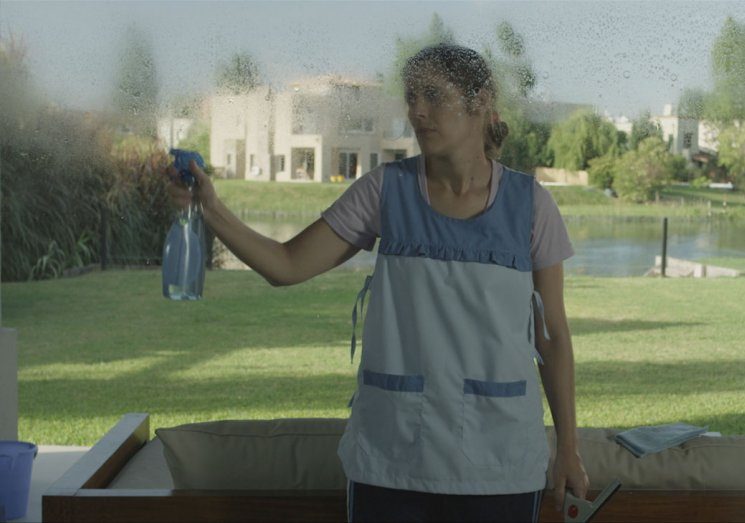
Belen (Iride Mockert) starts working for a rich woman and her spoiled son in a gated community outside Buenos Aires. (The residents inside those gates are wealthy, but in the surrounding area there are rundown streets littered with garbage.) Belen’s employer has a large house, but it presents a blank face to the world – it doesn’t look particularly comfortable or welcoming. It’s very bland, lacking personality, inside and out.

The property is on the far edge of the community and Belen soon notices that there is a nudist colony on the other side of the big hedge, and the (highly-)electrified fence. (She notices because she does everything at that house, buying groceries, washing floors, windows, dishes, doing laundry, cleaning the son’s sport shoes, and clipping that hedge. Belen’s employer, Diana (Andrea Strenitz) signs Belen up for cooking classes, too. (Among other things, they make cupcakes – a “very American recipe” according to the instructor.) When Diana can’t sleep, she wakes Belen to keep her company.

After days, maybe weeks, of watching the nudists, Belen lets her long hair down (literally), sheds her clothes and joins them. When they first see her, she is shyly recreating the pose from Botticelli’s Birth of Venus (the one with the big seashell).

They’re a very welcoming bunch and soon Belen is spending lots of time with them. Is this possible because Diana and her son, Juanchito, go away a lot for tennis tournaments, or could it be that Belen is just imagining herself having a different way of life with these people?

Much of the time, they are calm, quiet and relaxed, hanging out in or beside the water, dozing or reading. I won’t describe all of their activities, to avoid the accusation of “spoilers!” Let’s just say, this isn’t a “family-friendly” nudist club, and the place where the scenes were shot is actually a nudist swingers’ club, in the director’s own words.

The nudists do play loud music at night. It’s so loud that Diana’s windows vibrate and she can’t sleep. Other neighbours are upset about them, too, and they start a petition against the enclave.

Up until this point in A Decent Woman, I had no serious complaints. It had been moving at a  languid pace, possibly too slowly for some people, but I could handle it. (I did not notice anyone leaving, either.)

But. . . call me a coward or whatever, I did not like the abruptness nor the content of the ending. One or two people laughed. Was it serious laughter or nervous laughter? I wonder. I prefer to think that director Lukas Valenta Rinner did not know how to end the film, or that the ending is a dream that Belen has. (Yes, I know, dream sequences are a corny cliché.)

One person near me said “If I had known it would be like that, I would not have come.”

* * *

A FEW HOURS LATER:

(I went to A Decent Woman  because I thought that I had read several rave reviews about it, in reports from other festivals like Sarajevo and TIFF. Maybe I got it mixed up with something else.

The FNC catalogue and web site say that director Lukas Valenta Rinner also made Parabellum, which explains a lot. My brain must have skipped right over that. (Did you see it?) If you intend to see A Decent Woman, it might be better not to read about Parabellum beforehand.

As for not knowing how to end it, Parabellum won a prize at the Jeonju International Film Festival in South Korea. A few months later, the Jeonju Cinema Project offered Valenta Rinner money to make his next film, but that meant he only had six months to write, film and edit a work-in-progress version to show at the next edition of the festival.

On the other hand, in an interview with Cineuropa, Valenta Rinner indicates the abrupt ending was a “deliberate narrative decision,” to provide catharsis. And now that I think about it, abrupt changes of tone happen all the time in Korean cinema.

Lukas Valenta Rinner is an Austrian who went to film school in Argentina and still lives there. He has stated that his film is a comment on inequality and social tensions in Argentina. I’ve watched many films from Argentina, but I’ve never been there, so what do I know?

Final verdict: Mixed feelings. Can’t say I’m happy that I went, but I don’t feel ripped off either. I wouldn’t recommend it to everybody, but I imagine there are people within my extended circle who would like it.

Los Decentes (A Decent Woman)

Country: Austria, Republic of Korea, Argentina

Year: 2016

Genre: Fiction

Directed by: Lukas Valenta Rinner

Length: 104 minutes

Screenplay: Lukas Valenta Rinner, Ana Godoy, Martin Shanly, Ariel Gurevich

Cast: Iride Mockert, Martin Shanly, Andrea Strenitz, Mariano Sayavedra

I saw A Decent Woman at the  in Montreal. The festival will show the film again on Wednesday, Oct. 12, 2016 at 18h (6 p.m.)

Fantasia 2016 Review: Three by Johnnie To

Wallace Chung, left, Vicki Zhao Wei and Louis Koo in the Johnnie To film Three. Everything that happens in the film is a prelude to the madness depicted here.

Three did not do it for me. I’ve enjoyed many Johnnie To films over the years, thanks to the Fantasia International Film Festival, but I found Three both disappointing and annoying. The film asks us to throw common sense to the wind. I do that all the time, and not just at the movies, either, but I just couldn’t do it for Three.

(However, it’s only fair to point out that both Fantasia screenings were sold out, albeit in the smaller De Sève cinema, and that one of my friends, an esteemed film prof, watched it twice.

My problems with it, in no particular order: a dumb script with many unlikely events, unnecessary carnage, wooden acting.

To elaborate further: Shun (Wallace Chung), the leader of a criminal gang, is shot in the head by a cop (we don’t see it happen) and he’s taken to a hospital. Not only is he still alive, it seems that the bullet hasn’t done any damage – he’s quipping away about philosophy, taunting his police guards, etc. Even so, the doctors say that he needs surgery as soon as possible. Shun refuses that surgery because he wants to be conscious when his gang comes to rescue him. But then what? He’ll still have a bullet in his head, and it’s not like your average mob doc is prepared to deal with that.

Wouldn’t it make more sense to have the surgery now, and then have the gang rescue him while he’s being taken to prison? Hijack the prison van – should be a piece of cake, right?

If his henchmen are so scary (and we’re led to believe that they are) and he’s in such medical danger you’d think that he’d be held in a private room with many guards, but no, he’s in a ward with several other patients.

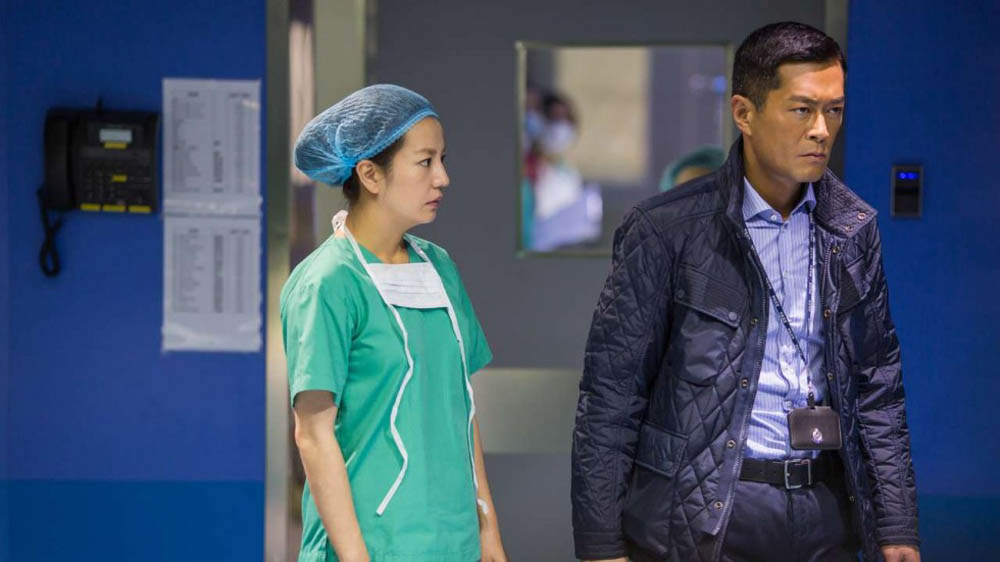
Vicki Zhao Wei plays a neurosurgeon and Louis Koo plays a police detective in Three, a film from Hong Kong director Johnnie To. Koo wears that same stone-faced look in 98 per-cent of the film.
Vicki Zhao Wei plays a neurosurgeon and Louis Koo plays a police detective in Three, a film from Hong Kong director Johnnie To. Koo wears that same stone-faced look in 98 per-cent of the film. He doesn’t take that jacket off, either.

Lotsa cops, led by Ken Chan (Louis Koo) are waiting for the gang to arrive so that they can arrest them. Or kill them. It’s a tense waiting game! Never mind that this plan puts all the patients, doctors, nurses, other hospital workers and visitors in extreme danger. The sensible thing to do would be to restrict access to the hospital, as was done in many countries during the SARS outbreak, and to catch those bad guys at some other time, in some other place. But no, Chan is determined to nab them today.

Because this is a Johnnie To film, we know that there will be an over-the-top-shoot out, and, um. . . (SPOILER ALERT!) other kinds of mayhem, as well. The only question is when. But even in the land of make believe, I object to doctors and patients being blown away for such contrived reasons.

Which brings us to the wooden acting. Most of the time Louis Koo looks grim, stoic, stubborn, angry, or determined, which is pretty much the same thing on his face. He barks, snaps and scowls at everybody. Neurosurgeon Dr. Tong (Vicki Zhao Wei), who is having a very bad week, looks glum and exhausted, sometimes on the verge of tears. Not a lot of nuance happening here. Well-cushioned Lam Suet, one of  Johnnie To’s regular actors, plays the guy sent to get lunches, of course. His character can barely speak in sentences.

A patient named “Uncle Chung” provides some comic relief, though he isn’t that funny. Two other patients offer what you might call tragic distraction. There’s a cliffhanger scene, or more precisely a-bedsheet-and-firehose scene, that is just left. . .hanging. Literally. We don’t see how it wraps up. There’s another scene that might remind you of the Odessa Steps sequence in Battleship Potemkin. And why not? Toss it all in!

Every time I look at Louis Koo in his quilted blue jacket I wonder – just how heavy is the air-conditioning supposed to be in this hospital?

For the squeamish: Action-film fans are used to shootouts, but are they used to gruesome surgery? Be warned that even though Shun refuses his operation, many other patients do get theirs. There are scalpels, drills, copious amounts of blood and exposed brains in Three.

Meh. I suggest watching something else by Johnnie To.

THREE
Director: Johnnie To
Writers: Yau Nai-hoi, Lau Ho-leung, Mak Tin-shu
Cast: Louis Koo, Wallace Chung, Vicki Zhao Wei, Lam Suet
Run Time: 87 minutes.
In Cantonese with subtitles in English and Traditional Chinese
Seen at the Fantasia International Film Festival in Montreal

Fantasia 2016 Review: Too Young To Die!

Nana Seino, Tomoya Nagase, Ryunosuke Kamiki and Kenta Kiritani play musicians in the Japanese film Too Young To Die! which was shown at the Fantasia International Fim Festival in Montreal.
Nana Seino, Tomoya Nagase, Ryunosuke Kamiki and Kenta Kiritani play musicians in the Japanese film Too Young To Die! which was shown at the Fantasia International Film Festival in Montreal.

Too Young To Die! is full of laughs, music, demons, and love. It’s educational, too!

I saw this raucous crowd pleaser in the very best circumstances possible, with hundreds of other enthusiastic film fans at the Fantasia International Film Festival, right here in Montreal.

Daisuke (Ryunosuke Kamiki) and his fellow high-school students are riding a bus home after a field trip. Earlier, Daisuke had bribed a friend to change seats with him so he could sit next to his crush, Hiromi (Aoi Morikawa). They are having a shy chat when the bus goes over a cliff.

Daisuke wakes up in Buddhist Hell wondering what he did to end up there and how he could be so much worse than his fellow classmates. None of them are there with him, even though initial reports say that all the students on the bus died, except one.

Daisuke tells Killer K (Tomoya Nagase) a long-haired, horned, fanged guitar-playing demon, that he wants to go wherever Hiromi is. (He hopes she’s alive but he assumes that she’s in Heaven.) When Killer K says that no one has ever gone from Hell to Heaven before, Daisuke vows to do his best to be the first person to do that.

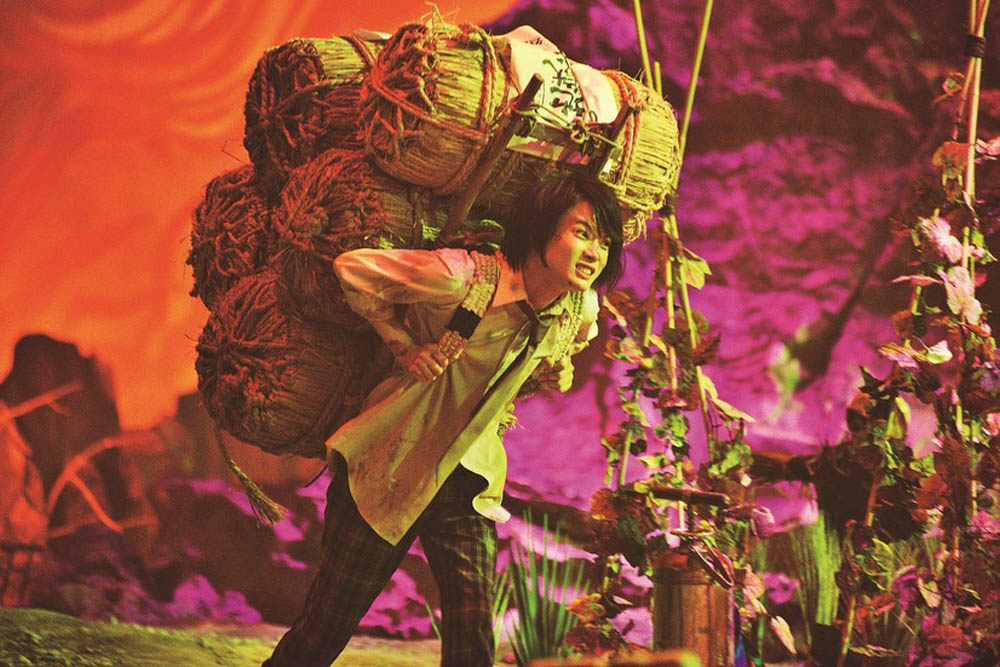
In the film To Young To Die, Daisuke (Ryunosuke Kamiki) works really hard in Hell; he'll do anything for another chance to see his true love Hiromi.
In the film To Young To Die, Daisuke (Ryunosuke Kamiki) works really hard in Hell; he’ll do anything for another chance to see his true love Hiromi.

There will be many challenges ahead! Daisuke has to haul heavy loads AND attend Hell Agricultural High School, too!  He’ll have to work very hard in Hell to be re-incarnated on Earth. What kind of creature he will be depends on his own efforts and the whims of Lord Enma, who sits in judgement. I’d be going into serious spoiler territory if I mentioned ALL of his reincarnations, though they include a bird, performing sea lion, a dog, and a giant scorpion. It’s pretty hilarious to watch Daisuke, who returns to his family home as a pale blue parakeet, frantically trying to delete a naughty video from his smartphone, and send one last text message to Hiromi.

Daisuke will get seven chances to redeem himself, but if he fails, he will turn into a demon like Killer K. Already his face is getting a bit redder, his teeth are longer and sharper and he can feel little bumps on his head where his future horns might sprout.

Arata Furuta plays Lord Enma in Too Young To Die! Lord Enma sends Daisuke back to Earth as a bird, a dog, and a sea lion, among other things.

Joining Hiromi is Daisuke’s main concern, but there’s a secondary plot line about a demonic battle of the bands. Killer K wants to recruit Daisuke for his group, Heruzu (Hells). This plot provides several tunes, some outrageous gags and an ultimate pyrotechnical showdown.

Despite the abundance of laughs and silly situations, Too Young to Die! is also a genuine love story. Years go by, but Daisuke’s love for Hiromi never wavers.  I found it very touching.

Writer and director Kankuro Kudo is obviously taking lots of liberties with his depiction of the Buddhist underworld, but he didn’t make it all up, either. Just Google Lord Enma and Ox-Face and Horse-Head for some background, and you’ll see. That’s why Too Young to Die! is also educational.

Musical Notes: Tomoya Nagase, who plays Killer K, is a musician in a band called Tokio. Director Kudo plays guitar in a band called Group Tamashii.  

Ryunosuke Kamiki, Tomoya Nagase, Kenta Kiritani and Nana Seino played the film’s title track at the Tokyo Metropolitan Rock Festival in May. If you like the songs in the film and you’ve got money to spare, you can order the film’s sound track from CD Japan.

Another film: Ryunosuke Kamiki and Takeru Satoh play high school students who write a manga in Bakuman, also shown at Fantasia this year. (You can read my review of Bakuman here.)

Interesting coincidence: Before the bus crash, Daisuke bought Hiromi an amulet at a temple. A few days after watching the film, I saw a guy on the metro with a similar amulet hanging off his knapsack. I would have liked to ask him about it, but I didn’t get the chance before I had to get off the train to watch another Fantasia film.

Too Young To Die!
125 minutes, in Japanese with English subtitles
Director: Kankuro Kudo
Screenplay: Kankuro Kudo
Cast: Tomoya Nagase, Ryunosuke Kamiki, Kenta Kiritani, Nana Seino, Aoi Morikawa, Arata Furuta

Fantasia 2016: Check out the manga film Bakuman on Saturday – you won’t be sorry!

In the film Bakuman, Moritaka (Takeru Satoh) and Akito (Ryunosuke Kamiki) play high-school students who want to get their manga into the magazine Shonen Jump.

I enjoyed Bakuman (バクマン。) very much. This Japanese film about breaking into the manga world has a good story, sympathetic characters, appealing actors, and lots of laughs. There are some lessons in friendship, co-operation and work/life balance, too, if you care to notice them; they didn’t seem heavy-handed to me, but feel free to ignore them if you’d rather.

And for the squeamish among you, no one gets any fingers cut off, either.

High-school students Moritaka (Takeru Satoh) and Akito (Ryunosuke Kamiki), try to create a manga AND have it accepted by the prestigious weekly magazine Shonen Jump. They aim high, these guys! Moritaka will draw and Akito will create the storyline.

There are multiple motives, including pride, the spirit of competition, money, and a desire for a future as someone other than an office drone. Moritaka’s main reason is to impress fellow student Miho (Nana Komatsu). He spends most of his class time sketching her surreptitiously. But the pure joy of creation is a very big part of it, too, and that’s a big part of the film’s appeal for me.

Moritaka can draw very well, but he must learn some new techniques, with pens and brushes, to make a manga. We learn these techniques along with him, and hear the scritch, scritch, scritch of his pen quite clearly. He already has a big advantage, since he spent many of his childhood years in the studio of his late uncle, who was a famous manga artist. In fact, that studio is still available for him to work in. (I didn’t quite grasp why that room had been left unused all that time. But never mind!)

The visuals in Bakuman are great. Facts about manga scroll across the screen; sometimes it’s like we’re inside a drawing, other times the characters are fighting like martial artists, with giant pens and brushes as their weapons. The newsroom of Shonen Jump is a sight to behold – it’s huge with lots of art on the walls and enormous piles of paper everywhere. Is that the real office, or a set? I won’t stop writing to find out right now, but I’m mighty curious! If it’s a set, what a job it must have been to create it. Fun, too, I imagine. (UPDATE: It is a set, but it does look like the Shonen Jump office.)

Moritaka (Takeru Satoh) and Akito (Ryunosuke Kamiki) wield their drawing instruments like weapons in Bakuman, a film about the world of manga.

Takayuki Yamada plays Akira Hattori, the editor our guys meet when they visit Shonen Jump. His character is rather scruffy and subdued, but he’s impressed by their work and he offers solid support and advice.

Lily Franky plays an editor-in-chief who seems very mean at best and downright sinister at other times. Since I’ve seen him play gangsters and psychopaths in other films, the sinister part might just be in my own head.

Shota Sometani, who seems to be in half the films coming out of Japan these days, plays Eiji Niizuma, a rival manga artist, who is also still in high school. He dresses in all in black and scuttles around in a crab-like manner that recalls assorted horror movies like The Hunchback of Notre Dame and The Phantom of the Opera. He’s already ruined his body by spending so many hours scrunched over his drawings.

This film about manga artists is based on a manga itself. (Of course it is!) I can’t claim to know much about manga myself, but viewers who do will likely pick up lots of references and enjoy many inside jokes. Maybe they could share them with me!

Takeru Satoh was the star of the wonderful film If Cats Disappeared From the World, which had a sold-out screening at Fantasia this year. He was also the star of the live-action Rurouni Kenshin trilogy. Ryunosuke Kamiki was in two of the Rurouni Kenshin films, and in two other films in this year’s Fantasia selection, As the Gods Will, and Too Young To Die. He was in Poison Berry in My Brain, a hit at Fantasia 2015.

Bakuman
Directed by: Hitoshi One
Written by: Tsugumi Ohba, Takeshi Obata
Cast: Takeru Satoh, Ryunosuke Kamiki, Takayuki Yamada, Nana Komatsu
Language: Japanese with English subtitles
Runtime: 120 min.
Distributor: Toho

You can see Bakuman as part of the Fantasia International Film Festival, at 6:40 p.m. Saturday, July 30, 2016, at the Hall Theatre of Concordia University, 1455 de Maisonneuve Blvd W. Fantasia runs until Aug. 3, 2016.

Fantasia 2016 Review: If Cats Disappeared From the World

Aw, can't you just imagine that soft fur against your face? Takeru Satoh is the main human star of the Japanese film If Cats Disappeared From the World.
Aw, can’t you just imagine that soft fur against your face? Takeru Satoh is the main human star of the Japanese film If Cats Disappeared From the World.

If Cats Disappeared from the World? Noooo! That’s a very distressing thought! But the Japanese film that carries that title is nothing short of magical. Everything works.

The script is based on a best selling book, Sekai kara Neko ga Kieta nara by Genki Kawamura. Takeru Satoh, the star of the live action Rurouni Kenshin trilogy, is excellent as the main character. He’s a handsome guy with big eyes, but I bet some special lighting was used to make him look extra luminous here.

Satoh plays a 30-year-old postman (he’s really 27 and he looks younger) who has been living from one day to the next without thinking too much about the future. After a tumble from his bicycle, his doctor tells him that he has an inoperable brain tumour and he could die any day. Then a guy who isn’t Death, but might be the Devil, shows up and tells the postman that he will die tomorrow, unless he’s interested in a deal. No contracts signed in blood or anything like that, though. Every day from now on the Devil will make some useless thing (in his cranky opinion) totally vanish from this world – how about starting with telephones? – and as long as the postman agrees, he can have one more day of life.

Don’t worry if that sounds weird, silly or stupid, it’s just a way to show us flashbacks and to get the postman and the audience thinking about memories, the things that are truly important to us, the totally random way we might have met someone who became a lifelong friend, and how much films, (and cats!) enrich our lives.

In the film If Cats Disappeared From the World, the postman (Takeru Satoh) and his girlfriend (Aoi Miyazaki) would talk on the phone so late into the night that when they went out on dates they were too tired to stay awake.
In the film If Cats Disappeared From the World, the postman (Takeru Satoh) and his girlfriend (Aoi Miyazaki) would talk to each other on the phone so late into the night that when they went out on dates together they couldn’t stay awake.

Most of the film was shot in the hilly port city of Hakodate, in Hokkaido, but there is also a bright, sunny interlude in Buenos Aires, Argentina, and a visit to the magnificent Iguazu Falls. And several cute kittens. There’s a scene early in the film where the postman is riding his bicycle while the kitty sits in the bike’s retro straw basket, looking adorable as all get out. Just about everyone in the cinema said “Awwwwww!”

If Cats Disappeared from the World could easily have turned out corny, or sickeningly sweet, but no one made a misstep. We were promised tears but I managed to hold mine in, just barely.The one and only screening at the Fantasia International Film Festival in Montreal was sold out and everyone there applauded heartily when the film was over. A few sniffles were heard. If you get a chance to see If Cats Disappeared from the World you should leap at it, and grab it with your paws and claws!

If Cats Disappeared from the World, directed by Akira Nagai, written by Genki Kawamura.
With Takeru Satoh, Aoi Miyazaki, Gaku Hamada, Eiji Okuda and Mieko Harada.

BTW: Takeru Satoh can also be seen in Bakuman, a film about two high school students (told you he looked young!) who write a manga. It’s very entertaining. You can watch Bakuman at Fantasia at 6:40 p.m. on Saturday, July 30, 2016 in the Hall Theatre, 1455 de Maisonneuve Blvd. W. Read more about Bakuman on the Fantasia web site. Fantasia continues until Wednesday, August 3, 2016.

Fantasia 2016 Review: Inerasable

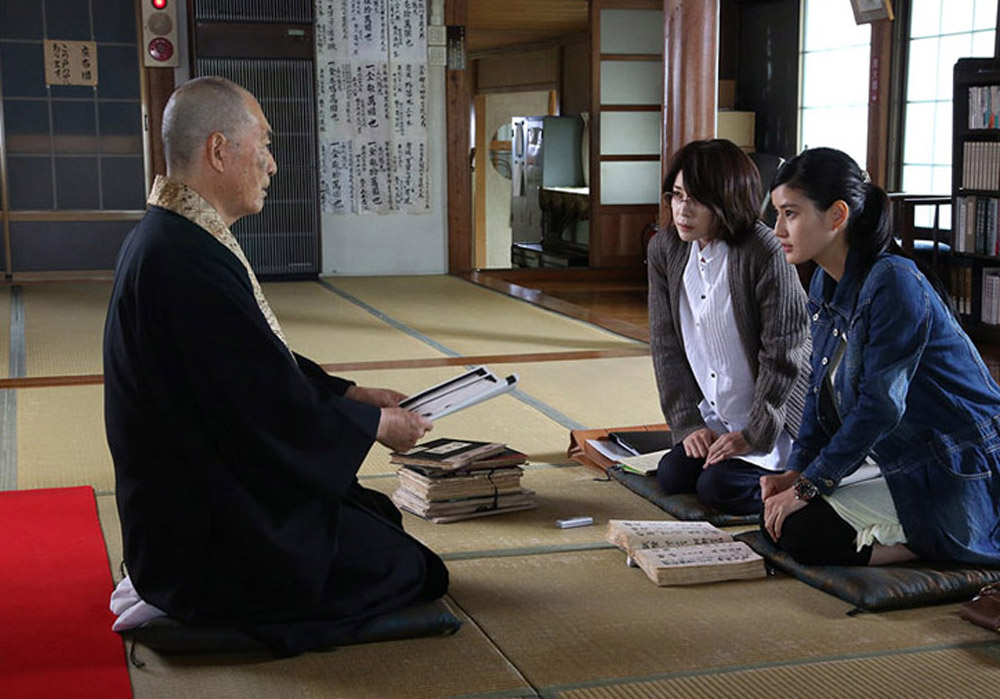
A writer (Yuko Takeuchi) and a student (Ai Hashimoto) seek information from a Buddhist priest in the Japanese film Inerasable, directed by Yoshihiro Nakamura. Inerasable is being shown at the Fantasia International Film Festival in Montreal.

A novelist (Yuko Takeuchi) has been writing short horror stories based on suggestions sent in by her readers. She gets a letter from Ms. Kubo (Ai Hashimoto), a student who has heard strange noises coming from her bedroom; swishing noises that sound like someone sweeping the tatami.

The nameless author remembers getting a similar letter a few years ago. . .when she finds it, she discovers that it was from a tenant in the same building. And that woman’s young daughter had acted as if she could see something. . . up near the ceiling. Then Kubo learns that another former resident of the building committed suicide shortly after moving somewhere else. (His landlady has a creepy story about the last time she saw him.)

Kubo and the writer start working together, trying to figure out what drove the man to kill himself. They look at old photos, land records and maps, and talk to old timers in the neighbourhood to learn about previous buildings where Kubo’s apartment block now stands, and the people who lived and sometimes died in them.

They go farther and farther back in time, and travel to other cities, too. They hear stories of apparent madness, fatal accidents, murder, and more suicides, all connected in some way. Restless spirits seem to be everywhere.

At one point, a young man who knows all about the ghost stories, rumours and gossip on Kyushu Island  casually mentions that the locals think just hearing those stories will leave you cursed. Oh, oh! “Ah, a classic ghost story rule!” (or words to that effect) says the writer’s husband, knowingly.

Director Yoshihiro Nakamura also made Fish Story (2009), Golden Slumber (2010) See You Tomorrow, Everyone (2013) and The Snow White Murder Case (2014), which were all shown at previous editions of Fantasia. See Inerasable at the Fantasia international Film Festival on Friday, July 22, 2016, at 5 pm in the Hall Theatre of Concordia University, 1455 de Maisonneuve Blvd. W.

Inerasable

Directed by Yoshihiro Nakamura,  written by Kenichi Suzuki, based on a book by Fuyumi Ono.

Cast: Yuko Takeuchi, Ai Hashimoto, Kentaro Sakaguchi, Kenichi Takito, Kuranosuke Sasaki,  107 minutes, in Japanese with English subtitles.

Fantasia 2016 Review: Psycho Raman

Nawazuddin Siddiqui plays a serial killer in the Indian film Psycho Raman (also known as Raman Raghav 2.0) The fim is being shown at the Fantasia International Film Festival in Montreal.

Psycho Raman (aka Raman Raghav 2.0) is one tense film. Ramanna is a serial killer, and actor Nawazuddin Siddiqui gives a bone-chilling performance in the part. He kills people because he likes to – men, women, children, it doesn’t matter, he doesn’t make any distinctions. The things that he says, and the look in his eyes when he says them, are extremely unsettling.There’s no telling what he might do next. And when he makes circles with his fingers and looks through them, as you would with binoculars. . .all I can say is Eeek! (The pose reminded me of the poster for The Look of Silence, Joshua Oppenheimer’s second documentary about genocide in Indonesia.) Ramanna takes his alias from Raman Raghav, a real-life serial killer in the 1960s.

The character is so disturbing that I felt uneasy watching him, as if my very presence in the theatre was some kind of approval for his (fictional) actions.

We see Ramanna swing a tire iron, and other weapons, but, mercifully, we don’t see them land on his victims. (And that’s just fine with me!) The guy is totally terrifying all the same – a perfect example of less is more.

Raghavan (Vicky Kaushal) is a crooked, violent, doped-up policeman, who got his position via family connections. The guy is so addicted and so callous that he snorts cocaine at the scene of a triple murder. One night, Ramanna sees Raghav kill someone for no reason. He’s convinced that they’re kindred spirits and wants to meet Raghav, maybe even work together? The film switches back and forth between their two worlds.

Ramanna keeps tracks of his victims in a little notebook. There’s no indication that Raghavan does the same, but I couldn’t help but wonder who had the bigger body count.

Like several other films in this year’s Fantasia lineup, Psycho Raman was well received at the Cannes Film Festival.

Psycho Raman (Raman Raghav 2.0), directed by Anurag Kashyap, written by Anurag Kashyap and Vasan Bala.
Cast: Nawazuddin Siddiqui, Vicky Kaushal, Vipin Sharma, Amruta Subhash, Sobhita Dhulipala, Ashok Lokhande, Harssh A. Singh
127 minutes long, in Hindi with English subtitles.

See Psycho Raman on Wednesday, July 20, 2016, at 5 p.m., in the de Seve Theatre of Concordia University, 1400 de Maisonneuve Blvd. W.

Fantasia 2016 Review: The Wailing

Poster for the Korean horror film The Wailing.

“An old stranger appears in a peaceful rural village, but no one knows when or why. As mysterious rumours begin to spread about this man, the villagers drop dead one by one. They grotesquely kill each other for inexplicable reasons. The village is swept by turmoil and the stranger is subjected to suspicion.”
– Synopsis from the press kit for The Wailing.

Dread, murder, unexplainable events, irrational behaviour, gossip, rumours, nightmares, fear of the other, a large, fierce dog, big, black crows and mesmerizing rituals. That’s what you get in Korean horror film The Wailing (aka Goksung, 곡성).

I’ve wanted to see it ever since I read the rave reviews from the Cannes Film Festival. It did not disappoint! (The Cannes critics liked director Na Hong-jin’s earlier films The Chaser and The Yellow Sea, too.)

The Wailing is set in the beautiful, misty mountains of rural Korea, where people still live in old-fashioned homes with tile roofs. It looks like the kind of place where nothing much happens from one decade to the next.

A string of gruesome murders disrupts the tranquility and we watch as policeman Jeon Jong-gu (Kwak Do-won) tries to figure out if and how they could be connected. While a newspaper headline blames the disorienting effects of poisonous wild mushrooms for the first murders, Jong-gu wonders if some kind of virus might be going around? (The presumed perpetrators all had horrible rashes.)

There's a lot of rain in The Wailing; it increases the feeling of dread.
There’s a lot of rain in The Wailing; it increases the feeling of dread.

Then there’s gossip about a strange Japanese man (Jun Kunimura) who lives in the forest. Some people are convinced that he’s evil, and responsible for the deaths, directly or indirectly. Supposedly he’s been seen wandering in the woods, half naked, chomping on dead animals. One woman says he’s a ghost, feeding on the spirits of the living. Any stranger could come under suspicion in an isolated community, but Japan’s earlier occupation of Korea would further complicate the way the locals view this interloper. Whoever or whatever he might be, a visit to his dwelling proves that he’s not just your everyday recluse.

Policeman Jeon Jong-gu is neither the suave, super cop of some films, nor the corrupt, crooked one of others, rather he’s an Everyman type; pudgy, and a bit of a doofus. After he gets a pre-dawn call to investigate the first murder scene he lets his wife and mother-in-law talk him into eating breakfast first – a few minutes more or less won’t make any difference to the dead, right? His boss and the other cops are not impressed when he finally shows up. Slacker!

Jong-gu seems rather indifferent to his wife (then again, this is not a romantic comedy) but he dotes on his cute young daughter, Hyojin (Kim Hwan-hee). Then she develops a rash too, and starts acting so much out of character that possession seems like a real possibility. When Jong-gu looks at her school notebook, it’s full of strange scribblings and scary drawings. (Have you seen The Babadook?) It also looks like it’s been mauled by a creature with long, sharp claws.

A mudang (shaman) is called in. The shaman is played by Hwang Jung-min and he’s great. I’ve seen shamanic rituals in many other Korean films but the ones here are exceptional, especially the second, longer, night-time one. (I read an article online that some people on the film set thought Hwang really was possessed.)

Hwang Jung-min plays a mudang, or shaman in the Korean film The Wailing.

The Wailing is NOT one of those films where the villain confesses everything, or some expert explains it all before the credits roll. If you go with friends you could have some very interesting post-film discussions about what really happened, who was good and who was evil. The Internet is full of contradictory theories, with some people essentially saying “I’m right because I’m Korean!”

If you read those theories, bear in mind that director Na Hong-jin told the Korea Times: “I mulled over the ending and decided I had to leave it open.”

A final note: Sadly, we Montrealers don’t get to see many Korean films outside of film festivals. If you like the sound of The Wailing try to see it at Fantasia because it will be more impressive there, on a big screen, with a great sound system and the famous, enthusisatic Fantasia audience. Furthermore, some scenes take place at night or in murky interiors – you’ll be able to see them much better in the cinema.

The film is 156 minutes long, but doesn’t feel like it.

The Wailing
Goksung
곡성
Director: Na Hong-Jin
Writer: Na Hong-Jin
Cast: Kwak Do-won, Hwang Jung-min, Jun Kunimura, Kim Hwan-hee, Chun Woo-hee
In Korean with English subtitles, 156 minutes long, showing at the Fantasia International Fim Festival Monday, July 18, 2016 at 9:35 p.m., in the hall Theatre, 1455 de Maisonneuve Blvd. W., Montreal.

I saw Guillermo del Toro three times on Friday – thanks Fantasia!

Director Guillermo del Toro with his Cheval Noir Award at the Fantasia International Film Festival in Montreal, Friday, July 15, 2016. The smiling guy behind Del Toro is festival programmer Mitch Davis. (Liz Ferguson photo)

On Friday afternoon, July 15, 2016, director Guillermo del Toro spoke with Fantasia Film Festival programmer Tony Timpone at a press conference where he also took questions from fans who are journalists, film profs, etc. Clearly, they were there because they wanted to hear his stories, not to do a job.

Del Toro is passionate about films, monsters, and his work. He’s really funny, too. (Not exactly news to those who are already his fans!)

Friday evening, Del Toro was given Fantasia’s Cheval Noir Award; then he appeared onscreen in the (excellent) documentary Creature Designers: The Frankenstein Complex, then he returned, again with Timpone, to share more insights and answer more questions.

I’ll post more details about his talks later, but here’s one of the things I particularly liked: Del Toro makes lots of Twitter posts about many kinds of art, but he only makes positive remarks, he doesn’t believe in tearing people or things down. He doesn’t mind criticizing politicians, though. (He tweets as @RealGDT.)

Sounds good to me!

Visit the Fantasia Film Festival web site to learn more about this year’s films and guests.