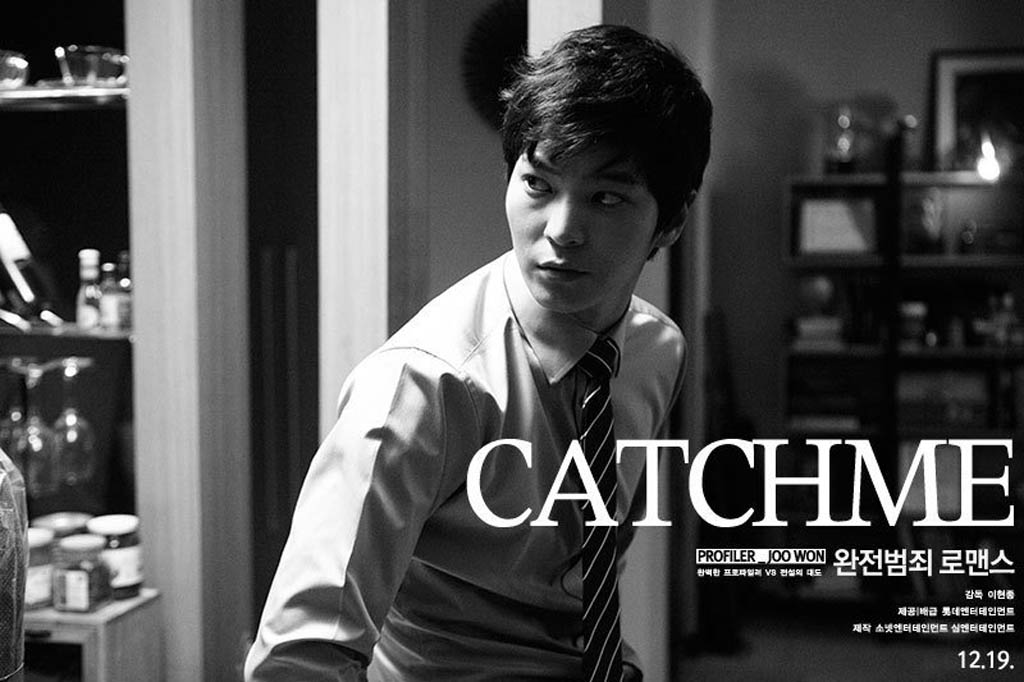
Korean romantic comedy Catch Me (Steal My Heart) puts more emphasis on comedy than romance

Joo Won in the Korean romantic comedy Catch Me (Steal My Heart).

The main characters in Catch Me (Steal My Heart) are Lee Ho-tae, and Yoon Jin-sook.
Lee is a smug police profiler, who sweeps into rooms and immediately starts pontificating. We see snippets of his dramatic lectures, when he tells his fellow cops that crimials are heartless monsters. His boss seems to appreciate him, as do his immediate co-workers, though there’s a rivalry happening with some other cops in the division. Lee is full of himself, for sure, but he isn’t evil, and since he’s played by the incredibly charming Joo Won, how could anyone possibly dislike him? Seriously. I dare you to even try it! (More about Joo Won later.) Those who are already fans might like to know that he sings a bit in this film, too.

Lee and his men have been trying to catch a serial killer for ages. Mere seconds before they move in to arrest him, their suspect is knocked over, not once, but twice (!) in a hit-and-run accident. (He survives, BTW.) Lee is mightily annoyed by this. His professional pride is hurt, and his boss teases him that the accident makes the unknown driver the real hero, instead of Lee, even though vehicular-almost-homicide is usually frowned upon.

Lee vows to find the driver, and his search leads him to the rather fancy home of Yoon Jin-sook. When her beauty-treatment mask falls off, he realizes that she’s the former girlfriend he has not seen in 10 years. Surprisingly, she does not resist arrest; she’s quite willing to go to the police station with him. They get into his car, he starts to drive there. . . but between one thing and another, they do not go to the station, he does not turn her over to his colleagues. (The police HQ looks really familiar to me. I’m wondering it that’s because it appears in many films, or did I possibly walk by it when I was in Seoul?)

Lee gives Yoon Jin-sook (remarkably chaste) shelter in his apartment while he tries to figure out what to do next. (Yoon Jin-sook is played by Kim Ah-joong, who is probably most famous for her role in 200 Pounds Beauty. In that film she plays a talented backup singer who embarks on a severe diet/fitness regimen and has lots and lots of plastic surgery to impress some guy. . .or to prove that he’s a shallow hypocrite. Possibly both? It’s been a few years since I saw it. Kim Ah-joong was also in the TV dramas Punch, Sign and The Accidental Couple.)

Back to the plot: When he returns to work, Lee is asked why he hasn’t brought the driver in yet; he also sees surveillance footage that suggests Yoon Jin-sook has committed other crimes – she is a suspect in a series of big-time art thefts. (Strange that she is so clumsy behind the wheel, in the kitchen and when handling Lee’s expensive action figures – dolls by another name! – yet she can be so light-fingered with precious vases, etc. Well, that’s comedy for you. Nobody slips on any banana peels in this film, though a few scenes come quite close.)

Joo Won, left, and Kim Ah-joong examine "love locks" in the Korean romantic comedy Catch Me (Steal My Heart).
Joo Won, left, and Kim Ah-joong examine “love locks” in the Korean romantic comedy Catch Me (Steal My Heart).

Back at Lee’s apartment, the two get reacquainted, and, through flashbacks, we learn, among other things, how they met, why Yoon did not show up for their 100-days-of-being-a-couple anniversary date (fans of Korean films and K-dramas will understand the importance of the 100-day-anniversary) and why Lee, an art student, decided to become a police officer. Most of these flashbacks are funny. Not all of them, though.

Awww! Are they cute or what? Joo Won, left, and Kim Ah-joong in a flashback scene in the Korean romantic comedy Catch Me (Steal My Heart).

So, a few more words about actor Joo Won. He has lots of fans, all over the world and all over the Internet. He was in many popular TV dramas, including Cantabile Tomorrow, Good Doctor, 7th Grade Civil Servant, Bridal Mask, Ojakgyo Family, and King of Baking, Kim Takgu.

While watching the first few minutes of Catch Me I was reminded of my fave, Kang Dong-won. It’s far from a “separated at birth” situation, and the similarity is easier to see when his face is in motion (especially his eyes) as opposed to frozen in a photo. When I Googled Joo Won I realized that this resemblance was a popular discussion topic, and that I had even read about it before. I just hadn’t remembered Joo Won’s name since I hadn’t seen any of his work yet.

In most of his scenes in the Korean romantic comedy Catch Me (Steal My Heart),  actor Joo Won wears casual clothes or a nice suit, but here he wears the police uniform of his charcacter Lee Ho-tae. I can imagine all his fan girls saying "Oppa! Arrest me now!"
In most of his scenes in the Korean romantic comedy Catch Me (Steal My Heart), actor Joo Won wears casual clothes or a nice suit, but here he wears the police uniform of his charcacter Lee Ho-tae. I can imagine all his fan girls saying “Oppa! Arrest me now!”

https://www.facebook.com/events/374012026140914/
As for the film in general, if you Google Catch Me (Steal My Heart) you can easily find some negative reviews. And I’ll grant you, the plot is pretty feeble (though no worse than many others) but the film is still good for many hearty laughs, especially if you watch it with a group. I saw it at a free public screening, presented by Ciné-Asie, at MAI on Jeanne-Mance St. The audience included males, females, young, old, Asian and non-Asian and everybody there seemed to be having a very good time.

The evening got off to a great start with several wonderful tunes from singer Griot, and guitarist Yellow Beats. While they played together on this occasion, they also have separate musical identities. The songs they played reminded me of the K-indie music I heard in cafés during my South Korean vacation. That was no accident, apparently they worked closely with the Ciné-Asie staff to choose just the right tunes to share with us. Their efforts were rewarded with very enthusisatic applause. I certainly hope to see and hear them again.

While the date has not been chosen yet, Ciné-Asie will probably show the very popular South Korean historical costume drama The Face Reader in August. Song Kang-ho (송강호) plays the face reader of the title, Kim Nae-kyeong, a man who can “read” a face the way others read a book. He sees through any kind of fakery to a person’s true character (clever, stupid, honest, corrupt, humble or haughty) and, by extrapolation, predict his/her future actions. Because of this talent, Kim finds himself in the middle of dangerous court intrigue.

You might know Song Kang-ho from his work in Snowpiercer, The Attorney, Secret Reunion, The Show Must Go On, The Host, Memories of Murder, Sympathy for Mr. Vengeance, Joint Security Area, The Foul King, Shiri, The Quiet Family. And that’s just a sampling, not his entire output! (Note to self: Write reviews for some of those films. Share links to reviews that I wrote a long time ago for the Montreal Gazette.)

Consider “liking” Ciné Asie’s Montreal Monthly Asian Film Screening (MAFS) Facebook page so you’ll be notified when a date is chosen for The Face Reader. The room has a limited seating capacity, so people will be asked to RSVP via email. (Sadly, the “monthly” part of the page’s name is no longer valid. But we can always hope for a change in the future, right?)
BTW: Ciné-Asie also organizes the AmérAsia Montreal Asian Film Festival (www.amerasiafestival.com), Korean Film Festival in Canada (www.koreanfilm.ca).


See Guy Maddin’s surreal documentary film My Winnipeg, Saturday afternoon at the Cinémathèque Québécoise

Guy Maddin's film My Winnipeg includes a surreal story about racehorses who were trapped in a river when they fled a fire in stable. The horses remained there, frozen in place, until spring arrived. The frozen horses even became a local tourist attraction!
Guy Maddin’s film My Winnipeg includes a weird tale about racehorses who were trapped in a river when they fled a stable fire. The horses remained there, frozen in place, until spring arrived. The frozen horses even became a local tourist attraction!

Montrealers! You can experience the wonderful film My Winnipeg this afternoon, for the first time or as a repeat visit, at the Cinémathèque Québécoise. And I strongly suggest that you do just that!

With My Winnipeg, director Guy Maddin made something that’s both very intriguing and very hard to classify. That’s par for the course with Maddin, though. (The first Maddin film I saw was Tales of the Gimli Hospital. So strange! I did not write about it at the time. Maybe some day.)

My Winnipeg combines elements of history, myth, fantasy, personal memoir and docu-drama. Even with that description, I’m probably leaving many things out, since it’s been a few years since I saw this 2007 film. Watching it was like being a guest in someone else’s fascinating, foggy dream. It was mesmerizing and occasionally hilarious, though Maddins delivery remains deadpan throughout.

Among the things I remember: Maddin talks about insomnia, his childhood home, a large network of secret alleyways that covers the city, without appearing on any maps, the brutally cold winter that saw race horses fleeing a burning barn only to die in the river, where they remained, frozen stiff, until spring came. Walking onto the ice to “visit” the horses became a popular thing to do.

Winnipeg is the capitol of Manitoba; Maddin takes us to the provincial legislature where he talks about Freemasons and examines the alleged symbolism and significance of the building’s architectural elements and the statue of the Golden Boy on the building’s dome.

In scenes set in Maddin’s childhood home (over a beauty parlour) elderly U.S. actress Ann Savage portrays his mother. Many early viewers thought that she WAS his mother. I believe that she won an award or two for her work. (I’ll try to verify that.)

Other things I remember: An old-fashioned looking map (like something from a film or TV show made back in the 1950s) showing Winnipeg as the centre of the world with various lines converging there, a visit with an astronomer, some kind of Nazi parade during World War II (it was part of a civil defence exercise, in case Canada was invaded by Germany).

My Winnipeg is a treat and it’s made by a Canadian, too. What’s not to like?

(Disclaimer: In the interest of speed, I have written this post based entirely on my memory of the film – except for the part about when it will be shown, the address of the Cinémathèque Québecoise, etc. After posting I’ll do some research and modify this post if necessary. And I’ll add some quotes from favourable reviews. I know they won’t be hard to find, because I’ve read them before.)

I’m back, with some review snippets. My Winnipeg has 119 reviews on imdb.com, though sadly, many of the links are broken, including the one to the review written by Al Kratina, my blogleague at the Montreal Gazette’s Cine Files. Tsk! Technology is not always our friend.

Esteemed film critic Roger Ebert liked My Winnipeg a lot. Here are some excerpts from his review: “If you love movies in the very sinews of your imagination, you should experience the work of Guy Maddin. . . If you hear of one opening, seize the day. Or search where obscure films can be found. You will be plunged into the mind of a man who thinks in the images of old silent films, disreputable documentaries, movies that never were, from eras beyond comprehension. His imagination frees the lurid possibilities of the banal. He rewrites history; when that fails, he creates it.”

“(1) Shot for shot, Maddin can be as surprising and delightful as any filmmaker has ever been, and (2) he is an acquired taste, but please, sir, may I have some more?”

Mark Kermode of The Observer says: “Fans of early David Lynch will find a kindred spirit in Maddin’s surreal monochrome vision, while his infatuation with the archaic mechanics of early cinema yields peculiarly modern dividends.”

“The narrative tone is sonorously ‘factual’, yet how much of this alternative history should we believe? . . .Is there really a surreptitious taxi trade serving backroads and alleyways that do not appear on any maps, crisscrossing the city over a maze of hidden rivers through which the true blood of the locals flows?”

Kermode’s final verdict? My Winnipeg is “poignant, truthful and hilarious.”

A.O. Scott of the New York Times says:  “After seeing “My Winnipeg,” Guy Maddin’s odd and touching tribute to his hometown, I was tempted to do some further research.”

But . . .”Fact-checking “My Winnipeg” would be absurd, since the film, which combines archival documentary images with freshly shot, antique-looking passages, is more concerned with lyrical truth than with literal accuracy. And even though I suspect that some of its more outlandish assertions are at least partly grounded in fact, Mr. Maddin is engaged less in historical inquiry than in hallucinatory autobiography, ruminating on the deep and accidental relationship between a specific place and an individual life.”

As “My Winnipeg” conjures it, the bond between city and filmmaker is ambivalent and reciprocal. Much as he may dream of taking that one-way rail journey to somewhere else, Mr. Maddin can no more spurn Winnipeg than it can disown him.”

“. . . unleashing his eye and imagination on the prosaic, sad reality of an ordinary North American town, he proposes an alternative account that is mysterious, heroic and tragic. His Winnipeg is a place where ghosts commingle with regular citizens and may in fact be the true native spirits.”


See My Winnipeg (2007) 35 mm, directed by Guy Maddin, 80 minutes long, in the original English version, on Saturday, June 13, 2015 at 5 p.m., at the Cinémathèque Québécoise, 335 de Maisonneuve Blvd E., (metro Berri-UQAM)

You can watch a trailer for My Winnipeg on the Cinémathèque’s web site. That trailer is not bad, but the excerpt below, about the secret alleys, will give you a better idea of the mood of the film.

Just a warning about the Cinémathèque’s web site – the page for “Today at the Cinémathèque'” says that the 5 p.m. film is La nuit du rêveur. What? A change in schedule? I feared that I had written this post for nothing. But no, La nuit du rêveur is the French name of the film. This version does not have French subtitles, though. This screenings is part of a series called Les nuits du cinéma, which runs until June 20, 2015.

Tickets at the Cinémathèque Québécoise are $10 for adults, $9 for students and seniors. Admission is FREE for those 16 years old and younger. How great is that?


See legendary adventure film The Thief of Bagdad, with live musicians, Saturday night!

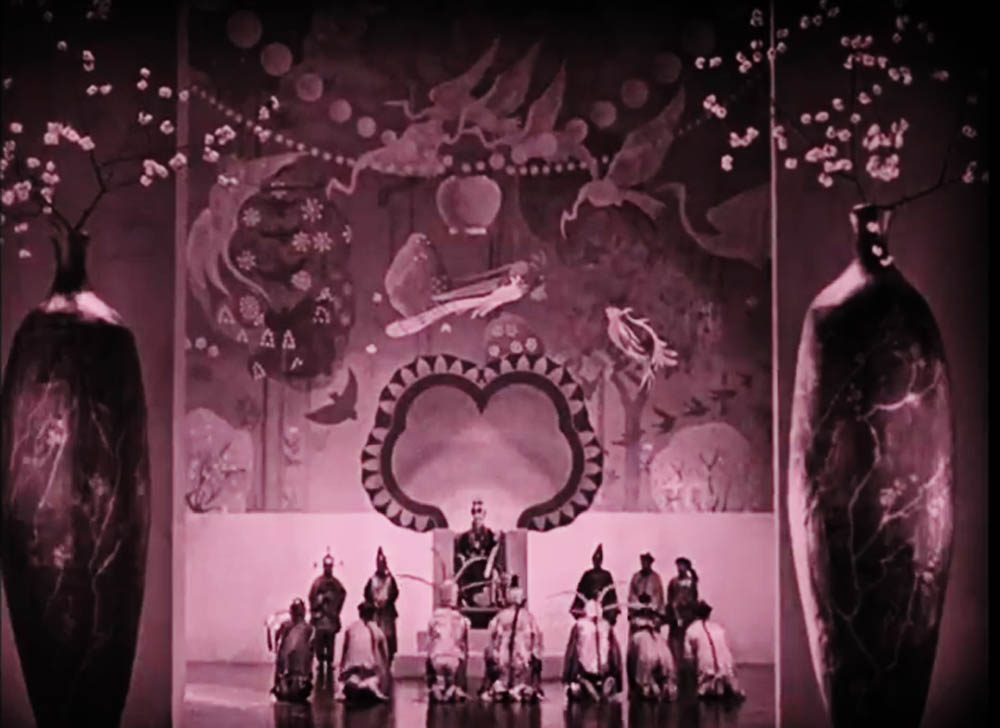
This Thief of Bagdad image is from the Facebook page created by Le CinŽclub de MontrŽal / The Film Society.

Douglas Fairbanks! His name, along with Errol Flynn’s, was once synonymous with swashbuckling adventure and derring do, and for some people, it still is.

See what the fuss was about when Le Cinéclub de Montréal / The Film Society presents The Thief of Bagdad on Saturday, May 30, 2015.

The Thief of Bagdad, which was made in 1924, is a silent film, but that just means that you won’t hear the actors speak. The evening itself will not be silent, far from it. Guillaume Martineau (piano) Joannie Labelle (percussion) and Jean-Sebastien Leblanc (clarinet) will provide lively musical accompaniment. (That’s one more person than the Cinémathèque Québécoise had on hand when it showed the film in 2013.)

The sets of The Thief of Bagdad are elaborate and luxurious.

The Thief of Bagdad appears on the “must-see” lists of many critics. The fairy-tale adventure was directed by Raoul Walsh and features sumptuous costumes by Mitchell Leisen, large, lavish sets by William Cameron Menzies, and genies, giant jars, magic baskets, flying carpets and other special effects, along with the proverbial “cast of thousands.” The $2-million budget was quite extraordinary for the time.

"Ah ha! Treasure!" Douglas Fairbanks as the thief, in The Thief of Bagdad, a silent film from 1924.
“Ah ha! Treasure!” Douglas Fairbanks as the thief, in The Thief of Bagdad, a silent film from 1924.


Douglas Fairbanks plays Ahmed, the thief of the title, who decides to go big and steal a princess, the daughter of the Caliph of Bagdad. But through one thing and another, he ends up in one of those competitions so common in myths, legends and fairy tales where a suitor has to prove his worth by doing, discovering, or defeating, some thing or someone.

Fairbanks is incredibly acrobatic, with lots of leaping, swinging, and climbing; he’s usually smiling, and he’s often shirtless, too. (Fairbanks was also the producer, and one of the screenwriters of The Thief of Bagdad.)

The princess is played by Julanne Johnston, whose name is not well known today. The better known Anna May Wong is listed as the “Mongol slave” of the princess, though she was actually more of a (scantily-clad) spy. In a different era she might have been given bigger and better roles.

Anna May Wong in The Thief of Bagdad.


Here are excerpts from some reviews of The Thief of Bagdad:
Kim Newman, Empire Magazine:  “Grinning impishly, (Fairbanks) has an energetic magnetism that few stars have since managed to recapture, every set-piece designed to showcase his swashbuckling prowess. Silent cinema at its most magical.”

The New York Times: “. . . Fairbanks. . .essentially invented the American action star, with his combination of easy athleticism, can-do optimism and self-deprecating humour. By the time of “The Thief of Bagdad” he had moved from modern dress to costume roles (“The Mark of Zorro,” “Robin Hood”) and into the particular timelessness of the superstar, standing at the centre of his own universe. . . ”
“The film’s extraordinary production design — located somewhere between the swoony Art Nouveau curves of Aubrey Beardsley and the robust literary illustrations of N. C. Wyeth — is the first major work of William Cameron Menzies, a brilliant jack-of-all-trades who would leave his mark on movies from “Gone With the Wind”. . .to the low-budget nightmare “Invaders from Mars.”

“Using a panoply of optical and mechanical effects Fairbanks leads the viewer through a range of magical worlds. Most memorably there is an undersea kingdom, where the chandeliers. . . are giant jellyfish composed of Venetian glass.”

From an unsigned review in TV Guide:  “Forty-year-old Douglas Fairbanks was at his peak when he released the film in 1924. Stripped to the waist virtually throughout, Fairbanks displays the physique of a 20-year-old gymnast and the exuberance of a person even younger. His daringly, beautifully florid performance is grounded less in dramatics than in dance. . .and acrobatics. . . Fairbanks’s kinetic performance is saved from pretentious posturing by his enormous likability, effervescence, and predisposition to self-mockery.”
The Thief of Badgad, Saturday, May 30, 2015, at 7:30 p.m. (doors open at 7.)
United Church 4695 de Maisonneuve W. (Vendôme Metro)
Tickets at the door, cash only, are $13, $9 (for students and those 65, and over, with ID).

Or buy your tickets online at lavitrine.com
INFO LINE: 514-738-FILM
The film is approximately two hours long. Coffee, tea, beer, popcorn, and sweet treats will be on sale before the film and at the intermission.

For more information visit the Facebook page for The Thief of Bagdad screening.

Learn more about Le Cinéclub de Montréal / The Film Society on its web page.

Documentary film How to Save the World examines the early days of Greenpeace

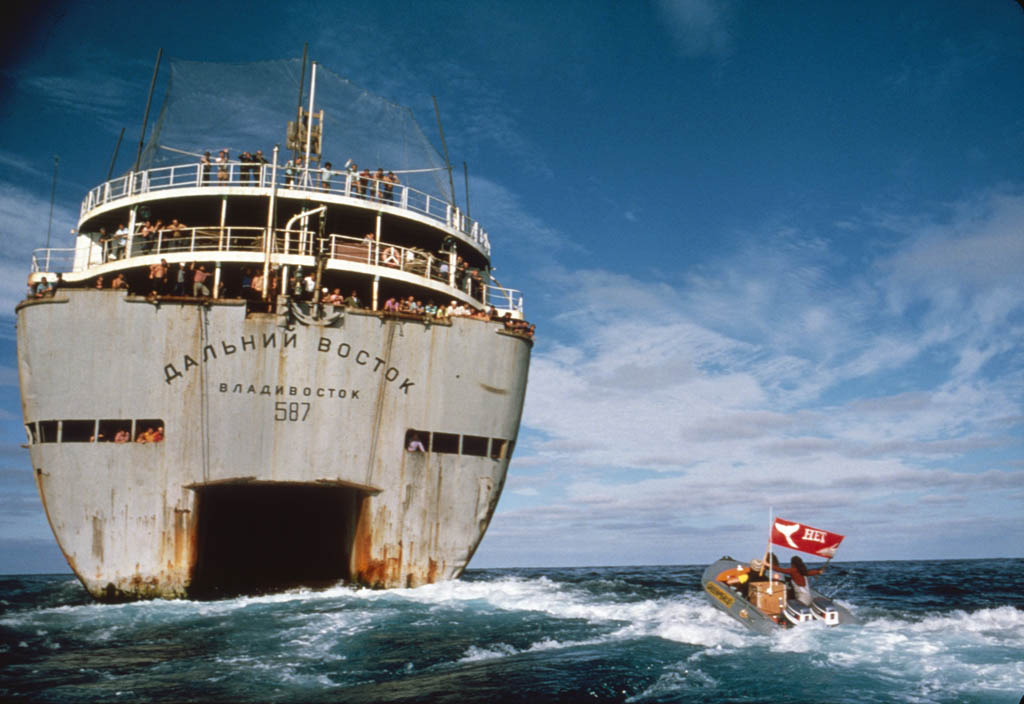
A Russian whaling ship towers over protesting members of Greenpeace.


RIDM, Montreal’s documentary film festival, takes place in November. But outside of that framework, RIDM’s Docville series presents a film at Excentris on the last Thursday of the month.

The selection for May, How To Change the World looks at the early days of Greenpeace. The non-governmental environmental organization now has branches in 41 countries, but it got its start in Vancouver, B.C., back in the 1970s.

Long before Facebook, Twitter, Instagram, smart phones, and widespread access to the World Wide Web, Greenpeace activists were able to galvanize the public against the testing of nuclear weapons, and the killing of whales and baby seals. They famously vowed to place themselves between the harpoons of fishermen and the whales those fishermen were hunting. Look at the trailer below, to see how vulnerable the Greenpeace members were, bobbing on the ocean waves in their small, inflatable boats while huge whaling ships loomed over them.

How To Change the World is a Canada-U.K. co-production, directed by Jerry Rothwell. Rothwell was blessed with access to many hours of original 16 mm footage that had been shot by cinematographer Ron Precious near the beginning of his career. In an interview with IndieWire, Precious says: “We got some great images for sure, like [Greenpeace co-founder] Paul Watson on the back of a dead whale. These are images that become iconic. For me, they’re some of my proudest moments. My entire career in film, nothing tops that. What gave me the most satisfaction was the days doing that work with Greenpeace.”

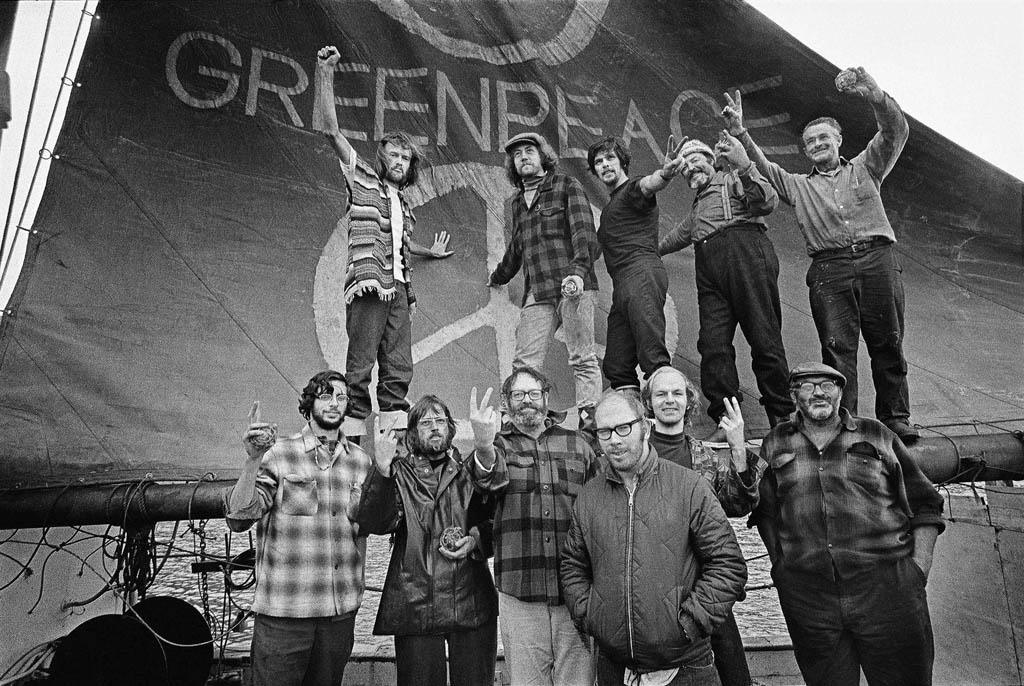
Canadian hippie journalists, photographers, musicians, scientists, and U.S. draft dodgers were among the people who created Greenpeace.

In his Director’s Notes, Rothwell writes: “The group had a prescient understanding of the power of media, knowing that capturing the perfect image was the most powerful weapon of all. But their footage richly evokes not only the dramatic actions they undertook, but their friendships and conflicts, dilemmas and decisions – a sometimes crazy mix of psychedelia and politics, science and theatre.”

In addition to dealing with dramatic public actions by Greenpeace, the film goes behind the scenes to document the internal workings of the group and disagreements and power struggles between three of the founders Paul Watson, Patrick Moore and Bob Hunter.

The film’s soundtrack includes music from Leonard Cohen, Joni Mitchell, Pink Floyd, Canned Heat and Country Joe and the Fish.

How To Change the World had its premiere at the Sundance Film Festival, and has been shown at many other festivals since then, including Toronto’s Hot Docs Film Festival, DOXA in Vancouver, theTrue/False Film Fest in Columbia, Mo., and the EcoFilm Festival in Portland, Ore. Future screenings will take place in San Francisco, Sheffield, England, Sydney and Canberra, Australia, Sao Paulo, Brazil, and Oakville, Ontario.

Embed from Getty Images

Will Jackson, left, Bous De Jong, Bobbi Hunter, Al Morrow, director Jerry Rothwell, John Murray, Rex Wyler and Emily Hunter at How To Change The World premiere at the 2015 Sundance Film Festival on January 22, 2015 in Park City, Utah. (Photo by Robin Marchant/Getty Images for Sundance)


HOW TO CHANGE THE WORLD
Directed by Jerry Rothwell. Canada/United Kingdom. 2015. 112 min. In the original English.
Thursday, May 28, 8 p.m., Cinéma Excentris, 3536 St Laurent Blvd.

Tickets can be bought online.

For more information, visit the How to Change the World Facebook page, or the How to Change the World web site.

Docville honours Albert Maysles and celebrates spring with colourful and exuberant Iris

iris apfel

RIDM, Montreal’s documentary film festival, takes place in November, but festival organizers keep film fans supplied with documentaries throughout the year via the monthly Docville program.

The presentation for Thursday, April 30, 2015, is Iris, a portrait of 93-year-old New York style icon Iris Apfel. It was the second-to-last film made by director Albert Maysles who died on March 5, 2015 at age 88.

You might have seen Iris Apfel in the documentaries Bill Cunningham, New York (2010), directed by Richard Press, or Bury My Ashes at Bergdorf’s (2013) by Matthew Miele. Both films were shown here in Montreal at Cinema du Parc.

The documentary Iris is a portrait of fashion legend Iris Apfel, directed by Albert Maysles.

Once seen, Apfel is not easily forgotten. She likes to wear several large necklaces at once, and covers her arms in chunky bracelets. As a look at the trailer below will show you, she isn’t one of those people who wears black all the time. More power to her, I say! The world is full of colour, so why not enjoy it as much as possible and as long as possible?
Many critics have praised the film and the obvious rapport that existed between Maysles and Apfel. (Certainly, they had time to get to know one another – Apfel told Vogue magazine that the film was shot “on and off for four years.”)

Manohla Dargis of the New York Times says: “There are few better ways right now to spend 80 movie minutes than to see Iris, a delightful eye-opener about life, love, statement eyeglasses, bracelets the size of tricycle tires and the art of making the grandest of entrances. . . this is a documentary about a very different kind of woman who holds your imagination from the moment she appears. You can’t take your eyes off Iris Apfel (she wouldn’t have it any other way), but, then, why would you want to?”

Stephanie Zacharek of the Village Voice says: “like all good documentaries, Iris is about much more than what we see on the surface, no matter how dazzling that surface may be. . . Iris is more than just a movie about an amusing lady who likes clothes an awful lot. It’s also a celebration of the revivifying power of creativity. . .Maysles’s camera opens its eyes wide to Apfel, taking the measure of her wildly beautiful and witty outfits as if it can hardly believe what it sees. There’s delight here in Maysles’s way of seeing. . .It’s also very quietly moving, considering that it’s not about growing old, but about already being there.”

Richard Brody of the New Yorker says: “The warm relationship between Apfel and Maysles comes through from the start, as she playfully shows off some of her treasures and addresses him on-camera throughout. Maysles endearingly reveals Apfel’s blend of blind passion and keen practicality, her unflagging enthusiasm for transmitting her knowledge to young people, and her synoptic view of fashion as living history.”

Iris, directed by Albert Maysles, United States, 2014, 83 min., in the original English.
Thursday, April 30, 8 p.m., at Cinéma Excentris, 3536 St. Laurent Blvd.
Single screenings cost $12 ($10 for students and seniors).

Tickets can be bought online. Doing so might be a good idea, since the Facebook page for Iris already indicates that 261 people intend to go. The Salle Cassavetes only holds 271 people and more than 1,000 (!) have been invited.
(If you can’t make it to Thursday’s screening, Iris will open at Cinéma du Parc on May 29, 2015.)

Animation film festival wraps up with three films about heroes

Teacher Ralph Whims us ready to defend his students from an invading motorcycle gang, in the short film, The Chaperone.

The closing event of the 2015 Montreal Animated Film Festival is all about heroism.
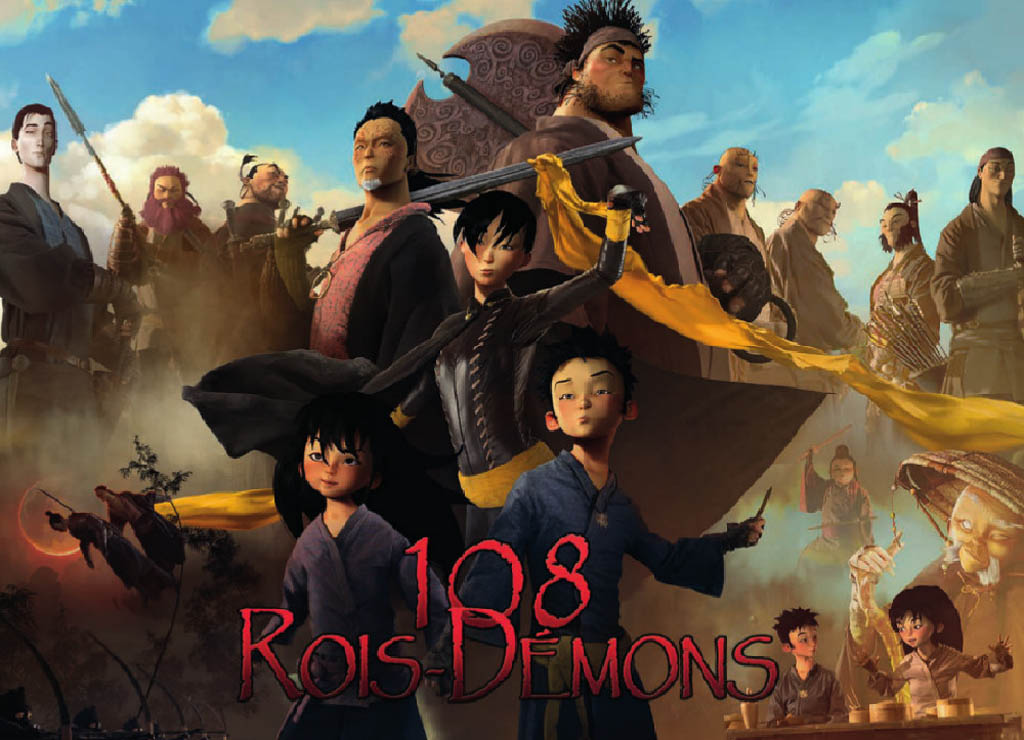
The feature film is 108 Demon Kings. That film takes elements from the Chinese classic novel Shuihui Zhuan (known in English as The Water Margin, Outlaws of the Marsh, or All Men Are Brothers) which is based on 12th century events and first published around 1368, and adds a young prince to make it even more appealing to a young audience. (Though, what with good guys and bad guys, demons, monsters, battles, etc., it ought tobe pretty appealing already!)

Image from the animated film 108 Demon Kings.

The The Water Margin is sometimes compared to Robin Hood to give Westerners an idea of the flavour.

The last minute addition of two shorts emphasizes the heroic theme. They are both Canadian and one is local, too!

High school dance, circa 1972, in The Chaperone.

The local one, The Chaperone, is based on a memorable event that took place at Rosemount High School, in east end Montreal, back in the 1970s (though I don’t think the school is named in the film.) One teacher and one DJ are the only adults at a high school dance. (In a recent radio interview, one of the filmmakers said that these days there’d be 10 teachers and eight parents or something like that.)

Anyway, scary-looking members of a motorcycle gang crash the dance. Oh, oh! Teacher Ralph Whims tells DJ Stefan to lock the doors and then proceeds to teach the bikers a lesson, so to speak, using chairs, fists, feet, etc. Just like in the movies! But it really happened! The film uses thousands of crayon drawings, puppets, stop-motion animation scenes showing the outside of the school, passing traffic, and the eventual arrival of police cars, shreds of paper from the explosions of dozens of pinatas, an hilarious live-action segment inspired by B-movies, AND a cheesy (in a good way) soundtrack inspired by blaxploitation films. There are some 3D parts, too. In other words, a bit of everything. It’s truly quite amazing. I watched it at home without the benefit of the 3D aspect, I’m sure it will be even more mind-blowing on the big screen. The film is made by Fraser Munden and Neil Rathbone. Fraser Munden knew the story well, because his father had been one of Ralph Whims’s students.Here’s a link to an article in Spectacular Optical about The Chaperone.


mynarski crop

Mynarski

The other Canadian short is Mynarski Death Plummet. It’s about Andrew Mynarski of Winnipeg, a gunner with the Royal Canadian Air Force in World War II. On June 12, 1944 his plane was badly damaged by gunfire and everyone was ordered to don their parachutes and jump from the burning plane. But Mynarski struggled through the flames to try to free tail gunner Pat Brophy, who was trapped at the back of the plane. This film blends live action and animation and ends with a fantastic creation unlike anything else I have ever seen before. The film contains 21,000 hand-painted 35 mm frames!

Here’s a quote from Greg Klymkiw’s Film Corner:

“This is such a great film. I could have watched all seven minutes of it if they’d somehow been elongated to a Dreyer-like pace and spread out over 90 minutes. That said, it’s perfect as it is. The fact that you don’t want it to end is a testament to director Matthew Rankin one of the young torchbearers (along with Astron-6) of the prairie post-modernist movement which hatched out of Winnipeg via the brilliantly demented minds of John Paizs and Guy Maddin. Blending gorgeously arcane techniques from old Hollywood, ancient government propaganda films with dollops of staggeringly, heart-achingly beautiful animation – bursting with colour and blended with superbly art-directed and costumed live action. . .”

108 Demon Kings, The Chaperone, and Mynarski Death Plummet are part of the Closing Ceremony and Awards Presentation of 2015 Montreal Animated Film Festival.
The event begins at 7 p.m., Sunday April 19, 2015 in H-110 of the Hall Building of Concordia University, 1455 de Maisonneuve W.
Visit the website lemiaff.com for prices and more information.

Montreal International Animated Film Festival – lots to see in four days

108 Demon Kings is based on the classic Chinese novel The Water Margin.

Montreal has dozens of film festivals, but it seems that there’s always room to squeeze in another one.

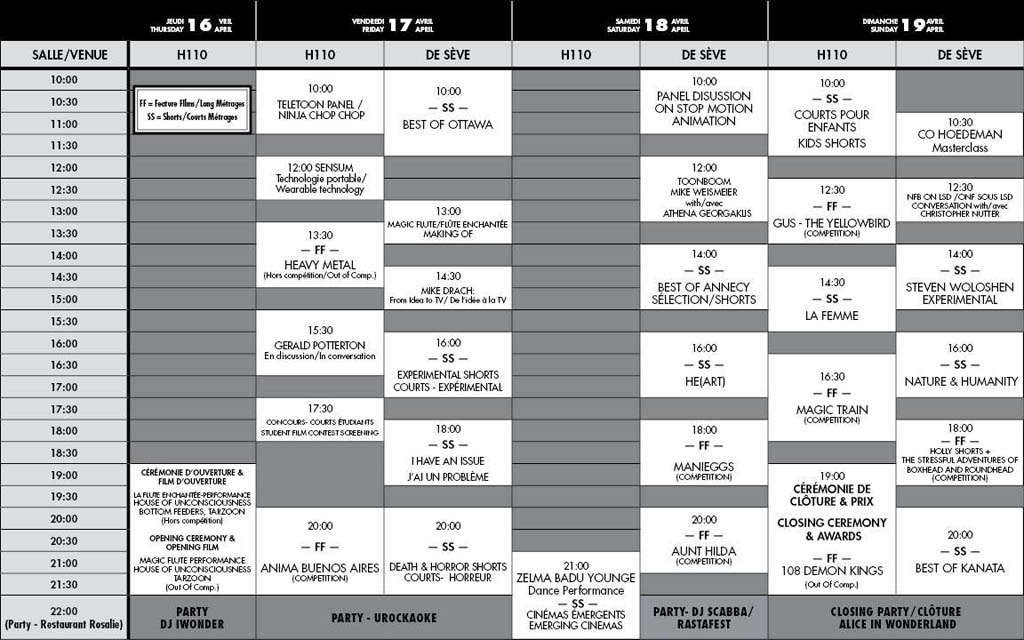
The Montreal International Animation Film Festival starts tonight, Thursday, April 16 and will run until Sunday, April 19, 2015. The festival will include animated features, shorts, panel discussions, a masterclass, a market AND time for partying.

The screenings and discussions will take place at the downtown campus of Concordia University; the partying will be at Restaurant Rosalie, a short walk away at 1232 de la Montagne.

The films come from Australia, Brazil, Bulgaria, Canada, China, Colombia, France, Germany, Hungary, India, Iran, Israel, Japan, Luxembourg, Poland, Portugal, Romania, Singapore, Slovenia, South Africa, South Korea, Switzerland, Taiwan, Turkey and the U.S.

Local animators taking part include Gerald Potterton, Co Hoedeman and Steven Woloshen.
The opening night film is described this way on the MIAFF web site: “The Land of the Magic Flute is a captivating browser-experience produced by the Interactive Media Foundation in Berlin. . . .sound-artist Philippe Lambert will be performing an intuitive and impressionistic rendition of his soundtrack composition. Playing with elements of Mozart’s original composition recorded by the Vienna Symphonic Orchestra, Lambert creates a soundscape that takes the opera into new spheres.”

Descriptions of some of the other feature films on the program are below.
108 Demon Kings is set in12th century China and based on the classic novel The Water Margin. It’s directed by Pascal Morelli who also directed Corto Maltese, which was a popular selection at the Fantasia Film Festival several years ago.

108 Demon Kings is set in 12th century China and based on the classic novel The Water Margin.

Aunt Hilda! (Tante Hilda!) is the botanist heroine of an ecological fable from France/Luxembourg that has genetically-modified organisms running rampant over the planet.

Giant plants run amok in Aunt Hilda!

Hungarian film Manieggs: Revenge of The Hard Egg is about a guy who’s seeking revenge after spending two weeks in prison for a crime he didn’t commit. All the characters are said to be eggs, though they also remind me of Minions and mini-Lego characters, too. The film looks like bizarre fun, at any rate.

Manieggs: Revenge of The Hard Egg.

According to its trailer, Anima Buenos Aires is “full of art, magic and humour.” Tango music, too.

On Friday afternoon there will be a screening of Gerald Potterton’s Heavy Metal (1981). The six episodes within the film feature an evil green orb, swords and sorcery, sci-fi, stoners, zombies, and giant breasts, with music from Black Sabbath, Blue Oyster Cult, Cheap Trick, Devo, Donald Fagen, DonFelder, Grand Funk Railroad, Journey, Nazareh, Sammy Hagar, and Stevie Nicks, and voice work provided by SCTV guys John Candy, Eugene Levy, Al Flaherty, Harold Ramis, Al Waxman, John Vernon, and former Lovin’ Spoonful member Zal Yanovsky.

There are several short film programs arranged by theme: Death & Horror, Emerging Cinema, ExPeRimEnTal, He(art), I Have an Issue, Offspring Kid Program and La femme.

“Best of Ottawa” has nine shorts “Recommended For Mature Audiences Only” from the Ottawa International Animation Festival, “Best of Annecy”  has eight shorts from the famous festival in France, while “Best of Kanata” is a selection of 12 films by Canadian Aboriginal filmmakers.
Visit the website lemiaff.com for prices and more information.

MIAFF schedule 1024


Cinema Politica Mondays: Discover Grace Lee Boggs, an exceptional American

Philosopher, writer and activist Grace Lee Boggs in her Detroit home.


There aren’t any dull moments in the documentary American Revolutionary: The Evolution of Grace Lee Boggs.

The philosopher, writer and activist Grace Lee Boggs will turn 100 in June, but in this film, which was released in 2013, she still has all her wits about her. Even more impressive, she still talks about revolution and social change, and does so in Detroit, her home since the 1950s. She has so many stories to share and hasn’t given up hope that people can work together to make a better world. She warns against placing too many expectations on political messiahs, though. She suggests that “We are the leaders we are looking for.”

Grace Lee’s father owned a big Chinese restaurant on Broadway in New York. She tells us that this gave her a comfortable home life, but she also reveals that her mother had never gone to school, and that she could not read or write. Grace Lee herself earned a BA from Barnard College and a PhD in philosophy from Bryn Mawr. Despite those qualifications, cracking the job market was not easy. In those days, she says, even department stores would not hire “Orientals.” She got a job at a library at the University of Chicago that paid $10 per week. She lived in a rat-infested basement and came into contact with the black community when she joined the struggle for better housing.

By the 1940s the Depression was over for whites but not for blacks. The U.S. was gearing up for war but the owners of defense plants would not hire black Americans. Activists began planning a July 1 protest march on Washington. An estimated 100,000 people would take part. To keep the march from happening, President Franklin Delano Roosevelt signed Executive Order 8802, banning discrimination in the defense industry. Grace Lee was very impressed by this example of people power in action. As she later told Bill Moyers: “When I saw what a movement could do I said, ‘Boy that’s what I wanna do with my life.’ ”

She went to Detroit because that’s “where the workers were.” She married James (Jimmy) Boggs, who was an auto worker, writer and activist. Until his death in 1993, they worked together in the labour movement and the Black Power movement; they knew Malcolm X and Martin Luther King. Their home was a meeting place for thinkers and organizers.

The film includes the derelict buildings we’re used to seeing in reports on present-day Detroit, along with scenes from the past – the prosperous past and the violent one, too. Some parts of the city look a bit like Montreal, with the same kind of buses we used to have; there’s a dark stone building with arches, kind of like The Bay department store on Ste. Catherine St. And then there’s the snow, Detroit seems to get quite a lot of snow, too.

There’s evidence that Detroit’s downhill spiral began much longer ago than one might think. Back in the 1930s as many as 95,000 people were working in one of the plants belonging to the Ford Motor Co., but by the late 1950s automation was already leading to layoffs.

The soundtrack includes “Run, Charlie, Run” a tune by The Temptations about white flight from the city to the ‘burbs. I count myself as a Motown fan, but I can’t remember ever hearing that one before. I wonder if it’s ever played on any “oldies” radio stations?

Philosopher, writer and activist Grace Lee Boggs, left, and filmmaker Grace Lee.

The film is directed by Grace Lee, who is no relation to Grace Lee Boggs. They have stayed in touch since 2000 when the filmmaker began work on The Grace Lee Project, a film about several Asian-American women who share the same name. (The Village Voice review of The Grace Lee Project says that Grace Lee Boggs is called Grace X by her neighbours.)

To learn more about Grace Lee Boggs, check out this book list; it includes books that she wrote and books that influenced her.

American Revolutionary: The Evolution of Grace Lee Boggs will be presented by Cinema Politica on Monday, April 13, 2015 at 7 p.m. in H 110 of the Hall Building at Concordia University, 1455 de Maisonneuve Blvd. W.
Admission is by voluntary donation.

For more information, visit the Facebook page about the screening.

Cinema Political will show films at various outdoor locations during the summer, but American Revolutionary: The Evolution of Grace Lee Boggs is the last presentation at the Hall Building for the 2014-2015 academic year.


Cinema Politica Mondays: Regarding Susan Sontag


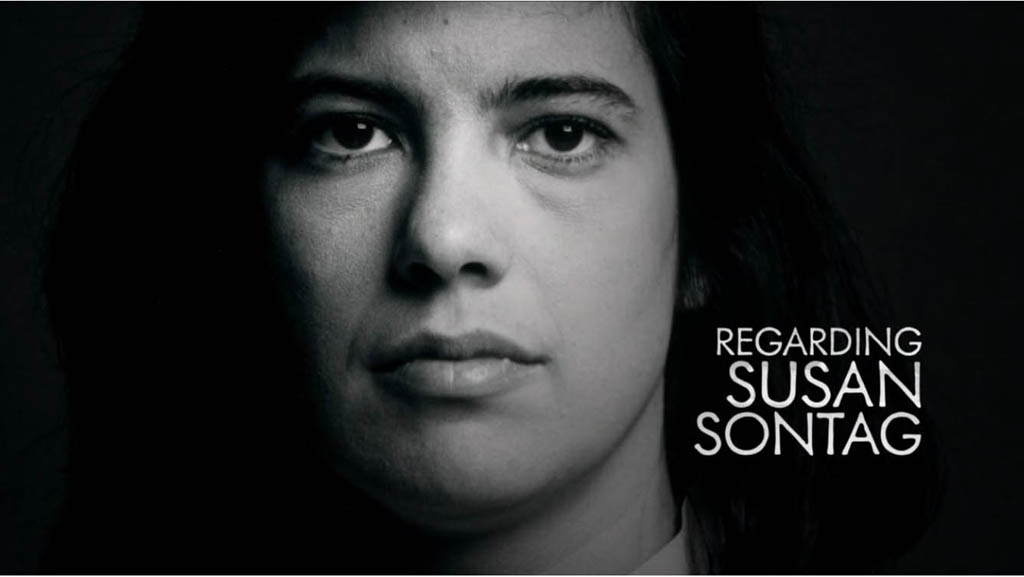
Regarding Susan Sontag, a documentary about the U.S. writer and intellectual, will be shown in Montreal on Monday, March 30, 2015, by Cinema Politica.

We can rely on Cinema Politica to bring us interesting documentaries throughout the school year. Tonight’s selection is Regarding Susan Sontag. Sontag was once one of the more visible intellectuals in the U.S.

I haven’t seen the film, but I certainly want to, based on several very enthusiastic reviews that I found. How often is a documentary film reviewed by newspapers, and Vogue and The Economist? Interesting company!

Nathan Heller in Vogue:   “She saw writing as a personal act that bore global responsibility. ‘I didn’t feel that I was expressing myself,’ she’s quoted as saying in Regarding Susan Sontag. . . ‘I felt that I was taking part in a noble activity.’ ”
In Vancouver’s Georgia Straight, Ken Eisner writes:
“this (film) should be seen by anyone with an interest in language and history.”

He also says that it “looks at how the great essayist (and not-so-great novelist) was viewed before the role of public intellectual became obsolete.”

But, but. . . don’t we still need “public intellectuals?” What do you think? On with info about the film.

Robert Lloyd In The Los Angeles Times: “Sontag’s best writing gives one permission to see things in a new way — or makes it impossible to continue to see them in the old one.” “Among American intellectuals, she was the rare rock star, and though her work stands on its own with allowance made for any writer’s ups and downs, her personal magnetism is very much part of the story; she was a thinking person’s pinup, friendly and formidable, impish and intense, bright-eyed, wide-smiled, with a head of hair that amounted almost to a signature.”

Susan Sontag wrote a lot of books! Regarding Susan Sontag, a documentary about the U.S. writer and intellectual, will be shown in Montreal on Monday, March 30, 2015, by Cinema Politica.

J. Bryan Lowder in Slate:  “Ten years after her death, Sontag’s supreme writerly confidence remains both an inspiration and a terror to would-be critics and public intellectuals, and for good reason—she was the embodiment of a certain school of serious, morally committed, iconoclastic, and often deliciously haughty 20th-century criticism.”  “. . .what this film provides, is an honest introduction to the person—in this case, a person who comprised qualities both deeply admirable and terribly off-putting in equal measure. Watching Regarding Susan Sontag, I felt awash in that person, carried aloft on the waves of her exquisite curiosities and pulled by the undertow of her messy personal life, suspended in the trough between the figure she wanted to be and the human being she was. . . I thoroughly enjoyed Kates’ attempt to do justice to that package—the whole package—sex, uncertainty, hubris, and brilliance, all mixed up together.”

BTW: Lowder’s review reveals that there is such a things as a master’s degree in criticism. Go ahead, call me naive, but I had no idea! Learn something everyday!

More details about this screening and Cinema Politica can be found on the Cinema Politica web site. According to the web site the “screening will be followed by a Skype Q&A with director Nancy Kates. Venue is wheelchair accessible.”

REGARDING SUSAN SONTAG, directed by Nancy Kates, / United States / 2014 / 100 ‘ / in English
Monday, March 30, 7 p.m.
Concordia University
1455 de Maisonneuve Blvd., W., H-110
Montreal

Admission: Pay what you can – $5 to $10 are suggested amounts.

FIFA 2015: See Escape From Moominvalley for beautiful paintings by Tove Jansson

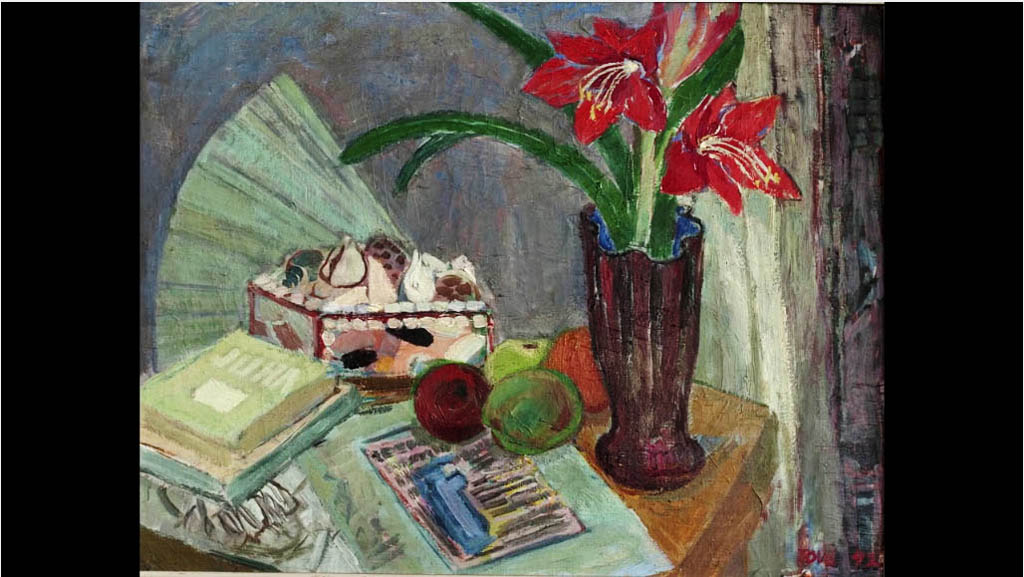
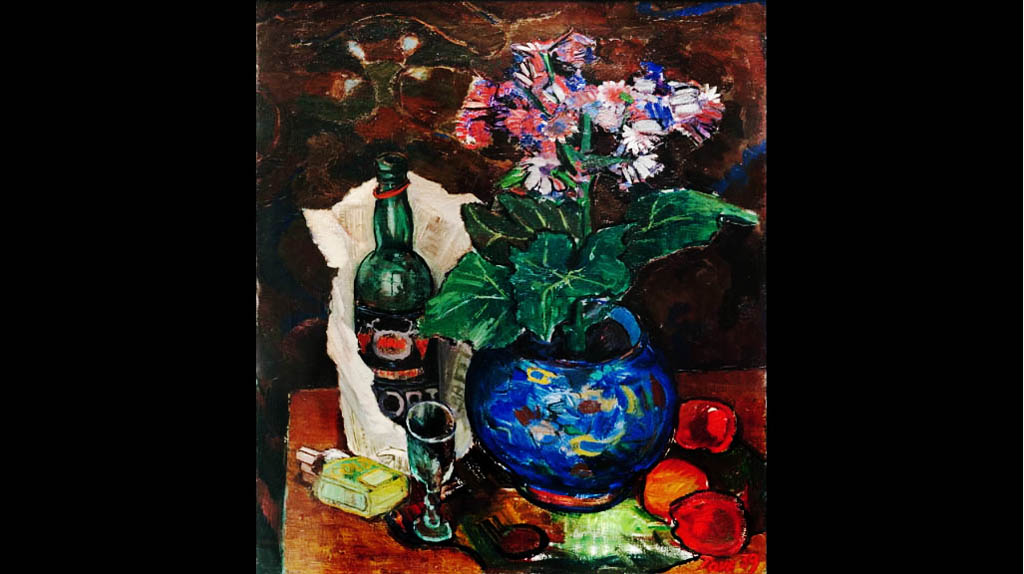
A still life by Tove Jansson, from the documentary film Escape From Moominville.

No need to be a Tove Jansson fan, or to know anything about her to enjoy Escape From Moomin Valley, it’s such a visual pleasure.

Tove Jansson (1914-2001) a member of Finland’s Swedish minority, achieved fame and presumably, fortune, through Moomins, creatures of her own invention who look vaguely like upright hippos. Moomins appeared in children’s books and a long-running comic strip; they are available as figurines, plush toys and printed on assorted bags, mugs, aprons, pencil cases, notebooks, etc. (Local publisher Drawn & Quarterly printed a large volume of her work in 2006.)

Artist and author Tove Jansson as a young adult, from the documentary film Escape From Moominville.

Jansson wrote short stories for adults and plays, as well, but she always considered herself a painter first and foremost. That’s what she wrote on her tax return, according to Escape From Moomin Valley.

Jansson came from an arty family; her father was a sculptor, her mother a graphic artist. She was expected to be an artist and a good one, too.

The film uses lots of photos, sketches, paintings and extracts read from Jansson’s letters and diaries to fill us in on her family life (she often argued with her father) her friends, her art classes and her travels. She studied in Stockholm and Paris, and visited Dresden, Brittany and Florence. Probably many other places, too. She was a forceful character and her art is wonderful to look at. Her studio is quite impressive, too. You might be jealous!

A still life by Tove Jansson, from the documentary film Escape From Moominville.

Jansson speaks briefly in the film and there are many remarks from her brothers, niece, and childhood friends.

Escape From Moominvalley is being shown as part of a double bill with the 55-minute film J.R.R. Tolkien: des mots, des mondes. A review of that is coming up! There’s a connection, too – while I don’t remember it in Escape From Moominvalley, Jansson illustrated a Swedish edition of The Hobbit.

Sunday, March 29, 2015, 1:30 pm, J.A. de Sève Theatre, McConnell Library Building, Concordia University, 1400 de Maisonneuve Blvd. W.

Escape From Moominvalley
Finland, Denmark, Sweden / 2014 / Color / 58 Min / Finnish S.T. English

A still life by Tove Jansson, from the documentary film Escape From Moominville.

Escape From Moominvalley
Realisation: Charlotte Airas
Script: Charlotte Airas, Kimmo Kohtamäki
Cinematography: Timo Peltonen
Sound: Pietari Koskinen
Editing: Kimmo Kohtamäki
Music: Pessi Levanto
Narration: Ylva Ekblad
Participation(s): Sophia Jansson, Per Olof Jansson, Boel Westin, Erik Kruskopf, Boris Konickoff, Tuula Karjalainen
Producer(s): Kaarle Aho
Production: Making Movies
Distribution: Making Movies
The Festival International du Film sur l’Art, known as FIFA, runs until Sunday, March 29, 2015. Visit the web site www.artfifa.com for more information