Caffeine and music! Two of life’s essentials. Leonard Cohen with coffee and a harmonica, in a shot from the 1965 NFB documentary film, Ladies and Gentlemen. . .Mr. Leonard Cohen.
Tonight, Friday, Nov. 18, 2016, at 7 p.m., RIDM, Montreal’s documentary film festival, in association with with the National Film Board of Canada (NFB/ONF), will present a free screening of the 1965 NFB documentary, Ladies and Gentlemen… Mr. Leonard Cohen by Donald Brittain and Don Owen.
In the black-and-white film, a 20-year-old Cohen returns to Montreal “to renew his neurotic affiliations.” The film includes scenes of streets that have probably changed a lot since those days. An email from RIDM says the film is a “casual portrait” of Cohen. “We see him reading his poetry for a rapt audience, alone at home, or socializing with family and friends.”
The film will be shown, free of charge, at RIDM Headquarters (3450, St. Urbain St., near the corner Sherbrooke St.). “A limited number of seats will be available,” (because the rooms are not huge!) The atmosphere will be very special, I’m sure!
Read more about RIDM on the festival’s web site, ridm.qc.ca
Leonard Cohen in his bath tub. Notice the Esquire magazine. Product placement? What’s that on the window ledge? Could it be. . .a transistor radio? Ask an old person.
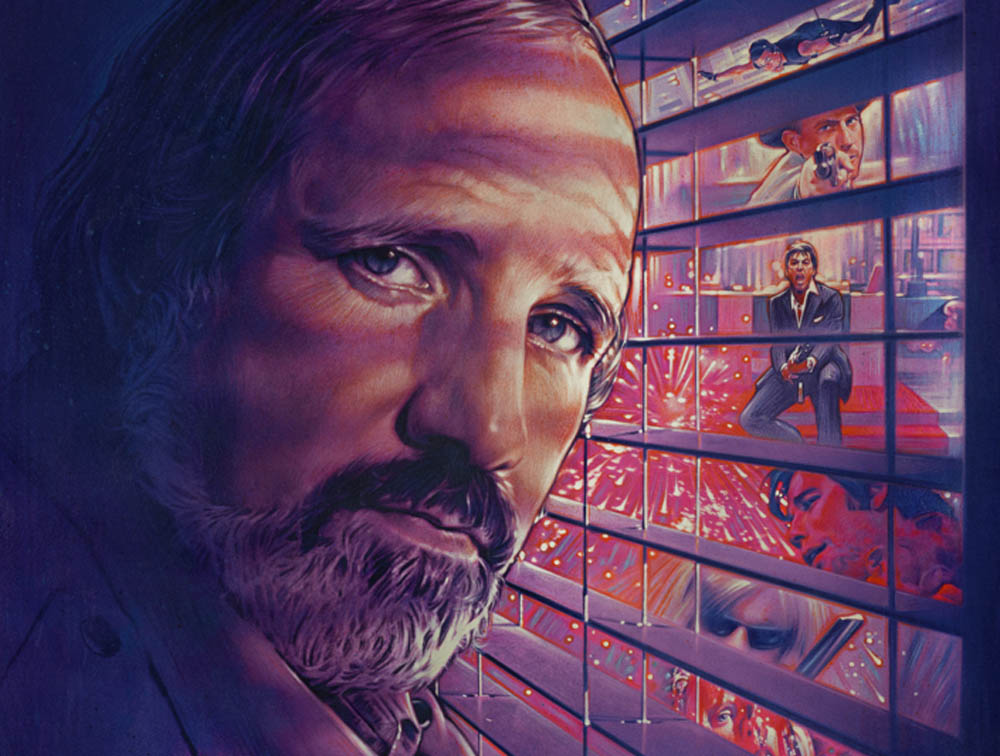
Detail from the poster for the documentary De Palma, directed by Noah Baumbach and Jake Paltrow.
In the documentary film De Palma, U.S. director Brian De Palma, 75, sits in front of a dark fireplace and talks. He’s just brimming with stories. He must have a great memory! De Palma first told those stories to his friends Noah Baumbach and Jake Paltrow over dinner, then he agreed to tell them again in front of a camera. (I had assumed that De Palma was shot at De Palma’s home but apparently not, it was done at Paltrow’s.)
According to a New Yorker story, the footage was shot over one week back in 2010. Baumbach and Paltrow don’t appear onscreen. Neither do actors, film-company execs or film profs. We just get De Palma’s own words and they’re plenty interesting enough.
De Palma shares stories about his family (his dad was a surgeon, so De Palma got used to seeing blood), his academic education (a Quaker school, then physics, math and Russian! at Columbia University) his cinematic education (Hitchcock and French New wave in New York’s cinemas) his films and his filmmaking contemporaries – guys like Martin Scorsese, George Lucas, Francis Ford Coppola, and Steven Spielberg. Laughs abound; Spielberg was the first person De Palma met who had a phone in his car – cue goofy, playful footage from back in the day.
We learn that Orson Welles and Robert De Niro caused De Palma grief when they wouldn’t or couldn’t learn their lines. Apparently, Sissy Spacek worked as a set dresser before De Palma put her in Carrie (1976).
We get clips from De Palma’s well-known films, like Carrie (1976), The Fury (1978), Dressed to Kill (1980), Scarface (1983), Body Double (1984), The Untouchables (1987), Carlito’s Way (1993), and from earlier ones, going as far back as 1962 horror short Woton’s Wake.
(Molly Haskell’s review of Woton’s Wake in the Village Voice made me think of Guy Maddin’s films: “After a brilliant opening-credit sequence in which the unfolding of an illegible “Old English” (or Norse) manuscript is accompanied by a madrigal-like theme announcing the terrors of the monster Woton, the film flies off in all directions, mixing camp, horror, and parody, real locations and expressionistic settings.” That’s Maddin all over, no? I wonder if they have ever met?)
De Palma also includes bits from Murder à la Mod (1968), Greetings (1968) The Wedding Party (1969) and Hi, Mom! (1970). The Wedding Party was Robert De Niro’s first film; Jill Clayburgh was in it, too.
De Palma’s Phantom of the Paradise (1974) was a bigger hit here in Canada than it was in the U.S., and it was extra popular in Winnipeg. He has other Canadian connections, too, though they aren’t mentioned as such in the documentary. Margot Kidder played a “French-Canadian model” in Sisters (1973) and Snake Eyes (1998) was partially shot in Montreal.
In his reluctance to compromise, De Palma has much in common with Guillermo del Toro, who was in Montreal recently to accept an award from the Fantasia International Film Festival. He spoke to fthe public twice while he was here.
Montrealers can watch De Palma at Cinema du Parc, 3575 Ave du Parc.
The film is directed by Noah Baumbach and Jake Paltrow; it’s in English and it’s 107 minutes long.
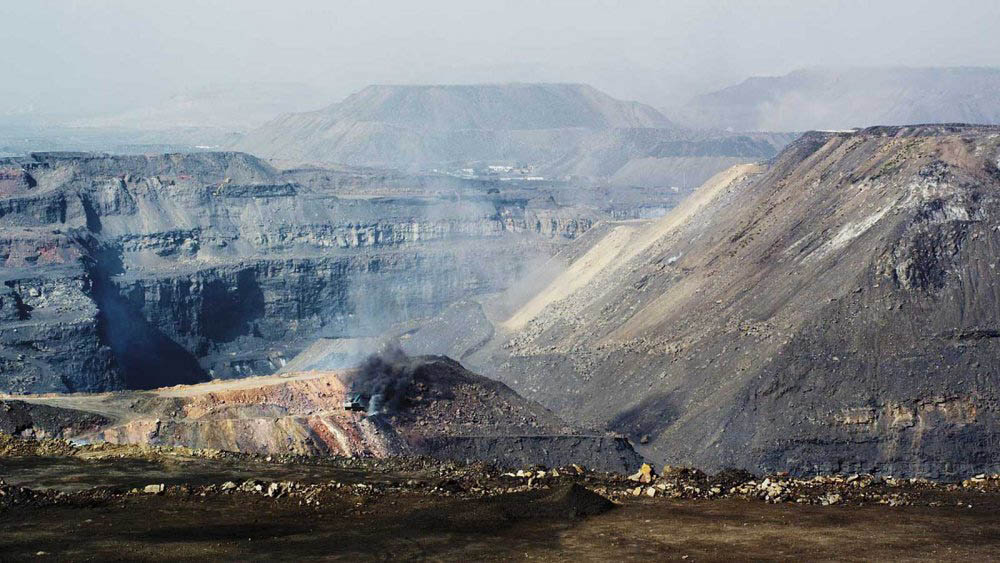
Zhao Liang’s documentary film Behemoth shows how parts of Inner Mongolia have been destroyed by coal mining.
RIDM, Montreal’s documentary film festival, takes place in November, but festival organizers keep the doc spirit alive throughout the year with monthly screenings at Cinema du Parc.
The selection for Thursday, May 26, 2016, is the Chinese film Behemoth, from director Zhao Liang.
Behemoth looks at the human and environmental devastation created by coal mining in Inner Mongolia. The landscape is scarred and ugly, while the men have blackened faces and hands. Imagine what their lungs must look like. We don’t see any chest X-rays in the trailer, but we do see them cough and struggle for breath. We see some hooked up to oxygen tanks, too.
The sooty face of a coal miner in Zhao Liang’s documentary film Behemoth.
That coal powers smoky, noisy, iron foundries and steel plants that glow with red-hot heat like a vision of hell. In fact, Zhao Liang took inspiration from Dante Alighieri’s Divine Comedy, which sees the Florentine poet travel to Hell, Purgatory, and Paradise. Behemoth uses excerpts from the poem in place of dialogue.
Foundry employees work with molten metal in Zhao Liang’s documentary film Behemoth.
I have read more than 10 reviews of Behemoth and they were all extremely enthusiastic. Here are quotes from a few of them.
Variety’s Jay Weissberg says Behemoth is: “stunningly lensed. . .impressively self-shot poetic exercise in controlled righteous outrage. . .”
In the New York Times, Amy Qin writes: “documentary combines with art film to produce a powerful testament to the human and environmental costs of coal mining and consumption in China, the world’s biggest user of coal and the leading emitter of greenhouse gases from coal.”
In Screen Daily,Lee Marshall writes: “Vast swathes of once-pristine Mongolian prairieland have, in the last couple of decades, become scarred and brutalised by open-cast coal mines, iron foundries and generating stations, with thousands of desperate Chinese migrant workers brought in to feed the insatiable demand for disposable, low-paid manpower to keep them operating. That’s the background to Zhao Liang’s remarkable, powerful film Behemoth (Beixi moshuo), a sort of ‘dream documentary’ set in this ravaged landscape but liberally inspired by Dante. Behemoth achieves much of its authority from the way the images comment wordlessly on a world in which humans are reduced to the status of servants of a vast, unfeeling industrial system.”
“. . .But it’s Behemoth’s final sequence, almost devoid of human figures, that is, paradoxically the most shocking. It shows a Mongolian ghost new-town, with its serried ranks of residential skyscrapers. These are all empty, we soon realise – as are the streets that surround them. Empty, that is, except for teams of migrant-worker street sweepers – one of whom chases after a drift of tumbleweed that has entered the shot, and tidies it away. Refreshingly undidactic, Behemoth leaves us to work out that, after hell and purgatory, this empty metropolis, made by the industrial monster that ravages the steppes, and the sweat and blood of those who serve it, is the film’s tragic, ironic heaven.”
Another Screen Daily writer, Wendy Ide, put Behemoth on her list of best films of 2015. She writes: “Behemoth (Beixi Moshuo) makes me forever grateful I write about films for a living and don’t have to pick bits of molten pig iron out of my skin at the end of each working day.”
In a scene from the film Homme de danse, Vincent Warren, right, watches as Arnab Bandyopadhyay demonstrates gestures from Indian classical dance.
Ballet dancer, ballet teacher, dance historian and archivist, Montrealer and Québecois by choice, Vincent Warren is, or has been, all of those things. He’s also a superb raconteur, and many of his stories are hilarious. He shares those stories in Un Homme de danse (A Man of Dance) a film directed by Marie Brodeur. Like many Montrealers, Warren speaks English and French and often switches from one to the other in mid-sentence. He wears a scarf with great panache, too!
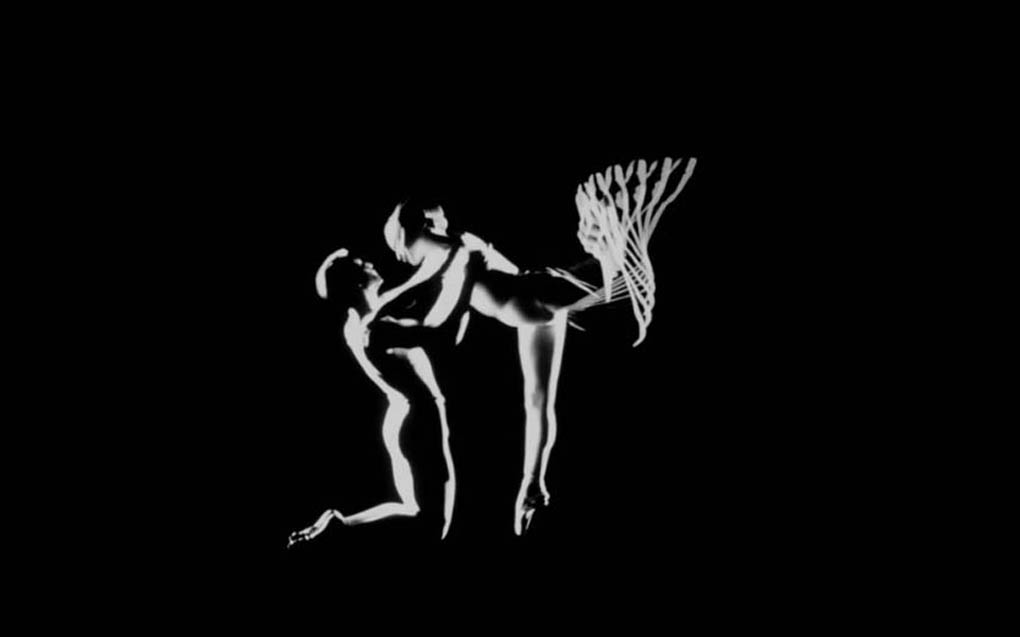
I didn’t know his name before seeing Homme de danse, but I soon realized that I had seen Warren dance many times; he is the male dancer in Pas de deux, an award-winning film that Norman McLaren made for the National Film Board of Canada in 1968. (The ballerina is Margaret Mercier and the choreography is by Ludmilla Chiriaeff.) With its mesmerizing multiple exposures, the film was ground-breaking for its time. If I had a nickel for every time I saw it back in my school days. . .
Vincent Warren and Margaret Mercier dance in Pas de deux, a film that Norman McLaren made for the National Film Board of Canada in 1968.
In yet another claim to fame, Warren danced the title role in the ballet Tommy, which choreographer Fernand Nault created for Les Grands Ballets Canadiens in 1970, using music from the rock opera of the same name by The Who. The work appealed to young audiences and encouraged young men to consider careers in ballet.
Warren was born into a large family in Jacksonville, Florida, a place where boys were expected to play football, as his own older brothers did. But Warren was entranced by dance when he saw the film The Red Shoes at age 11. (Read the Wikipedia entry for The Red Shoes here, reviews of The Red Shoes at the Internet Movie Database.) He read everything he could about ballet, and started a ballet scrapbook, which he still has to this day (take that, all you “toss-it-out” minimalists!) He paid for his first ballet lessons with money he earned as a paper boy, but he didn’t pay for long; male students were so rare, they had to be encouraged. (“Boys were always welcome.”)
A page from Vincent Warren’s ballet scrapbook. He was smitten by dance after he watched the 1948 film The Red Shoes.
After finishing high school Warren headed to New York where he received scholarships to the American Ballet Theater School (Rudolf Nuryev was in his class!) and then to the Metropolitan Opera Ballet School. He was hired by the Metropolitan Opera at a time when Maria Callas and Renata Tebaldi were performing there. Warren was a party animal, hanging out until the early-morning hours with the poet Frank O’Hara and his gang of abstract expressionist painters.
Warren also danced at the Sante Fe Opera Ballet, with an orchestra conducted by Igor Stravinsky. (Warren has a good Stravinsky story – but better you should hear it from him than from me.) In the summer, Warren worked in summer stock, where companies presented a new musical each week and performed as many as eight in one season.
In 1961 Warren joined Les Grands Ballets Canadiens, under the direction of Ludmilla Chiriaeff. He danced with the company until 1979, when he turned 40. He then taught performance and dance history until 1992 at École Supérieure de Danse du Québec, the school connected to Les Grands. The school had a tiny library with little more than 300 books. Warren donated thousands of his own books, magazines and prints to turn it into the best dance library in Canada. It’s now called Bibliothèque de la Danse Vincent-Warren, and it’s open to the public. “We want you to visit,” Warren said at the screening I attended.
Warren is not the only one who gets to tell stories – we also hear from dancers Véronique Landory, Annette av Paul, Anik Bissonnette, choreographers Brian Macdonald, Jeanne Renaud, Paul-André Fortier, Aileen Passloff, and journalist Linde Howe-Beck. Warren’s longtime friend, Peter Boneham, another American dancer and choreographer who made a home in Canada, is a real hoot. The two could probably form a comedy act if they wanted to.
Homme de danse might be a history lesson or a nostalgia fest, depending on the age and interests of the viewer. There’s footage of Place des Arts, so new that it’s still surrounded by rubble, a glimpse of former Montreal Mayor Jean Drapeau, colourful scenes at the World’s Fair, Expo 67, and excerpts from many ballets, too. I was surprised to learn that Radio-Canada used to present live ballet performances two to four times per week.
After living in a second-floor apartment in Mile End for 47 years, “like an old bear in his cave,” Warren decided to move to a ground-floor place. Director Brodeur filmed him as he packed up his possessions; it was a great idea, since so many of those objects sparked memories and stories.
Un Homme de danse (Man of Dance) directed by Marie Brodeur, will be shown as part of FIFA, Festival International du Film sur l’Art, on Sunday, March 20, 2016 at 5 p.m. in the Maxwell Cummings Auditorium of the Montreal Museum of Fine Arts, 1379 Sherbrooke St. W. Vincent Warren will attend the screening.
General admission tickets are $12.50; seniors (65 and older) pay $11; those 25 and younger pay $10; children 12 and younger pay $5.
For more information or to buy tickets online, visit www.artfifa.com
Around the World in 50 Concerts is a film about a world tour by the Royal Concertgebouw Orchestra. The documentary by Heddy Honigmann is the January selection for RIDM+, an offshoot of Montreal’s RIDM film festival.
RIDM, Montreal’s documentary film festival, takes place in November. But, to keep memories of the festival alive, and to give film fans a treat, RIDM+ presents a film on the last Thursday of the month.
January’s selection is Around the World in 50 Concerts. Filmmaker Heddy Honigmann accompanies the musicians of Amsterdam’s Royal Concertgebouw Orchestra on a world tour to celebrate the orchestra’s 125th anniversary. Despite the name, the film does not include excerpts from 50 concerts; most of the scenes were shot in Buenos Aires, Johannesburg and St. Petersburg.
There’s lots of praise for Around the World in 50 Concerts on the Internet. The Hollywood Reporter says it is “accessibly entertaining and suitable for audiences old and young, including those previously immune to classical music’s charms,” and the New York Times takes note of its “ecstatic impressionism, shot through with melancholy.”
On the web site of the New Zealand Film Festival: “It’s impossible to imagine a more appreciative observer of the venture than Honigmann. Her alertness to what drives musicians to dedicate their lives to performing is matched by a subtle understanding of the consolations that music can offer to any of us. And both are rendered all the more potent by her abiding sensitivity to exile, whether it be felt by a young flautist in his hotel room missing a son’s birthday halfway across the world; or by an elderly Russian who finds in Mahler’s Symphony No 8 a conduit to the vanished world of his mother who once heard it conducted by the composer himself.”
In POV Magazine, Marc Glassman says: “Honigmann is a true artist and arguably, the finest Dutch documentary director living today. (Like Canada, Holland has a fine documentary tradition, so that’s quite a statement).”
“Honigmann makes films that honour their subjects but go farther than most docs take us. In Around the World, she starts the film with the orchestra’s percussionist. What’s it like to play for only a minute in a symphony? The musician lights up and launches into a detailed explanation of how one should play the cymbals quite spectacularly—-but briefly—in the second movement of Bruckner’s 7th. The anticipation of the moment and the delight when he rises and adds his spectacular KLANG to the symphony is blissfully human.”
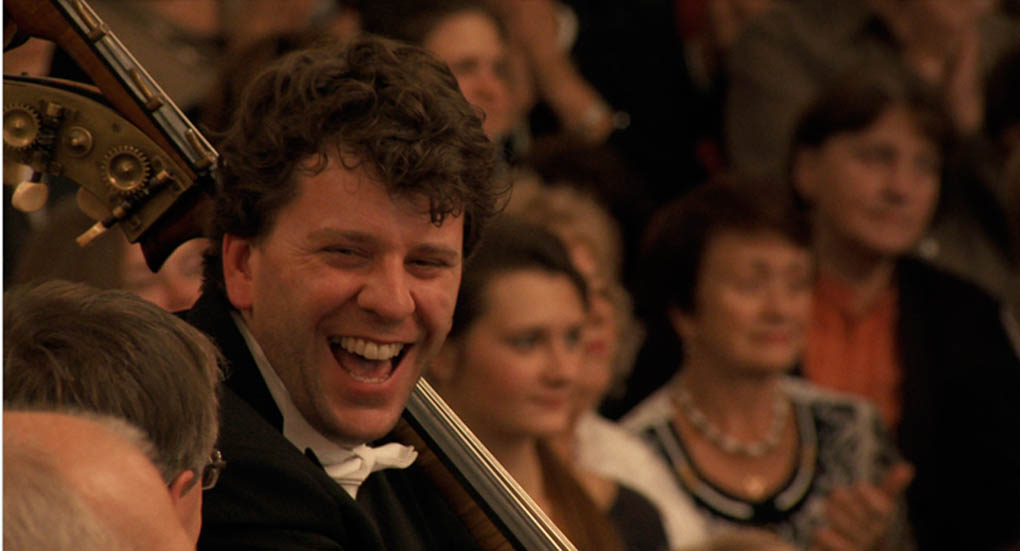
Members of the Royal Concertgebouw Orchestra share laughs in a scene from Around the World in 50 Concerts. The documentary by Heddy Honigmann is the January selection for RIDM+, an offshoot of Montreals RIDM film festival.
Ronnie Scheib of Variety writes: “Honigmann focuses on individual orchestra and audience members without fanfare, allowing them virtuoso riffs but never losing sight of the ensemble. . . Orchestra members, accustomed to her company, seem to spontaneously confide in her, telling her stories. Audience members, interviewed one-on-one in moving vehicles or in their homes, enter more fully into a dialogue with Honigmann, their exchanges very casual and conversational.” Reader Kazuhiro Soda added this enthusiastic comment to the Variety article: “I saw this film at MoMA. It was a masterpiece. It is definitely one of the best movies ever made about music but it’s much more. As always, Heddy showed us the best part of our humanity. She reminds us that there’s something beautiful in this world despite all the violence and miseries. One of the musicians in the film said that art is larger than politics. By watching the film, I truly believed it. Heddy’s approach to documentary is so classical but at the same time very modern and new.”
On his web site The Whole Note, Paul Ennis says: “The power of music to elevate, soothe and communicate is at the core of this moving documentary.” Ennis also gives a rundown of some of the music in the film: “Bruckner’s Seventh, Rachmaninov’s Paganini Variations, Tchaikovsky’s Fifth Symphony and Violin Concerto, Verdi’s Requiem, Mahler’s First, Second and Eighth among others.”
Check out the trailer for Around the World in 50 Concerts below. I noticed that here are lots of smiles in it.
A 15-minute short film, Le Son Du Silence, directed by Maxim Rheault, will be shown before Around the World in 50 Concerts. Laetitia Grou, the producer of Le Son Du Silence, will be there. Le Son Du Silence and Around the World in 50 Concerts, 8 p.m., Thursday, January 28, 2016, at Cinéma du parc, 3575 Ave du Parc.
This screengrab from the Unknown Photographer web site show the videos that can be watched even after the RIDM documentary film festival is over. (Since it is just a screengrab, clicking on the arrows won’t do anything.
Like the Polar Sea 360° project, The Unknown Photographer has one component that you can explore with an Oculus virtual reality headset for the duration of RIDM, and several other parts that you can enjoy at home whenever you choose to do so.
The Unknown Photographer is a co-production between the National Film Board of Canada and Turbulent, with the financial support of Canada Media Fund. It was inspired by a thick album of World War I photos that was found in an abandoned building in Morin Heights. Some accounts say the building was a home, some say it was a barn, but in Looking For Fletcher Wade Moses, a film on the project’s web site, filmmaker Philippe Baylaucq says he found it in a sort of “haunted house” when he was still a teenager. That story is better yet, no? He felt it was a treasure that needed to be saved, so he took it, and eventually gave it to photographer Bertrand Carrière, who made Looking For Fletcher Wade Moses.
The album belonged to Fletcher Wade Moses, but despite lots of research into the man’s life, including talks with his daughter and grandson, Carrière was not able to determine if he had taken the photos or not. While he was interested in Fletcher Wade Moses, he was more interested in the photos and the landscapes they depicted. He was shocked by the devastation, with entire cities reduced to rubble. He realized that most of the photos had been taken in the last years of the war, on the Western Front. He went to France to see what those places looked like years later.
Precisely because it was impossible to identify the photographer (or photographers) the virtual reality part of the project is a work of imagination and conjecture. In fact, the narrator who leads us through the experience is unsure of just who he is or where he is, though he does “remember the war.” (Julian Casey provides the voice of the English version; François Papineau provides the French one.)
This barren battlefield is seen in the virtual-reality component of The Unknown Photographer.
Considering the present date and when the war was (1914-1918) he could well be speaking to us from the hereafter. Participants in the virtual reality experience can choose their trajectory through their head movements and by moving a joystick. They can move through a barren landscape of blackened trees, climbing down into trenches or up hillsides. They can navigate a huge, dark, museum-like space, and drift through photographic cubes that tumble from the sky, a bit like Tetris. A strange figure, upright, with the antlered head of a deer, makes frequent appearances. What is he? Some kind of spirit animal? A shaman? An ancestral memory from our cavemen days?
The parts that can be watched at home include videos about the “Vest Pocket Kodak: The Soldiers’ Camera,” and “Postcards and Letters in Times of War.”
This is the setup for experiencing The Unknown Photographer in the UXdoc Space at the Cinematheque Quebecoise. Does it look like plugging into The Matrix?
The Unknown Photographer, (Le Photographe Inconnu)
Directed by Loïc Suty
Country : Quebec
Year : 2015
Language : English, French
Runtime : 120 Min
Platform : Réalité Virtuelle / Virtual Reality (Oculus Rift)
Production : Marc Beaudet, Benoît Beauséjour, Claire Buffet, Louis-Richard Tremblay
Technical Direction : Osman Zeki
Sound : Martin Fish
Contact (Distribution) Élise Labbé, Office National Du Film Du Canada
e.labbe@onf.ca
Cinémathèque Québécoise – Salle Norman Mclaren (Salle UXdoc), 335 de Maisonneuve Blvd. E. (For the virtual reality part)
(For the virtual reality part)
Visit unknownphotographer.nfb.ca for online components.
RIDM (Rencontres internationales du documentaire de Montréal) runs from Nov. 12-22, 2015. Visit the web site ridm.qc.ca for more information.
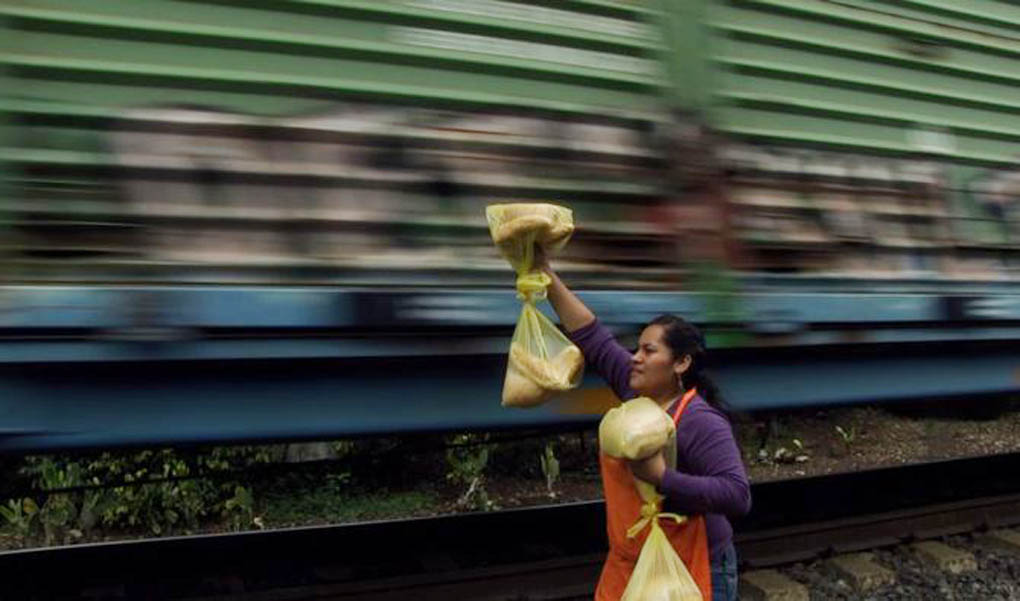
In a scene from the film Llévate mis amores, a member of the group Las Patronas holds bags of food for Central American migrants travelling north on a freight train.
Llévate mis amores (All of Me) is a film about a group of Mexican women known as Las Patronas, after La Patrona, their village in Veracruz state. They’re poor in possessions, but rich in humanity and love. Even though they have very little themselves, they work hard to help people who have even less than they do.
Since 1995 they have been preparing food and water for migrants from Central America who ride freight trains through Mexico into the U.S. The trains are called La Bestia (the Beast), or sometimes, the Train of Death, because people can die if they fall off. The migrants are victims of a bad economy and globalization – there isn’t enough work in their home countries and they can only travel via freight trains because passenger service ended when the Mexican railroads were privatized in the 1990s. A train might have as many as 800 riders, with some inside the boxcars cars, others on the roof or even hanging precariously between the cars. The train is not the only danger on the trip – there are crooked police, thieves, kidnappers, human traffickers and extortionists.
Every day the women cook huge pots of rice and beans and make tortillas over wood fires. They pack the food in plastic bags and fill recycled bottles with water. When they hear the whistle of an approaching train, they rush to the tracks to toss the food and water to the migrants, who hold their hands out eagerly. They never know when the trains will come or how many there might be.
In this scene from the documentary film Llévate mis amores (All of Me), a Central American migrant is able to call her mother, thanks to the helpful women known as Las Patronas.
Some migrants jump off the train for the food, and then they can’t get back on. When that happens, they are driven to the next place that the train stops or slows down. That’s not all that La Patronas do. They have taken injured migrants to hospitals, and on those occasions when doctors or hospitals refused to help, they have nursed them back to health themselves. They lend people cellphones so they can check in with their families.
When the director asks the women to describe themselves the younger ones talk of their hopes for the future (to be a lawyer or a journalist) while the older ones talk about their pasts – one had an abusive husband who was murdered, another had a potential husband who stayed up north too long, yet another was pulled out of school at a young age because someone told her father that the vaccinations given to students would cause sterility. One woman liked to sing and dance; she had wanted to be in a band. Some worked in the fields, others worked as maids; those with children want them to have a better life.
Llévate mis amores (All of Me) is truly inspirational; long before it was over I was wondering what I could do to make the world a better place. It was great to see the screening sell out, too. You can buy tickets online to make sure that you get in. Director Arturo González Villaseñor will be at the screening to answer questions after the film. When asked if the film will be available for rent or purchase he said that it probably will be eventually, but for now it’s still making the rounds of film festivals. Llévate mis amores (All of Me), Sunday, Nov. 22, 2015, 9:15 p.m., Excentris (Salle Cassavetes), 3536 St Laurent Blvd.
RIDM (Rencontres internationales du documentaire de Montréal) runs from Nov. 12-22, 2015. Visit the web site ridm.qc.ca for more information.
A scene from the Mexican documentary Llevate mis amores (All of Me), one of many films being shown at RIDM, Montreal’s documentary film festival.
Before I go to bed tonight, I hope to write proper reviews of these films that I’m suggesting to you, but for now, I’ll just write a short description to get something online as soon as possible.
Click on the underlined name of a film to be taken to the synopsis on the RIDM web site.
Oncle Bernard – L’anti-Leçon d’économie
Words of wisdom from the late economist Bernard Maris. He was one of the people killed at the offices of Charlie Hebdo earlier this year. Oncle Bernard – L’anti-leçon d’économie, Sunday, Nov. 22, 2015, 7 p.m., Excentris (Salle Cassavetes)
The next two films are on at the same time. What a shame, and what a quandary, because I think they’re both wonderful. I’ll go out on a limb and suggest Llévate mis amores(All of Me), directed by Arturo González Villaseñor, as a first choice because there is no guarantee that it will come back to Montreal again, though I truly hope that it does. This is a film about people in Mexico, mostly women, who do a lot to help others, even though they have very little themselves. Every day they prepare food and water for migrants who are making their way north to the U.S. by train. RIDM says it is “A wonderful human adventure,” but that’s really an understatement. It’s inspiring! Seriously.
This film was sold out on Saturday, so if you want to see it, consider buying your tickets online to avoid disappointment. I almost missed it myself. I thought that Saturday’s screening was the second, and last one. I am so glad that it isn’t, so that I can suggest it to you. Director Arturo González Villaseñor will be at the screening to answer questions after the film.
Llévate mis amores (All of Me), Sunday, Nov. 22, 2015, 9:15 p.m., Excentris (Salle Cassavetes)
Another film that starts at 9:15 p.m. is Le Bouton de nacre (El botón de nácar in Spanish, The Pearl Button in English), directed by Patricio Guzmán. It’s quite wonderful too, but given Guzman’s fame, it is more likely to return to Montreal screens. (Guzmán directed Nostalgia For The Light, one of my very favourite documentaries, along with Salvador Allende, The Pinochet Case, The Battle of Chile, and others.)
Le Bouton de nacre is about water, the universe, Chile’s native peoples and the disappeared of the Pinochet years. It is full of beautiful images and sounds and also contains tales of incredible horror. Some of those tales are quite recent, while others are much older. Le Bouton de nacre, Sunday, Nov. 22, 2015, 9:15 p.m., Cinéma du Parc 2
I have seen the three films above, and recommend them wholeheartedly.
In Police Academie (Cop Class) director Mélissa Beaudet follows “three very different cadets during their final year of training.” It sounds interesting, and it has received good reviews, but it starts at 9 p.m., which puts it in conflict with Llévate mis amores (All of Me) and Le Bouton de nacre (El botón de nácar). Police Academie will be shown at Excentris starting on Nov. 27, and it will be on TV (ICI RDI) on Jan. 16, 2016. Police Academie (Cop Class), Sunday, Nov. 22, 2015, 9 p.m., Cinéma Du Parc 1
RIDM (Rencontres internationales du documentaire de Montréal) runs from Nov. 12-22, 2015. Visit the web site ridm.qc.ca for more information.
Screen grab from Polar Sea 360 web site. Clicking on it won’t do anything!
Go to RIDM’s UXdoc Space at Cinémathèque Québécoise, put on the virtual reality headset, and you’ll find yourself immersed in the Arctic – except you won’t need big mitts and an extra warm coat.
You can look right, left, up, down or behind you; there’s always something to see. You might be in a helicopter, on a blue-sky, sunny day, hovering above ice, snow, glaciers and icebergs or somehow outside the ‘copter, looking into it at the pilots. You might be on the deck of a small boat, in the dining room of cruise ship, or riding through a small village on an all-terrain vehicle. On top of all that, you can see the aurora borealis shimmering in the night sky in its mysterious way.
For me, it was a fascinating experience and well worth the trip to the Cinémathèque, which is conveniently located mere steps from the Berri-UQAM metro. But that’s not all, there so much more!
Before and/or after experiencing the Arctic in this way, you can find a wealth of information, from many points of view, at the web site polarsea360.arte.tv There is a video with several chapters, and a “magazine” with 10 episodes; some of these episodes also have short videos embedded in them, as well. During the main video, and many of the video segments, viewers can use the arrow keys on their computer to get a 360-degree view. (The project can be enjoyed on smartphones and tablets, too, but I used a desktop computer. If you have a virtual reality headset at home, you cam use that. too. The web site has links to three companies that sell them.)
Screen grab for the Polar Sea 360 web site shows Arctic ice bergs.
Polar Sea 360° is an international project with participants from Canada, Argentina, Denmark, France, Germany, Greenland, Ireland, Norway, and Switzerland. They include Arctic residents, authors, amateur explorers, biologists, a Canadian Coast Guard officer, filmmakers, geographers, geologists, historians, photographers, a prof in international politics, sailors, sea captains, scientists, singers, and veterinarians.
Climate change, and the way it affects people, wildlife and the landscape, is a major topic of the videos and the texts. The trip offered by the French cruise ship Boréal would not have been possible in past decades, because the ice was thicker then. Increased access to the Arctic means more shipping, exploration for oil and minerals and the habitat destruction and pollution that can come with that.
We also learn about the DEW Line, the Franklin expedition, explorer Roald Amundsen, and Inuit history and culture, including the forced relocation of some Inuit to Resolute Bay to shore up Canada’s arctic sovereignty claims, the abuse at residential schools, the importance of narwhal and seal in the traditional Inuit diet, their hospitality customs, hunting methods, throat singing, traditional place names, historical routes, and the problems of the present day; Nunavut has highest suicide rate in Canada.
A graphic about Arctic sovereignty from Polar Sea 360. The international, interactive project combines information about ecology, geology, history, politics and more.
The waters being navigated in Polar Sea 360° are part of the famous, near mythical, Northwest Passage. Mention of it takes me back to Grade 6 history class. (You, too?) In those days, we didn’t learn much about the negative aspects of exploration and the imperialism that came with it. But we did learn about the Northwest Passage – for centuries, explorers dreamed of it and searched for it – a quicker way from Europe to the riches of Asia. The man (of course, it would be a man!) who found it would be rich, famous, admired, bring glory to his country, etc. It was a big deal then and it has become a big deal once again. Read more about the RIDM presentation of Polar Sea 360° here.
Polar Sea 360°
Country : Canada, Germany
Year : 2014
Language : English, French, German
Runtime : (up to you!)
Platform : Réalité Virtuelle / Virtual Reality (Samsung Gear Vr)
Website : http://polarsea360.arte.tv
Production : Irene Vandertop, Thomas Wallner, Stephanie Weimar
Artistic Direction : Thomas Wallner
Technical Direction : Scott Herman
Sound : Janine White
Contact
(Production)
Thomas Wallner, Deep Inc., thomas@deep-inc.com
Visit the UXdoc Space at Cinémathèque Québécoise, 335 de Maisonneuve Blvd E., from Nov. 12-22, 2015, from 11a.m. to 8p.m., to see Polar Sea 360° and other interactive presentations.
RIDM (Rencontres internationales du documentaire de Montréal) runs from Nov. 12-22, 2015. Visit the web site ridm.qc.ca for more information.
Director Brett Gaylor explains the Do Not Track interactive web documentary at RIDM, Montreal’s documentary film festival.
Director Brett Gaylor explains the interactive web series Do Not Track at RIDM, Montreal’s documentary film festival.
Do you know about Brett Gaylor? He directed Rip! A Remix Manifesto, a documentary about fair use, the concepts of “CopyRight and CopyLeft” and DJ Girl Talk. Maybe I’ll post some links about that later.
These days, Gaylor is the mastermind behind Do Not Track, an educational and international interactive web series about our privacy, or the lack thereof, on the Internet.
The project is a co-production between Canada’s own National Film Board, UPIAN, ARTE, Bayerischer Rundfunk (Bavarian Public Broadcasting), with the participation of Radio-Canada, AJ+ (“the digital-only video news network and community from the Al Jazeera innovation department”), RTS (Radio Télévision Suisse). It has seven supporters, too, including Montreal’s EyeSteel Film. You can see them all here.
There are seven episodes, with most being about 7 minutes long. Some could be longer, depending on the options viewers choose. The subjects are Tracking, Cookies, Social Networks, Mobile, Big Data, Future Bubble and Future of Tracking.
Each episode also has some articles related to the video – what we’d call “sidebars” in the newspaper biz. “How to protect your smartphone” part of Episode 4 of Do Not Track, would probably be of interest to anyone who has one. That same episode includes links to articles in the New York Times, The Intercept, and the Electronic Frontier Foundation. (The EFF has rated so-called “secure messaging” products.
You can watch these videos at home, but if you come to the director’s navigation you can hear the inside scoop on the project, ask Gaylor some questions and possibly volunteer as a guinea pig to discover your Big 5 Personality Traits, according to an algorithm that analyzes your online activity.
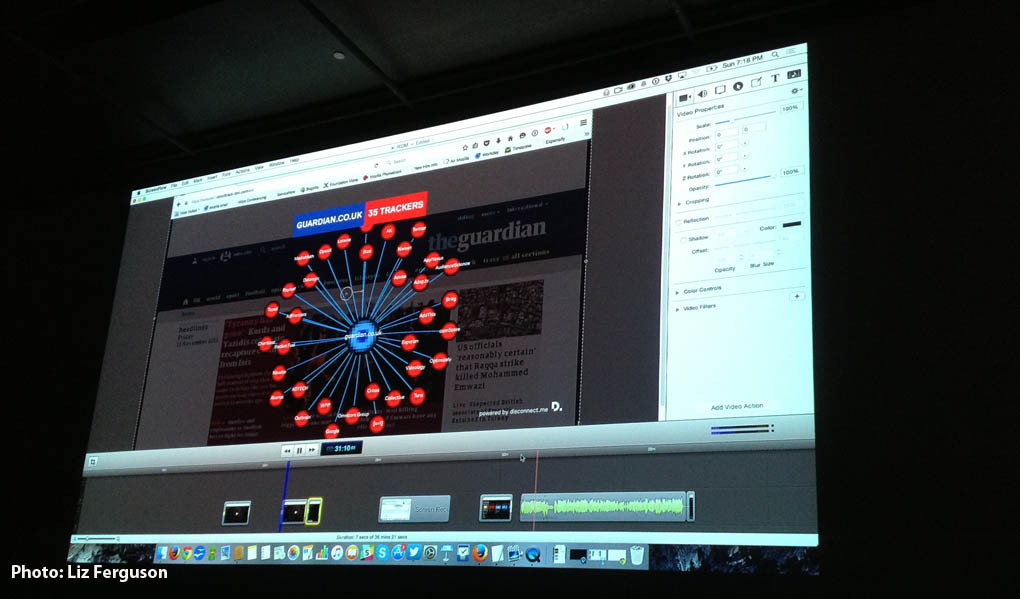
At an assisted navigation of the documentary web series, Do Not Track, director Brett Gaylor showed participants that the web site of The Guardian has 35 trackers.
Gaylor remined us that the Internet isn’t really free, we pay for it with information about ourselves instead of with money. (Gaylor went on the Guardian web page and showed us that it had 35 trackers.) Trackers collect information about our needs and interests to create a profile which they then sell to the highest bidder, who then places ads on our Facebook feed and elsewhere. He said Europe has better legislation about online privacy than the U.S. does, but that technology is moving so fast that legislation can’t keep up.
He raised the possibility that people would be denied loans, mortgages, or insurance coverage based on information gleaned from their online profiles and from the profiles of their friends and families.
Gaylor pointed out that we do get notices about cookies, but our only option is to click “OK,” there isn’t a “NO” button for opting out.
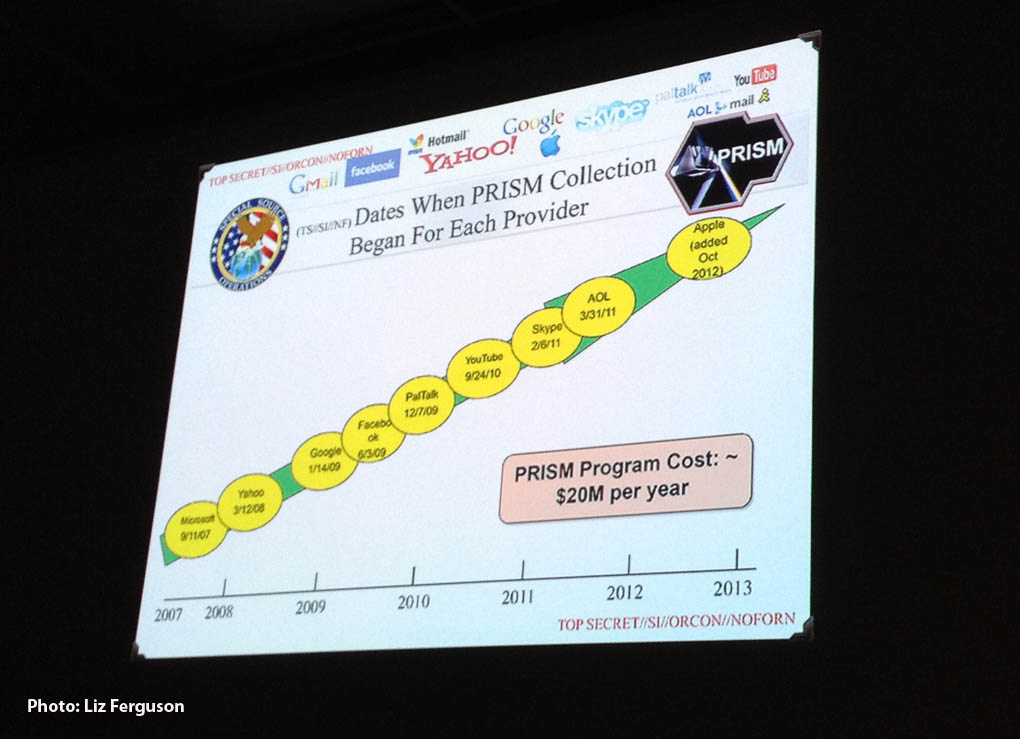
Has the NSA’s surveillance program PRISM been reading your emails? This graphic was part of a presentation about the interactive web documentary Do Not Track. (Photo: Liz Ferguson)
Spying on us isn’t just about selling stuff either, Gaylor presented a graphic about the NSA’s PRISM program, which has been reading email provided by Microsoft since 2007.
He asked people in the audience how much they’d be willing to pay for Facebook and Google if they would be free of ads and cookies. (What about you?)
Some people were willing to pay $10 per year for Facebook and as much as $50 for Google. Gaylor revealed that Facebook earns $9 per year on each Facebook account and Google earns $45 from selling information about each user.
Do Not Track
By Brett Gaylor, with the collaboration of Sandra Rodriguez and Akufen (Big Data episode)
Country : Quebec, Germany, France
Year : 2015
Language : German, English, French
Runtime :120 min
Platform : Webdocumentaire
Website : Http://donottrack-doc.dom
Production : Alexandre Brachet, Margaux Missika, Louis-Richard Tremblay, Gregory Trowbridge
Technical Direction : Nicolas Menet, Maxime Quintard, Avec La Collaboration D’akufen (Épisode Big Data)
Sound : Jason Staczeck
Distribution: Élise Labbé
Office National Du Film Du Canada
e.labbe@onf.ca










 Mostlymovies.ca