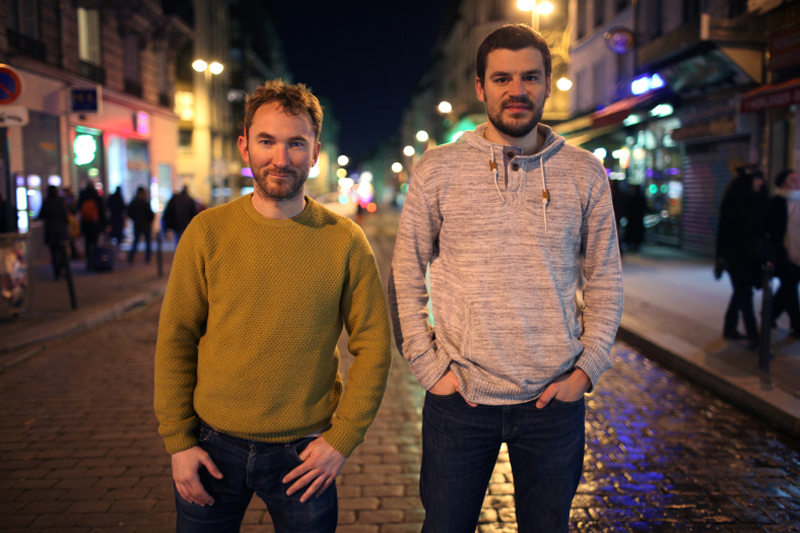
Fantasia 2017 Review: Estonian film November (Rehepapp)

In the Estonian film November (Rehepapp), Liina’s mother is waiting for her daughter in the graveyard.

November (Rehepapp) is a black-and-white film that draws upon Estonian history and folklore. It plays out like a timeless, definitely-not-Disney fairy tale – almost everybody is dressed in rags and has a very dirty face, even though they DO have saunas. As far as we can see, those saunas are used more by the dead than by the living. Every autumn, villagers await their deceased relatives in the local graveyard, then take them home for food, gossip and a sauna. Rumour has it that the dead are somehow transformed into giant chickens while using the sauna.

Even more fantastical than those ideas, for me, was the concept of the kratt – a sometimes cranky, sarcastic creature made from odds and ends (branches, pitchforks, hay) who serves his master by stealing things and doing chores around the farm. A kratt does not come cheaply, though – a person has to sell his soul to the devil to make his kratt come alive. Where does one meet the devil? At the crossroads, in the dead of night, of course.

There’s nothing bucolic about life in the countryside – the peasants face hunger, poverty and the plague. There is conflict between parent and child, Christianity and paganism. Co-operation seems like an unknown concept; greed and selfishness abound. People are willing to betray family, friends, and neighbours for any small advantage. Many hope to get their hands on a legendary cache of hidden silver.
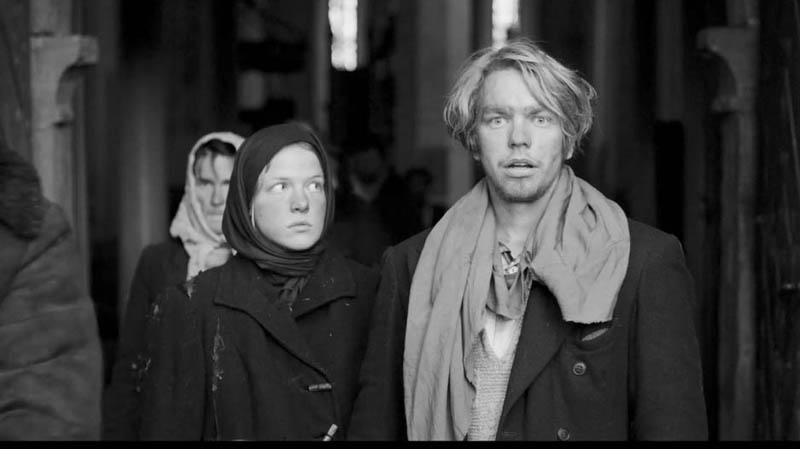
In the Estonian film November (Rehepapp) Liina (Rea Lest) watches in dismay as Hans (Jöšrgen Liik) stares at the baron’s daughter.

Young Liina (Rea Lest) lives with her father, who wants to marry her off to his gross old drinking buddy, Endel. Liina will have none of it; she wants to marry Hans (Jörgen Liik), her friend and contemporary. But Hans is smitten by the sleep-walking daughter of the German baron who rules the area from his imposing manor house. (Unlike the others, the baron and his daughter have clean faces and clean clothes. At home, the baron wears a fancy embroidered coat that makes him look the Liberace of his day. German actor Dieter Laser plays the baron; Imdb.com says he was also in the Human Centipede films.)

The baron (Dieter Laser) and his daughter (Katariina Unt) are among the few clean, well-fed people in November(Rehepapp). Just how tall is that hat, anyway?

Google tells me that Estonia was among the last European countries to be Christianized, and the last to abolish serfdom, as well. Though the characters in the film are nominally Christian, that doesn’t stop them from stealing things from the church, nor does it stop Liina from asking a witch to help her win Hans over. If they are still serfs, that would go far in explaining their miserable circumstances.

I saw November (Rehepapp) at the Fantasia International Film Festival in Montreal. Both screenings were sold out, so I was very lucky to see it at all. Unlike some of the other popular films at the festival, November is not full of laughs, or action, but it’s well worth seeking out.

Oscilloscope Films has the North American distribution rights and will give the film a theatrical release in the fall.  Watch out for it! An article on the Deadline.com web site has a very apt quote from Oscilloscope’s Dan Berger: “November is one of the most unique and stunning films to come along in some time. It’s equal measures beautiful love story and balls-to-wall bonkers-ass folk tale. It keeps you rapt, guessing and intrigued from its first frame to its last.” Yeah, what he said!

Some films are quite entertaining while we’re watching, but once they’re over we move on. After  watching November the first thing I looked up was the kratt – was it the author’s invention or was it part of folklore? Folklore it was! Then I wanted to know about Estonian history, its rulers, serfdom, paganism and Christianity, saunas for the dead, the ravages of the plague, etc., etc. I really like it when that happens, though such exploration delays my reviews a bit.

November’s cinematographer Mart Taniel won the Best Cinematography in an International Narrative Feature award at the 2017 Tribeca Film Festival. I can’t find photos of one of the more stunning images in the film – a lake surrounded by trees with white leaves.

November is based on the novel Rehepapp, by Andrus Kivirähk. There doesn’t seem to be an English translation yet, but it has been translated into French, as Les Groseilles de novembre: Chronique de quelques détraquements dans la contrée des kratts. Another book by Andrus Kivirähk has been translated into French as Homme qui savait la langue des serpents. In English it is called The Man Who Spoke Snakish. Kivirähk’s books are available at Amazon and Indigo; Indigo has German and Spanish translations of the “Snakish” book, as well.
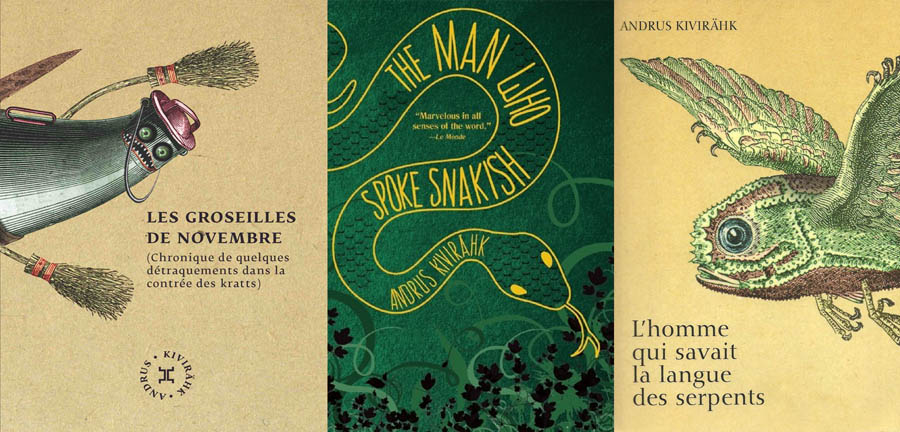
The film November is based on Andrus KivirŠahk’s book Rehepapp. It has been translated into French as Les Groseilles de novembre: Chronique de quelques dŽétraquements dans la contrŽée des kratts. There is no English translation. Another one of his books is available in French and English translations as L’homme qui savait la langue des serpents and The Man Who Spoke Snakish.

November (Rehepapp) is an Estonia, Poland, Netherlands co-production, in Estonian and German, with English subtitles.
Written and directed by Rainer Sarnet
Cast: Rea Lest, Jörgen Liik, Dieter Laser, Katariina Unt, Taavi Eelmaa, Arvo Kukumägi, Heino Kalm, Meelis Rämmeld
Cinematographer: Mart Taniel
Production company: Homeless Bob Production, PRPL, Opus Film
North American distribution by Oscilloscope.

Fantasia 2017 Review: Have A Nice Day

A stupid guy steals one million yuan from his boss in the Chinese animated neo-noir Have a Nice Day.

Have A Nice Day (Hao Ji Le) is a very clever, animated neo-noir film from China. I don’t remember seeing such a thing before. You?

The character Xiao Zhang, on the other hand, is not clever at all. In fact, he’s dumber than the proverbial sack of hammers. As a fan of movies like The Godfather, he ought to know that stealing from your sadistic, criminal boss, is a very bad idea. Mistake No. 2 was taking the bag full of money (100 million yuan = $187,090.52 Canadian) from a fellow employee at knifepoint, so there’s no mystery about who the culprit is.

Maybe he could have gotten away with this for a short time, but the idiot doesn’t even leave town! And he isn’t any good at covering his physical tracks, nor his digital ones.

The crime boss, Uncle Liu, sends his henchman Skinny, who is also a butcher (gulp!) after Xiao Zhang. Of course, once other people hear about the stolen money, they go looking for him, too. He draws attention to himself by using a large bill to pay for a cheap meal. His rudeness towards a guy at an Internet cafe leads the man’s friends to beat up Xiao Zhang and take the bag.

That bag passes through many hands, rooms and vehicles in the course of Have A Nice Day.

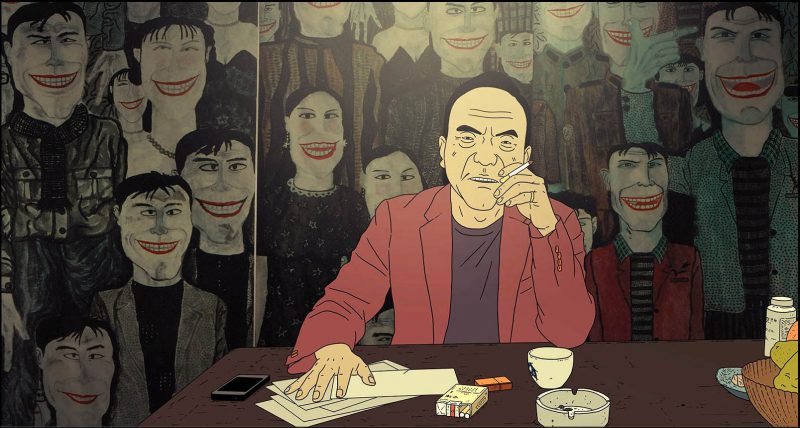
This is Uncle Liu, the baddest bad guy in Chinese animated film Have a Nice Day. Would you mess with this man?

BTW: There’s no question that Uncle Liu is sadistic – early on we see that he’s holding a hostage – a half-naked, bruised and bloodied man who’s tied to a chair. When Uncle Liu tells an embarrassing anecdote about him we realize that they’ve known each other since childhood, though we never do find out exactly why the man is tied to a chair.

In old U.S. films, a guy might do a stupid or dangerous thing (robbery, kidnapping or a boxing match) because a sick mother, brother or sister needs surgery to prevent blindness, replace a failing kidney, etc. But Xiao Zhang has stolen the money because his his fiancée’s plastic surgery did not go well. He wants to take her to South Korea to get the job done right. He must make her happy, so they can marry, have children and make his mother happy. Filial piety is still a thing!

These are just two of the many people chasing after stolen money in the Chinese neo-noir animation Have a Nice Day.

Philosophical remarks about the different levels of freedom, and an animated music video that mocks the iconography of Chairman Mao’s era are among the many things that make Have A Nice Day entertaining. We are so very far from that era now. People dye their hair all sorts of colours, including blue; they wear U.S. T-shirts; they have U.S. film posters on their walls, they struggle to send their children to university in the U.S. or U.K., they talk about Steve Jobs, Bill Gates, Mark Zuckerberg and Brexit. We even hear a few words from Donald Trump on the radio! Some practice Christianity, while others just wear crosses as a fashion statement. I didn’t see anyone riding a bicycle, either!

The Chinese animated film Have a Nice Day contains a music video mocking the iconography from the era of Chairman Mao.

Director Liu Jian also wrote the film and his name appears in several other places in the credits, too. Seems like a multi-talented guy! And I wonder if he jokingly named the villainous crime boss after himself?

Have A Nice Day was shown in competition at the Berlin Film Festival earlier this year. Variety says that Strand Releasing has bought the distribution rights for the U.S. and the company plans to show the film there in the fall.  Memento Films International has sold distribution rights for Have A Nice Day in the U.K., Spain, Benelux, Switzerland, Greece, Turkey and Eastern Europe.

If you get a chance to see Have A Nice Day you really, really should! (Did I mention that the music is great, too? It includes tunes from the Shanghai Restoration Project.)

Meanwhile, lucky Montrealers can see it on Wednesday, July 19, at 3:15 p.m., in Salle J.A. De Sève of Concordia University, 1400 de Maisonneuve Blvd. W., as part of the Fantasia International Film Festival.

Have A Nice Day, China, 2017, 77 minutes long
In Mandarin with English subtitles
Directed by: Liu Jian
Written by: Liu Jian
Voice cast: Zhu Changlong, Yang Siming, Ma Xiaofeng, Zheng Yi, Cao Kai
Company: Memento Films International

Visit the Fantasia web site for more information.

Fantasia 2017 Review: Free and Easy

The Chinese film Free and Easy has two screenings at the Fantasia International Film Festival in Montreal. The film won the World Cinema Dramatic Special Jury Award for Cinematic Vision at the Sundance Film Festival.

Free and Easy is low-key, black comedy that takes place in an unnamed Chinese town in winter. Many of the town’s buildings have fallen down, while others are in an advanced state of disrepair.

There’s some symmetry in Free and Easy: two con men, two policemen, two guys pasting posters on walls. Eventually we see a con woman, too, and a third person pasting posters.

One con man asks people to smell the soap he’s selling. Something in it quickly renders them unconscious. He takes their money, phones and watches while they’re knocked out. Pretty easy as far as it goes, but the pickings can’t be great in such a rundown place. There aren’t many people out and about, either, though it’s not clear if they’re sticking close to home or if the town is more or less abandoned. If there were more people around, surely they’d warn each other about this guy.

The other con man is an alleged monk who offers “free” amulets, but then requests a “donation,” to rebuild his burnt-out temple. If they don’t want an amulet, people can touch him “for luck.” Of course, he wants money for that, too.

When the monk and the soap man walk along some railroad tracks, there are ugly grey hills in the distance, the kind of scenery we see in films by Jia Zhang-ke. Is this place a former mining town?

As for the poster-pasters, one is looking for his mother, who has been missing for years, while the other is looking for a very large tree, which vanished more recently.

The policemen don’t seem to have much to do; they smoke and eat in the station house, even sharing their medications in a weird, comradely way. One of them has plenty of time to make unwelcome visits to a woman who runs a boarding house. Coincidentally, the soap man rents a room from her, and her husband, who’s in charge of a reforestation project, is the man looking for the missing tree. This tree man is a very quiet sort. Slow moving, too. He might be bored out of his. . .tree, exhausted, or suffering from narcolepsy, who knows?

The jokes in Free and Easy are subtle; there aren’t any martial-arts battles, or car chases (hardly any cars at all, actually). There is a troublesome dead body that has to be dealt with, though. Free and Easy won the World Cinema Dramatic Special Jury Award for Cinematic Vision at the Sundance Film Festival. Music in the film is from Chinese band Second Hand Rose. Second Hand Rose has a web site, and a Facebook page. The New Yorker wrote a profile on the group back in 2014.

Free and Easy
China (2016) 99 minutes long, in Mandarin with English (subtitles)
Directed by: Geng Jun
Written by: Liu Bing, Geng Jun, Feng Yuhua
Cast: Xue Baohe, Gu Benbin, Xu Gang, Yuan Liguo, Zhang Xun, Wang Xuxu, Zhang Zhiyong
Company: FilmRise

Free and Easy will be shown on Thursday, July 20, 2017, at 5:30 p.m. in Salle J.A. De Sève of Concordia University, 1400 de Maisonneuve Blvd. W., as part of the Fantasia International Film Festival.

Visit the Fantasia web site for more information.

Fantasia 2017 Review: The Senior Class

Jung-woo and Ju-hee are art students in the animated Korean film The Senior Class. (Lee Joo-seung provides the voice of Jung-wwo and Kang Jin-ah plays Ju-hee.)

When I’m watching a horror movie, I often want to yell: “Don’t go in the basement!” While watching The Senior Class I was pulled into the story enough that I wanted to shout: “Don’t do that; don’t say that; don’t go there!”

The Senior Class is not a horror movie, strictly speaking, though many people behave horribly. It was written by Yeon Sang-ho, who wrote The King of Pigs, The Fake, Seoul Station and Train to Busan, evidence enough that Yeon knows plenty about bad behaviour. (Hong Deok-pyo directed the film, and he came to Fantasia to present it to us and to take questions after the screening.)

The story is set in a class of art students in their final year of university. The students all have anxiety over final projects, the evaluation of their year’s work and a coming exhibition of that work.

The main characters are the quiet, slightly nerdy Jung-woo, his loudmouth, jerky friend Dong-hwa and pretty Ju-hee, who concentrates on her work and is rather quiet herself. Some classmates assume she’s a snob because of that. The female students talk about her behind her back, but they put on friendly faces  when they want to know where she bought her handbag.

Jung-woo has had a crush on Ju-hee for a long time. Maybe it’s more like an obsession. She appears as a delicate, ethereal angel in an online cartoon he works on regularly, while he portrays himself as a scrawny, caring, sensitive merman. (Really!) In many belief systems, angels protect us, but this angel seemingly needs the protection of Jung-woo’s alter-ego. In real life, Jung-woo can barely say hello to Ju-hee.

Jung-woo and Ju-hee get to know each other better when he discovers something about her and she begs him to keep it to himself. He agrees to do that, but can he keep his mouth shut? And since he made this discovery while doing an errand for Dong-hwa, it’s quite possible that Dong-hwa will find out, too. We’ve got some tension, now!

In the animated Korean film The Senior Class, Jung-woo, centre, is quite literally stuck in the middle of a dispute between his jerky friend Dong-hwa, left, and the young woman on the right, who was seduced and then rejected by Dong-hwa.

The Senior Class is distressing to watch, because there is so much meanness and betrayal in it. There’s also some “cutting off your nose to spite your face” behaviour, that makes no sense, logically, but people do act illogically all the time.

Though The Senior Class lacks the physical violence seen in the other films written by Yeon Sang-ho, it is like them in that it exposes a rampant hypocrisy that is hardly unique to Korean society. Gossip is harmful, but hypocrisy is so much worse.

I haven’t included a link to the trailer because I think it gives away too much of the story, but you can find it on the Fantasia web site, if you want to. (Link is below.)

Director Hong Deok-pyo will attend the screening and answer questions after. I’m sorry that I did not ask one myself. A certain character reminded me of Marilyn Monroe. I wonder if that was an intentional thing, or just my imagination? I’ll try to find out before he leaves! (The last time I thought I saw something in a Korean film, it WAS all in my head!

At the Q&A for The Senior Class: Fantasia International Film Festival programmer Rupert Bottenberg, translator Noeul Kang, and director Hong Deok-pyo.

The Senior Class, in Korean with English subtitles, 82 minutes long.
Directed by: Hong Deok-pyo
Written by: Yeon Sang-ho
(Voice) cast: Lee Ju-seung, Kang Jin-ah, Jeong Yeong-gi
Company: Contents Panda

The Senior Class will be shown Monday, July 17, 5:10 pm, Salle J.A. De Sève of Concordia University, 1400 de Maisonneuve Blvd. W., as part of Montreal’s Fantasia International Film Festival, which runs until Aug. 2, 2017.

Visit the Fantasia web site for more information.

Fantasia 2017 Review: Tilt

Joseph Cross plays a filmmaker named Joseph Burns in the film Tilt, directed by Kasra Farahani and shown at the Fantasia International Film Festival in Montreal.

In the U.S. film Tilt we watch a man slowly coming unhinged. Joseph Burns (played by Joseph Cross) is a documentary filmmaker, though he has only completed one film so far. His second film will be about the the Golden Age of America, or rather, the myth of it. It was never really more than fairy tale, or propaganda in the first place, right?

His film is a very low-budget, independent project that he’s making in a shed in his backyard, using clips from newsreels and educational shorts from an earlier era, when average citizens were more innocent, or gullible. Among those films is the (in)famous Duck and Cover. Imagine telling school children to hide under their desks if an atomic bomb is dropped on their school. Joe has been watching that stuff for awhile and maybe it’s taking a toll. He empties many cans and bottles while working, too. I don’t think they are soft drinks.

He’s also been watching TV, where the 2016 presidential campaign is underway, so we can cringe along with Joe (well, I cringed) when Donald Trump, still just an inexplicable candidate, talks about losers, etc. Joe’s wife, Joanne, asks why watch if Trump annoys him so much? (A person could write an essay, or entire book about that, I think!)

Joanne (Alexia Rasmussen) is a nurse who will soon be applying to medical school. She is the voice of sanity and reason in their home. Possibly also the voice of conformity, convention and authority. When she semi-sarcastically says “Not everyone is as smart as you,” he gives her a look cold enough to stop your heart. Then he hits her in the face with the cork while opening a wine bottle. He apologizes profusely for this “accident,” but it’s a disturbing moment.

Alexia Rasmussen as Joanne Burns and Joseph Cross, as Joseph Burns, in the film Tilt. This might be the only time that both characters manage to share a smile.

Joanne is pregnant and Joe does not seem ready for fatherhood at all, though he never says it in so many words. Joanne berates him because he’s not super enthusiastic about the baby’s sonogram photo, the way that her friends are.

Joe can’t sleep at night so he takes long walks around his dark, largely empty Los Angeles neighbourhood. (In a city where they say “no one walks” Joe has given up the expense of a car and a smartphone for the sake of his film.)  There’s a definite feeling of danger, tension and unease during these scenes. Each time he went out, I was expecting something bad to happen to Joe. On the other hand, he looks kinda scary himself, with his face half hidden under a dark hoodie. He looks scarier still when paints his face with black stripes before heading out to observe Halloween/ Dia de Los Muertos festivities.

Dia de Los Muertos (Day of the Dead) festivities in Los Angeles, seen in the film Tilt, shown at the Fantasia International Film Festival in Montreal.

About those names, Joseph and Joanne, both abbreviated to have the same sound: Jo(e). In real life that could be an amusing coincidence. But in a script? The same name might imply too much togetherness or a loss of identity, I don’t know. But when he tells his wife things like “I don’t know if I’m safe, Jo,” he could just as well be talking out loud to himself. And that sentence could be taken two ways. While the more obvious interpretation is that Joe might be in danger, it could mean that Joe himself is dangerous.

Tilt prompts one to wonder, could trying circumstances totally change a person, or do they allow parts that were hidden and controlled to finally break free?

I give Tilt full marks for mood and cinematography. I will gladly watch another film from Kasra Farahani. My only small complaint is, it seemed a bit long. Perhaps it would be stronger still if trimmed by a few minutes.

No wonder it looks good!: The Internet reveals that director and co-writer Kasra Farahani was an art director or concept artist for many Hollywood films. Check out his imdb page, or his resume.

Tilt

Directed by: Kasra Farahani
Written by: Kasra Farahani, Jason O’Leary
Cast: Joseph Cross, Alexia Rasmussen, Jessy Hodges, Kelvin Yu, Jade Sealey, C.S. Lee, Billy Khoury
Company: Bad Guy Good Guy
100 minutes long, in English

Seen at the Fantasia International Film Festival in Montreal, Canada, July 14, 2017

Django review: Go for the music – ignore the plot

Reda Kateb, centre, plays jazz guitarist Django Reinhardt in the film Django, directed by Etienne Comar.

The French film Django presents the life of renowned jazz guitarist Django Reinhardt during the last years of World War II in Occupied France. The music is wonderful, but the plot is disappointing. It features a fictional, generic, femme fatale while all but ignoring Dietrich Schulz-Koehn, a real-life Luftwaffe officer who loved the very music that the Nazis criticized as degenerate. Schulz-Koehn wrote about jazz and even supervised recording sessions under the name Dr. Jazz. More than once he helped Reinhardt and other musicians get out of trouble. Wouldn’t you want to know more about such a conundrum? (Director Stanley Kubrick had hoped to make a film about Schulz-Koehn. The Atlantic wrote an article about that.)

Many German officers attend jazz concerts in Paris, despite that degenerate label. (Signs warn that they’d better not try any dancing, though.) Django (played by Reda Kateb) does not mind playing for Nazis. Music is all he knows and he has to make a living, after all. He also declares “It’s not my war.” On the other hand, he’s in no rush to leave the familiarity of France for an extensive tour of Germany, and the idea of playing for Minister of Propaganda Joseph Goebbels and other bigwigs holds no appeal at all, especially since solos, syncopation, quick tempos and other musical flourishes are strictly controlled, when not banned altogether. (Does that fall under the “banality of evil?”)

Django’s manager reminds Django and his bandmates that saying “No” to the Germans is a very dangerous thing to do. The fictional femme fatale, Louise de Klerk (Cécile de France) points out that travelling into the heart of Nazi darkness would also be dangerous. There’s no happy solution to this problem.

After a certain amount of dithering in Paris, Django and his entourage head for the border in hopes of crossing into neutral Switzerland. It’s a closely watched border, though, so they must wait (and wait and wait) while hoping that members of the Resistance will deign to help them eventually. The film pretty much grinds to a halt at this point. Django plays in local bars to earn some food money, sometimes hiding his face under a hat, sometimes not. It seems extremely foolhardy considering his fame and unique style.

(SPOILER!) In one laughably silly scene Django is being chased by tracking dogs, so he lies down in the snow and sprinkles a few handfuls of the white stuff on top of himself. Somehow, I don’t think that would fool the dogs at all.

As many viewers will already know, Django did indeed survive the war, but as far as I can tell, the film fudges his escape attempt. The implication is that he made it into Switzerland and presumably stayed there until the war was over, but in fact, the Swiss border guards would not let him in.

What I did not know before seeing this film: Django Reinhardt could also play huge honking church organs and compose for them, too.

Things I learned later from Google: Django Reinhardt was touring England with his Quintette du Hot-Club de France when England declared war on Germany on Sept. 3, 1939. Django returned to France immediately, but the Quintette’s violinist, Stéphane Grappelli, stayed in England until the war was over.

In regard to spending the war in France, Django said: “It is better to be frightened in your own country than in another one.”

In France during the war you could trade a Django Reinhardt record for two kg of butter on the black market. Django Reinhardt died May 16, 1953 at the relatively young age of 43.

Django is 115 minutes long

Director: Étienne Comar.

Screenplay: Étienne Comar and Alexis Salatko, based on the novel Folles de Django by Alexis Salatko.

With: Reda Kateb, Cécile de France, Beata Balya, BimBam Merstein, Gabriel Mirété, Vincent Frade, Johnny Montreuil, Raphaël Dever, Patrick Mille, Xavier Beauvois (In French, German, English, Romani dialogue)

Music by the Rosenberg Trio.

In Montreal, Django is playing, with English subtitles, at the Quartier Latin Cinema, 350 rue Emery, H2X 1J1.

Django Reinhardt’s music, as performed by Nomad O Swing, Eclectic Django and Denis Chang, can often by heard at Montreal Jazz Bar Diese Onze, 4115-A, rue St. Denis, H2W 2M7.

Rêveurs Définitifs brings magic and mystery to Just For Laughs Festival

Clones? Doppelgangers?The cast of Rêveurs Définitifs seems increase, thanks to some visual trickery.

So what is this “Magie Nouvelle” (new magic) anyway? Based on my experience at the show Rêveurs Définitifs, now on at Montreal’s Théâtre St. Denis, it can include ethereal songs and dances, in which  dancer  Ingrid Estarque floats above the stage; a flying, ghostly orb; and multiple versions of the performers interacting with each other, thanks to holography, and other mysterious trickery.

Besides all that, there’s still room for more traditional elements, like doves appearing out of clean air, jokes, card tricks, and audience participation.

The songs are performed by local musical hero Patrick Watson, by the way, and pianist Isabelle Mathieu provides live music for many of the acts.

The show was created by Raphaël Navarro for the Théâtre du Pond-Point in Paris. Other performers include Éric Antoine, Étienne Saglio, Yann Frisch.

Don’t freak out if this “creature” flies over your head!

The show is entirely in French and I must confess that I did not catch every last joke during the card-trick section. Perhaps that’s because the performers were talking very quickly, or maybe I’m just a dumb anglo, who knows? The show is mostly a visual spectacle, so an attendee’s language skills (or lack thereof) don’t matter much at all. Even if you don’t speak French, don’t worry, you’ll be fine!

Those who do understand French can read more reviews of Rêveurs Définitifs on the web sites of La Presse, Montreal TV and Le Devoir.

The cast of Rêveurs Définitifs.

Rêveurs Définitifs is part of the Just for Laughs Festival Juste pour rire. There are performances every night at 8 p.m., at Théâtre St. Denis, 1594 St. Denis, until July 15, 2017. There will be a 4 p.m. show on July 15 as well, and three 4 p.m shows on July 20, 21 and 22. You can buy tickets online, or at the theatre.

Théâtre St. Denis is quite close to the Berri-UQAM metro station.

Kedi Review: A warm, lyrical documentary about the street cats of Istanbul

A cat from the documentary film Kedi looks wise and regal.

Kedi is a delightful documentary film about the street cats of Istanbul, Turkey, and their human friends. It’s just lovely. The cats are elegant and endearing, the humans are eloquent and kind. (As you might guess, Kedi is the Turkish word for cat.)

Turkish-American filmmaker Ceyda Torun lived in Istanbul until she was 11 years old. Her fond memories of the city’s cats led her to make Kedi. She shows cats strolling, snoozing, and snacking, cajoing, climbing, and cuddling, playful, preening, and pouncing, watching, waiting and leaping. There are males and females; some with kittens, some are long-haired, others short-haired; they are tabby, calico, marmalade, or black-and-white. The cats make themselves at home on sidewalks, in doorways, at outdoor cafés and markets and down at the wharf. They seem to be everywhere, like the little dishes of food and water that people leave out for them.

Some Istanbul cats hang out at cafes, where the owners and the customers are happy to see them and feed them.

Cats have lived in Istanbul for thousands of years. The theory is that the population was regularly augmented by cats arriving on trading ships; they would leap out for a little rest and relaxation and not did not always find their way back to their home ship before it left the port. Cats lived on ships to keep rats and mice out of the cargo and the food supply; no doubt the sailors appreciated their company, too.

Torun introduces us to seven cats, revealing their personalities, special quirks and exploring their day-to-day routine. We also meet the people who help them and love them. In many cases, this help goes beyond just providing food – one man says that everyone in his neighbourhood has running tabs with at least one veterinarian, often several. Another man regularly carries antibiotic drops for cats with infected eyes. Among those who feed them is a woman who goes above and beyond by cooking 20 pounds of chicken every day!

Sari walks purposefully through the streets of Istanbul, in the documentary film Kedi.


Sari’s kittens are waiting for her. They’re hungry!

People provide shelters for the cats, too. Some are just cardboard boxes, but one impressive structure looked like a townhouse for multiple cats.

Because of silly stereotypes about women and cats, it’s refreshing that so many of the “cat people” in Kedi are men. In particular, a fisherman shares stories about the low points in his life and how a cat helped him to recover.

Cat-loving cartoonist Bulent Ustun makes a brief appearance, though his name only appears on the credits, not onscreen next to his face. The animated film Bad Cat (also known as Bad Cat Serafettin) is based on his graphic novel Kotu Kedi Sarafettin. Bad Cat was shown at Montreal’s Fantasia Film Festival in 2016. Kedi and Bad Cat might make a great double bill, something to think about when Kedi is available for purchase. Bad Cat is definitely not family friendly the way Kedi is, though. You couldn’t call Serafettin a model citizen.

Cinematographers Alp Korfali and Charlie Wupperman do a fine job of keeping up with the cats, whether they’re scampering over rooftops, climbing trees or barrelling down the street. (I read somewhere that some footage was shot with miniature cameras mounted on remote-controlled toy cars.)

Kedi is a bit of a travelogue too, with images of Hagia Sophia, the Blue Mosque, Galata Tower, sunshine on sparkling waves and soaring seagulls worthy of a tourism brochure. Neighbourhoods visited include Cihangir, Kandilli, Karakoy, Nisantasi, and Samatya, since that’s where the profiled cats live.

Kedi will probably boost tourist visits to Istanbul.

In addition to music that Kira Fontana composed for the film, there are tunes from assorted Turkish artists including Mavi Isiklar who were sometimes called the Turkish Beatles. Here’s a link to the film’s tunes at imdb. While I didn’t look for all of them yet, I found some videos on YouTube.

I’d read many positive reviews before seeing Kedi and it totally lived up to expectations. I felt calm, happy and light-hearted after seeing it. You might find it as beneficial as yoga or meditation. I’m tempted to say, you’d have to be a curmudgeon not to like it, but maybe that would be going too far.

If you don’t live with a cat already, Kedi might put you in the mood to get one, or more. You might want to visit Istanbul as well, but consider checking government travel advisories before doing that.

In Montreal, Kedi is playing at Cinéma du Parc with English subtitles and at Cinema Beaubien (2396 Beaubien E. H2G 1N2) with French subtitles. It is 79 minutes long.


Review: Documentary Under The Sun shows that ‘normal, everyday life’ is a foreign concept in North Korea

Zin-mi, right, and her friend smile in Under The Sun. It’s a cute photo, but sadly, it’s one of the few times anyone looks happy in the film. Even here, the girls are probably just pretending.

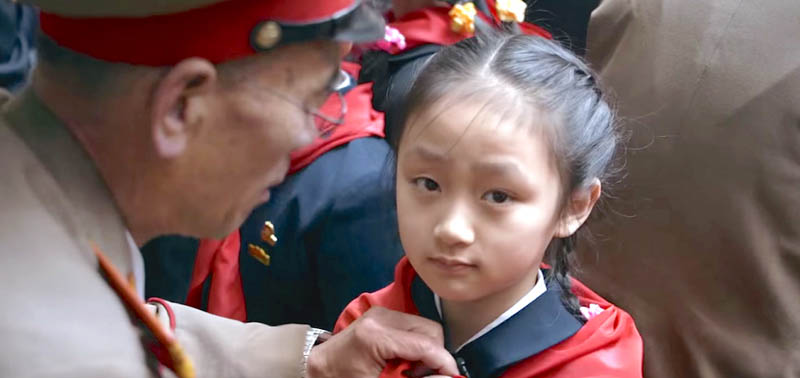
The subversive documentary film Under The Sun takes us to North Korea, where we observe 8-year-old Zin-mi as she eats with her parents in their apartment, attends school, joins the North Korean Children’s Union, and rehearses her part in a pageant that will celebrate “The Day of the Sun,” the birthday of Kim Il Sung, the grandfather of the current ruler, Kim Jong-un. The Day of the Sun (April 15) is the most important holiday of the entire year in North Korea.

We also visit the alleged workplaces of Zin-mi’s parents. (In an early meeting, Zin-mi had told filmmaker Vitaly Mansky that her father was a journalist and her mother worked in a cafeteria, but in the film they are seen as an engineer in a garment factory and a worker at a soy milk plant, respectively. Made me think of “I’m not a doctor, but I play one on TV.” Mom and her co-workers wear white uniforms with red aprons and cute, red rubber boots. This echoes the white shirts and red scarves of the members of the Children’s Union.)

Mansky wanted to make a film about day to day life North Korea, with co-operation from the government. He knew there would be restraints, but he got many more than he had expected. The script was written by the North Korean government. Government minders were always close by, telling people where to walk, what to say, to speak more loudly, to show more animation. “Look at her when she’s talking!” They would make people repeat dialogue over and over to achieve the appropriate level of breathless enthusiasm. Mansky had no freedom in choosing events or locations. He was not allowed to make small talk with any North Koreans in between shooting scenes. He had to show his footage to the government at the end of each day.

You might expect the resulting film to be as exciting as the “Bulgarian tractor epics” of the past. The thing that makes Under The Sun different is that Mansky kept his cameras running all day. He did not wait for the government chaperones to yell “action,” and did not stop filming when they said “cut.” Despite all the supervision, he did not hand over ALL of his footage for scrutiny. I’ve read different explanations for exactly how that worked, but one way or the other, he had secret copies that the authorities probably did not know about until the documentary was released. On the other hand, he made filming two trips to North Korea in 2014, but never received his visa for a planned third trip. So maybe they did have an inkling, after all.

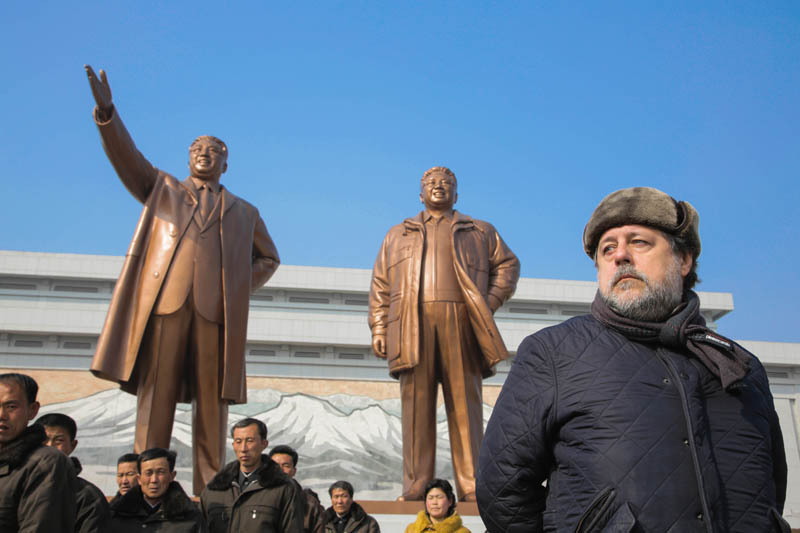
Documentary filmmaker Vitaly Manksy in in Pyongyang, North Korea, in 2014. Mansky is standing in front of one of the many monuments to North Korea’s founder, Kim Il-Sung, and his son, Kim Jong-Il.

A scene of garment workers celebrating their heroic production is exceedingly awkward and unnatural. In the first take, they have surpassed their government quota by 150 per cent. By the next take, the figure has grown to 200 per cent. Seriously, how dumb do they think we are?

Even seemingly ordinary, boring scenes of people crossing a square or boarding a bus were scripted and directed. When films are sold on DVD they often include a behind-the-scenes “Making Of” documentary. Under the Sun has made those scenes an integral part of the film, instead of setting them apart.

In their alleged apartment, Zin-mi and her parents sit in front of a table that’s crowded with luscious-looking food. Remember that North Korea is a country that has lost millions of citizens to famine. After Zin-mi and her father praise the health benefits of their national dish, kimchi, (several times) the table is carried out of the room, with most of the food untouched. What happened to it? Who ate it? Perhaps Zin-mi is perfectly healthy, but she is very slight and often looks tired. Too bad they didn’t let her eat some more.

In one of the most heartbreaking scenes of the film, Zin-mi is asked how she sees her future. She has nothing to say, and starts to cry.

Eight-year-old North Korean girl Zin-mi, the main character in Vitaly Mansky’s documentary Under The Sun, often looks tired and overwhelmed.

Needless to say, Under the Sun has not been shown officially in North Korea, though someone recorded a screening somewhere, and showed it to North Korean authorities. Those authorities contacted the Russian government, which had provided some of the film’s funding, and asked that the film be destroyed and Mansky be punished. Mansky was criticized, but he was not punished; his film was not seized. In fact, it won the FIPRESCI Prize at the Message to Man International Film Festival in St. Petersburg, Russia. And while eight theatres in Moscow refused to show it, 20 others did. In 2016, New York’s Museum of Modern Art cancelled its screening of the film, though it apologized later.

Vitaly Mansky was born in Ukraine, when it was part of the USSR. He spent most of his adult life in Russia, though he lives in Latvia now.

Random thoughts, observations and questions:

Though the Sun of the title refers to Kim Il Sung (Il Sung means “to realize the sun”) we don’t see much sunshine in the film at all. Some wintry scenes look foggy, but is it really fog, or air pollution?

Many scenes were shot in February. Mansky has said that it was very cold, even indoors. He lets us know by showing students warming their hands over a radiator in their classroom.

Every room we see, whether public or private, has portraits of North Korea’s founder, Kim Il-Sung, and his son, Kim Jong-Il. There are many huge murals and monuments to them in Pyongyang. How much did those photos and monuments cost? How much food could have been bought with that money?

In interviews, Mansky has speculated that many families do not live together. He thinks that many students live at their schools and he knows that many workers live at their factories. I’d like to know more about that.

Even though North Korea is cut off from the rest of the world, clunky, ugly platform shoes managed to get in.

North Korea is often demonized because it has nuclear weapons and an unpredictable leader. There has been some talk about bombing the place, “taking out Kim Jong-un,” etc. Films like Under The Sun add some nuance to the us-and-them narrative, and showing us the people who could be killed by those bombs.

Hope for the future? The huge monuments, the exercise instructions given over loud speakers, and the huge squares filled with robotic, marching people reminded me of scenes from China in the 1960s. Life in China might be far from perfect now, but it seems better than it was. Maybe things will improve for North Koreans, too? (Without the poisoned air and water of China?)
Choosing a girl to be the main character in this story might be the final irony. An article on the web site of Human Rights Watch says that “every day North Korean women face severe gender discrimination at work and home, and sexual harassment and violence that the authorities do nothing to stop.”

That name though….It’s a minor point, but the name Zin-mi was puzzling. In decades of watching Korean films I don’t remember anyone named Zin-mi. Articles about hangul, the Korean writing system, and hangul charts don’t show any symbols that correspond to “Z.” There are some online articles from South Korea that call her Jin-mi.

Under The Sun, directed by Vitaly Mansky
Russia, Latvia, Germany, Czech Republic, North Korea | 2016 | 106 minutes
In the original Korean, with English subtitles

Under The Sun was shown by RIDM+, January-to-May series of films presented by RIDM, the Montreal International Documentary Festival. RIDM will run from November 9 to 19, 2017.


Review of La sociologue et l’ourson: Puppets, politicians and same-sex marriage

French sociologist Irène Théry appears in the form of a stuffed bear in the documentary film La sociologue et l’ourson (The Sociologist and the Bear Cub).

It’s not every day that we can learn about the evolution of the family and changing social mores from a witty, articulate, stuffed bear. So why not take advantage of the opportunity and watch La sociologue et l’ourson?

In the fall of 2012, the video and filmmaking duo Étienne Chaillou et Mathias Théry set out to make a film about the debate over a proposed law that would allow same-sex marriage in France. The law, which had been one the campaign promises of recently elected President François Hollande, would also allow same-sex couples to adopt children. As part of their research for the film, Mathias Théry recorded many phone chats with his mother, Irène Théry, the sociologist of the title. She’s an academic who studies the family and human rights. She was also one of many experts who had advised the French government on the proposed law.

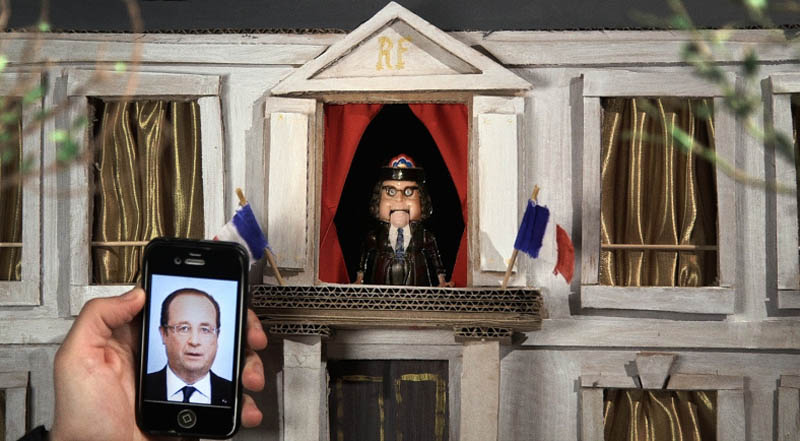
President François Hollande in the French documentary film La sociologue et l’ourson (The Sociologist and the Bear Cub).

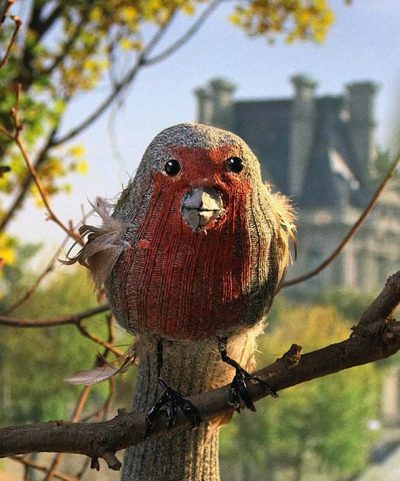
Chaillou et Théry wanted to use those chats in the film, but they had no video footage to go with it. What to do? I don’t imagine they wanted to use “Ken Burns technique” of panning over photos. They decided to use stuffed animals to represent Irène Théry and other participants. Irène Théry becomes a Mama Bear with swinging hair, (and Mathias Théry is her  “ourson” – the bear cub, of the title.) President François Hollande looks like some kind of Lego figurine, while newscasters are depicted as birds of various kinds – some halfway realistic ones, along with others that are clearly made from grey socks. This introduces some humour into a situation that became more heated than the filmmakers had expected. Though Chaillou et Théry are on record as saying there is no particular meaning to the animals they chose viewers might wonder about that when they see that some lawyers are depicted as pigs.

In the French animated documentary La sociologue et l’ourson, reporters and newscasters appear as birds.

While there is some footage of the real life Irène Théry on public transit, appearing on TV, at demonstrations, etc., we mostly see her animal avatar in her office, her kitchen, riding taxis, etc., as she explains how much families have changed over the centuries, and how cruel French society once was toward unmarried mothers and their children. There are also some funny bits of a more personal nature, connected with her marriage, her husband, his fish stick errand, etc. I wonder if Chaillou et Théry are fans of the Muppets, because the puppet version of Irène sometimes tosses her hair in a way that makes me think of Miss Piggy.  (Irène Théry is better looking, of course.)

Many people were against the proposed legislation, including religious leaders. Close to 2,000 mayors said they were unwilling to marry gay couples. Between October 2012 and May 2013 thousands of people attended demonstrations for and against same-ex marriage and adoption. Many of the “anti” demonstrations were led by a right-wing satirist and activist known as “Frigide Barjot.” (Her real name is Virginie Tellenne; Barjot means daffy, crazy, nuts, bonkers.) When Irène Théry attends those  demonstrations, her gregarious nature and her network of connections become obvious. Many people come to greet her and more than once she is introduced to “my future husband.”

NOT A SPOILER! Anyone with an Internet connection and an interest in the news will likely know that the legislation did pass. There were 7,000 same sex marriages in 2013, 10,000 in 2014, 7,751 in 2015 and 7,000 in 2016. However, Marine Le Pen, leader of the right-wing Front national, has said that she would rescind the law if she is elected president this year.

Mathias Théry and Étienne Chaillou, directors of La sociologue et l’ourson, will present their film in Montreal on Friday, April 7, 2017. Irène Théry will be there, too.

La sociologue et l’ourson begins its run at Cinéma Beaubien on Friday, April 7, 2017. Étienne Chaillou, Mathias Théry and Irène Théry will be there to introduce the 7 p.m. screening of the film and answer questions afterward. Will they bring some of their puppets with them? I hope so! When the film was shown by RIDM + at Cinéma du Parc last week, Chaillou and Théry talked to the audience via a glitchy Skype connection. It was the middle of the night for them, as they sat in their respective kitchens. They said they were looking forward to a “real discussion” when they arrived in Montreal.

Cinéma Beaubien is at 2396 Beaubien St E. Visit the Cinéma Beaubien web site for more information about the film and the screening.