FNC 2016 Review of Son of Joseph (Le Fils de Joseph)

Victor Ezenfis, Natacha Regnier, Fabrizio Rongione in Son of Joseph (Le Fils de Joseph).

Son of Joseph (Le Fils de Joseph) opens with scenes of Paris, people walking around, etc. Then we see two boys trying to torture a caged rat. I did wonder what kind of film I’d walked into. But those guys are just the idiotic classmates of Vincent, one of the main characters, and we don’t see much of them again. Just as well.

Teenage Vincent (Victor Ezenfis) lives in Paris with his single mother (Natacha Regnier), who’s an almost saintly nurse. In his bedroom he has a poster of Caravaggio’s 1603 painting, The Sacrifice of Isaac. Kinda gruesome!

Vincent’s mother has always refused to tell him who his father is, and on this particular day he is so enraged about it one wonders how his mother put up with him for so many  years.

After rummaging through a rolltop desk, Vincent finds a letter that reveals his father’s identity. You’d think, if he was so determined to know, that he would have found that letter years ago, but never mind, I won’t argue about it.

Vincent bluffs his way into a book-launch party, meets some ditzy and pretentious characters on the literary scene, and gets a glimpse of his father, Oscar Pormenor (Mathieu Amalric) a man so monstrous he can’t even remember how many children he had with his wife. “Details bore me,” he says.

With his red tie, red scarf, wealth, scorn and libidinous attitude, Oscar Pormenor made me think of Donald Trump. (Sorry!) The more Vincent learns about him, the more horrified he becomes. He hatches a plan which is unwise, not to mention illegal, immoral, etc.

On the plus side, Vincent meets Joseph (Fabrizio Rongione), Oscar’s brother and pretty much his polar opposite. Joseph is a really great guy, even if he’s not a success in the business world. More likely he’s a great guy precisely because he’s not a success in the business world.

The people in Son of Joseph speak in a very stilted, serious and unnatural way, almost like. . .inexperienced actors. Of course, the actors are not inexperienced at all, declamation is just part of director Eugène Green’s style. (Apparently, Green has a cult following, just like Hong Sang-soo, whose film Yourself and Yours will be playing at the same time today, just a few blocks away. Both films are on the schedule of the Festival du nouveau cinéma.) At first I found this way of talking rather strange. I got used to it, though I never stopped noticing it, and it made the funny parts funnier still.

Son of Joseph is about serious things, like how to be a good person, the longing for family, connection, and acceptance, but it also offers beautiful Parisian scenery and many laughs as well.

Almost all the interior scenes take place in very old buildings with creaky wooden floors. My congratulations to the sound people for picking up (or maybe recreating) all those creaks.

Coffee and Films was the production company for Son of Joseph. Isn’t Coffee and Films a great name?

Son of Joseph (Le Fils de Joseph)
France, Belgium | 115 Minutes
In French with English subtitles
Written and directed by Eugène Green
With Victor Ezenfis, Natacha Regnier, Fabrizio Rongione, Mathieu Amalric, Maria de Medeiros, Julia de Gasquet, Jacques Bonnaffe

Sunday, Oct.16, 2016
Program #281 15:15
Cinéma du Parc 2, as part of the Festival du nouveau cinéma.

FNC 2016: Review of Hong Sang-soo film Yourself and Yours

Lee You-young, centre, as Minjung, with two of her drinking buddies, in the Hong Sang-soo film Yourself and Yours.

Yourself and Yours, the latest film from Korean director Hong Sang-soo, looks at relationships in a way that’s insightful and hilarious. (Well, I thought it was hilarious.) I guess someone who has recently broken up with a significant other might feel differently.

After hearing gossip from a friend, Youngsoo (Kim Joo-hyuck) accuses his girlfriend Minjung (Lee You-young) of drinking with other men. Quite apart from the jealousy angle, he is upset because she had promised him to cut way back on her drinking.

An offended Minjung denies the accusations and suggests “taking a break.” Self-righteous Youngsoo replies (approximately) “You’re in the wrong and you’re upset with ME?”

Later, Youngsoo regrets his behaviour; he misses Minjung and when he can’t reach her, he fears that “taking a break” is her way of saying “break up.”

Youngsoo starts moping around pathetically. He tells his friends how much he loves Minjung, how special she is, that others don’t understand her, etc. All this might come from genuine love and regret, though I suspect it comes from loneliness or a feeling of having lost control of this situation, and his life in general. Who knows, really? Seeing her had  probably become a habit for him, as well, and habits are notoriously hard to break.

There are several scenes of Minjung, or someone who looks just like Minjung, drinking with other men. When they first speak to her, they claim to know her from some other occasion. Some of them are rather agressive in their insistence that they know her; it verges on creepy. She says that she never saw them before, but does agree to drink with them now.

Minjung seems more humourous and interesting to know than Youngsoo is. Her daring, if slightly rude habit of telling men exactly what she thinks of them is not something we see too often in Korean films; it’s still a patriarchal place.

It’s likely that many of these scenes, maybe all of them, only take place in Youngsoo’s unsettled dreams or waking imagination. That would be consistent with Hong Sang-soo’s style, but I have other reasons for thinking so, too. Sharing those reasons might constitute “spoilers,” though, so I’ll keep them to myself for now.

You could have lots of fun dissecting those scenes, and the film in general, with friends after the film, maybe over a meal at a Korean restaurant. Have some soju! Sadly, you aren’t likely to find the milky alcoholic beverage ( 막걸리 makgeolli, makkoli, makgeoli, etc.) in Montreal restaurants. That’s the stuff that the characters in Yourself and Yours drink from metal bowls, when they’re not having beer or soju.

A little laugh of recognition for people who follow Korean pop culture: At some point, Minjung talks about her “ideal type.” In interviews, Korean singers and actors are always being asked about their ideal type. They usually name other singers and actors and then their fans have fun discussing these choices on the Internet.

I’d read several enthusiastic reviews before seeing Yourself and Yours, and assumed that I would enjoy it, but It actually surpassed my expectations. For those who have heard of Hong Sang-soo, but haven’t seen his work yet, Yourself and Yours would be an excellent place to start. His Montreal fans have probably bought their tickets already.

http://www.nouveaucinema.ca/en/films/yourself-and-yours

Yourself and Yours, directed by Hong Sang-soo, with Kim Joo-hyuck, Lee You-young, Kim Eui-sung.

At the 2016 Festival du nouveau cinéma,
Sunday, Oct. 16, 2016
Program #284 15:00
Cinéma Impérial
1430 Bleury

FNC 2016: Review of A Decent Woman

fnc-2016-a-decent-woman

A Decent Woman was shot in Argentina. The original Spanish title is Los Decentes. It has also been shown under with the English title The Decent. It’s a satire.

Belen is a woman who does not say much. She observes, sometimes warily.

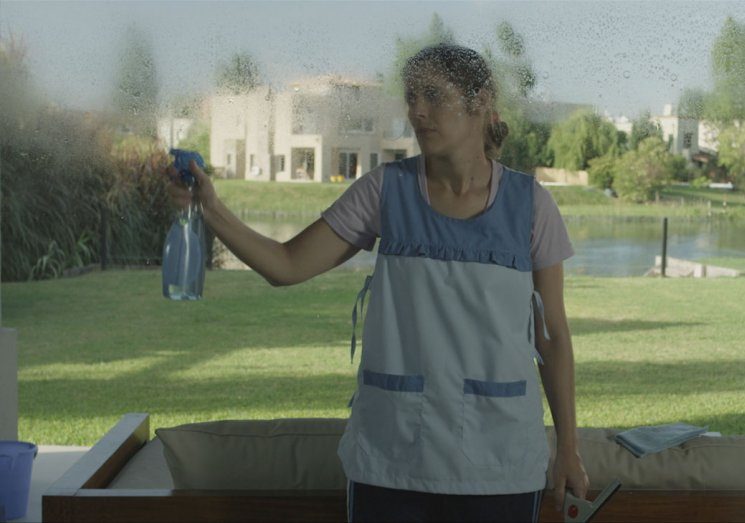
Belen (Iride Mockert) starts working for a rich woman and her spoiled son in a gated community outside Buenos Aires. (The residents inside those gates are wealthy, but in the surrounding area there are rundown streets littered with garbage.) Belen’s employer has a large house, but it presents a blank face to the world – it doesn’t look particularly comfortable or welcoming. It’s very bland, lacking personality, inside and out.

The property is on the far edge of the community and Belen soon notices that there is a nudist colony on the other side of the big hedge, and the (highly-)electrified fence. (She notices because she does everything at that house, buying groceries, washing floors, windows, dishes, doing laundry, cleaning the son’s sport shoes, and clipping that hedge. Belen’s employer, Diana (Andrea Strenitz) signs Belen up for cooking classes, too. (Among other things, they make cupcakes – a “very American recipe” according to the instructor.) When Diana can’t sleep, she wakes Belen to keep her company.

After days, maybe weeks, of watching the nudists, Belen lets her long hair down (literally), sheds her clothes and joins them. When they first see her, she is shyly recreating the pose from Botticelli’s Birth of Venus (the one with the big seashell).

They’re a very welcoming bunch and soon Belen is spending lots of time with them. Is this possible because Diana and her son, Juanchito, go away a lot for tennis tournaments, or could it be that Belen is just imagining herself having a different way of life with these people?

Much of the time, they are calm, quiet and relaxed, hanging out in or beside the water, dozing or reading. I won’t describe all of their activities, to avoid the accusation of “spoilers!” Let’s just say, this isn’t a “family-friendly” nudist club, and the place where the scenes were shot is actually a nudist swingers’ club, in the director’s own words.

The nudists do play loud music at night. It’s so loud that Diana’s windows vibrate and she can’t sleep. Other neighbours are upset about them, too, and they start a petition against the enclave.

Up until this point in A Decent Woman, I had no serious complaints. It had been moving at a  languid pace, possibly too slowly for some people, but I could handle it. (I did not notice anyone leaving, either.)

But. . . call me a coward or whatever, I did not like the abruptness nor the content of the ending. One or two people laughed. Was it serious laughter or nervous laughter? I wonder. I prefer to think that director Lukas Valenta Rinner did not know how to end the film, or that the ending is a dream that Belen has. (Yes, I know, dream sequences are a corny cliché.)

One person near me said “If I had known it would be like that, I would not have come.”

* * *

A FEW HOURS LATER:

(I went to A Decent Woman  because I thought that I had read several rave reviews about it, in reports from other festivals like Sarajevo and TIFF. Maybe I got it mixed up with something else.

The FNC catalogue and web site say that director Lukas Valenta Rinner also made Parabellum, which explains a lot. My brain must have skipped right over that. (Did you see it?) If you intend to see A Decent Woman, it might be better not to read about Parabellum beforehand.

As for not knowing how to end it, Parabellum won a prize at the Jeonju International Film Festival in South Korea. A few months later, the Jeonju Cinema Project offered Valenta Rinner money to make his next film, but that meant he only had six months to write, film and edit a work-in-progress version to show at the next edition of the festival.

On the other hand, in an interview with Cineuropa, Valenta Rinner indicates the abrupt ending was a “deliberate narrative decision,” to provide catharsis. And now that I think about it, abrupt changes of tone happen all the time in Korean cinema.

Lukas Valenta Rinner is an Austrian who went to film school in Argentina and still lives there. He has stated that his film is a comment on inequality and social tensions in Argentina. I’ve watched many films from Argentina, but I’ve never been there, so what do I know?

Final verdict: Mixed feelings. Can’t say I’m happy that I went, but I don’t feel ripped off either. I wouldn’t recommend it to everybody, but I imagine there are people within my extended circle who would like it.

Los Decentes (A Decent Woman)

Country: Austria, Republic of Korea, Argentina

Year: 2016

Genre: Fiction

Directed by: Lukas Valenta Rinner

Length: 104 minutes

Screenplay: Lukas Valenta Rinner, Ana Godoy, Martin Shanly, Ariel Gurevich

Cast: Iride Mockert, Martin Shanly, Andrea Strenitz, Mariano Sayavedra

I saw A Decent Woman at the  in Montreal. The festival will show the film again on Wednesday, Oct. 12, 2016 at 18h (6 p.m.)

FNC 2016: El Gusto review

Chaabi orchestra El Gusto in concert.

Two-sentence review: There is some fantastic music in the documentary El Gusto. I heartily suggest that you watch it!

Longer review: The documentary El Gusto is about Algerian chaabi music in general, and some musicians who used to play it, who came together to play it again, after many years apart. The film has been called the Algerian version of the Buena Vista Social Club.

The film has three main elements – a tour through the narrow, twisty streets of old Algiers, anecdotes about chaabi and life in Algeria, before and after the country’s independence from France, and musical performances.

Chaabi music has roots in Arab, Berber and Andalusian music. It was heard at weddings, parties and in the bars and cafés of the Casbah. Have you heard Rachid Taha sing Ya Rayah? That’s a chaabi tune, though Taha is usually described as someone who sings rai.

Chaabi orchestras include piano, violins, lutes, ouds, mandoles, banjos, zithers, accordions, drums and tambourines. People had already been playing it for decades when El Hadj Mohammed El Anka began teaching formal classes at the Municipal Conservatory of Algiers in the 1950s. Back then Muslims and Jews were neighbours and friends who partied together and made music together.

Safinez Bousbia, the film’s director, was studying architecture in Ireland in 2003 when she took a vacation trip to Algiers, the city where she was born. While discussing a purchase in Mohamed Ferkioui’s mirror shop, she learned about his earlier life as a chaabi musician. He was among the first graduates of the El Anka’s course at the conservatory.

Bousbia was so fascinated by his story that she wanted to find out what had happened to the other musicians, and to help them re-connect with one another. It took her several years to locate them. Some were still in Algeria while others had moved to Paris or Marseille long ago. Once the connections were made, they wanted to meet and they also wanted to play together again. They did so under the name El Gusto Orchestra of Algiers. The film includes footage from rehearsals and concerts in Algeria and France. An audience in France enthusiastically sings along to Ya Rayah. (The group went on to perform in the U.S. and the U.K., as well.)

You can preview and buy the group’s two albums, Abdel Hadi Halo & The El Gusto Orchestra of Algiers, and Orchestre El Gusto on iTunes.

El Gusto, directed by Safinez Bousbia, In French and Arabic with French subtitles, 93 minutes long.

With Mamad Haïder Benchaouch, Rachid Berkani, Ahmed Bernaoui,  Robert Castel, Abdelkader Chercham, Luc Cherki, Maurice El Medioni, Abdelrahmane Guellat, Joseph Hadjaj,  Liamine Haimoun (and many more).

El Gusto will be shown Monday Oct, 10, 2016, at 13:30, at Cinéma du Parc as part of the Festival du Nouveau Cinéma in Montreal.

Read more about the film and buy tickets on the FNC web site.

Fantasia 2016 Review: Three by Johnnie To

Wallace Chung, left, Vicki Zhao Wei and Louis Koo in the Johnnie To film Three. Everything that happens in the film is a prelude to the madness depicted here.

Three did not do it for me. I’ve enjoyed many Johnnie To films over the years, thanks to the Fantasia International Film Festival, but I found Three both disappointing and annoying. The film asks us to throw common sense to the wind. I do that all the time, and not just at the movies, either, but I just couldn’t do it for Three.

(However, it’s only fair to point out that both Fantasia screenings were sold out, albeit in the smaller De Sève cinema, and that one of my friends, an esteemed film prof, watched it twice.

My problems with it, in no particular order: a dumb script with many unlikely events, unnecessary carnage, wooden acting.

To elaborate further: Shun (Wallace Chung), the leader of a criminal gang, is shot in the head by a cop (we don’t see it happen) and he’s taken to a hospital. Not only is he still alive, it seems that the bullet hasn’t done any damage – he’s quipping away about philosophy, taunting his police guards, etc. Even so, the doctors say that he needs surgery as soon as possible. Shun refuses that surgery because he wants to be conscious when his gang comes to rescue him. But then what? He’ll still have a bullet in his head, and it’s not like your average mob doc is prepared to deal with that.

Wouldn’t it make more sense to have the surgery now, and then have the gang rescue him while he’s being taken to prison? Hijack the prison van – should be a piece of cake, right?

If his henchmen are so scary (and we’re led to believe that they are) and he’s in such medical danger you’d think that he’d be held in a private room with many guards, but no, he’s in a ward with several other patients.

Vicki Zhao Wei plays a neurosurgeon and Louis Koo plays a police detective in Three, a film from Hong Kong director Johnnie To. Koo wears that same stone-faced look in 98 per-cent of the film.
Vicki Zhao Wei plays a neurosurgeon and Louis Koo plays a police detective in Three, a film from Hong Kong director Johnnie To. Koo wears that same stone-faced look in 98 per-cent of the film. He doesn’t take that jacket off, either.

Lotsa cops, led by Ken Chan (Louis Koo) are waiting for the gang to arrive so that they can arrest them. Or kill them. It’s a tense waiting game! Never mind that this plan puts all the patients, doctors, nurses, other hospital workers and visitors in extreme danger. The sensible thing to do would be to restrict access to the hospital, as was done in many countries during the SARS outbreak, and to catch those bad guys at some other time, in some other place. But no, Chan is determined to nab them today.

Because this is a Johnnie To film, we know that there will be an over-the-top-shoot out, and, um. . . (SPOILER ALERT!) other kinds of mayhem, as well. The only question is when. But even in the land of make believe, I object to doctors and patients being blown away for such contrived reasons.

Which brings us to the wooden acting. Most of the time Louis Koo looks grim, stoic, stubborn, angry, or determined, which is pretty much the same thing on his face. He barks, snaps and scowls at everybody. Neurosurgeon Dr. Tong (Vicki Zhao Wei), who is having a very bad week, looks glum and exhausted, sometimes on the verge of tears. Not a lot of nuance happening here. Well-cushioned Lam Suet, one of  Johnnie To’s regular actors, plays the guy sent to get lunches, of course. His character can barely speak in sentences.

A patient named “Uncle Chung” provides some comic relief, though he isn’t that funny. Two other patients offer what you might call tragic distraction. There’s a cliffhanger scene, or more precisely a-bedsheet-and-firehose scene, that is just left. . .hanging. Literally. We don’t see how it wraps up. There’s another scene that might remind you of the Odessa Steps sequence in Battleship Potemkin. And why not? Toss it all in!

Every time I look at Louis Koo in his quilted blue jacket I wonder – just how heavy is the air-conditioning supposed to be in this hospital?

For the squeamish: Action-film fans are used to shootouts, but are they used to gruesome surgery? Be warned that even though Shun refuses his operation, many other patients do get theirs. There are scalpels, drills, copious amounts of blood and exposed brains in Three.

Meh. I suggest watching something else by Johnnie To.

THREE
Director: Johnnie To
Writers: Yau Nai-hoi, Lau Ho-leung, Mak Tin-shu
Cast: Louis Koo, Wallace Chung, Vicki Zhao Wei, Lam Suet
Run Time: 87 minutes.
In Cantonese with subtitles in English and Traditional Chinese
Seen at the Fantasia International Film Festival in Montreal

Fantasia 2016 Review: Too Young To Die!

Nana Seino, Tomoya Nagase, Ryunosuke Kamiki and Kenta Kiritani play musicians in the Japanese film Too Young To Die! which was shown at the Fantasia International Fim Festival in Montreal.
Nana Seino, Tomoya Nagase, Ryunosuke Kamiki and Kenta Kiritani play musicians in the Japanese film Too Young To Die! which was shown at the Fantasia International Film Festival in Montreal.

Too Young To Die! is full of laughs, music, demons, and love. It’s educational, too!

I saw this raucous crowd pleaser in the very best circumstances possible, with hundreds of other enthusiastic film fans at the Fantasia International Film Festival, right here in Montreal.

Daisuke (Ryunosuke Kamiki) and his fellow high-school students are riding a bus home after a field trip. Earlier, Daisuke had bribed a friend to change seats with him so he could sit next to his crush, Hiromi (Aoi Morikawa). They are having a shy chat when the bus goes over a cliff.

Daisuke wakes up in Buddhist Hell wondering what he did to end up there and how he could be so much worse than his fellow classmates. None of them are there with him, even though initial reports say that all the students on the bus died, except one.

Daisuke tells Killer K (Tomoya Nagase) a long-haired, horned, fanged guitar-playing demon, that he wants to go wherever Hiromi is. (He hopes she’s alive but he assumes that she’s in Heaven.) When Killer K says that no one has ever gone from Hell to Heaven before, Daisuke vows to do his best to be the first person to do that.

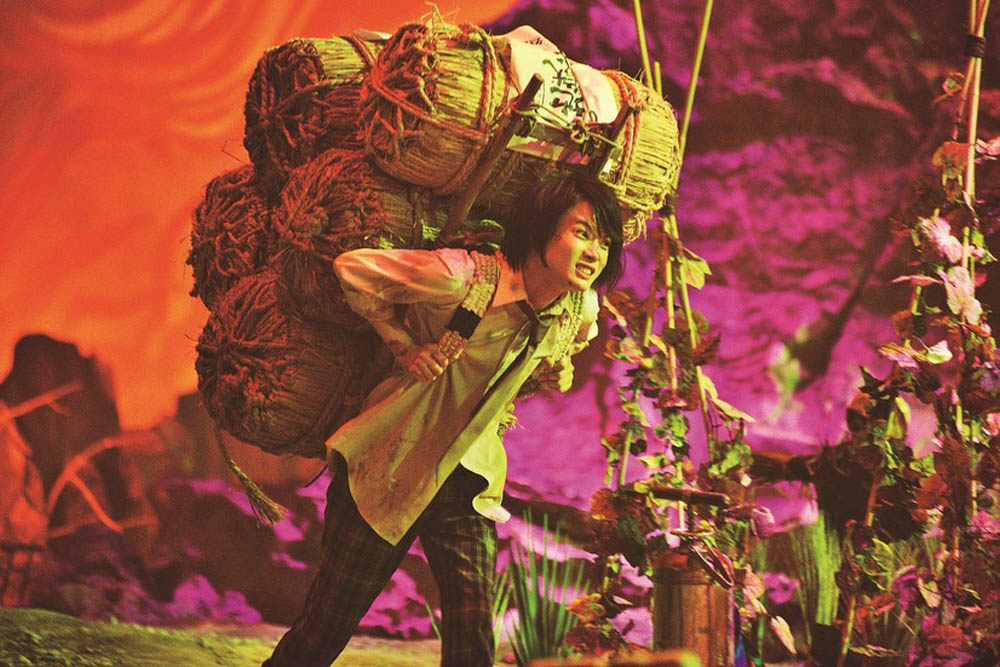
In the film To Young To Die, Daisuke (Ryunosuke Kamiki) works really hard in Hell; he'll do anything for another chance to see his true love Hiromi.
In the film To Young To Die, Daisuke (Ryunosuke Kamiki) works really hard in Hell; he’ll do anything for another chance to see his true love Hiromi.

There will be many challenges ahead! Daisuke has to haul heavy loads AND attend Hell Agricultural High School, too!  He’ll have to work very hard in Hell to be re-incarnated on Earth. What kind of creature he will be depends on his own efforts and the whims of Lord Enma, who sits in judgement. I’d be going into serious spoiler territory if I mentioned ALL of his reincarnations, though they include a bird, performing sea lion, a dog, and a giant scorpion. It’s pretty hilarious to watch Daisuke, who returns to his family home as a pale blue parakeet, frantically trying to delete a naughty video from his smartphone, and send one last text message to Hiromi.

Daisuke will get seven chances to redeem himself, but if he fails, he will turn into a demon like Killer K. Already his face is getting a bit redder, his teeth are longer and sharper and he can feel little bumps on his head where his future horns might sprout.

Arata Furuta plays Lord Enma in Too Young To Die! Lord Enma sends Daisuke back to Earth as a bird, a dog, and a sea lion, among other things.

Joining Hiromi is Daisuke’s main concern, but there’s a secondary plot line about a demonic battle of the bands. Killer K wants to recruit Daisuke for his group, Heruzu (Hells). This plot provides several tunes, some outrageous gags and an ultimate pyrotechnical showdown.

Despite the abundance of laughs and silly situations, Too Young to Die! is also a genuine love story. Years go by, but Daisuke’s love for Hiromi never wavers.  I found it very touching.

Writer and director Kankuro Kudo is obviously taking lots of liberties with his depiction of the Buddhist underworld, but he didn’t make it all up, either. Just Google Lord Enma and Ox-Face and Horse-Head for some background, and you’ll see. That’s why Too Young to Die! is also educational.

Musical Notes: Tomoya Nagase, who plays Killer K, is a musician in a band called Tokio. Director Kudo plays guitar in a band called Group Tamashii.  

Ryunosuke Kamiki, Tomoya Nagase, Kenta Kiritani and Nana Seino played the film’s title track at the Tokyo Metropolitan Rock Festival in May. If you like the songs in the film and you’ve got money to spare, you can order the film’s sound track from CD Japan.

Another film: Ryunosuke Kamiki and Takeru Satoh play high school students who write a manga in Bakuman, also shown at Fantasia this year. (You can read my review of Bakuman here.)

Interesting coincidence: Before the bus crash, Daisuke bought Hiromi an amulet at a temple. A few days after watching the film, I saw a guy on the metro with a similar amulet hanging off his knapsack. I would have liked to ask him about it, but I didn’t get the chance before I had to get off the train to watch another Fantasia film.

Too Young To Die!
125 minutes, in Japanese with English subtitles
Director: Kankuro Kudo
Screenplay: Kankuro Kudo
Cast: Tomoya Nagase, Ryunosuke Kamiki, Kenta Kiritani, Nana Seino, Aoi Morikawa, Arata Furuta

Fantasia 2016: Slash Review

Jessie Ennis plays Martine, Michael Johnston plays Neil and Hannah Marks plays Julia in the film Slash. It was shown in Montreal during the Fantasia International Film Festival.

Slash is a coming-of-age film with an easy rapport between the main actors, Michael Johnston and Hannah Marks. They play Neil, 15, and Julia,16, fellow high-school students who both write erotic fanfiction. They only become aware of each other after Neil drops his notebook at school, other students grab it, read from it and mock him. Would a guy who’s already a bit of an outsider bring his notebook to school and risk such exposure? I have my doubts, but these characters have to be brought together somehow, and they are cute together, so I’ll go along with it.

We see excerpts from Neil’s somewhat overwrought stories, about his favourite hero, Vanguard, acted out onscreen. Some of those scenes were shot at the Vasquez Rocks outside of Los Angeles, the same place where many Star Trek scenes were shot.  Until now I had assumed that those Star Trek rocks were made out of plaster – they looked fake to me back in the day and they still look fake to me now, but that fake look and the Star Trek connection just add more cheesiness to Neil’s stories.

Julia indicates that she has an unhappy home life, even though we don’t actually see it, and Neil hasn’t figured out his sexuality yet, so they both need as much friendship and moral support as they can get. Julia encourages Neil to lie about his age and submit his writing to an Internet site called the Rabbit Hole. Soon Neil is getting friendly messages from an older man. Oh, oh. For Neil, the possibility of meeting that man adds a frisson to their attendance at a Houston comic-con that has a minor slash component hidden away behind closed doors.

I liked Slash, though the lively Julia makes Neil seem bland. She might have made a better main character.

According to some Internet comments, writer-director Clay Liford does not present an accurate picture of slash culture. I have no way to know if that is so, but I confess that the accusations tainted my enjoyment a bit. Here’s a link to a review on The Daily Dot, by Aja Romano, who says the film is “Beautifully filmed and wonderfully acted” but “For all it may be a movie titled Slash, its depiction of slash is completely wrong. It is a bizarre, distorted, inaccurate, outdated, inexplicably porn-obsessed, and inexplicably male-centric version of slash fiction and slash fandom that doesn’t reflect reality.” Romano also says that “Julia still bears all the earmarks of a classic manic pixie dreamgirl.”

Romano includes a link to another article, “A guide to fanfiction for people who can’t stop getting it wrong,” that she co-wrote with Gavia Baler-Whitelaw.

Clay Liford told IndieWire that he did lots of research before making the film, though the world he describes doesn’t sound like the one presented by Romano and Baler-Whitelaw. If you write fanfic yourself, feel free to comment below!

On the other hand, as someone who has never owned a car and has many car-less friends, the car culture and world of privilege that Neil and Julia live in seem more foreign to me than slash culture does – Julia is only 16 but she seems to have access to an expensive-looking SUV whenever she wants it, and the two of them (just 15 and 16, remember) check into a Houston hotel without any difficulties at all.

I watched Slash via online screener at the 2016 edition of the Fantasia International Film Festival in Montreal.

Slash, written and directed by Clay Liford, with Michael Johnston, Hannah Marks, Missi Pyle, Jessie Ennis, Peter Vack, Sarah Ramos, Michael Ian Black, Tishuan Scott.

Fantasia 2016: Superpowerless review

In the film Superpowerless, actor Josiah Polhemus plays former superhero Captain Truth. The film had its world premiere at the Fantasia International Film Festival in Montreal.

The poster for Superpowerless calls it “A coming-of-middle-age story.”

Bob used to be Captain Truth, sort of the Batman of San Francisco – he didn’t have a fortune, a mansion, or a souped-up car, but he did save the good citizens from muggers, accidents and natural disasters. He also had a diminutive sidekick named Liberty Boy. Seriously.

Bob can still speak in the deep, threatening tones of Captain Truth, but he can’t come through with fists and feet and he doesn’t dare try to fly. His powers have faded away and he doesn’t know what to do next. He’s lost his “job,” his identity and he’s not yet ready to be normal and ordinary.

Nowadays, Bob (Josiah Polhemus) stays home drinking, or he wanders the streets aimlessly while his girlfriend Mimi (Amy Prosser) is at her office. (While Bob has lost his dream job, we learn that Mimi never achieved hers, even though she seems to be doing okay financially – she has a house and all in beautiful and super-expensive SAN FRANCISCO! She had always wanted to live and work in Rome, but she never made the leap.)

Real-life couple Josiah Polhemus and Amy Prosser play former superhero Captain Truth and his girlfriend Mimi in the film Superpowerless.

One of the things that struck me about Mimi is. . .to put it bluntly, she is a bit wrinkly. She was Bob’s childhood sweetheart and therefore, they are more or less the same age. This should not be remarkable in any way, yet it is, because men in Hollywood films are so often paired with women young enough to be their daughters.

When Bob learns that Liberty Boy has published a book he considers doing the same and starts dictating his thoughts. His description of how he discovered that he could fly, and how much he misses doing it, is fascinating and touching. You might wish that you could fly, too.

H.P. Mendoza plays Liberty Boy, former sidekick to superhero Captain Truth, in the film Superpowerless.

Speaking of women young enough to be a daughter – Bob gets in touch with a young and toothy potential editor who spells her name Danniell (Natalie Lander). He foolishly tells Mimi that this editor is a guy, named Daniel. Of course, we can guess that this will lead to problems later. It’s a situation older than TV sitcoms like I Love Lucy.

Because Bob does a lot of walking we are treated to views of many parts of San Francisco. Never mind superheroes, even ordinary citizens must be very fit to handle all those hills! There’s an interlude with a guy who makes bird houses and a car trip to Bob’s childhood neighbourhood in Palo Alto. When he’s walking, Bob often hides his face under a hoodie – this made me think of characters in the video game Assassins Creed. (Coincidentally, Assassins Creed is made by Ubisoft, which was a Fantasia sponsor for many years. We used to see ads with faces hidden under hoods before almost every film.)

After reading the synopsis for Superpowerless, I mistakenly expected a comedy, satire, or even a farce. In the end, I was happy enough with a film that’s relatively serious, with occasional comic moments.

Something I noticed while reading the credits: Actor Josiah Polhemus did the paintings that hang in Bob and Mimi’s home. He’s a multi-talented guy!

Superpowerless (2016)
80 minutes
Director: Duane Andersen
Writers: Duane Andersen, Dominic Mah
Stars: Josiah Polhemus, Amy Prosser, Natalie Lander, Guinevere Turner, Pepe Serna, H.P. Mendoza, Warren Serkin

Fantasia 2016: I saw Yoga Hosers and Kevin Smith and I’m very glad I did!

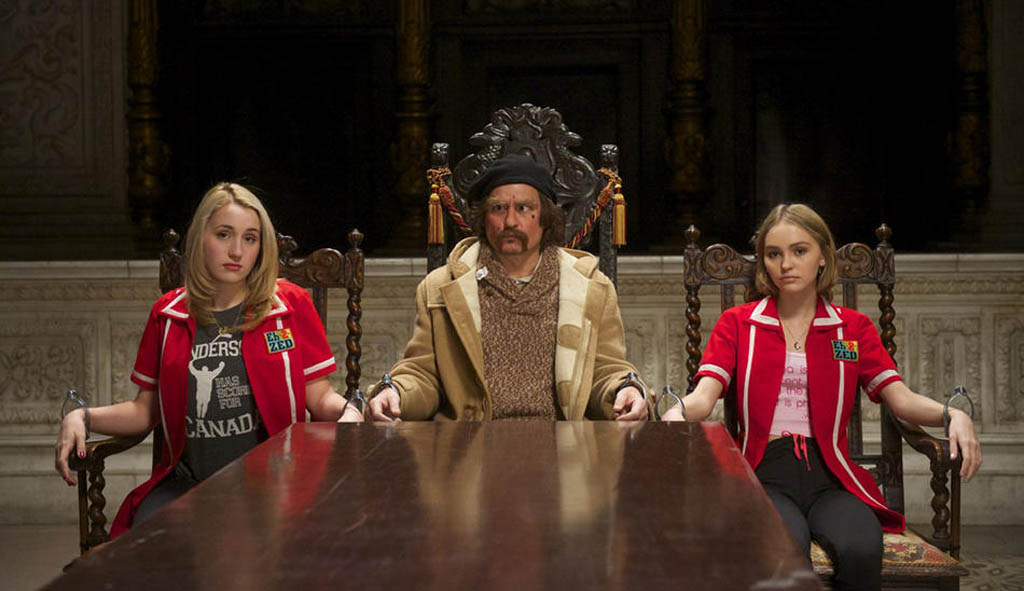
Harley Quinn Smith, left, and Lily-Rose Melody Depp give a decent rendition of O Canada during the closing credits of Kevin Smith's film Yoga Hosers. Depp even sings some of the French verses.
Harley Quinn Smith, left, and Lily-Rose Melody Depp give a decent rendition of O Canada during the closing credits of Kevin Smith’s film Yoga Hosers. Depp even sings some of the French verses.

I can’t imagine a better place to see Kevin Smith’s Yoga Hosers than at the Fantasia International Film Festival. The audience is famous for being warm, welcoming and enthusiastic. And to have Smith himself introduce his film and answer questions later. . .bonus!

I swear, he talked for ONE HOUR before the film even started. I was sitting down (he wasn’t!) and his talk was interesting, so I didn’t mind. After the film, almost everyone in the room stayed for the entire Q&A, even though the metro would close before he stopped talking. We’d figure out how to get home later.

If the critics who did not enjoy Yoga Hosers could have seen it with us…maybe they would have had a different reaction.

Smith told us that he had written the film with teenage girls in mind, after his wife had pointed out that he was taking their daughter, Harley Quinn Smith, to a lot of films about male superheroes. “BatMAN, SuperMAN, IronMAN, do you see a pattern here?” she had asked him. So he made a film about girls hanging out together, playing with their phones, and fighting evil.

Smith is famously fond of our country. Why is that? Well. . . His parents went to Niagara Falls, and then to Montreal, on their honeymoon, and after they had children, they took them to those cities, too. And then there’s hockey, and SCTV, and the DeGrassi TV series. Smith went to film school in Vancouver and met his good friend Scott A. Mosier there. This friendship was foretold by an Indian fakir, no less. (“You will meet someone with the initials S.A.M.”)

Smith said that when the Internet became available to one and all, he thought “Oh, good, now I can learn more about Canada!” He hopes to have dual citizenship one day. He would probably pass the exam easily enough! Daughter Harley came to the screening with him. She likes Montreal; he told her that’s good because “we might be moving here.” (You know, depending how the presidential elections go.)

What about the movie, Yoga Hosers? Of course it’s silly, but it was better than I expected. Harley Quinn Smith plays Colleen McKenzie, and her good friend Lily-Rose Melody Depp, the daughter of Johnny Depp and Vanessa Paradis, plays Colleen Collette. People call them Colleen M and Colleen C. (Or Colleen Squared.) I assume that the McKenzie name is a tribute to hoser brothers Bob and Doug McKenzie from SCTV. The two Colleens work in a Winnipeg convenience store (or dep, as we’d say here in Montreal) owned by Colleen C’s father.

The store has lots of maple syrup in stock, and even sells frozen poutine. As often as possible, the two Colleens head to the back to practice their singing. This inadvertently leads to the appearance of tiny men, made of bratwurst, wearing red jackets and Kaiser Wilhelm-type pointy helmets, who start killing people.

The two Colleens go to Terry Fox Preparatory School(!) Their history teacher, played by Vanessa Paradis, talks about Nazi sympathizers in Canada during World War II. Some U.S. or U.K. reviewers might not have grasped that that part of the story was not fictional at all. Sadly. (This might seem like a weird thing to mention, or even notice, in a film with bratwurst Nazis, but it seemed strange to me that Paradis, as the teacher, could wear skinny jeans at school while her students had to wear school uniforms. Also, we don’t do that junior, senior, sophomore stuff here in Canada. Whatever, though.)

Colleen M (Harley Quinn Smith) left, Guy Lapointe (Johnny Depp) centre, and Colleen C are held prisoner in a secret, underground lair in Kevin Smith's film Yoga Hosers.
Colleen M (Harley Quinn Smith) left, Guy Lapointe (Johnny Depp) centre, and Colleen C are held prisoner in a secret, underground lair in Kevin Smith’s film Yoga Hosers.

Johnny Depp plays a Montreal detective named Guy Lapointe. He’s got bushy eyebrows and wears a beret. (Depp told Smith that he could do a very good Québécois accent, because of the time that he’s spent here in Montreal, but if Smith preferred a bad one, he could do that, too. “Dial it down to stupid,” Smith told him.

The yoga part of Yoga Hosers? The girls take a yoga class with Yogi Bayer (Justin Long). The moves he teaches them come in very handy when they have to defend themselves from murderous satanists, not to mention the Goalie Golem!

Yoga Hosers and Kevin Smith got lots of applause and a standing ovation from the Fantasia crowd. The introduction, the film itself and the post-film Q&A, took about 3.5 hours. Time well spent; I have no regrets!

During the Q&A, there was a heart-warming moment when a man in the audience said that he had met Smith last year at Comic-Con and the encouragement he got from Smith then  had led him to write his first feature film.

Yoga Hosers, written and directed by Kevin Smith, starring Harley Quinn Smith, Lily-Rose Depp, Johnny Depp, Vanessa Paradis, Justin Long, Haley Joel Osment, Ralph Garman, Stan Lee.

Los Angeles stands in for Winnipeg.

Yoga Hosers was seen at a sold-out screening at the Fantasia International Film Festival in Montreal on Friday, July 29, 2016.

Fantasia 2016: Check out the manga film Bakuman on Saturday – you won’t be sorry!

In the film Bakuman, Moritaka (Takeru Satoh) and Akito (Ryunosuke Kamiki) play high-school students who want to get their manga into the magazine Shonen Jump.

I enjoyed Bakuman (バクマン。) very much. This Japanese film about breaking into the manga world has a good story, sympathetic characters, appealing actors, and lots of laughs. There are some lessons in friendship, co-operation and work/life balance, too, if you care to notice them; they didn’t seem heavy-handed to me, but feel free to ignore them if you’d rather.

And for the squeamish among you, no one gets any fingers cut off, either.

High-school students Moritaka (Takeru Satoh) and Akito (Ryunosuke Kamiki), try to create a manga AND have it accepted by the prestigious weekly magazine Shonen Jump. They aim high, these guys! Moritaka will draw and Akito will create the storyline.

There are multiple motives, including pride, the spirit of competition, money, and a desire for a future as someone other than an office drone. Moritaka’s main reason is to impress fellow student Miho (Nana Komatsu). He spends most of his class time sketching her surreptitiously. But the pure joy of creation is a very big part of it, too, and that’s a big part of the film’s appeal for me.

Moritaka can draw very well, but he must learn some new techniques, with pens and brushes, to make a manga. We learn these techniques along with him, and hear the scritch, scritch, scritch of his pen quite clearly. He already has a big advantage, since he spent many of his childhood years in the studio of his late uncle, who was a famous manga artist. In fact, that studio is still available for him to work in. (I didn’t quite grasp why that room had been left unused all that time. But never mind!)

The visuals in Bakuman are great. Facts about manga scroll across the screen; sometimes it’s like we’re inside a drawing, other times the characters are fighting like martial artists, with giant pens and brushes as their weapons. The newsroom of Shonen Jump is a sight to behold – it’s huge with lots of art on the walls and enormous piles of paper everywhere. Is that the real office, or a set? I won’t stop writing to find out right now, but I’m mighty curious! If it’s a set, what a job it must have been to create it. Fun, too, I imagine. (UPDATE: It is a set, but it does look like the Shonen Jump office.)

Moritaka (Takeru Satoh) and Akito (Ryunosuke Kamiki) wield their drawing instruments like weapons in Bakuman, a film about the world of manga.

Takayuki Yamada plays Akira Hattori, the editor our guys meet when they visit Shonen Jump. His character is rather scruffy and subdued, but he’s impressed by their work and he offers solid support and advice.

Lily Franky plays an editor-in-chief who seems very mean at best and downright sinister at other times. Since I’ve seen him play gangsters and psychopaths in other films, the sinister part might just be in my own head.

Shota Sometani, who seems to be in half the films coming out of Japan these days, plays Eiji Niizuma, a rival manga artist, who is also still in high school. He dresses in all in black and scuttles around in a crab-like manner that recalls assorted horror movies like The Hunchback of Notre Dame and The Phantom of the Opera. He’s already ruined his body by spending so many hours scrunched over his drawings.

This film about manga artists is based on a manga itself. (Of course it is!) I can’t claim to know much about manga myself, but viewers who do will likely pick up lots of references and enjoy many inside jokes. Maybe they could share them with me!

Takeru Satoh was the star of the wonderful film If Cats Disappeared From the World, which had a sold-out screening at Fantasia this year. He was also the star of the live-action Rurouni Kenshin trilogy. Ryunosuke Kamiki was in two of the Rurouni Kenshin films, and in two other films in this year’s Fantasia selection, As the Gods Will, and Too Young To Die. He was in Poison Berry in My Brain, a hit at Fantasia 2015.

Bakuman
Directed by: Hitoshi One
Written by: Tsugumi Ohba, Takeshi Obata
Cast: Takeru Satoh, Ryunosuke Kamiki, Takayuki Yamada, Nana Komatsu
Language: Japanese with English subtitles
Runtime: 120 min.
Distributor: Toho

You can see Bakuman as part of the Fantasia International Film Festival, at 6:40 p.m. Saturday, July 30, 2016, at the Hall Theatre of Concordia University, 1455 de Maisonneuve Blvd W. Fantasia runs until Aug. 3, 2016.