Mustang Review: Turkish sisters struggle to maintain their independence


The young women who play sisters in the film Mustang have a great rapport and are very believable as siblings. (Metropole Films)

Mustang opens at the end of the school year – as our main characters, five sisters, are saying goodbye to their friends and teachers. In their school uniform of white blouses, loosely knotted ties and a-line skirts they look like girls you might see right here on the streets of Montreal. They seem happy, self-confident and they have long, glorious hair. (The kind of hair I always wanted to have in high school. . .sigh. All the cool girls had long hair. They were great at field hockey, too.)

About that title, Mustang, which might make one think of a Western, it’s all about that hair. In the press kit, Director Deniz Gamze Ergüven says “A mustang is a wild horse that perfectly symbolizes my five spirited and untamable heroines. Visually, even, their hair is like a mane and, in the village, they’re like a herd of mustangs coming through. And the story moves fast, galloping forward, and that energy is at the heart of the picture, just like the mustang that gave it its name.”

Back to the story: It’s a beautiful day, so the sisters decide to walk home instead of taking the school bus. The story is set in a seaside village on the Black Sea, and their walk takes them by a beach. This leads to some playful frolicking in the water with their male friends. Oh, oh.

By the time they get home, their grandmother has already heard about this indiscretion and she pretty much accuses them of engaging in an orgy. (What will the neighbours think? What will they say?) She also beats them, starting with the oldest one first, and working her way down chronologically. As outraged as she is, things only get worse when her son, the girls’ uncle Erol (Ayberk Pekcan) comes home. (Their parents have been dead for years.)

The life the sisters had known is over now. Grandma (Nihal Koldas) gathers up their telephones, their computer, confiscates books, makeup, and any other thing that might have a pernicious influence, and locks all of it in a cupboard. The sisters are driven to a local clinic and made to suffer the indignity of virginity tests.

Their home becomes a “wife factory.” Neighbourhood women in headscarves come in to instruct them in sewing, stuffing a duvet, cooking (they even make chewing gum!) and advanced window cleaning. They must wear muddy-coloured, long-sleeved dresses. Sometimes when the family is just hanging out, we can hear speeches on the TV about how women ought to behave.

Before we know it, the two oldest girls, Sonay (Ilayda Akdogan) and Selma (Tugba Sunguroglu), are serving coffee and cookies to the neighbourhood women. It’s a sort of an audition, or presentation of the merchandise, really. A woman will offer a son as a groom, then bring her husband in, that very same day, to confirm the engagement, with rings and red ribbons. The wishes and opinions of the future partners don’t seem to matter. At least Sonay manages to get engaged to the guy she’s already been seeing on the sly. Selma is not so lucky; she’s paired off with a guy who looks just as unenthusiastic as she does.
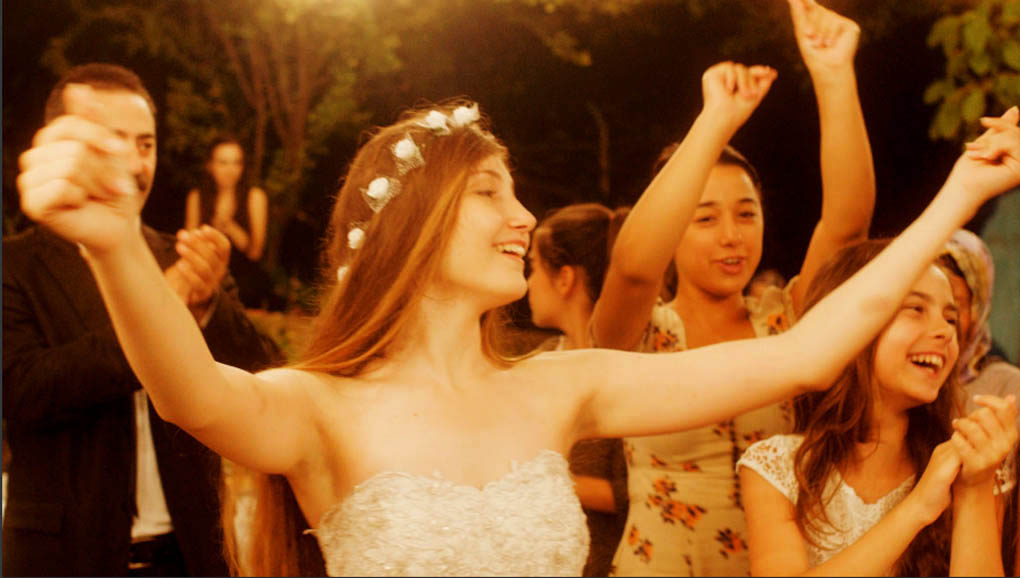
Ilayda Akdogan plays Sonay in a wedding scene from the film Mustang. (Metropole Films)

There’s an interlude at a soccer game that might remind some viewers of Jafar Panahi’s film Offside. The youngest girl, Lale (Gunes Sensoy), is a big soccer fan, but her uncle won’t take her to matches or even let her watch them on TV with him when his pals come over. But, after some violent incidents, the authorities decide that a coming match will only be open to women and young children. All the sisters welcome this chance to escape the wife factory and they join their friends for a raucous bus ride and a joyful game. (Turkey really did have some women-and-children only games in 2011, with 41,000 fans attending.)

After this outing, the walls around the house are made higher still, a tall wrought-iron gate is installed and bars are placed on the windows. The place really feels like a prison, now. However, all this “security” will come in mighty handy for some of the sisters later.

To my shock and surprise, when school starts again, none of the girls are allowed to return. (The actress playing Lale was 13 in real life, but she looked younger than that to me. I’m not sure how old she was supposed to be in the story.) No one comes to find out why they aren’t in school.

Throughout the film Lale has been watching, without saying a lot, but it’s obvious that she’s in no hurry to become a housewife. She’s plotting to rescue herself and her remaining single-but-already-engaged sister and we get to be a part of it. She might be young, but she’s very resourceful and she’s already found a good ally on “the outside.” An ally, mind you, not a prince or a knight, because she is not a helpless girl.

While some parts of the film are upsetting, maddening, even tragic, the bond the sisters have is wonderful to behold. Viewers who don’t have any sisters might well wish that they did. The actresses are so comfortable together they are very believable as sisters. Outdoors, they do gallop like mustangs, but at home they might tumble around playfully, or cuddle up together, like a bunch of kittens.

Hundreds of teenagers auditioned for parts in the film. Elit Iscan (Ece) was only one with previous acting experience, though you wouldn’t know it. Director Deniz Gamze Ergüven first saw Tugba Sunguroglu (Selma) on an airplane flight.

Ergüven was born in Turkey but she’s based in France now. She often moved between France and Turkey, and also spent time in the U.S. and in South Africa, where she earned an M.A. in African History.

The film was shot in the Black Sea village of Inebolu. It is 600 km from Istanbul, though in the story the sisters are 1,000 km from the big city. For them, it probably seems as far away as the moon.

Mustang was written by Deniz Gamze Ergüven and Alice Winocour.


I really enjoyed the film’s sound track. Most of the tunes were composed by Australian musician Warren Ellis, of Nick Cave and the Bad Seeds. Three tunes (or fragments of them) that Ellis recorded with Cave are in the film, though they are not on the Mustang sound track album. Those tunes are Home, Moving On, The Mother. Of the 12 tracks on the album ($9.99) 11 are by Warren Ellis, and one is from the Turkish band Baba Zula. (Here is a link to the Mustang soundtrack, at iTunes.) Coincidentally, Baba Zula played here in Montreal in October, 2015. Two other tunes, Yüksek Yüksek Tepeler (The Song of a Homesick Bride), performed by Selim Sesler, and Esrefoglu Hear My Words (Eyefoölu Al Haberi) performed by Ahmet (Dede) Yurt, are in the film, but not on the soundtrack. I think their tunes provided the lively dance music at a wedding reception. (Selim Sesler’s music is here, on iTunes; there’s a video of Ahmet Yurt on YouTube.

Mustang is a France-Turkey-Germany co-production For those who care about such things, Mustang is France’s entry for the foreign-language Oscar.

Mustang is in Turkish. In Montreal a version with English subtitles is being shown at Cinéma du Parc and Cineplex Forum. The version with French subtitles is being shown at Cinéma Beaubien, Cineplex Odeon Quartier Latin, and Méga Plex Pont Viau.


Review: Dangerous Men

Mina (Melody Wiggins) is the main character in the film Dangerous Men. After her boyfriend is murdered, she embarks on a killing spree to kill as many bad men as she can. (Drafthouse Films)


I’ve already written one blog post about the film Dangerous Men quoting some online articles and reviews. Now that I’ve seen a screener, I can give my own opinion.

While watching all by myself I burst out laughing on several occasions, but this is definitely a film to watch with a large group. I can imagine Dangerous Men going over really well in Fantasia’s longtime venue, the Hall Theatre of Concordia. I hope it works just as well at Cinéma du Parc.

So, what makes Dangerous Men funny, ridiculous or strange? Where to start? The script makes no sense, there’s bad dialogue, badly delivered, and several levels of bad acting on display. People talk to dead bodies; they also have long, rambling conversations with themselves. About eighty per cent of the male characters have moustaches, but the film was begun back in the day of detective show Magnum P.I. after all. (Google it if that doesn’t ring a bell.) There’s a living room bellydance performance when you’d least expect it. And just wait for the closeup view of a police badge, or the newscast set that looks like it was made from cardboard and duct tape.

The opening minutes of the film manage to be boring and puzzling at the same time. Scenes keep switching back and forth between two couples declaring their love for each other. Who are they and why should we care? It’s not clear if these “events,” such as they are, are happening at the same time, or if we are just switching between the two couples for the sake of variety.

In one night-time scene, a man in a black suit approaches a house. (Was it the filmmaker’s home? Woudn’t be surprised.) We just see this guy from the knees down, or from the back; the lighting is so strange that his shadow often looks like a second man. The way he’s filmed we assume he’s up to no good.

Later, when he is outside smoking (near his home, far from his home, who knows?) he interrupts the armed robbery of a liquour store. This is a way of letting us know that he’s a cop. I guess.

Before he interrupts that robbery, we see a woman, safe behind some shelves, and invisible to the two robbers, watch them pull a gun on the cashier and collect money. I thought she was a customer, but no, she was the store owner. As the robbers are about to leave, she confronts one of them with a yell, grabs his bag of loot and tries some laughably ineffective martial-arts moves on him. What kind of idiot would do that? Seriously? There will be lots more illogical behaviour before we’re through. The owner gets shot and falls down in a very unconvincing, theatrical way.

Turns out that the cop is named Dave. The other man is Daniel, his brother. Daniel and Mina tell Mina’s father that they want to get engaged. Mina’s father doesn’t look old enough to be her father – a big brother, maybe. Mostly, we see dad in profile or from the back, as if the actor didn’t really want to show his face.

The next day, Daniel and Mina hit the road. (Everything seems to be taking place in California, but Daniel and Mina have a car with New York state plates. I don’t know why.) They have a run-in with some thuggish bikers on a beach and Daniel ends up dead. Mina vows to get revenge on all the bad men in this world. (That would be most of them.) She embarks upon a killing spree. Many of the murders are presented in a visual shorthand – we see Mina’s shadow on a wrinkled sheet as she stabs the shadow of her anonymous victim. Saves money on actors and fake blood!

At one point Mina takes a train somewhere. . .I think. Well, we’re shown a train, which made me think she rode it. Then again, maybe it was just passing by and I filled in the blanks, incorrectly? Mina travels without luggage or even a handbag, yet she magically has several changes of clothes. She even has an off-the-shoulder sweatshirt like the one Jennifer Beale wore in Flashdance (1983). Not to mention, where does she stash her eyeshadsow, lipstick, mascara, teasing comb, etc?

After Daniel’s body is found, brother Dave tries to find the killer, even though his boss tells him he’s too close to the case to do that. Of course, Dave ignores his boss, doesn’t everybody? Dave seems mildly curious about the fact that Mina is missing, but not as worried as one might expect, since they had almost become in-laws and he had told his brother that he liked Mina very much. In that conversation, he mentions “wedding arrangements” and says arrangements in such a strange way, it sounds like English is not his first language. The director should have asked for another take!

Most of the things I describe above happened in the first few minutes, there are lots more ridiculous things to come. Fight scenes were clumsily absurd. During some of them I swear I heard someone saying “Whack, whack,” every time a fist connected with a body.

The music was funny for a few minutes and then became very annoying, verging on excruciating. The same riffs would be repeated for several minutes even when the mood of a scene had changed radically.

Neutral observation: The handguns in Dangerous Men are relatively small. If the film were made today, I imagine that they would be much larger and look scarier.

Watching Dangerous Men has made me appreciate the scripts, actors, sound tracks, continuity, etc. of mainstream movies much more, even the ones that are far from perfect.

Dangerous Men is (unintentionally) funny, but I did feel a bit sad about it, too. It was the passion project of John S. Rad (real name: Jahangir Salehi Yeganehrad) an Iranian who fled Iran for the U.S. in 1979, five days after the Shah left Iran himself. Supposedly, Rad made between three and 11 films in Iran, and he was also personal cameraman to the Shah. After Watching Dangerous men I have very serious doubts about that, but maybe no one watched his Iranian films, either. Or maybe they were shorts. Maybe he shot very short scenes for the Shah, too, and someone else edited them.

One review I read says that Dangerous Men looks like a film made by someone who had never seen one before, and I have to agree! Yet, Rad spent more than 20 years writing, shooting editing, etc. What did he learn in that time? I also wonder if he neglected his family and friends while devoting so much time to this project? He was a bit cavalier with the posssessions of others, too. A car that gets pushed down a steep hillside had belonged to his daughter; she only found out what happened to it when she watched the film.

I’m one of those people who feels obliged to read the credits. What’s in them? Mina (Melody Wiggins) and her boyfriend Daniel (Kelay Miller) are identified as Mina and Daniel. But Dave, Daniel’s brother, is just “Police Detective.” The actor is named Michael Gradilone but Michael is mispelled as Micheal. A character named Black Pepper in the film is simply “Head of Drug Dealers” in the credits. One “biker” was played by Gorge Derby. Is that a real name, or George mispelled?? I know Jorge is a name. Another actor is just “Terry,” and a camera operator is just “Felix.” I wouldn’t have wanted to give my full name, either.

.

.
Dangerous Men, written, directed, edited, produced (etc.) by John S. Rad
In English, 80 minutes long.
Thursday, Jan. 21, 2016, at 9:15 p.m. at Cinéma du Parc, 3575 Ave du Parc


RIDM 2015 Review: The Unknown Photographer

This screengrab from the Unknown Photographer web site show the videos that can be watched even after the RIDM documentary film festival is over. (Since it is just a screengrab, clciking on the arrows won't do anything.
This screengrab from the Unknown Photographer web site show the videos that can be watched even after the RIDM documentary film festival is over. (Since it is just a screengrab, clicking on the arrows won’t do anything.

Like the Polar Sea 360° project, The Unknown Photographer has one component that you can explore with an Oculus virtual reality headset for the duration of RIDM, and several other parts that you can enjoy at home whenever you choose to do so.

The Unknown Photographer is a co-production between the National Film Board of Canada and Turbulent, with the financial support of Canada Media Fund. It was inspired by a thick album of World War I photos that was found in an abandoned building in Morin Heights. Some accounts say the building was a home, some say it was a barn, but in Looking For Fletcher Wade Moses, a film on the project’s web site, filmmaker Philippe Baylaucq says he found it in a sort of “haunted house” when he was still a teenager. That story is better yet, no? He felt it was a treasure that needed to be saved, so he took it, and eventually gave it to photographer Bertrand Carrière, who made Looking For Fletcher Wade Moses.

The album belonged to Fletcher Wade Moses, but despite lots of research into the man’s life, including talks with his daughter and grandson, Carrière was not able to determine if he had taken the photos or not. While he was interested in Fletcher Wade Moses, he was more interested in the photos and the landscapes they depicted. He was shocked by the devastation, with entire cities reduced to rubble. He realized that most of the photos had been taken in the last years of the war, on the Western Front. He went to France to see what those places looked like years later.

Precisely because it was impossible to identify the photographer (or photographers) the virtual reality part of the project is a work of imagination and conjecture. In fact, the narrator who leads us through the experience is unsure of just who he is or where he is, though he does “remember the war.” (Julian Casey provides the voice of the English version; François Papineau provides the French one.)

This barren battlefield is seen in the virtual-reality component of The Unknown Photographer.

Considering the present date and when the war was (1914-1918) he could well be speaking to us from the hereafter. Participants in the virtual reality experience can choose their trajectory through their head movements and by moving a joystick. They can move through a barren landscape of blackened trees, climbing down into trenches or up hillsides. They can navigate a huge, dark, museum-like space, and drift through photographic cubes that tumble from the sky, a bit like Tetris. A strange figure, upright, with the antlered head of a deer, makes frequent appearances. What is he? Some kind of spirit animal? A shaman? An ancestral memory from our cavemen days?

The parts that can be watched at home include videos about the “Vest Pocket Kodak: The Soldiers’ Camera,” and “Postcards and Letters in Times of War.”

This is the setup for experiencing The Unknown Photographer in the UXdoc Space at the Cinematheque Quebecoise. Does it look like plugging into The Matrix?

The Unknown Photographer, (Le Photographe Inconnu)
Directed by Loïc Suty
Country : Quebec
Year : 2015
Language : English, French
Runtime : 120 Min
Platform : Réalité Virtuelle / Virtual Reality (Oculus Rift)
Production : Marc Beaudet, Benoît Beauséjour, Claire Buffet, Louis-Richard Tremblay
Technical Direction : Osman Zeki
Sound : Martin Fish
Contact (Distribution) Élise Labbé, Office National Du Film Du Canada
e.labbe@onf.ca
Cinémathèque Québécoise – Salle Norman Mclaren (Salle UXdoc), 335 de Maisonneuve Blvd. E. (For the virtual reality part)
(For the virtual reality part)
Visit unknownphotographer.nfb.ca for online components.
RIDM (Rencontres internationales du documentaire de Montréal) runs from Nov. 12-22, 2015. Visit the web site ridm.qc.ca for more information.

RIDM 2015 Review: Llévate mis amores (All of Me)

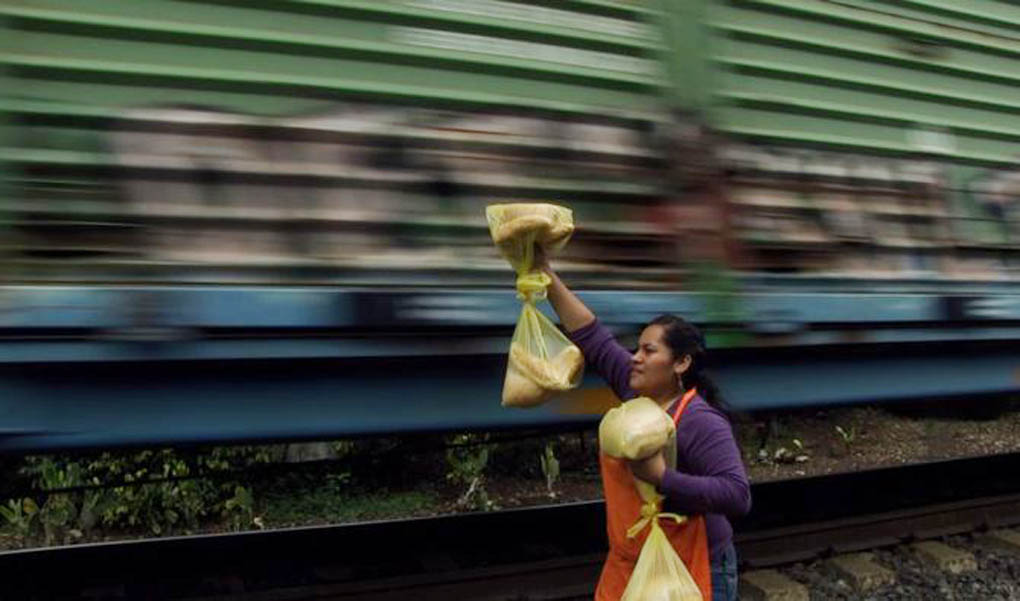
In a scene from the film LlŽevate mis amores, a member of the group Las Patronas holds bags of food for Central American migrants travelling north on a freight train.
In a scene from the film LlŽévate mis amores, a member of the group Las Patronas holds bags of food for Central American migrants travelling north on a freight train.

Llévate mis amores (All of Me) is a film about a group of Mexican women known as Las Patronas, after La Patrona, their village in Veracruz state. They’re poor in possessions, but rich in humanity and love. Even though they have very little themselves, they work hard to help people who have even less than they do.

Since 1995 they have been preparing food and water for migrants from Central America who ride freight trains through Mexico into the U.S. The trains are called La Bestia (the Beast), or sometimes, the Train of Death, because people can die if they fall off. The migrants are victims of a bad economy and globalization – there isn’t enough work in their home countries and they can only travel via freight trains because passenger service ended when the Mexican railroads were privatized in the 1990s. A train might have as many as 800 riders, with some inside the boxcars cars, others on the roof or even hanging precariously between the cars. The train is not the only danger on the trip – there are crooked police, thieves, kidnappers, human traffickers and extortionists.

Every day the women cook huge pots of rice and beans and make tortillas over wood fires. They pack the food in plastic bags and fill recycled bottles with water. When they hear the whistle of an approaching train, they rush to the tracks to toss the food and water to the migrants, who hold their hands out eagerly. They never know when the trains will come or how many there might be.

In this scene from the documentary film LlŽevate mis amores (All of Me), a Central American migrant is able to call her mother, thanks to the helpful women known as Las Patronas.
In this scene from the documentary film LlŽévate mis amores (All of Me), a Central American migrant is able to call her mother, thanks to the helpful women known as Las Patronas.

Some migrants jump off the train for the food, and then they can’t get back on. When that happens, they are driven to the next place that the train stops or slows down. That’s not all that La Patronas do. They have taken injured migrants to hospitals, and on those occasions when doctors or hospitals refused to help, they have nursed them back to health themselves. They lend people cellphones so they can check in with their families.

When the director asks the women to describe themselves the younger ones talk of their hopes for the future (to be a lawyer or a journalist) while the older ones talk about their pasts – one had an abusive husband who was murdered, another had a potential husband who stayed up north too long, yet another was pulled out of school at a young age because someone told her father that the vaccinations given to students would cause sterility. One woman liked to sing and dance; she had wanted to be in a band. Some worked in the fields, others worked as maids; those with children want them to have a better life.

Llévate mis amores (All of Me) is truly inspirational; long before it was over I was wondering what I could do to make the world a better place. It was great to see the screening sell out, too. You can buy tickets online to make sure that you get in. Director Arturo González Villaseñor will be at the screening to answer questions after the film. When asked if the film will be available for rent or purchase he said that it probably will be eventually, but for now it’s still making the rounds of film festivals.
Llévate mis amores (All of Me)Sunday, Nov. 22, 2015, 9:15 p.m., Excentris (Salle Cassavetes), 3536 St Laurent Blvd.

RIDM (Rencontres internationales du documentaire de Montréal) runs from Nov. 12-22, 2015. Visit the web site ridm.qc.ca for more information.

RIDM 2015: My suggestions for Sunday, Nov. 22, the last day of this year’s festival

A scene from the Mexican documentary Llevate mis amores (All of Me), one of many films being shown at RIDM, Montreal's documentary film festival.
A scene from the Mexican documentary Llevate mis amores (All of Me), one of many films being shown at RIDM, Montreal’s documentary film festival.

Before I go to bed tonight, I hope to write proper reviews of these films that I’m suggesting to you, but for now, I’ll just write a short description to get something online as soon as possible.

Click on the underlined name of a film to be taken to the synopsis on the RIDM web site.

Oncle Bernard – L’anti-Leçon d’économie
Words of wisdom from the late economist Bernard Maris. He was one of the people killed at the offices of Charlie Hebdo earlier this year.
Oncle Bernard – L’anti-leçon d’économie, Sunday, Nov. 22, 2015, 7 p.m., Excentris (Salle Cassavetes)

The next two films are on at the same time. What a shame, and what a quandary, because I think they’re both wonderful. I’ll go out on a limb and suggest Llévate mis amores (All of Me), directed by Arturo González Villaseñor, as a first choice because there is no guarantee that it will come back to Montreal again, though I truly hope that it does. This is a film about people in Mexico, mostly women, who do a lot to help others, even though they have very little themselves. Every day they prepare food and water for migrants who are making their way north to the U.S. by train. RIDM says it is “A wonderful human adventure,” but that’s really an understatement. It’s inspiring! Seriously.

This film was sold out on Saturday, so if you want to see it, consider buying your tickets online to avoid disappointment. I almost missed it myself.  I thought that Saturday’s screening was the second, and last one. I am so glad that it isn’t, so that I can suggest it to you. Director Arturo González Villaseñor will be at the screening to answer questions after the film.

Llévate mis amores (All of Me), Sunday, Nov. 22, 2015, 9:15 p.m., Excentris (Salle Cassavetes)
Another film that starts at 9:15 p.m. is Le Bouton de nacre (El botón de nácar in Spanish, The Pearl Button in English), directed by Patricio Guzmán. It’s quite wonderful too, but given Guzman’s fame, it is more likely to return to Montreal screens. (Guzmán directed Nostalgia For The Light, one of my very favourite documentaries, along with Salvador Allende, The Pinochet Case, The Battle of Chile, and others.)

Le Bouton de nacre is about water, the universe, Chile’s native peoples and the disappeared of the Pinochet years. It is full of beautiful images and sounds and also contains tales of incredible horror. Some of those tales are quite recent, while others are much older.
Le Bouton de nacre, Sunday, Nov. 22, 2015, 9:15 p.m., Cinéma du Parc 2

I have seen the three films above, and recommend them wholeheartedly.

In Police Academie (Cop Class) director Mélissa Beaudet follows “three very different cadets during their final year of training.” It sounds interesting, and it has received good reviews, but it starts at 9 p.m., which puts it in conflict with Llévate mis amores (All of Me) and Le Bouton de nacre (El botón de nácar). Police Academie will be shown at Excentris starting on Nov. 27, and it will be on TV (ICI RDI) on Jan. 16, 2016.
Police Academie (Cop Class), Sunday, Nov. 22, 2015, 9 p.m., Cinéma Du Parc 1
RIDM (Rencontres internationales du documentaire de Montréal) runs from Nov. 12-22, 2015. Visit the web site ridm.qc.ca for more information.

RIDM 2015 Review: The Other Side

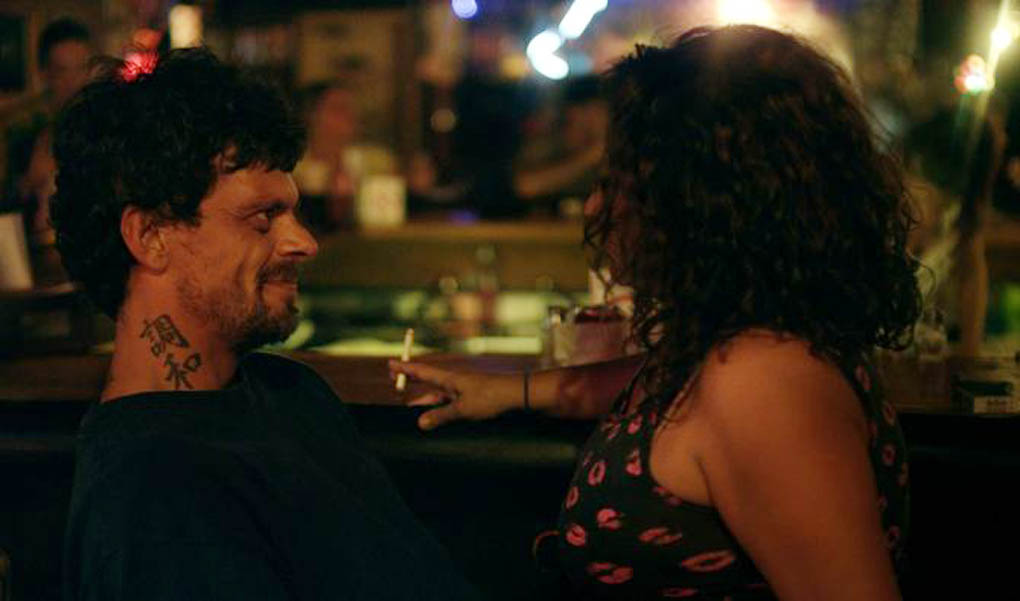
Mark and Lisa in the documentary film The Other Side.

Do you ever watch a film and find yourself wondering “WHAT were they thinking?” Or, “What WERE they thinking?” “They” could be the film studio, the writer, the director, the actors, or, in the case of a documentary, the participants.

I had that thought often while watching The Other Side, a documentary filmed in rural Louisiana by Italian filmmaker Roberto Minervini. The film is divided into two parts of unequal length. The first, and longest part, is about Mark and Lisa, down-on-their luck lovers and drug addicts who aren’t shy about getting naked. In fact, they spend most of their at-home time that way. There’s also a scene where Mark wakes up at the side of the road, starkers, and ambles home, his bare feet making a flappin noise on the highway.

They use drugs frequently while on camera, and Mark is seen injecting Lisa and others with them. Could that drug-use footage be used as evidence, if they are arrested? Or do the authorities alreasdy have plenty on him already? He has spent time in jail.

In another scene, Mark and a (male) friend break into a school and make fun of a wall chart that explains economics and capitalism. (I’m not suggesting that those things are above mockery, far from it!) While they’re having their laughs, they describe themselves as pimps, which I found disturbing. If they really are pimps, it was not demonstrated explicitly. Mark injects a pregnant, nude dancer before she does her act. Does he gets part of her earnings?

Whatever you might think of drug dealing, it seems that “good, honest work” is not readily available in Mark’s neck of the woods.

The other part of the film deals with some heavily-armed guys who are expecting bad things, and pretty soon, too. An insurrection, a revolution, the big bad government coming to take their weapons, something like that. While their world-view seems more than a little twisted, they seem dead serious. These guys are scary. I’m glad they are far away, thugh heaven knows, maybe there are others who think the same way, closer to home than I realize.

People throughout the film badmouth U.S. president Barack Obama with racist language, which I found uncomfortable to listen to. The support one guy expressed for Hillary Clinton was surprising, because I had assumed that racists would be sexists, too. Apparently not always.

Quite apart from the too-much-information aspect and the racism, The Other Side won’t be for everyone. It would be depressing as fiction, as reality it’s much worse.
The Other Side (click for more info)
directed by Roberto Minervini
Country : France, Italy
Year : 2015
Language : English
Subtitles : French
Runtime : 92 Min
Production : Muriel Meynard, Paolo Benzi, Dario Zonta
Cinematography : Diego Romero Suarez-Llanos
Editing : Marie-Hélène Dozo
Sound : Chico Bernat Fortiana, Ingrid Simon, Thomas Gauder
Contact
(Distribution)
Maxwell Wolkin
Film Movement
maxwell@filmmovement.com

Saturday, Nov. 21, 2015, 9:30 p.m.
Cinéma Excentris – Cassavetes, 3536 St. Laurent Blvd.

RIDM 2015 Review: Polar Sea 360° is a virtual-reality voyage to the Arctic with a rich, detailed, online component, too

Screen grab from Polar Sea 360 web site. Clicking on it won't do anything!
Screen grab from Polar Sea 360 web site. Clicking on it won’t do anything!

Go to RIDM’s UXdoc Space at Cinémathèque Québécoise, put on the virtual reality headset, and you’ll find yourself immersed in the Arctic – except you won’t need big mitts and an extra warm coat.

You can look right, left, up, down or behind you; there’s always something to see. You might be in a helicopter, on a blue-sky, sunny day, hovering above ice, snow, glaciers and icebergs or somehow outside the ‘copter, looking into it at the pilots. You might be on the deck of a small boat, in the dining room of cruise ship, or riding through a small village on an all-terrain vehicle. On top of all that, you can see the aurora borealis shimmering in the night sky in its mysterious way.

For me, it was a fascinating experience and well worth the trip to the Cinémathèque, which is conveniently located mere steps from the Berri-UQAM metro. But that’s not all, there so much more!

Before and/or after experiencing the Arctic in this way, you can find a wealth of information, from many points of view, at the web site polarsea360.arte.tv  There is a video with several chapters, and a “magazine” with 10 episodes; some of these episodes also have short videos embedded in them, as well. During the main video, and many of the video segments, viewers can use the arrow keys on their computer to get a 360-degree view. (The project can be enjoyed on smartphones and tablets, too, but I used a desktop computer. If you have a virtual reality headset at home, you cam use that. too. The web site has links to three companies that sell them.)

Screen grab for the Polar Sea 360¡ web site shows Arctic ice bergs.
Screen grab for the Polar Sea 360 web site shows Arctic ice bergs.

Polar Sea 360° is an international project with participants from Canada, Argentina, Denmark, France, Germany, Greenland, Ireland, Norway, and Switzerland. They include Arctic residents, authors, amateur explorers, biologists, a Canadian Coast Guard officer, filmmakers, geographers, geologists, historians, photographers, a prof in international politics, sailors, sea captains, scientists, singers, and veterinarians.

Climate change, and the way it affects people, wildlife and the landscape, is a major topic of the videos and the texts. The trip offered by the French cruise ship Boréal would not have been possible in past decades, because the ice was thicker then. Increased access to the Arctic means more shipping, exploration for oil and minerals and the habitat destruction and pollution that can come with that.

We also learn about the DEW Line, the Franklin expedition, explorer Roald Amundsen, and Inuit history and culture, including the forced relocation of some Inuit to Resolute Bay to shore up Canada’s arctic sovereignty claims, the abuse at residential schools, the importance of narwhal and seal in the traditional Inuit diet, their hospitality customs, hunting methods, throat singing, traditional place names, historical routes, and the problems of the present day; Nunavut has highest suicide rate in Canada.

A graphic about Arctic sovereignty from Polar Sea 360. The international, interactive project combines information about ecology, geology, history, politics and more.

The waters being navigated in Polar Sea 360° are part of the famous, near mythical, Northwest Passage. Mention of it takes me back to Grade 6 history class. (You, too?) In those days, we didn’t learn much about the negative aspects of exploration and the imperialism that came with it. But we did learn about the Northwest Passage – for centuries, explorers dreamed of it and searched for it – a quicker way from Europe to the riches of Asia. The man (of course, it would be a man!) who found it would be rich, famous, admired, bring glory to his country, etc. It was a big deal then and it has become a big deal once again. Read more about the RIDM presentation of Polar Sea 360° here.


Polar Sea 360°

Country : Canada, Germany
Year : 2014
Language : English, French, German
Runtime : (up to you!)
Platform : Réalité Virtuelle / Virtual Reality (Samsung Gear Vr)
Website : http://polarsea360.arte.tv
Production : Irene Vandertop, Thomas Wallner, Stephanie Weimar
Artistic Direction : Thomas Wallner
Technical Direction : Scott Herman
Sound : Janine White
Contact
(Production)
Thomas Wallner, Deep Inc., thomas@deep-inc.com

Visit the UXdoc Space at Cinémathèque Québécoise, 335 de Maisonneuve Blvd E., from Nov. 12-22, 2015, from 11a.m. to 8p.m., to see Polar Sea 360° and other interactive presentations.
RIDM (Rencontres internationales du documentaire de Montréal) runs from Nov. 12-22, 2015. Visit the web site ridm.qc.ca for more information.

RIDM 2015: Watch interactive documentary at home, or take part in an ‘assisted navigation’ with director Brett Gaylor

Director Brett Gaylor explains the Do Not Track interactive web documentary at RIDM, Montreal's documentary film festival.
Director Brett Gaylor explains the Do Not Track interactive web documentary at RIDM, Montreal’s documentary film festival.

Director Brett Gaylor explains the  interactive web series Do Not Track at RIDM, Montreal’s documentary film festival.

Do you know about Brett Gaylor? He directed Rip! A Remix Manifesto, a documentary about fair use, the concepts of “CopyRight and CopyLeft” and DJ Girl Talk. Maybe I’ll post some links about that later.

These days, Gaylor is the mastermind behind Do Not Track, an educational and international interactive web series about our privacy, or the lack thereof, on the Internet.
The project is a co-production between Canada’s own National Film Board, UPIAN, ARTE, Bayerischer Rundfunk (Bavarian Public Broadcasting), with the participation of Radio-Canada, AJ+ (“the digital-only video news network and community from the Al Jazeera innovation department”), RTS (Radio Télévision Suisse). It has seven supporters, too, including Montreal’s EyeSteel Film. You can see them all here.

There are seven episodes, with most being about 7 minutes long. Some could be longer, depending on the options viewers choose. The subjects are Tracking, Cookies, Social Networks, Mobile, Big Data, Future Bubble and Future of Tracking.

Each episode also has some articles related to the video – what we’d call “sidebars” in the newspaper biz. “How to protect your smartphone” part of Episode 4 of Do Not Track, would probably be of interest to anyone who has one. That same episode includes links to articles in the New York Times, The Intercept, and the Electronic Frontier Foundation. (The EFF has rated so-called “secure messaging” products.

You can watch these videos at home, but if you come to the director’s navigation you can hear the inside scoop on the project, ask Gaylor some questions and possibly volunteer as a guinea pig to discover your Big 5 Personality Traits, according to an algorithm that analyzes your online activity.

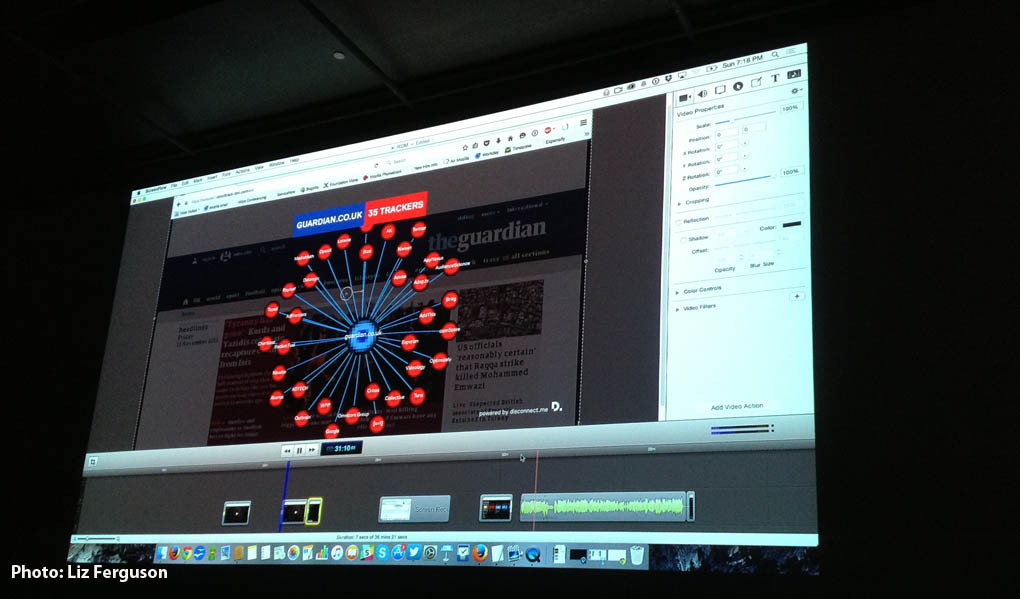
At an assisted navigation of the documentary web series, Do Not Track, director Brett Gaylor showed particpants that the the web site of The Guardian has 35 trackers.
At an assisted navigation of the documentary web series, Do Not Track, director Brett Gaylor showed participants that the web site of The Guardian has 35 trackers.

Gaylor remined us that the Internet isn’t really free, we pay for it with information about ourselves instead of with money. (Gaylor went on the Guardian web page and showed us that it had 35 trackers.) Trackers collect information about our needs and interests to create a profile which they then sell to the highest bidder, who then places ads on our Facebook feed and elsewhere. He said Europe has better legislation about online privacy than the U.S. does, but that technology is moving so fast that legislation can’t keep up.

He raised the possibility that people would be denied loans, mortgages, or insurance coverage based on information gleaned from their online profiles and from the profiles of their friends and families.

Gaylor pointed out that we do get notices about cookies, but our only option is to click “OK,” there isn’t a “NO” button for opting out.

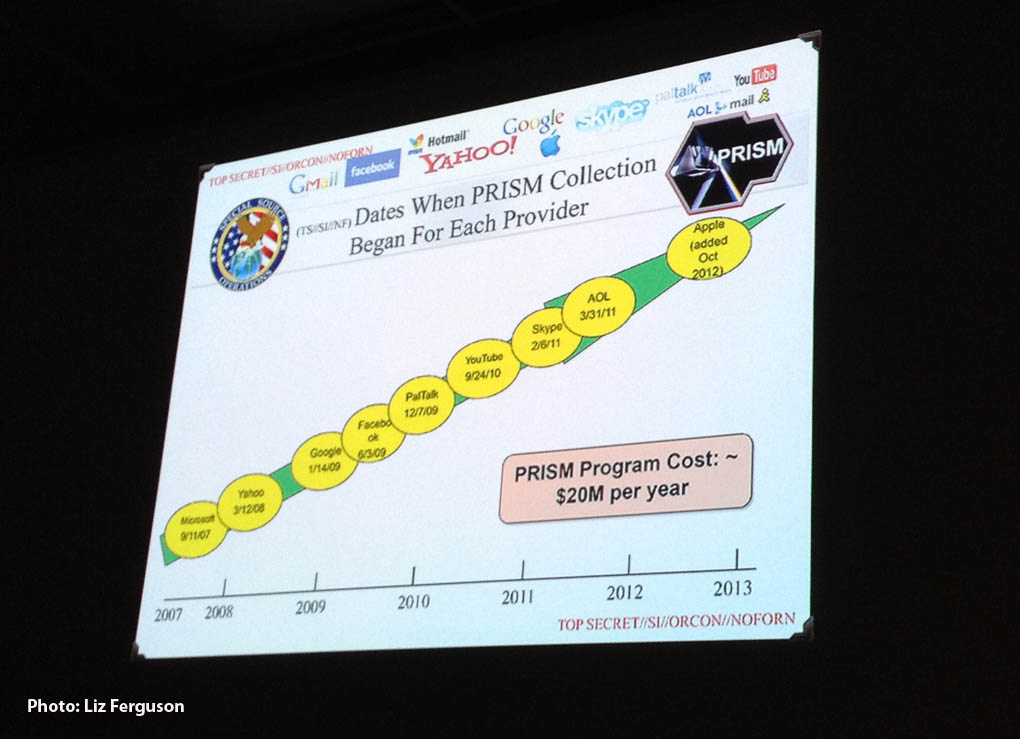
Has the NSA's surveillance program PRISM been reading your emails? This graphic was part of a presentation abut the interactive web documentary Do Not Track. (Photo: Liz Ferguson)
Has the NSA’s surveillance program PRISM been reading your emails? This graphic was part of a presentation about the interactive web documentary Do Not Track. (Photo: Liz Ferguson)

Spying on us isn’t just about selling stuff either, Gaylor presented a graphic about the NSA’s PRISM program, which has been reading email provided by Microsoft since 2007.

He asked people in the audience how much they’d be willing to pay for Facebook and Google if they would be free of ads and cookies. (What about you?)

Some people were willing to pay $10 per year for Facebook and as much as $50 for Google. Gaylor revealed that Facebook earns $9 per year on each Facebook account and Google earns $45 from selling information about each user.

Do Not Track
By Brett Gaylor, with the collaboration of Sandra Rodriguez and Akufen (Big Data episode)
Country : Quebec, Germany, France
Year : 2015
Language : German, English, French
Runtime :120 min
Platform : Webdocumentaire
Website : Http://donottrack-doc.dom
Production : Alexandre Brachet, Margaux Missika, Louis-Richard Tremblay, Gregory Trowbridge
Technical Direction : Nicolas Menet, Maxime Quintard, Avec La Collaboration D’akufen (Épisode Big Data)
Sound : Jason Staczeck
Distribution: Élise Labbé
Office National Du Film Du Canada
e.labbe@onf.ca

Do Not Track Screening – Navigation Assistée / Director’s Navigation
Tuesday, Nov. 17, 2015, 7 p.m.
Cinémathèque Québécoise – Salle Norman Mclaren (Salle Uxdoc)
335 de Maisonneuve Blvd E.

RIDM 2015 Review: Maman? Non, merci!

Why do strangers feel free to question women about their reproductive choices? That's one of the many things explored in the documentary film Maman? No merci! (No Kids For Me, Thanks!) It's being shown at RIDM, Montreal's documentary film festival.
Why do strangers feel free to question women about their reproductive choices? That’s one of the many things explored in the documentary film Maman? No merci! (No Kids For Me, Thanks!) It’s being shown at RIDM, Montreal’s documentary film festival.


“Baby hunger.” That’s what one of my friends used to call it. An overwhelming, seemingly impossible-to- ignore desire to have children. Some women have it, some don’t. All the same, women are expected to produce children, because. . .because we can? Contraception and abortion, if available, make it easier to plan the arrival of those children, but opting out of the idea of motherhood entirely is regarded as odd, possibly abnormal, inhuman, even. Where’s that famous maternal instinct?

Women who say they don’t want children are not taken seriously; they’re told that they’ll change their minds; they just haven’t met the right guy yet; they’re missing out on the most wonderful experience they could possibly have; they’re being selfish; they will have a lonely old age, and “you’ll be sorry!”

Consider for a moment the semantic differences between “childless” and “child free.” The first sounds rather forlorn, and might remind one of other words that end in “less” – words like homeless, penniless, hopeless. But “child free” – is it too celebratory? Could those who do have children see it as a criticism of motherhood and parenthood?

Perfect strangers feel entitled to quiz the childless-by-choice, berate them and analyze them. Seriously, is it anyone else’s business? Is there any other area of our lives that’s so open to scrutiny by others?

Author Lucie Joubert decries "frenetic maternalism" in her book L'Envers du landau.
Author Lucie Joubert decries “frenetic maternalism” in her book L’Envers du landau.

Maman? No merci! (No Kids For Me, Thanks!) is a documentary about women in Quebec, France and Belgium who are childless by choice, and quite clear and eloquent about it, too. Some men share their views, as well.

In the opening minutes of Maman? Non, merci!, director Magenta Baribeau says that she was surprised that strangers were so curious about her personal reproductive decisions; she decided to find other women like herself, and to discover why deliberate childlessness was so shocking for some in this day and age.

Right after the screening, there will be a French-language debate in the theatre on the topic La maternité, un idéal à repenser? (Rethinking Motherhood).

The participants will be: Magenta Baribeau, director of Maman? Non merci!; Stéphanie Benoit-Huneault, Special Projects Assistant, Réseau québécois en études féministes (RéQEF); Chiara Piazzesi, Professor, PhD (Département de Sociologie, UQAM); Judith Rouan, President of Fédération du Québec pour le planning des naissances (FQPN). Mélanie Sarazin, President of Fédération des femmes du Québec (FFQ) will be the moderator.
Maman? No merci! (No Kids For Me, Thanks!)
Directed by Magenta Baribeau
Country : Quebec
Year : 2015
Language : French
Subtitles : English
Runtime : 74 min
Production : Magenta Baribeau
Cinematography : Magenta Baribeau
Editing : Étienne Langlois
Sound : Gordon Neil Allen

Tuesday, Nov. 17, 2015, 5:30 p.m.
Cinéma Excentris – Cassavetes, 3536 St. Laurent Blvd.

RIDM 2015 Review: Star*Men


Director Alison Rose, second from right, and her astronomer friends take a break at the Rainbow Bridge National Monument in Utah.

Majestic music, monumental landscapes, mighty telescopes, and millions and millions of stars and galaxies! Billions, actually, but I was enjoying the alliteration.

You will find those things and more in the documentary film Star*Men. It’s a real treat. In addition to the sound and images mentioned above, you get human interest stories with historical significance.

The 1957 launch of the Soviet space satellite Sputnik in 1957 caused serious alarm in the West. The other side in the Cold War had better technology – what might they do with it? There must have been some wounded pride, too, because Sputnik was right up there in the night sky for anyone to see.

The U.S. did not have enough experts of its own and recruited scientists from all over the world to help it compete in this “Space Race.” The “star men” of the film’s title are Roger Griffin, Donald Lynden-Bell, Wal Sargent and Nick Woolf, British astronomers who were hired to work at the California Institute of Technology in Pasadena. As they explain, this was wonderful in so many ways. At that time there was little work in the U.K. for people with degrees in astronomy. They could leave the class system and the U.K. weather behind for sunny skies and open roads.

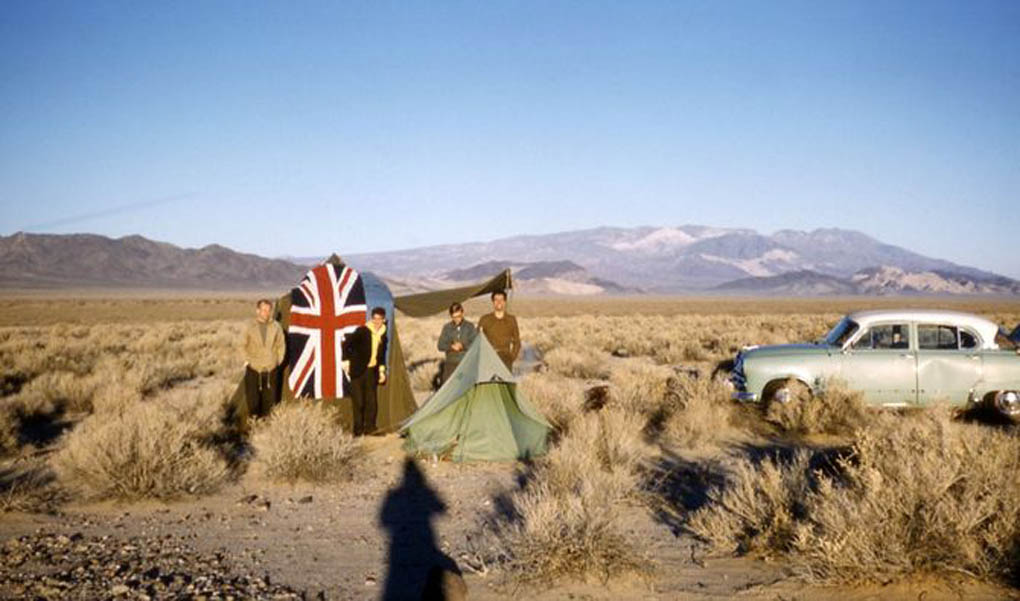
Photo taken by Roger Griffin in 1960 show his fellow astronomers at a their U.S. campsite with a large English flag. After they noticed the American fondness for their flag, they decided to take lots of photos with their own.

All four made important discoveries in astronomy during their working lives. In time two returned to the U.K. and two found other jobs in the U.S. Beside explaining their accomplishments, director Alison Rose takes us along when the four have a reunion, 50 years after their arrival in California, that includes much fascinating talk and some very strenuous hiking, including a visit to the Rainbow Bridge National Monument in Utah. And they wear huge backpacks while doing it, too! The cinematography of Star*Men is exceptional – natural landscapes and the views of star galaxies and nebulae are stunning. The music is great, too. Director Alison Rose will attend the screening and answer questions afterwards.

The Very Large Array, an astronomicla radio observatory in New Mexico. Do they look like giant ears to you? (Malcolm Park photo from Star*Men web site.
The Very Large Array, an astronomical radio observatory in New Mexico. Do they look like giant ears to you? (Malcolm Park photo from Star*Men web site.

Star*Men
Directed by Alison Rose
Country: Canada
Year: 2015
Language : English
Runtime: 88 min
Production : Alison Rose
Cinematography : Daniel Grant
Editing: Dave Kazala
Sound: Ken Myhr, Daniel Pellerin, Peter Sawade
Contact: Alison Rose
aer@inigofilms.com
Star*Men, Monday, Nov. 16, 2015, 6 p.m.
Cinémathèque Québécoise – Salle Claude-Jutra, 335 de Maisonneuve Blvd E.
RIDM (Rencontres internationales du documentaire de Montréal) runs from Nov. 12-22, 2015. Visit the web site ridm.qc.ca for more information.