Nawazuddin Siddiqui plays a serial killer in the Indian film Psycho Raman (also known as Raman Raghav 2.0) The fim is being shown at the Fantasia International Film Festival in Montreal.
Psycho Raman (aka Raman Raghav 2.0) is one tense film. Ramanna is a serial killer, and actor Nawazuddin Siddiqui gives a bone-chilling performance in the part. He kills people because he likes to – men, women, children, it doesn’t matter, he doesn’t make any distinctions. The things that he says, and the look in his eyes when he says them, are extremely unsettling.There’s no telling what he might do next. And when he makes circles with his fingers and looks through them, as you would with binoculars. . .all I can say is Eeek! (The pose reminded me of the poster for The Look of Silence, Joshua Oppenheimer’s second documentary about genocide in Indonesia.) Ramanna takes his alias from Raman Raghav, a real-life serial killer in the 1960s.
The character is so disturbing that I felt uneasy watching him, as if my very presence in the theatre was some kind of approval for his (fictional) actions.
We see Ramanna swing a tire iron, and other weapons, but, mercifully, we don’t see them land on his victims. (And that’s just fine with me!) The guy is totally terrifying all the same – a perfect example of less is more.
Raghavan (Vicky Kaushal) is a crooked, violent, doped-up policeman, who got his position via family connections. The guy is so addicted and so callous that he snorts cocaine at the scene of a triple murder. One night, Ramanna sees Raghav kill someone for no reason. He’s convinced that they’re kindred spirits and wants to meet Raghav, maybe even work together? The film switches back and forth between their two worlds.
Ramanna keeps tracks of his victims in a little notebook. There’s no indication that Raghavan does the same, but I couldn’t help but wonder who had the bigger body count.
Like several other films in this year’s Fantasia lineup, Psycho Raman was well received at the Cannes Film Festival.
Psycho Raman (Raman Raghav 2.0), directed by Anurag Kashyap, written by Anurag Kashyap and Vasan Bala.
Cast: Nawazuddin Siddiqui, Vicky Kaushal, Vipin Sharma, Amruta Subhash, Sobhita Dhulipala, Ashok Lokhande, Harssh A. Singh
127 minutes long, in Hindi with English subtitles.
See Psycho Raman on Wednesday, July 20, 2016, at 5 p.m., in the de Seve Theatre of Concordia University, 1400 de Maisonneuve Blvd. W.
“An old stranger appears in a peaceful rural village, but no one knows when or why. As mysterious rumours begin to spread about this man, the villagers drop dead one by one. They grotesquely kill each other for inexplicable reasons. The village is swept by turmoil and the stranger is subjected to suspicion.”
– Synopsis from the press kit for The Wailing.
Dread, murder, unexplainable events, irrational behaviour, gossip, rumours, nightmares, fear of the other, a large, fierce dog, big, black crows and mesmerizing rituals. That’s what you get in Korean horror film The Wailing (aka Goksung, 곡성).
I’ve wanted to see it ever since I read the rave reviews from the Cannes Film Festival. It did not disappoint! (The Cannes critics liked director Na Hong-jin’s earlier films The Chaser and The Yellow Sea, too.)
The Wailing is set in the beautiful, misty mountains of rural Korea, where people still live in old-fashioned homes with tile roofs. It looks like the kind of place where nothing much happens from one decade to the next.
A string of gruesome murders disrupts the tranquility and we watch as policeman Jeon Jong-gu (Kwak Do-won) tries to figure out if and how they could be connected. While a newspaper headline blames the disorienting effects of poisonous wild mushrooms for the first murders, Jong-gu wonders if some kind of virus might be going around? (The presumed perpetrators all had horrible rashes.)
There’s a lot of rain in The Wailing; it increases the feeling of dread.
Then there’s gossip about a strange Japanese man (Jun Kunimura) who lives in the forest. Some people are convinced that he’s evil, and responsible for the deaths, directly or indirectly. Supposedly he’s been seen wandering in the woods, half naked, chomping on dead animals. One woman says he’s a ghost, feeding on the spirits of the living. Any stranger could come under suspicion in an isolated community, but Japan’s earlier occupation of Korea would further complicate the way the locals view this interloper. Whoever or whatever he might be, a visit to his dwelling proves that he’s not just your everyday recluse.
Policeman Jeon Jong-gu is neither the suave, super cop of some films, nor the corrupt, crooked one of others, rather he’s an Everyman type; pudgy, and a bit of a doofus. After he gets a pre-dawn call to investigate the first murder scene he lets his wife and mother-in-law talk him into eating breakfast first – a few minutes more or less won’t make any difference to the dead, right? His boss and the other cops are not impressed when he finally shows up. Slacker!
Jong-gu seems rather indifferent to his wife (then again, this is not a romantic comedy) but he dotes on his cute young daughter, Hyojin (Kim Hwan-hee). Then she develops a rash too, and starts acting so much out of character that possession seems like a real possibility. When Jong-gu looks at her school notebook, it’s full of strange scribblings and scary drawings. (Have you seen The Babadook?) It also looks like it’s been mauled by a creature with long, sharp claws.
A mudang (shaman) is called in. The shaman is played by Hwang Jung-min and he’s great. I’ve seen shamanic rituals in many other Korean films but the ones here are exceptional, especially the second, longer, night-time one. (I read an article online that some people on the film set thought Hwang really was possessed.)
Hwang Jung-min plays a mudang, or shaman in the Korean film The Wailing.
The Wailing is NOT one of those films where the villain confesses everything, or some expert explains it all before the credits roll. If you go with friends you could have some very interesting post-film discussions about what really happened, who was good and who was evil. The Internet is full of contradictory theories, with some people essentially saying “I’m right because I’m Korean!”
If you read those theories, bear in mind that director Na Hong-jin told the Korea Times: “I mulled over the ending and decided I had to leave it open.”
A final note: Sadly, we Montrealers don’t get to see many Korean films outside of film festivals. If you like the sound of The Wailing try to see it at Fantasia because it will be more impressive there, on a big screen, with a great sound system and the famous, enthusisatic Fantasia audience. Furthermore, some scenes take place at night or in murky interiors – you’ll be able to see them much better in the cinema.
The film is 156 minutes long, but doesn’t feel like it.
The Wailing
Goksung
곡성
Director: Na Hong-Jin
Writer: Na Hong-Jin
Cast: Kwak Do-won, Hwang Jung-min, Jun Kunimura, Kim Hwan-hee, Chun Woo-hee
In Korean with English subtitles, 156 minutes long, showing at the Fantasia International Fim Festival Monday, July 18, 2016 at 9:35 p.m., in the hall Theatre, 1455 de Maisonneuve Blvd. W., Montreal.
Director Guillermo del Toro with his Cheval Noir Award at the Fantasia International Film Festival in Montreal, Friday, July 15, 2016. The smiling guy behind Del Toro is festival programmer Mitch Davis. (Liz Ferguson photo)
On Friday afternoon, July 15, 2016, director Guillermo del Toro spoke with Fantasia Film Festival programmer Tony Timpone at a press conference where he also took questions from fans who are journalists, film profs, etc. Clearly, they were there because they wanted to hear his stories, not to do a job.
Del Toro is passionate about films, monsters, and his work. He’s really funny, too. (Not exactly news to those who are already his fans!)
Friday evening, Del Toro was given Fantasia’s Cheval Noir Award; then he appeared onscreen in the (excellent) documentary Creature Designers: The Frankenstein Complex, then he returned, again with Timpone, to share more insights and answer more questions.
I’ll post more details about his talks later, but here’s one of the things I particularly liked: Del Toro makes lots of Twitter posts about many kinds of art, but he only makes positive remarks, he doesn’t believe in tearing people or things down. He doesn’t mind criticizing politicians, though. (He tweets as @RealGDT.)
In a scene from the documentary film B-Movie Lust & Sound in West-Berlin 1979-1989, Mark Reeder gives TV presenter Muriel Gray a tour of West Berlin in 1983.
B-Movie Lust & Sound in West-Berlin 1979-1989 – it’s long and unwieldy, but it’s also quite straightforward, unlike some film titles. It doesn’t need to be decoded or anything.
B-Movie is a documentary film with three directors (Klaus Maeck, Jörg Hoppe, Heiko Lange) and one guide – Mark Reeder, a musician and one-time record store employee from Manchester, England, whose interest in German music took him to Berlin in the late 1970s.
The directors had access to many film clips from the era, including some by Reeder himself, and they use Reeder’s experiences and his narration to tie everything together. Actor Marius Weber plays Reeder in some re-enactments. Mark Reeder is 58 now, but his voice still sounds youthful and enthusiastic, like that of a person still in his 20s.
And lest we think the film is only about looking backwards, Reeder told The New Statesman “Artists still come to Berlin searching for something, whether they stay for a few months or a few years. And this film is about inspiration. Not nostalgia.”
Footage includes day and night streetscapes, violent demonstrations, musical performances, interviews and visits to music clubs. (Reeder explains that typical night out might begin at midnight and end at 7 or 8 a.m.). German bands who play and talk include Malaria!, Shark Vegas, Einstürzende Neubauten, Die Tödliche Doris, Die Artze, and Die Toten Hosen.(Blixa Bargeld of Einstürzende Neubauten played with Nick Cave and the Bad Seeds between 1983 and 2003.) There is a brief glimpse of Nena, who had the hit 99 Luft Balloons. Musician Farin Urlaub appears, wearing a clerical collar.
Singer Eric Burdon appears with a rodent on his shoulder, artist Keith Haring paints the Berlin Wall, TV star David Hasselhoff sings while wearing a flashing-light jacket AND a piano key scarf – guess he’s not one of those “less is more” types.
These days, Tilda Swinton looks ageless to me, but we see a few seconds of her looking really young. Swinton appeared in the 1991 German film The Party: Nature Morte; presumably Reeder met her through his bit part in it. (His part was “Drunk.”)
In regard to artists from English-speaking countries, the Australian Nick Cave gets the most screen time. He lived in West Berlin for three years and stayed with Reeder until he found a place of his own.
West Berlin rents were cheap in those days, though Reeder and many others lived in “squats” and didn’t pay any rent at all. Nevertheless, a person needs some money to live on and Reeder earned his as the Berlin representative of British company Factory Records, as a record producer, a band manager, and dubbing porn films. In addition to The Party, he also appeared in Joan of Arc of Mongolia, and the horror film Nekromantik 2, directed by Jörg Buttgereit.
My one quibble with this film: Reeder has a fetish for uniforms, because they “hard-wearing, practical and they get people mad.” Some of them are Nazi uniforms, or the look like Nazi uniforms. For me, that’s just creepy and distasteful.
B-Movie Lust & Sound in West-Berlin 1979- 1989, is being shown at 7 pm, Thursday, May 5, 2016 at Cinema du Parc, 3575 av du Parc, as part of the Goethe Institute’s once-a-month Achtung Film series. It’s 92 minutes long, in German with English subtitles.
In a scene from the film Homme de danse, Vincent Warren, right, watches as Arnab Bandyopadhyay demonstrates gestures from Indian classical dance.
Ballet dancer, ballet teacher, dance historian and archivist, Montrealer and Québecois by choice, Vincent Warren is, or has been, all of those things. He’s also a superb raconteur, and many of his stories are hilarious. He shares those stories in Un Homme de danse (A Man of Dance) a film directed by Marie Brodeur. Like many Montrealers, Warren speaks English and French and often switches from one to the other in mid-sentence. He wears a scarf with great panache, too!
I didn’t know his name before seeing Homme de danse, but I soon realized that I had seen Warren dance many times; he is the male dancer in Pas de deux, an award-winning film that Norman McLaren made for the National Film Board of Canada in 1968. (The ballerina is Margaret Mercier and the choreography is by Ludmilla Chiriaeff.) With its mesmerizing multiple exposures, the film was ground-breaking for its time. If I had a nickel for every time I saw it back in my school days. . .
Vincent Warren and Margaret Mercier dance in Pas de deux, a film that Norman McLaren made for the National Film Board of Canada in 1968.
In yet another claim to fame, Warren danced the title role in the ballet Tommy, which choreographer Fernand Nault created for Les Grands Ballets Canadiens in 1970, using music from the rock opera of the same name by The Who. The work appealed to young audiences and encouraged young men to consider careers in ballet.
Warren was born into a large family in Jacksonville, Florida, a place where boys were expected to play football, as his own older brothers did. But Warren was entranced by dance when he saw the film The Red Shoes at age 11. (Read the Wikipedia entry for The Red Shoes here, reviews of The Red Shoes at the Internet Movie Database.) He read everything he could about ballet, and started a ballet scrapbook, which he still has to this day (take that, all you “toss-it-out” minimalists!) He paid for his first ballet lessons with money he earned as a paper boy, but he didn’t pay for long; male students were so rare, they had to be encouraged. (“Boys were always welcome.”)
A page from Vincent Warren’s ballet scrapbook. He was smitten by dance after he watched the 1948 film The Red Shoes.
After finishing high school Warren headed to New York where he received scholarships to the American Ballet Theater School (Rudolf Nuryev was in his class!) and then to the Metropolitan Opera Ballet School. He was hired by the Metropolitan Opera at a time when Maria Callas and Renata Tebaldi were performing there. Warren was a party animal, hanging out until the early-morning hours with the poet Frank O’Hara and his gang of abstract expressionist painters.
Warren also danced at the Sante Fe Opera Ballet, with an orchestra conducted by Igor Stravinsky. (Warren has a good Stravinsky story – but better you should hear it from him than from me.) In the summer, Warren worked in summer stock, where companies presented a new musical each week and performed as many as eight in one season.
In 1961 Warren joined Les Grands Ballets Canadiens, under the direction of Ludmilla Chiriaeff. He danced with the company until 1979, when he turned 40. He then taught performance and dance history until 1992 at École Supérieure de Danse du Québec, the school connected to Les Grands. The school had a tiny library with little more than 300 books. Warren donated thousands of his own books, magazines and prints to turn it into the best dance library in Canada. It’s now called Bibliothèque de la Danse Vincent-Warren, and it’s open to the public. “We want you to visit,” Warren said at the screening I attended.
Warren is not the only one who gets to tell stories – we also hear from dancers Véronique Landory, Annette av Paul, Anik Bissonnette, choreographers Brian Macdonald, Jeanne Renaud, Paul-André Fortier, Aileen Passloff, and journalist Linde Howe-Beck. Warren’s longtime friend, Peter Boneham, another American dancer and choreographer who made a home in Canada, is a real hoot. The two could probably form a comedy act if they wanted to.
Homme de danse might be a history lesson or a nostalgia fest, depending on the age and interests of the viewer. There’s footage of Place des Arts, so new that it’s still surrounded by rubble, a glimpse of former Montreal Mayor Jean Drapeau, colourful scenes at the World’s Fair, Expo 67, and excerpts from many ballets, too. I was surprised to learn that Radio-Canada used to present live ballet performances two to four times per week.
After living in a second-floor apartment in Mile End for 47 years, “like an old bear in his cave,” Warren decided to move to a ground-floor place. Director Brodeur filmed him as he packed up his possessions; it was a great idea, since so many of those objects sparked memories and stories.
Un Homme de danse (Man of Dance) directed by Marie Brodeur, will be shown as part of FIFA, Festival International du Film sur l’Art, on Sunday, March 20, 2016 at 5 p.m. in the Maxwell Cummings Auditorium of the Montreal Museum of Fine Arts, 1379 Sherbrooke St. W. Vincent Warren will attend the screening.
General admission tickets are $12.50; seniors (65 and older) pay $11; those 25 and younger pay $10; children 12 and younger pay $5.
For more information or to buy tickets online, visit www.artfifa.com
The young women who play sisters in the film Mustang have a great rapport and are very believable as siblings. (Metropole Films)
Mustang opens at the end of the school year – as our main characters, five sisters, are saying goodbye to their friends and teachers. In their school uniform of white blouses, loosely knotted ties and a-line skirts they look like girls you might see right here on the streets of Montreal. They seem happy, self-confident and they have long, glorious hair. (The kind of hair I always wanted to have in high school. . .sigh. All the cool girls had long hair. They were great at field hockey, too.)
About that title, Mustang, which might make one think of a Western, it’s all about that hair. In the press kit, Director Deniz Gamze Ergüven says “A mustang is a wild horse that perfectly symbolizes my five spirited and untamable heroines. Visually, even, their hair is like a mane and, in the village, they’re like a herd of mustangs coming through. And the story moves fast, galloping forward, and that energy is at the heart of the picture, just like the mustang that gave it its name.”
Back to the story: It’s a beautiful day, so the sisters decide to walk home instead of taking the school bus. The story is set in a seaside village on the Black Sea, and their walk takes them by a beach. This leads to some playful frolicking in the water with their male friends. Oh, oh.
By the time they get home, their grandmother has already heard about this indiscretion and she pretty much accuses them of engaging in an orgy. (What will the neighbours think? What will they say?) She also beats them, starting with the oldest one first, and working her way down chronologically. As outraged as she is, things only get worse when her son, the girls’ uncle Erol (Ayberk Pekcan) comes home. (Their parents have been dead for years.)
The life the sisters had known is over now. Grandma (Nihal Koldas) gathers up their telephones, their computer, confiscates books, makeup, and any other thing that might have a pernicious influence, and locks all of it in a cupboard. The sisters are driven to a local clinic and made to suffer the indignity of virginity tests.
Their home becomes a “wife factory.” Neighbourhood women in headscarves come in to instruct them in sewing, stuffing a duvet, cooking (they even make chewing gum!) and advanced window cleaning. They must wear muddy-coloured, long-sleeved dresses. Sometimes when the family is just hanging out, we can hear speeches on the TV about how women ought to behave.
Before we know it, the two oldest girls, Sonay (Ilayda Akdogan) and Selma (Tugba Sunguroglu), are serving coffee and cookies to the neighbourhood women. It’s a sort of an audition, or presentation of the merchandise, really. A woman will offer a son as a groom, then bring her husband in, that very same day, to confirm the engagement, with rings and red ribbons. The wishes and opinions of the future partners don’t seem to matter. At least Sonay manages to get engaged to the guy she’s already been seeing on the sly. Selma is not so lucky; she’s paired off with a guy who looks just as unenthusiastic as she does.
Ilayda Akdogan plays Sonay in a wedding scene from the film Mustang. (Metropole Films)
There’s an interlude at a soccer game that might remind some viewers of Jafar Panahi’s film Offside. The youngest girl, Lale (Gunes Sensoy), is a big soccer fan, but her uncle won’t take her to matches or even let her watch them on TV with him when his pals come over. But, after some violent incidents, the authorities decide that a coming match will only be open to women and young children. All the sisters welcome this chance to escape the wife factory and they join their friends for a raucous bus ride and a joyful game. (Turkey really did have some women-and-children only games in 2011, with 41,000 fans attending.)
After this outing, the walls around the house are made higher still, a tall wrought-iron gate is installed and bars are placed on the windows. The place really feels like a prison, now. However, all this “security” will come in mighty handy for some of the sisters later.
To my shock and surprise, when school starts again, none of the girls are allowed to return. (The actress playing Lale was 13 in real life, but she looked younger than that to me. I’m not sure how old she was supposed to be in the story.) No one comes to find out why they aren’t in school.
Throughout the film Lale has been watching, without saying a lot, but it’s obvious that she’s in no hurry to become a housewife. She’s plotting to rescue herself and her remaining single-but-already-engaged sister and we get to be a part of it. She might be young, but she’s very resourceful and she’s already found a good ally on “the outside.” An ally, mind you, not a prince or a knight, because she is not a helpless girl.
While some parts of the film are upsetting, maddening, even tragic, the bond the sisters have is wonderful to behold. Viewers who don’t have any sisters might well wish that they did. The actresses are so comfortable together they are very believable as sisters. Outdoors, they do gallop like mustangs, but at home they might tumble around playfully, or cuddle up together, like a bunch of kittens.
Hundreds of teenagers auditioned for parts in the film. Elit Iscan (Ece) was only one with previous acting experience, though you wouldn’t know it. Director Deniz Gamze Ergüven first saw Tugba Sunguroglu (Selma) on an airplane flight.
Ergüven was born in Turkey but she’s based in France now. She often moved between France and Turkey, and also spent time in the U.S. and in South Africa, where she earned an M.A. in African History.
The film was shot in the Black Sea village of Inebolu. It is 600 km from Istanbul, though in the story the sisters are 1,000 km from the big city. For them, it probably seems as far away as the moon.
Mustang was written by Deniz Gamze Ergüven and Alice Winocour.
I really enjoyed the film’s sound track. Most of the tunes were composed by Australian musician Warren Ellis, of Nick Cave and the Bad Seeds. Three tunes (or fragments of them) that Ellis recorded with Cave are in the film, though they are not on the Mustang sound track album. Those tunes are Home, Moving On, The Mother. Of the 12 tracks on the album ($9.99) 11 are by Warren Ellis, and one is from the Turkish band Baba Zula. (Here is a link to the Mustang soundtrack, at iTunes.) Coincidentally, Baba Zula played here in Montreal in October, 2015. Two other tunes, Yüksek Yüksek Tepeler (The Song of a Homesick Bride), performed by Selim Sesler, and Esrefoglu Hear My Words (Eyefoölu Al Haberi) performed by Ahmet (Dede) Yurt, are in the film, but not on the soundtrack. I think their tunes provided the lively dance music at a wedding reception. (Selim Sesler’s music is here, on iTunes; there’s a video of Ahmet Yurt on YouTube.
Mustang is a France-Turkey-Germany co-production For those who care about such things, Mustang is France’s entry for the foreign-language Oscar.
Mustang is in Turkish. In Montreal a version with English subtitles is being shown at Cinéma du Parc and Cineplex Forum. The version with French subtitles is being shown at Cinéma Beaubien, Cineplex Odeon Quartier Latin, and Méga Plex Pont Viau.
Mina (Melody Wiggins) is the main character in the film Dangerous Men. After her boyfriend is murdered, she embarks on a killing spree to kill as many bad men as she can. (Drafthouse Films)
I’ve already written one blog post about the film Dangerous Men quoting some online articles and reviews. Now that I’ve seen a screener, I can give my own opinion.
While watching all by myself I burst out laughing on several occasions, but this is definitely a film to watch with a large group. I can imagine Dangerous Men going over really well in Fantasia’s longtime venue, the Hall Theatre of Concordia. I hope it works just as well at Cinéma du Parc.
So, what makes Dangerous Men funny, ridiculous or strange? Where to start? The script makes no sense, there’s bad dialogue, badly delivered, and several levels of bad acting on display. People talk to dead bodies; they also have long, rambling conversations with themselves. About eighty per cent of the male characters have moustaches, but the film was begun back in the day of detective show Magnum P.I. after all. (Google it if that doesn’t ring a bell.) There’s a living room bellydance performance when you’d least expect it. And just wait for the closeup view of a police badge, or the newscast set that looks like it was made from cardboard and duct tape.
The opening minutes of the film manage to be boring and puzzling at the same time. Scenes keep switching back and forth between two couples declaring their love for each other. Who are they and why should we care? It’s not clear if these “events,” such as they are, are happening at the same time, or if we are just switching between the two couples for the sake of variety.
In one night-time scene, a man in a black suit approaches a house. (Was it the filmmaker’s home? Woudn’t be surprised.) We just see this guy from the knees down, or from the back; the lighting is so strange that his shadow often looks like a second man. The way he’s filmed we assume he’s up to no good.
Later, when he is outside smoking (near his home, far from his home, who knows?) he interrupts the armed robbery of a liquour store. This is a way of letting us know that he’s a cop. I guess.
Before he interrupts that robbery, we see a woman, safe behind some shelves, and invisible to the two robbers, watch them pull a gun on the cashier and collect money. I thought she was a customer, but no, she was the store owner. As the robbers are about to leave, she confronts one of them with a yell, grabs his bag of loot and tries some laughably ineffective martial-arts moves on him. What kind of idiot would do that? Seriously? There will be lots more illogical behaviour before we’re through. The owner gets shot and falls down in a very unconvincing, theatrical way.
Turns out that the cop is named Dave. The other man is Daniel, his brother. Daniel and Mina tell Mina’s father that they want to get engaged. Mina’s father doesn’t look old enough to be her father – a big brother, maybe. Mostly, we see dad in profile or from the back, as if the actor didn’t really want to show his face.
The next day, Daniel and Mina hit the road. (Everything seems to be taking place in California, but Daniel and Mina have a car with New York state plates. I don’t know why.) They have a run-in with some thuggish bikers on a beach and Daniel ends up dead. Mina vows to get revenge on all the bad men in this world. (That would be most of them.) She embarks upon a killing spree. Many of the murders are presented in a visual shorthand – we see Mina’s shadow on a wrinkled sheet as she stabs the shadow of her anonymous victim. Saves money on actors and fake blood!
At one point Mina takes a train somewhere. . .I think. Well, we’re shown a train, which made me think she rode it. Then again, maybe it was just passing by and I filled in the blanks, incorrectly? Mina travels without luggage or even a handbag, yet she magically has several changes of clothes. She even has an off-the-shoulder sweatshirt like the one Jennifer Beale wore in Flashdance (1983). Not to mention, where does she stash her eyeshadsow, lipstick, mascara, teasing comb, etc?
After Daniel’s body is found, brother Dave tries to find the killer, even though his boss tells him he’s too close to the case to do that. Of course, Dave ignores his boss, doesn’t everybody? Dave seems mildly curious about the fact that Mina is missing, but not as worried as one might expect, since they had almost become in-laws and he had told his brother that he liked Mina very much. In that conversation, he mentions “wedding arrangements” and says arrangements in such a strange way, it sounds like English is not his first language. The director should have asked for another take!
Most of the things I describe above happened in the first few minutes, there are lots more ridiculous things to come. Fight scenes were clumsily absurd. During some of them I swear I heard someone saying “Whack, whack,” every time a fist connected with a body.
The music was funny for a few minutes and then became very annoying, verging on excruciating. The same riffs would be repeated for several minutes even when the mood of a scene had changed radically.
Neutral observation: The handguns in Dangerous Men are relatively small. If the film were made today, I imagine that they would be much larger and look scarier.
Watching Dangerous Men has made me appreciate the scripts, actors, sound tracks, continuity, etc. of mainstream movies much more, even the ones that are far from perfect.
Dangerous Men is (unintentionally) funny, but I did feel a bit sad about it, too. It was the passion project of John S. Rad (real name: Jahangir Salehi Yeganehrad) an Iranian who fled Iran for the U.S. in 1979, five days after the Shah left Iran himself. Supposedly, Rad made between three and 11 films in Iran, and he was also personal cameraman to the Shah. After Watching Dangerous men I have very serious doubts about that, but maybe no one watched his Iranian films, either. Or maybe they were shorts. Maybe he shot very short scenes for the Shah, too, and someone else edited them.
One review I read says that Dangerous Men looks like a film made by someone who had never seen one before, and I have to agree! Yet, Rad spent more than 20 years writing, shooting editing, etc. What did he learn in that time? I also wonder if he neglected his family and friends while devoting so much time to this project? He was a bit cavalier with the posssessions of others, too. A car that gets pushed down a steep hillside had belonged to his daughter; she only found out what happened to it when she watched the film.
I’m one of those people who feels obliged to read the credits. What’s in them? Mina (Melody Wiggins) and her boyfriend Daniel (Kelay Miller) are identified as Mina and Daniel. But Dave, Daniel’s brother, is just “Police Detective.” The actor is named Michael Gradilone but Michael is mispelled as Micheal. A character named Black Pepper in the film is simply “Head of Drug Dealers” in the credits. One “biker” was played by Gorge Derby. Is that a real name, or George mispelled?? I know Jorge is a name. Another actor is just “Terry,” and a camera operator is just “Felix.” I wouldn’t have wanted to give my full name, either.
.
. Dangerous Men, written, directed, edited, produced (etc.) by John S. Rad
In English, 80 minutes long.
Thursday, Jan. 21, 2016, at 9:15 p.m. at Cinéma du Parc, 3575 Ave du Parc
This screengrab from the Unknown Photographer web site show the videos that can be watched even after the RIDM documentary film festival is over. (Since it is just a screengrab, clicking on the arrows won’t do anything.
Like the Polar Sea 360° project, The Unknown Photographer has one component that you can explore with an Oculus virtual reality headset for the duration of RIDM, and several other parts that you can enjoy at home whenever you choose to do so.
The Unknown Photographer is a co-production between the National Film Board of Canada and Turbulent, with the financial support of Canada Media Fund. It was inspired by a thick album of World War I photos that was found in an abandoned building in Morin Heights. Some accounts say the building was a home, some say it was a barn, but in Looking For Fletcher Wade Moses, a film on the project’s web site, filmmaker Philippe Baylaucq says he found it in a sort of “haunted house” when he was still a teenager. That story is better yet, no? He felt it was a treasure that needed to be saved, so he took it, and eventually gave it to photographer Bertrand Carrière, who made Looking For Fletcher Wade Moses.
The album belonged to Fletcher Wade Moses, but despite lots of research into the man’s life, including talks with his daughter and grandson, Carrière was not able to determine if he had taken the photos or not. While he was interested in Fletcher Wade Moses, he was more interested in the photos and the landscapes they depicted. He was shocked by the devastation, with entire cities reduced to rubble. He realized that most of the photos had been taken in the last years of the war, on the Western Front. He went to France to see what those places looked like years later.
Precisely because it was impossible to identify the photographer (or photographers) the virtual reality part of the project is a work of imagination and conjecture. In fact, the narrator who leads us through the experience is unsure of just who he is or where he is, though he does “remember the war.” (Julian Casey provides the voice of the English version; François Papineau provides the French one.)
This barren battlefield is seen in the virtual-reality component of The Unknown Photographer.
Considering the present date and when the war was (1914-1918) he could well be speaking to us from the hereafter. Participants in the virtual reality experience can choose their trajectory through their head movements and by moving a joystick. They can move through a barren landscape of blackened trees, climbing down into trenches or up hillsides. They can navigate a huge, dark, museum-like space, and drift through photographic cubes that tumble from the sky, a bit like Tetris. A strange figure, upright, with the antlered head of a deer, makes frequent appearances. What is he? Some kind of spirit animal? A shaman? An ancestral memory from our cavemen days?
The parts that can be watched at home include videos about the “Vest Pocket Kodak: The Soldiers’ Camera,” and “Postcards and Letters in Times of War.”
This is the setup for experiencing The Unknown Photographer in the UXdoc Space at the Cinematheque Quebecoise. Does it look like plugging into The Matrix?
The Unknown Photographer, (Le Photographe Inconnu)
Directed by Loïc Suty
Country : Quebec
Year : 2015
Language : English, French
Runtime : 120 Min
Platform : Réalité Virtuelle / Virtual Reality (Oculus Rift)
Production : Marc Beaudet, Benoît Beauséjour, Claire Buffet, Louis-Richard Tremblay
Technical Direction : Osman Zeki
Sound : Martin Fish
Contact (Distribution) Élise Labbé, Office National Du Film Du Canada
e.labbe@onf.ca
Cinémathèque Québécoise – Salle Norman Mclaren (Salle UXdoc), 335 de Maisonneuve Blvd. E. (For the virtual reality part)
(For the virtual reality part)
Visit unknownphotographer.nfb.ca for online components.
RIDM (Rencontres internationales du documentaire de Montréal) runs from Nov. 12-22, 2015. Visit the web site ridm.qc.ca for more information.
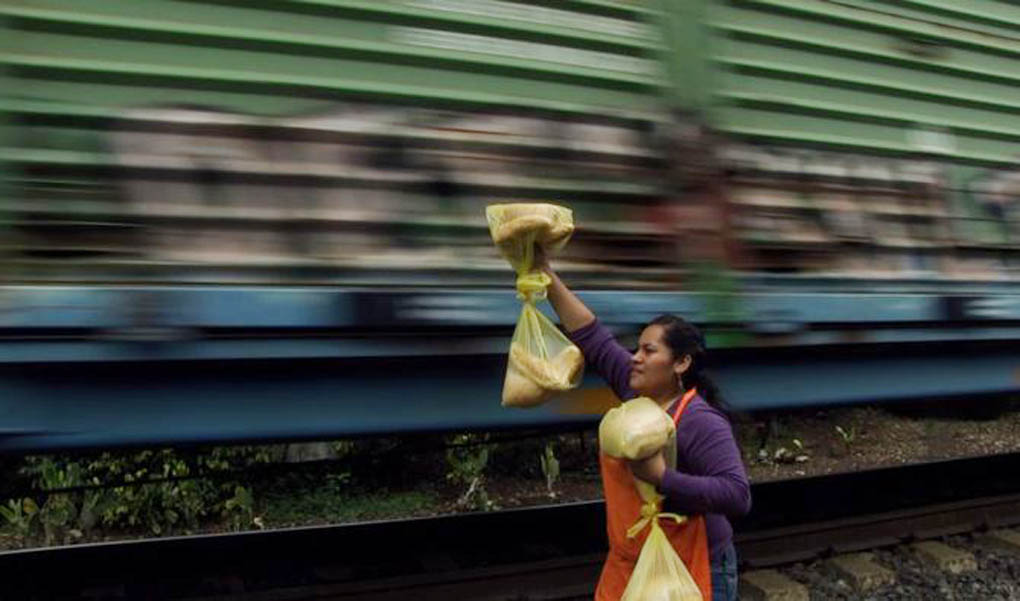
In a scene from the film Llévate mis amores, a member of the group Las Patronas holds bags of food for Central American migrants travelling north on a freight train.
Llévate mis amores (All of Me) is a film about a group of Mexican women known as Las Patronas, after La Patrona, their village in Veracruz state. They’re poor in possessions, but rich in humanity and love. Even though they have very little themselves, they work hard to help people who have even less than they do.
Since 1995 they have been preparing food and water for migrants from Central America who ride freight trains through Mexico into the U.S. The trains are called La Bestia (the Beast), or sometimes, the Train of Death, because people can die if they fall off. The migrants are victims of a bad economy and globalization – there isn’t enough work in their home countries and they can only travel via freight trains because passenger service ended when the Mexican railroads were privatized in the 1990s. A train might have as many as 800 riders, with some inside the boxcars cars, others on the roof or even hanging precariously between the cars. The train is not the only danger on the trip – there are crooked police, thieves, kidnappers, human traffickers and extortionists.
Every day the women cook huge pots of rice and beans and make tortillas over wood fires. They pack the food in plastic bags and fill recycled bottles with water. When they hear the whistle of an approaching train, they rush to the tracks to toss the food and water to the migrants, who hold their hands out eagerly. They never know when the trains will come or how many there might be.
In this scene from the documentary film Llévate mis amores (All of Me), a Central American migrant is able to call her mother, thanks to the helpful women known as Las Patronas.
Some migrants jump off the train for the food, and then they can’t get back on. When that happens, they are driven to the next place that the train stops or slows down. That’s not all that La Patronas do. They have taken injured migrants to hospitals, and on those occasions when doctors or hospitals refused to help, they have nursed them back to health themselves. They lend people cellphones so they can check in with their families.
When the director asks the women to describe themselves the younger ones talk of their hopes for the future (to be a lawyer or a journalist) while the older ones talk about their pasts – one had an abusive husband who was murdered, another had a potential husband who stayed up north too long, yet another was pulled out of school at a young age because someone told her father that the vaccinations given to students would cause sterility. One woman liked to sing and dance; she had wanted to be in a band. Some worked in the fields, others worked as maids; those with children want them to have a better life.
Llévate mis amores (All of Me) is truly inspirational; long before it was over I was wondering what I could do to make the world a better place. It was great to see the screening sell out, too. You can buy tickets online to make sure that you get in. Director Arturo González Villaseñor will be at the screening to answer questions after the film. When asked if the film will be available for rent or purchase he said that it probably will be eventually, but for now it’s still making the rounds of film festivals. Llévate mis amores (All of Me), Sunday, Nov. 22, 2015, 9:15 p.m., Excentris (Salle Cassavetes), 3536 St Laurent Blvd.
RIDM (Rencontres internationales du documentaire de Montréal) runs from Nov. 12-22, 2015. Visit the web site ridm.qc.ca for more information.
A scene from the Mexican documentary Llevate mis amores (All of Me), one of many films being shown at RIDM, Montreal’s documentary film festival.
Before I go to bed tonight, I hope to write proper reviews of these films that I’m suggesting to you, but for now, I’ll just write a short description to get something online as soon as possible.
Click on the underlined name of a film to be taken to the synopsis on the RIDM web site.
Oncle Bernard – L’anti-Leçon d’économie
Words of wisdom from the late economist Bernard Maris. He was one of the people killed at the offices of Charlie Hebdo earlier this year. Oncle Bernard – L’anti-leçon d’économie, Sunday, Nov. 22, 2015, 7 p.m., Excentris (Salle Cassavetes)
The next two films are on at the same time. What a shame, and what a quandary, because I think they’re both wonderful. I’ll go out on a limb and suggest Llévate mis amores(All of Me), directed by Arturo González Villaseñor, as a first choice because there is no guarantee that it will come back to Montreal again, though I truly hope that it does. This is a film about people in Mexico, mostly women, who do a lot to help others, even though they have very little themselves. Every day they prepare food and water for migrants who are making their way north to the U.S. by train. RIDM says it is “A wonderful human adventure,” but that’s really an understatement. It’s inspiring! Seriously.
This film was sold out on Saturday, so if you want to see it, consider buying your tickets online to avoid disappointment. I almost missed it myself. I thought that Saturday’s screening was the second, and last one. I am so glad that it isn’t, so that I can suggest it to you. Director Arturo González Villaseñor will be at the screening to answer questions after the film.
Llévate mis amores (All of Me), Sunday, Nov. 22, 2015, 9:15 p.m., Excentris (Salle Cassavetes)
Another film that starts at 9:15 p.m. is Le Bouton de nacre (El botón de nácar in Spanish, The Pearl Button in English), directed by Patricio Guzmán. It’s quite wonderful too, but given Guzman’s fame, it is more likely to return to Montreal screens. (Guzmán directed Nostalgia For The Light, one of my very favourite documentaries, along with Salvador Allende, The Pinochet Case, The Battle of Chile, and others.)
Le Bouton de nacre is about water, the universe, Chile’s native peoples and the disappeared of the Pinochet years. It is full of beautiful images and sounds and also contains tales of incredible horror. Some of those tales are quite recent, while others are much older. Le Bouton de nacre, Sunday, Nov. 22, 2015, 9:15 p.m., Cinéma du Parc 2
I have seen the three films above, and recommend them wholeheartedly.
In Police Academie (Cop Class) director Mélissa Beaudet follows “three very different cadets during their final year of training.” It sounds interesting, and it has received good reviews, but it starts at 9 p.m., which puts it in conflict with Llévate mis amores (All of Me) and Le Bouton de nacre (El botón de nácar). Police Academie will be shown at Excentris starting on Nov. 27, and it will be on TV (ICI RDI) on Jan. 16, 2016. Police Academie (Cop Class), Sunday, Nov. 22, 2015, 9 p.m., Cinéma Du Parc 1
RIDM (Rencontres internationales du documentaire de Montréal) runs from Nov. 12-22, 2015. Visit the web site ridm.qc.ca for more information.








 Mostlymovies.ca