Last minute news! RIDM Honours Leonard Cohen with free screening of 1965 documentary about Montreal’s late poet and musician

Caffeine and music! Two of life's essentials. Leonard Cohen with coffee and a harmonica, in a shot from the 1965 NFB documentary film, Ladies and Gentlemen. . .Mr. Leonard Cohen.
Caffeine and music! Two of life’s essentials. Leonard Cohen with coffee and a harmonica, in a shot from the 1965 NFB documentary film, Ladies and Gentlemen. . .Mr. Leonard Cohen.

Tonight, Friday, Nov. 18, 2016, at 7 p.m., RIDM, Montreal’s documentary film festival, in association with with the National Film Board of Canada (NFB/ONF), will present a free screening of the 1965 NFB documentary, Ladies and Gentlemen… Mr. Leonard Cohen by Donald Brittain and Don Owen.

In the black-and-white film, a 20-year-old Cohen returns to Montreal “to renew his neurotic affiliations.” The film includes scenes of streets that have probably changed a lot since those days. An email from RIDM says the film is a “casual portrait” of Cohen. “We see him reading his poetry for a rapt audience, alone at home, or socializing with family and friends.”

The film will be shown, free of charge, at RIDM Headquarters (3450, St. Urbain St., near the corner Sherbrooke St.). “A limited number of seats will be available,” (because the rooms are not huge!) The atmosphere will be very special, I’m sure!
Read more about RIDM on the festival’s web site, ridm.qc.ca

Leonard Cohen in his bath tub. Notice the Esquire magazine. Product placement? What's that on the window ledge? Could it be. . .a transistor radio? Ask an old person.
Leonard Cohen in his bath tub. Notice the Esquire magazine. Product placement? What’s that on the window ledge? Could it be. . .a transistor radio? Ask an old person.


RIDM 2016: Review of documentary film The Great Wall

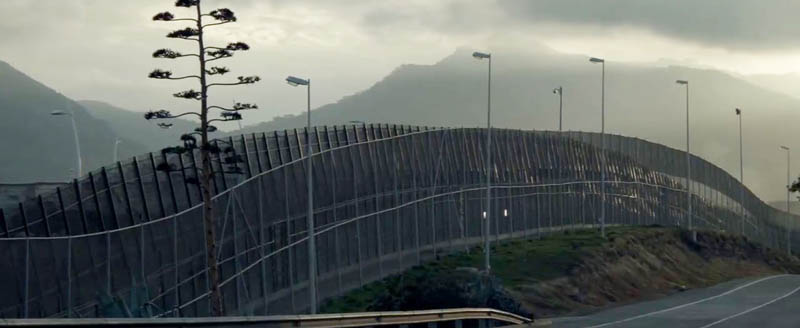
An image from the documentary The Great Wall, whch is being shown at the 2016 RIDM documentary film festival in Montreal. For me, the curves of this fence suggest the dragon-like undulations of The Great Wall of China.

The Great Wall is about walls and borders, old and new. The old one is the Great Wall of China, as described by Franz Kafka, in his short story Building The Great Wall of China, which was written in 1917, though not published until 1931. (Coincidentally, I happened to read it a few weeks before I heard of this film. Everyone seems to call it a short story, but it reads more like a philosophical essay to me. )

The short story’s nameless narrator is someone who worked on the wall himself, thouands of years ago; he muses about why it was built the way it was – in many unconnected pieces of 1,000 metres each, with great gaps in between. He declares that it was dysfunctional and the authorities must have known that, so they must have intended it to be dysfunctional. . .but again, why?

The film’s narrator, Nicola Creighton, reads excerpts from Kafka, in the original German, while we look at walls and very tall fences marking borders in Europe and North Africa. Those North African scenes were shot in Melilla, a small chunk of Morocco that Spain has held on to since 1497.

Because I had read the story recently, I caught a change that had been made to Kafka’s words. He wrote: “Against whom was the great wall to provide protection? Against the people of the north.” The film narration says “people of the south.” This north-south change occurs several times in the narration.

Walls and fences alone are not enough to keep the “others” out. There are watchers in the sky, in airplanes, surveillance cameras with night vision, and the kind of towers you see in films about prisons and concentration camps.

Often, it is not clear where we are in the world, though palm trees hint at a hot climate. Is that because one border often looks like another? Is it because some refugees/migrants don’t always know where they are, either? Should we think of it as a metaphor, more than anything?

Sometimes, the forces of law and order give us a clue: what does it say on the back of their uniforms? POLICE, POLIZEI or GUARDIA CIVIL? In Greece, their shields say POLICE, but there is another word writen in Greek alphabet.

Some scenes start in one country and end in another (far as I could tell). The Great Wall was shot in 11 countries; I did not recognize all of them. One city had a large, strange, ugly building. I want to learn the story of that. (As in, who are the guilty parties?)

There are scenes of huge skyscrapers in big cities, with pedestrians in suits walking around looking powerful and purposeful. My thought about that was, those buildings are another kind of wall or border, that will succeed in keeping strangers out. It’s likely that few migrants will be able to enter them, except perhaps as cleaners.

The music in the film gives an air of menace to many scenes. On the other hand, we often hear birds singing. My interpretation of that: birds are almost everywhere, they sing on good days and bad, they can go to any place that the wind and their wings will take them, unlike humans, they know no borders.

Coincidence: This was the second time this week that I have seen Maersk shipping lines onscreen. The other time was in a documentary about the “boat people” who fled Vietnam 40 years ago. Some of them were rescued by a Maersk ship.

At 72 minutes, The Great Wall felt a bit longer than it is. Some viewers might find their interest flagging toward the end. Or not. I’m not sorry that I went. There’s lots of food for thought in the film.
The Great Wall, 2015, from Ireland.
Director: Tadhg O’Sullivan
Camera: Feargal Ward
In German with English subtitles

The Great Wall is being shown as part of RIDM, Montreal’s Documentary film festival. See it at 8:30 pm, Friday, Nov. 18, at Cinéma du Parc, 3575 Ave du Parc. You can read more about it, and buy tickets on the RIDM web site. The trailer below looks very dark. Most of the scenes in the film are not like that.

You can see three Isabelle Huppert films at Cinemania this weekend

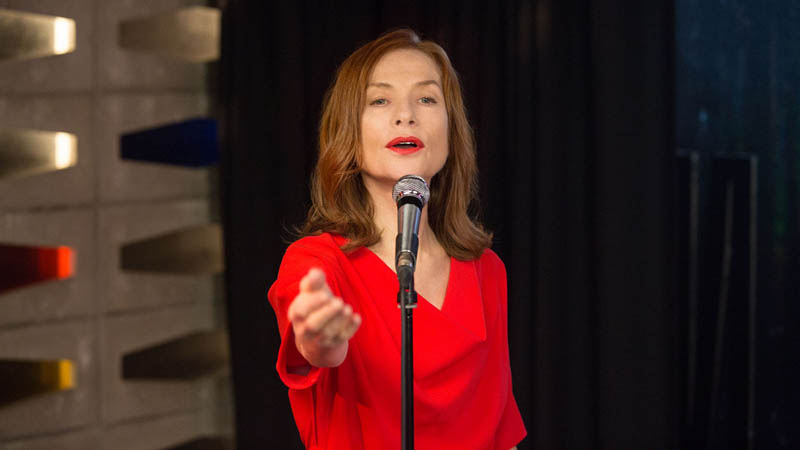
In the film Souvenir, Isabelle Huppert plays a singer who lost a contest to ABBA in her younger days. Souvenir is being shown at the Cinemania film festival in Montreal.

Jonathan Romney of the Guardian/Observer has said “No festival should be without a superb Huppert performance. . .”

During the last weekend of this year’s film festival, Cinemania will show three Isabelle Huppert films– L’Avenir (Things To Come), Souvenir, and Elle, the same three that were shown in Toronto in September. (Added bonus – Cinemania tickets are much cheaper than those at TIFF!)

All three films have English subtitles. They will be shown at the beautifully restored Imperial cinema on Bleury St.

RIDM 2016: Film suggestions for Friday, Nov. 11

An image from Deborah Stratman's film Illinois Parables. The documentary is being shown at Montreal's RIDM film festival.
An image from Deborah Stratman’s film The Illinois Parables. The documentary is being shown at Montreal’s RIDM film festival.

RIDM (Rencontres Internationales Du Documentaire De Montréal) is Montreal’s documentary film festival. It runs from Nov. 10 until Nov. 20, 2016. The festival’s (English) home page is ridm.qc.ca/en. Here are my three suggestions for tonight, Friday, Nov. 11, based on the descriptions in the festival’s catalogue and reviews from the Internet. I have not seen these films yet myself, but I intend to.
The Illinois Parables will only be shown once, so it’s now or never!
From RIDM: “A suite of Midwestern parables questioning the historical role belief has played in ideology and national identity.”

Michael Pattison has a VERY enthusiastic review on the web site RogerEbert.com. He has certainly convinced me! Here are some extracts: “The best film I saw at this year’s Berlinale was Deborah Stratman’s “The Illinois Parables.” . . . Her latest project, an hour-long essay film, traces the history of “America’s most average state” (and its fifth most populous) from the seventh century to the mid-1980s, all weaved together from an inescapably present-day vantage point. . . .Stratman’s rhythms are seductive, her chosen histories fascinating, her modes of address playfully demanding. She employs archival imagery (moving and still), witness testimony, verbal and dramatic re-enactment, voice-over, on-screen text, and her own 16mm footage—which, in capturing present-day pockets of the eponymous state in richly colored analog, makes the whole thing feel like a document from another age. “I see no hierarchy between these modes,” the filmmaker remarked, “and I’m interested in the poetic sparks created when one style abuts another.”

From Erika Balsom’s interview with director Deborah Stratman on the web site of the British Film Institute:
“I love infrastructure, and I love the way that stories can be hidden or embedded in places without the landscape necessarily giving them up. I like that landscape is coy, but seductive as well. I love pilgrimage, and going to see what it feels like to be in different places. I like how Simon Schama, Rebecca Solnit and John McPhee write at the intersection of geography and history. I’m interested in how the landscape can contain a politics. It contains anything, can hold everything – maybe that’s why it’s so important to me.”

There are other positive reviews for The Illinois Parables out there, I’ve just chosen to link to these two.
The Illinois Parables is 60 minutes long. Friday, Nov. 11, 19/7 p.m.
Cinémathèque Québécoise – Salle Fernand-Seguin

An image from the documentary film INAATE/SE/ [it shines a certain way. to a certain place./it flies.falls./]. The film is being shown at the RIDM  film festival in Montreal.
An image from the documentary film INAATE/SE/ [it shines a certain way. to a certain place./it flies.falls./]. The film is being shown at the RIDM film festival in Montreal.
INAATE/SE/ [it shines a certain way. to a certain place./it flies.falls./].
You can see this curiously named film on Friday at 9 p.m., or Sunday, Nov. 13 at 5:30 p.m. (If you do an Internet search on INAATE/SE/ I suggest that you put it within quotation marks, or your browser might be unhappy.)
From the film’s Vimeo page: “Adam Khalil and Zack Khalil’s new film re-imagines an ancient Ojibway story, the Seven Fires Prophecy, which both predates and predicts first contact with Europeans. A kaleidoscopic experience blending documentary, narrative, and experimental forms, INAATE/SE/ transcends linear colonized history to explore how the prophecy resonates through the generations in their indigenous community within Michigan’s Upper Peninsula. With acute geographic specificity, and grand historical scope, the film fixes its lens between the sacred and the profane to pry open the construction of contemporary indigenous identity.”
Leo Goldsmith at Brooklyn Rail writes:  “the Khalil Brothers . . .eschew all documentary convention, unleashing a full audiovisual arsenal against the traumatic circularity of history. . .(with) “animated fantasias, satirical remixing, goofy humor, and psychedelic interludes—all of which amounts to a cinematic language that’s utterly uncategorizable: dynamic, hilarious, angry, and sensorially overwhelming, but never passive.”

INAATE/SE/ [it shines a certain way. to a certain place./it flies.falls./].: 9 pm, Salle JA de Seve, Concordia University.

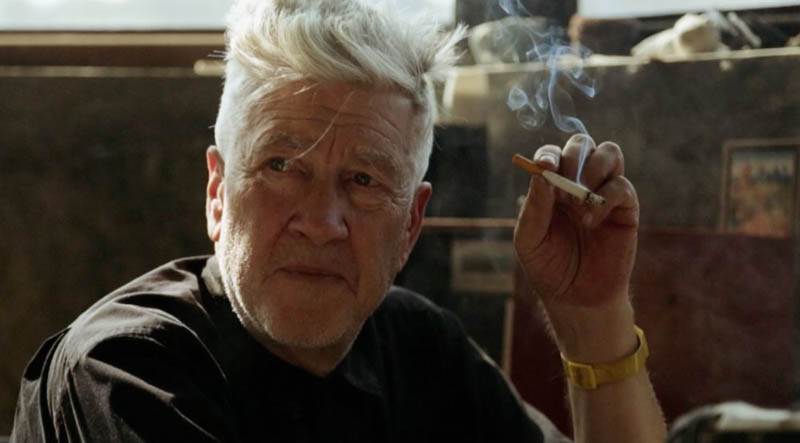
An image from David Lynch: The Art Life. The documentary is being shown at Montreal's RIDM film festival.
An image from David Lynch: The Art Life. The documentary is being shown at Montreal’s RIDM film festival.

David Lynch: The Art Life: 9:30 p.m. at Concordia University, Friday Nov. 11 and Sunday, Nov. 13 at 8:30 p.m, at Cinematheque Quebecoise.
Deborah Young, Hollywood Reporter: “Although it is more about painting than his filmmaking, David Lynch, The Art Life will entrance the director’s fans and, who knows, inspire budding, out-of-the-box creators in an artistic coming-of-age tale, told in his own words and deliberate tones. . .Kept company by his toddler daughter, Lynch works on new paintings and artwork in his studio in the hills above Hollywood, where he recounts unsettling stories from his past that resonate with the haunting quality of his films.”
Nick James, on the web site of the British Film Institute: “Lynch, mostly in voiceover, narrates his life more thoroughly, poignantly and evocatively than I’ve ever heard from him before.”
Guy Lodge of Variety has this to say about David Lynch: The Art Life:
“Nominally focused on the celebrated filmmaker’s lesser-known dabblings in fine art, “The Art Life” emerges as a more expansive study of Lynch’s creative impulses and preoccupations, as he relates first-hand the formative experiences that spurred and shaped a most unusual imagination.”

“(Jon) Nguyen and his team were previously responsible for 2007’s similarly fond, close-quarters doc “Lynch,” which followed the director through the completion of . . . “Inland Empire,” a decade ago. They know their subject intimately by this point, and not just in an interpersonal sense: “The Art Life’s” own construction is colored by an understanding of Lynch’s aesthetic, from the serenely brooding, grainy textures of Jason S.’s camerawork to the thrumming, Badalamenti-channeling menace of Jonatan Bengta’s score, which moves from swarming synths to sparse, dripping-tap keyboard plinks.”

David Lynch: The Art Life: 9:30 p.m. in the Hall Building at Concordia University.

FNC 2016 Review of Son of Joseph (Le Fils de Joseph)

Victor Ezenfis, Natacha Regnier, Fabrizio Rongione in Son of Joseph (Le Fils de Joseph).

Son of Joseph (Le Fils de Joseph) opens with scenes of Paris, people walking around, etc. Then we see two boys trying to torture a caged rat. I did wonder what kind of film I’d walked into. But those guys are just the idiotic classmates of Vincent, one of the main characters, and we don’t see much of them again. Just as well.

Teenage Vincent (Victor Ezenfis) lives in Paris with his single mother (Natacha Regnier), who’s an almost saintly nurse. In his bedroom he has a poster of Caravaggio’s 1603 painting, The Sacrifice of Isaac. Kinda gruesome!

Vincent’s mother has always refused to tell him who his father is, and on this particular day he is so enraged about it one wonders how his mother put up with him for so many  years.

After rummaging through a rolltop desk, Vincent finds a letter that reveals his father’s identity. You’d think, if he was so determined to know, that he would have found that letter years ago, but never mind, I won’t argue about it.

Vincent bluffs his way into a book-launch party, meets some ditzy and pretentious characters on the literary scene, and gets a glimpse of his father, Oscar Pormenor (Mathieu Amalric) a man so monstrous he can’t even remember how many children he had with his wife. “Details bore me,” he says.

With his red tie, red scarf, wealth, scorn and libidinous attitude, Oscar Pormenor made me think of Donald Trump. (Sorry!) The more Vincent learns about him, the more horrified he becomes. He hatches a plan which is unwise, not to mention illegal, immoral, etc.

On the plus side, Vincent meets Joseph (Fabrizio Rongione), Oscar’s brother and pretty much his polar opposite. Joseph is a really great guy, even if he’s not a success in the business world. More likely he’s a great guy precisely because he’s not a success in the business world.

The people in Son of Joseph speak in a very stilted, serious and unnatural way, almost like. . .inexperienced actors. Of course, the actors are not inexperienced at all, declamation is just part of director Eugène Green’s style. (Apparently, Green has a cult following, just like Hong Sang-soo, whose film Yourself and Yours will be playing at the same time today, just a few blocks away. Both films are on the schedule of the Festival du nouveau cinéma.) At first I found this way of talking rather strange. I got used to it, though I never stopped noticing it, and it made the funny parts funnier still.

Son of Joseph is about serious things, like how to be a good person, the longing for family, connection, and acceptance, but it also offers beautiful Parisian scenery and many laughs as well.

Almost all the interior scenes take place in very old buildings with creaky wooden floors. My congratulations to the sound people for picking up (or maybe recreating) all those creaks.

Coffee and Films was the production company for Son of Joseph. Isn’t Coffee and Films a great name?

Son of Joseph (Le Fils de Joseph)
France, Belgium | 115 Minutes
In French with English subtitles
Written and directed by Eugène Green
With Victor Ezenfis, Natacha Regnier, Fabrizio Rongione, Mathieu Amalric, Maria de Medeiros, Julia de Gasquet, Jacques Bonnaffe

Sunday, Oct.16, 2016
Program #281 15:15
Cinéma du Parc 2, as part of the Festival du nouveau cinéma.

FNC 2016: Review of Hong Sang-soo film Yourself and Yours

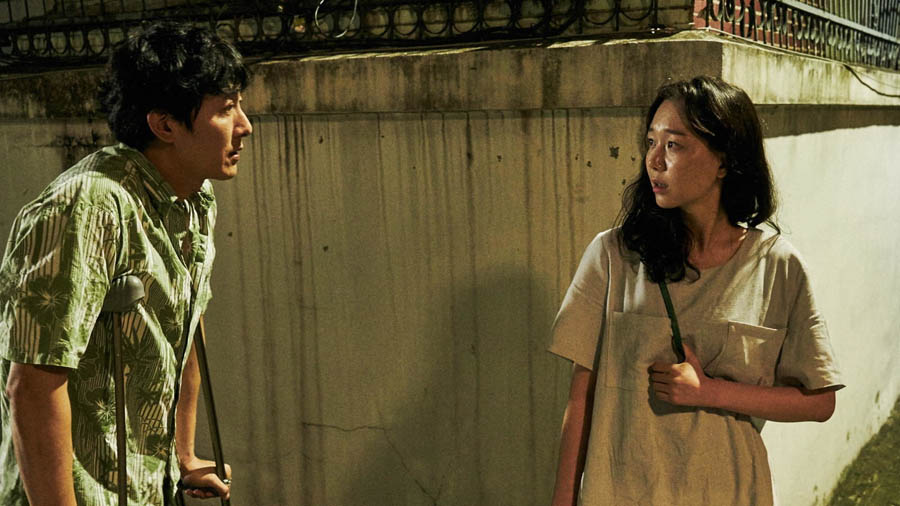
Lee You-young, centre, as Minjung, with two of her drinking buddies, in the Hong Sang-soo film Yourself and Yours.

Yourself and Yours, the latest film from Korean director Hong Sang-soo, looks at relationships in a way that’s insightful and hilarious. (Well, I thought it was hilarious.) I guess someone who has recently broken up with a significant other might feel differently.

After hearing gossip from a friend, Youngsoo (Kim Joo-hyuck) accuses his girlfriend Minjung (Lee You-young) of drinking with other men. Quite apart from the jealousy angle, he is upset because she had promised him to cut way back on her drinking.

An offended Minjung denies the accusations and suggests “taking a break.” Self-righteous Youngsoo replies (approximately) “You’re in the wrong and you’re upset with ME?”

Later, Youngsoo regrets his behaviour; he misses Minjung and when he can’t reach her, he fears that “taking a break” is her way of saying “break up.”

Youngsoo starts moping around pathetically. He tells his friends how much he loves Minjung, how special she is, that others don’t understand her, etc. All this might come from genuine love and regret, though I suspect it comes from loneliness or a feeling of having lost control of this situation, and his life in general. Who knows, really? Seeing her had  probably become a habit for him, as well, and habits are notoriously hard to break.

There are several scenes of Minjung, or someone who looks just like Minjung, drinking with other men. When they first speak to her, they claim to know her from some other occasion. Some of them are rather agressive in their insistence that they know her; it verges on creepy. She says that she never saw them before, but does agree to drink with them now.

Minjung seems more humourous and interesting to know than Youngsoo is. Her daring, if slightly rude habit of telling men exactly what she thinks of them is not something we see too often in Korean films; it’s still a patriarchal place.

It’s likely that many of these scenes, maybe all of them, only take place in Youngsoo’s unsettled dreams or waking imagination. That would be consistent with Hong Sang-soo’s style, but I have other reasons for thinking so, too. Sharing those reasons might constitute “spoilers,” though, so I’ll keep them to myself for now.

You could have lots of fun dissecting those scenes, and the film in general, with friends after the film, maybe over a meal at a Korean restaurant. Have some soju! Sadly, you aren’t likely to find the milky alcoholic beverage ( 막걸리 makgeolli, makkoli, makgeoli, etc.) in Montreal restaurants. That’s the stuff that the characters in Yourself and Yours drink from metal bowls, when they’re not having beer or soju.

A little laugh of recognition for people who follow Korean pop culture: At some point, Minjung talks about her “ideal type.” In interviews, Korean singers and actors are always being asked about their ideal type. They usually name other singers and actors and then their fans have fun discussing these choices on the Internet.

I’d read several enthusiastic reviews before seeing Yourself and Yours, and assumed that I would enjoy it, but It actually surpassed my expectations. For those who have heard of Hong Sang-soo, but haven’t seen his work yet, Yourself and Yours would be an excellent place to start. His Montreal fans have probably bought their tickets already.

http://www.nouveaucinema.ca/en/films/yourself-and-yours

Yourself and Yours, directed by Hong Sang-soo, with Kim Joo-hyuck, Lee You-young, Kim Eui-sung.

At the 2016 Festival du nouveau cinéma,
Sunday, Oct. 16, 2016
Program #284 15:00
Cinéma Impérial
1430 Bleury

FNC 2016: What you should know about Korean director Hong Sang-soo

Kim Joo-hyuck and Lee You-young in the Korean film Yourself and Yours, by Hong Sang-soo.

Kim Joo-hyuck and Lee You-young in Yourself and Yours, by Hong Sang-soo.

The Festival du nouveau cinéma will show the film Yourself and Yours, by Korean director Hong Sang-soo on Friday, Oct. 14 and Sunday, Oct. 16, 2016.

Some film fans prefer to go into a film knowing as little as possible about it, but when it comes to Hong Sang-soo, knowing a bit about his style will add to your enjoyment, and possibly stave off confusion, too.

Hong Sang-soo is a “what if?” kinda guy. His films explore possibilities, alternative outcomes, and interpretations.

For instance, three or four friends go to a bar, and Hong shows several variations of that event. Things might turn out this way, or that way. Maybe what we see is the way this person, or that one, perceived things. Maybe a director insulted an actor, or maybe it was just a joke? And when copious amounts of alcohol are involved, as they often are in Korean films, can anyone’s recollection be trusted?

The main male character in a Hong film is often a film director or a former film director. Maybe he teaches at a university when he’s between films. He might have an inflated sense of his own importance, and think that he’s “God’s gift to women.” (Especially after a few drinks.) He might also be suffering from writer’s block.

According to the reviews I’ve read, Youngsoo, the man in Yourself and Yours, is a painter, not a filmmaker. Still an arty guy, though, and possibly a pretentious one. He’s played by Kim Joo-hyuck. Youngsoo gets upset when a friend tells him his girlfriend Minjung (Lee You-young) has been seen drinking with other men. Minjung says it wasn’t her.

Evidently, this time, in Yourself and Yours, it’s not so much situations that repeat themselves, but the character of Minjung.

In a review in Screen Daily, Wendy Ide writes: “Meanwhile, a girl who may be Minjung or may look just like her has a series of encounters with other men. . .Although she is repeatedly approached by men who say they recognise her. . .she denies knowing any of them. . . But is she a liar? Are there multiple Minjungs, all wreaking havoc on the hearts of the men who hit on her? Or is it all in the mind of Youngsoo. . .”

Yourself and Yours, directed by Hong Sang-soo, with Kim Joo-hyuck, Lee You-young, Kim Eui-sung.
In Korean with English subtitles, 86 minutes long.

Friday, Oct. 14, 2016
Program #238 17:00
Cineplex Odeon Quartier Salle 10

Sunday, Oct. 16, 2016
Program #284 15:00
Cinéma Impérial

FNC 2016: Check out the interactive film Tantale, tonight!

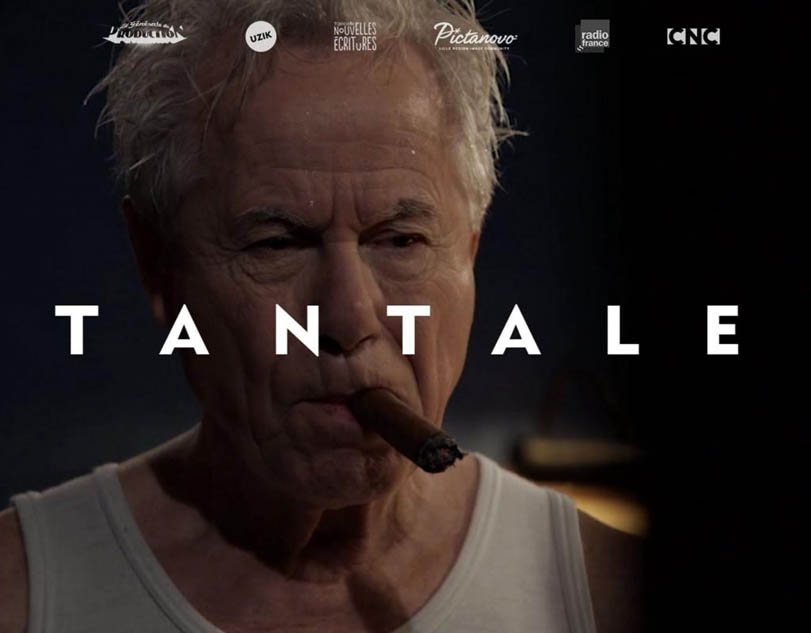
Francois Marthouret plays the cigar-chomping president of France in the interactive film Tantale.

Viewers at the screening of the interactive film Tantale can put themselves in the (probably very expensive) shoes of the President of France as he schemes to win the summer Olympics. What might he be prepared to do? The synopsis from the web site of the Festival du Nouveau Cinéma is below.

“With 5 different endings and 25 ways to get there, the viewer is the hero. September 2017. The President of the French Republic goes to the Carlton Hotel where numerous sports celebs and political figures have gathered to designate the host city of the next summer Olympics. In the plush corridors of the luxury hotel, there’s lots of secret speculation — since assigning the games also seals the fate of issues a world away from the Olympic playing fields. In Tantale, it’s all up to you . . . because you’re the President. What if your decisions could change the course of events?”

Last week the festival showed the interactive film Late Shift. A university student in London was forced to participate in a robbery at an auction house. Every few minutes he had to make a new and possibly life-or-death decision. In fact, the viewers made the decision for him, using an app that they downloaded to their phones or tablets before the film began. The story was intriguing, it was a very immersive experience and lots of fun.

I imagine that Tantale will be equally intriguing and enjoyable. The trailer looks good! You can buy tickets online.

Tantale,
Directed by Gilles Portes, with François Marthouret, Jean-Luc Bideau and Benjamin Siksou
Thursday October 13, 2016
Program #197 19:00
Cinéma du Parc 2

FNC 2016: Review of French sketch-comedy film Apnée

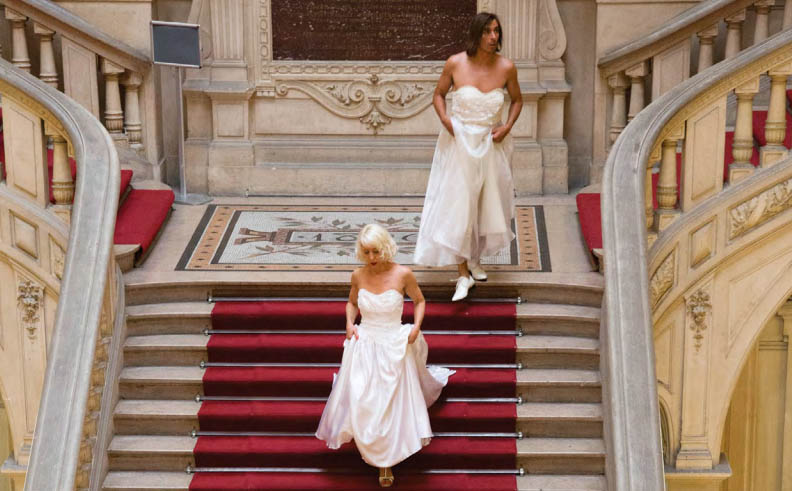
Thomas Scimeca and Céline Fuhrer in the French comedy Apnee.
Thomas Scimeca and Céline Fuhrer in the French comedy Apnée.

Apnée begins with two men and a woman, each wearing strapless wedding dresses, flouncing into an elegant town hall and asking the mayor to marry them to each other. The mayor explains the available options in a polite and friendly manner. He tells them with regret that they can’t marry each other “yet.” The implication is clear: have some patience and your day will come. But the three don’t want to wait and they begin a collective rant about their rights. Then it’s time for the mayor to express his many frustrations with his job and his family. You had to be there. It was funny!

Apnée is a collection of loosely connected sketches, a bit like the old Monty Python show, though there isn’t any animation and the Spanish Inquisition doesn’t show up, either. In the press notes, director Jean-Christophe Meurisse calls it a road-trip and a “comédie socialo-mélancolique.”

A few of the subjects include: dealing with bankers; the ridiculous price of housing ($1755. for less than 200 square feet!) and the hoops people still have to leap through for the privilege of paying for a tiny, overpriced dump; parent-child relations, expectations and disappointments; a mock job interview at an employment centre that gets stuck at the handshaking part and just gets sillier and sillier (in a good way).

Some outdoor scenes in Apnée were shot in lovely parts of Corsica. That might give the tourist industry a boost.

DirectorMeurisse and the three main actors, Céline Fuhrer, Thomas Scimeca and Maxence Tual, are part of the popular French theatrical troupe Les Chiens de Navarre. (The group presented its latest play, Les armoires normandes, here in Montreal last month.)

I enjoyed some sketches more than others, and the driving scenes went on too long for my taste, but I thought Apnée was pretty damn funny. The description in the Festival du Nouveau Cinéma catalogue already sounded appealing, but then a friend recommended it to me, and that clinched the deal. I’m glad I went!

The English subtitles are a blessing because the actors speak very quickly and sometimes everyone is talking at once. Serge, the friend who suggested Apnée to me, is a francophone, but even he appreciated the English subtitles.

Not sure if I should even mention this but. . .I’m also very glad that I did not see Jay Weissberg’s review in Variety before I went. He called it an “insufferable improvised madcap comedy.”

Of course, people have different tastes, experiences, backgrounds and expectations, but I feel like we did not watch the same film. Maybe he was suffering form “film-festival burnout.” I’ve had that happen right here in Montreal, on my home turf. Imagine the stress and pressures of the Cannes Film Festival. Variety is a very powerful publication, so I hope his negative review does not scare people away from Apnée.

Apnée (or Apnea)
Directed by Jean-Christophe Meurisse
With: Céline Fuhrer, Thomas Scimeca, Maxence Tual, Thomas de Pourquery, Olivier Saladin, Claire Nadeau, Jean-Luc Vincent, Nicolas Bouchaud, Pascal Sangla, Robert Hatisi, Solal Bouloudnine.
88 minutes long, in French with English subtitles.

Seen at the 2016 Festival du Nouveau Cinéma in Montreal.

FNC 2016: Review of A Decent Woman

fnc-2016-a-decent-woman

A Decent Woman was shot in Argentina. The original Spanish title is Los Decentes. It has also been shown under with the English title The Decent. It’s a satire.

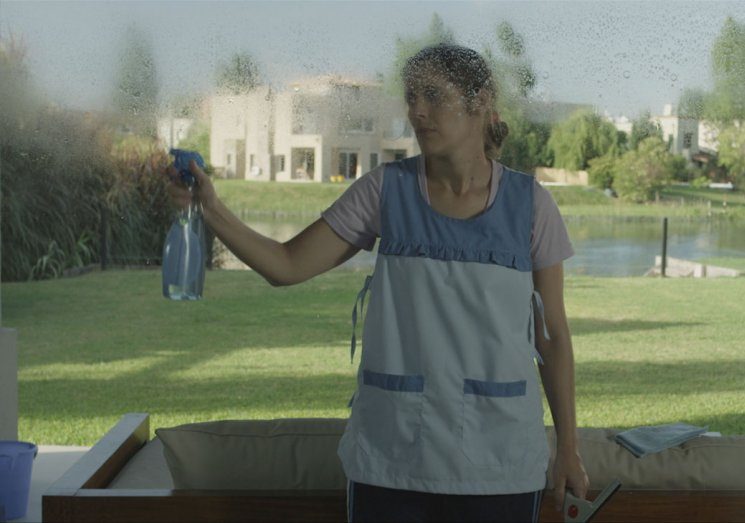
Belen is a woman who does not say much. She observes, sometimes warily.

Belen (Iride Mockert) starts working for a rich woman and her spoiled son in a gated community outside Buenos Aires. (The residents inside those gates are wealthy, but in the surrounding area there are rundown streets littered with garbage.) Belen’s employer has a large house, but it presents a blank face to the world – it doesn’t look particularly comfortable or welcoming. It’s very bland, lacking personality, inside and out.

The property is on the far edge of the community and Belen soon notices that there is a nudist colony on the other side of the big hedge, and the (highly-)electrified fence. (She notices because she does everything at that house, buying groceries, washing floors, windows, dishes, doing laundry, cleaning the son’s sport shoes, and clipping that hedge. Belen’s employer, Diana (Andrea Strenitz) signs Belen up for cooking classes, too. (Among other things, they make cupcakes – a “very American recipe” according to the instructor.) When Diana can’t sleep, she wakes Belen to keep her company.

After days, maybe weeks, of watching the nudists, Belen lets her long hair down (literally), sheds her clothes and joins them. When they first see her, she is shyly recreating the pose from Botticelli’s Birth of Venus (the one with the big seashell).

They’re a very welcoming bunch and soon Belen is spending lots of time with them. Is this possible because Diana and her son, Juanchito, go away a lot for tennis tournaments, or could it be that Belen is just imagining herself having a different way of life with these people?

Much of the time, they are calm, quiet and relaxed, hanging out in or beside the water, dozing or reading. I won’t describe all of their activities, to avoid the accusation of “spoilers!” Let’s just say, this isn’t a “family-friendly” nudist club, and the place where the scenes were shot is actually a nudist swingers’ club, in the director’s own words.

The nudists do play loud music at night. It’s so loud that Diana’s windows vibrate and she can’t sleep. Other neighbours are upset about them, too, and they start a petition against the enclave.

Up until this point in A Decent Woman, I had no serious complaints. It had been moving at a  languid pace, possibly too slowly for some people, but I could handle it. (I did not notice anyone leaving, either.)

But. . . call me a coward or whatever, I did not like the abruptness nor the content of the ending. One or two people laughed. Was it serious laughter or nervous laughter? I wonder. I prefer to think that director Lukas Valenta Rinner did not know how to end the film, or that the ending is a dream that Belen has. (Yes, I know, dream sequences are a corny cliché.)

One person near me said “If I had known it would be like that, I would not have come.”

* * *

A FEW HOURS LATER:

(I went to A Decent Woman  because I thought that I had read several rave reviews about it, in reports from other festivals like Sarajevo and TIFF. Maybe I got it mixed up with something else.

The FNC catalogue and web site say that director Lukas Valenta Rinner also made Parabellum, which explains a lot. My brain must have skipped right over that. (Did you see it?) If you intend to see A Decent Woman, it might be better not to read about Parabellum beforehand.

As for not knowing how to end it, Parabellum won a prize at the Jeonju International Film Festival in South Korea. A few months later, the Jeonju Cinema Project offered Valenta Rinner money to make his next film, but that meant he only had six months to write, film and edit a work-in-progress version to show at the next edition of the festival.

On the other hand, in an interview with Cineuropa, Valenta Rinner indicates the abrupt ending was a “deliberate narrative decision,” to provide catharsis. And now that I think about it, abrupt changes of tone happen all the time in Korean cinema.

Lukas Valenta Rinner is an Austrian who went to film school in Argentina and still lives there. He has stated that his film is a comment on inequality and social tensions in Argentina. I’ve watched many films from Argentina, but I’ve never been there, so what do I know?

Final verdict: Mixed feelings. Can’t say I’m happy that I went, but I don’t feel ripped off either. I wouldn’t recommend it to everybody, but I imagine there are people within my extended circle who would like it.

Los Decentes (A Decent Woman)

Country: Austria, Republic of Korea, Argentina

Year: 2016

Genre: Fiction

Directed by: Lukas Valenta Rinner

Length: 104 minutes

Screenplay: Lukas Valenta Rinner, Ana Godoy, Martin Shanly, Ariel Gurevich

Cast: Iride Mockert, Martin Shanly, Andrea Strenitz, Mariano Sayavedra

I saw A Decent Woman at the  in Montreal. The festival will show the film again on Wednesday, Oct. 12, 2016 at 18h (6 p.m.)